

give me simplified version of this figure which is easy to represent in university theory exam
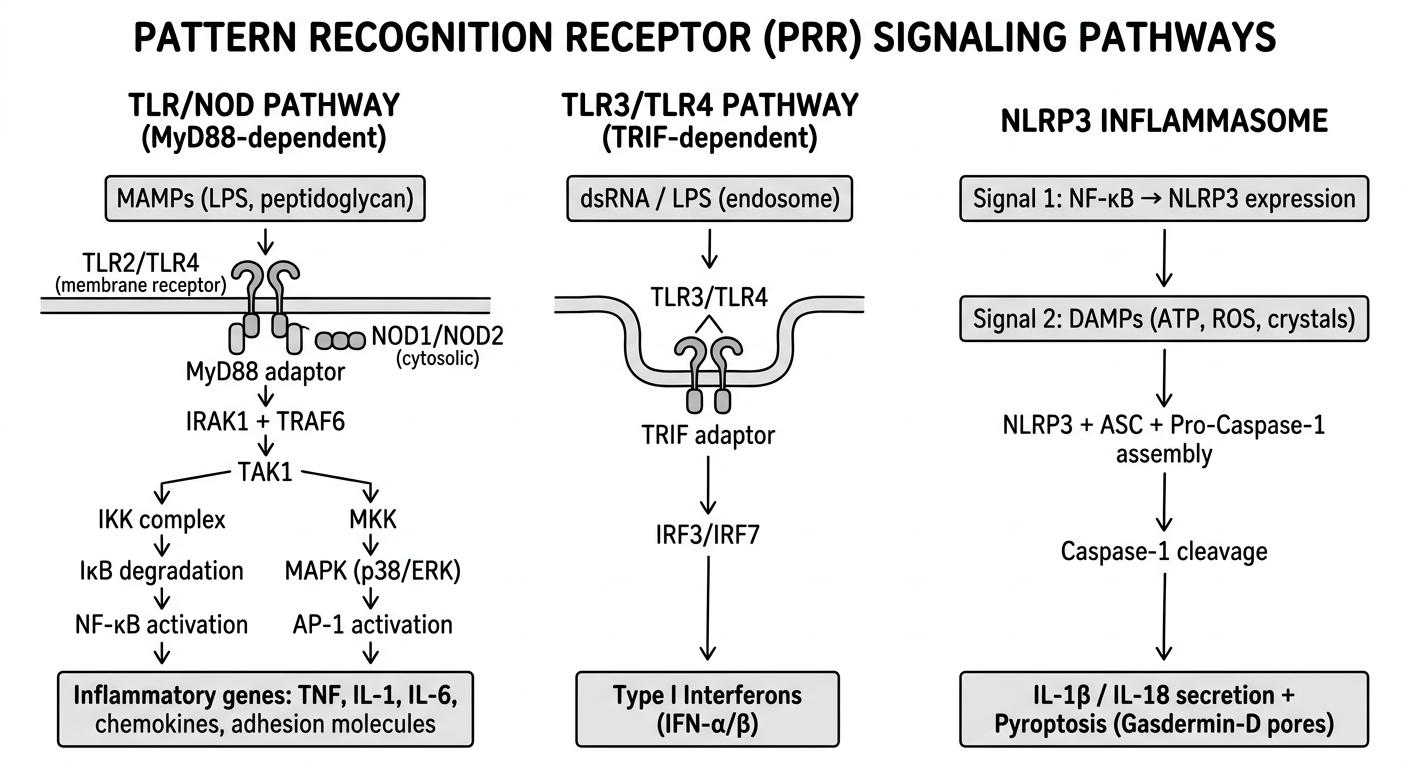
Clean simplified university exam diagram showing Pattern Recognition Receptor (PRR) signaling pathways. Black and white line art style, clear labels, minimal detail. Three main pathways shown as vertical columns with arrows: LEFT COLUMN - "TLR/NOD Pathway (MyD88-dependent)": Box at top: "MAMPs (LPS, peptidoglycan)" → TLR2/TLR4 (membrane receptor) or NOD1/NOD2 (cytosolic) → MyD88 adaptor → IRAK1 + TRAF6 → TAK1 → two branches: (1) IKK complex → IκB degradation → NF-κB activation, (2) MKK → MAPK (p38/ERK) → AP-1 activation → OUTCOME BOX: "Inflammatory genes: TNF, IL-1, IL-6, chemokines, adhesion molecules" MIDDLE COLUMN - "TLR3/TLR4 Pathway (TRIF-dependent)": Box at top: "dsRNA / LPS (endosome)" → TLR3/TLR4 → TRIF adaptor → IRF3/IRF7 → OUTCOME BOX: "Type I Interferons (IFN-α/β)" RIGHT COLUMN - "NLRP3 Inflammasome": Box at top: "Signal 1: NF-κB → NLRP3 expression" then "Signal 2: DAMPs (ATP, ROS, crystals)" → NLRP3 + ASC + Pro-Caspase-1 assembly → Caspase-1 cleavage → OUTCOME BOX: "IL-1β / IL-18 secretion + Pyroptosis (Gasdermin-D pores)" Clean layout, bold headers for each pathway, simple arrows, no color fills except light gray boxes, suitable for hand-drawing in exam
Three Core Pathways to Know
1. MyD88-Dependent Pathway (Most TLRs + NOD1/NOD2)
MAMP → TLR/NOD → MyD88 → IRAK1/TRAF6 → TAK1
                                              ↓           ↓
                                          IKK → NF-κB   MKK → MAPK → AP-1
                                              ↓
                          Cytokines (TNF, IL-1, IL-6), Chemokines, Adhesion molecules
2. TRIF-Dependent Pathway (TLR3, endosomal TLR4)
dsRNA/LPS → TLR3/TLR4 (endosome) → TRIF → IRF3/IRF7 → Type I IFNs (IFN-α/β)
TLR9 (bacterial DNA) also uses MyD88 but activates IRFs - a hybrid pathway.
3. NLRP3 Inflammasome (Two-Signal Model)
Signal 1 + Signal 2 → NLRP3 + ASC + Pro-Caspase-1 (complex assembly)
                                          ↓
                                   Cleaved Caspase-1
                                     ↙           ↘
                            IL-1β / IL-18      Gasdermin-D cleavage
                            (secreted)          → pores → Pyroptosis
Quick Exam Memory Aid
| Pathway | Receptor | Adaptor | Outcome |
|---|---|---|---|
| Most TLRs | TLR2/4, NOD1/2 | MyD88 | NF-κB + AP-1 → Inflammation |
| Antiviral | TLR3/endosomal TLR4 | TRIF | IRF3/7 → IFN-α/β |
| Danger signals | NLRP3 (cytosolic) | ASC | Caspase-1 → IL-1β + Pyroptosis |