
Leoprolide
I'll look up leuprolide (note: "Leoprolide" is likely "Leuprolide") from the medical library right away.
Searching sources...
Reading File
Now let me search the library and web in parallel for leuprolide:
Finding Sources
Searching the Web
leuprolide mechanism of action clinical uses pharmacology
Good. Now let me read the most relevant pharmacology sections in parallel:
Reading File
Reading File
Let me read more of the Goodman & Gilman section for complete clinical uses, adverse effects, and formulations:
Reading File
Finding Sources
Let me read the Lippincott section on GnRH agonist adverse effects and the Goldman-Cecil section on ADT:
Reading File
Reading File
Let me now read the Lippincott section that specifically covers GnRH agonist adverse effects:
Reading File
Reading File
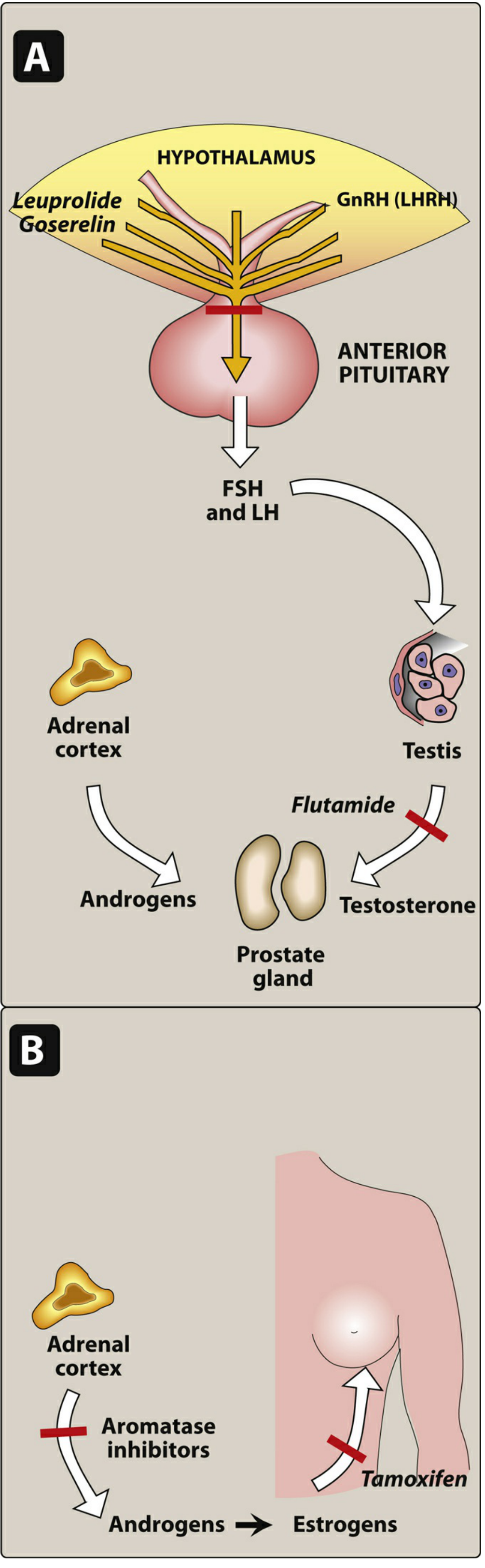
I have rich information. Let me also fetch the diagram image from Lippincott:
Loading Image
I now have comprehensive information from authoritative sources. Here is a complete overview of Leuprolide (you may have seen it spelled "Leoprolide" - the correct name is Leuprolide):
Leuprolide (Brand names: Lupron, Eligard)
Drug Class
Synthetic GnRH (Gonadotropin-Releasing Hormone) agonist analogue - a member of the GnRH congener family alongside goserelin, nafarelin, triptorelin, and histrelin.
Mechanism of Action
Leuprolide is a synthetic peptide analogue of GnRH with two key structural modifications:
- A substitution at position 6 that protects against proteolysis
- A substitution at the carboxyl terminus that improves receptor-binding affinity
These modifications give it enhanced potency and prolonged duration of action compared to native GnRH.
The biphasic effect:
- Phase 1 (initial - first 1-2 weeks): Leuprolide binds and continuously stimulates GnRH receptors in the anterior pituitary → transient surge in LH and FSH → transient rise in testosterone (males) or estrogen (females). This is called the "flare" effect.
- Phase 2 (sustained - after ~2-4 weeks): Continuous receptor occupancy leads to receptor downregulation and desensitization → marked suppression of LH and FSH secretion → fall in testosterone/estrogen to castration levels ("medical castration").
This is the paradox of leuprolide: a GnRH agonist ultimately produces profound gonadotropin suppression through receptor desensitization.
FDA-Approved Clinical Uses
| Indication | Notes |
|---|---|
| Advanced prostate cancer | Medical castration; equivalent in efficacy to bilateral orchiectomy |
| Endometriosis | Reduces estrogen-dependent lesions and pelvic pain |
| Uterine fibroids (leiomyomata) | Preoperative reduction in fibroid size |
| Central (GnRH-dependent) precocious puberty | Arrests premature sexual maturation with minimal side effects |
| Assisted reproduction | Prevents premature LH surge during ovarian stimulation |
Diagnostic use: The depot form (3.75 mg SC) is used to differentiate GnRH-dependent from GnRH-independent precocious puberty. A plasma LH > 6.6 mIU/mL at 2 hours is diagnostic of central (GnRH-dependent) disease. In hypothalamic disease, the intact pituitary responds to leuprolide; in pituitary disease, it does not.
Formulations and Dosing
| Route | Formulation | Dose |
|---|---|---|
| SC injection | Daily | 1 mg/day |
| SC depot | Monthly | 7.5 mg/month |
| SC depot | 3-month | 22.5 mg q3 months |
| SC depot | 4-month | 30 mg q4 months |
| SC depot | 6-month | 45 mg q6 months |
| IM depot | Monthly | 3.75 mg/month |
| IM depot | 3-month | 11.25 mg q3 months |
For endometriosis, the 3.75 mg or 11.25 mg formulations are co-packaged with norethindrone 5 mg/day (oral progestin) to minimize hypoestrogenic bone loss.
Pediatric (central precocious puberty): 0.2-0.3 mg/kg IM (monthly); 11.25-30 mg IM (3 months); 45 mg SC (6 months).
Adverse Effects
Tumor "Flare" (Critical - first 1-2 weeks)
- The initial testosterone surge can worsen symptoms in prostate cancer patients with bone metastases - spinal cord compression, increased bone pain, urinary obstruction
- Prevention: Pre-treat with an antiandrogen (flutamide, bicalutamide, or nilutamide) for 1-2 weeks before starting leuprolide in patients with significant metastatic disease
Hypogonadal Effects (both sexes)
- Hot flashes
- Sexual dysfunction (reduced libido, erectile dysfunction in males)
- Decreased bone mineral density (osteoporosis with long-term use)
- Vaginal dryness / atrophic changes (females)
- Weight gain
- Fatigue and loss of muscle mass
Metabolic Effects (long-term ADT in prostate cancer)
- Increased serum cholesterol
- Increased blood pressure
- Increased risk of major adverse cardiovascular events (MACE) - notably, the cumulative incidence of MACE is approximately 50% higher with leuprolide compared to the GnRH antagonist relugolix, per Goldman-Cecil Medicine
Other
- Injection site reactions
- Gynecomastia (males)
Key Comparison: GnRH Agonists vs. Antagonists
| Feature | Leuprolide (GnRH agonist) | Degarelix/Relugolix (GnRH antagonist) |
|---|---|---|
| Mechanism | Receptor desensitization after initial stimulation | Direct receptor blockade |
| Initial testosterone surge (flare) | Yes - requires antiandrogen cover | No |
| Speed to castration | ~30 days | Faster (days) |
| PSA suppression | Slower | More rapid |
| Cardiovascular risk | Higher (vs. relugolix) | Lower (relugolix) |
Pharmacokinetics
- Bioavailability of intranasal formulations is low (~4%), while parenteral formulations (SC/IM) have much higher bioavailability
- Multiple depot formulations allow for monthly to biannual dosing, improving compliance
- The GnRH agonists as a class are resistant to proteolytic degradation due to the D-amino acid at position 6
Sources:
- Goodman & Gilman's Pharmacological Basis of Therapeutics, Table 46-3 and Ch. 46
- Lippincott Illustrated Reviews: Pharmacology, Ch. 37 (GnRH agonists, Figure 37.27)
- Goldman-Cecil Medicine, Androgen Deprivation Therapy section
This is a shared conversation. Sign in to Orris to start your own chat.