
Latest DKA management
Reading File
Now I'll run all searches in parallel - textbook headings, paragraph content, recent PubMed evidence, and web search simultaneously.
Finding Sources
Searching PubMed
"diabetic ketoacidosis" AND management
Searching the Web
DKA diabetic ketoacidosis management guidelines 2024 2025
Good - I have the 2024 consensus report data and a textbook reference. Let me now read the textbook block and get the PubMed abstract for the subcutaneous insulin meta-analysis, plus extract more detail from the Cleveland Clinic article.
Reading File
Reading Article
PMID: 39090718
Reading Article
PMID: 40032308
Finding Sources
I found a DKA flowchart image and Rosen's Emergency Medicine has a full treatment box. Let me fetch the image and read the Rosen's and Goldman-Cecil sections.
Loading Image
Reading File
Reading File
I now have excellent data from multiple authoritative sources. Let me compile the full, comprehensive response.
Diabetic Ketoacidosis (DKA): Latest Management
Based on the 2024 ADA Consensus Report (updated June 2024, the first major revision in 15 years), textbook sources, and recent meta-analyses.
Diagnosis - Updated 2024 DKA Criteria (DKA Triad)
All three criteria must be present:
| Criterion | Threshold |
|---|---|
| D - Diabetes/Hyperglycemia | Glucose ≥200 mg/dL OR prior history of diabetes |
| K - Ketosis | Beta-hydroxybutyrate (BHB) ≥3.0 mmol/L OR urine ketones 2+ or higher |
| A - Metabolic Acidosis | pH <7.3 AND/OR bicarbonate <18 mmol/L |
Note: The 2024 consensus now specifically uses beta-hydroxybutyrate (not nitroprusside-based urine/serum ketones) as the preferred ketosis marker, since BHB doesn't react with nitroprusside and is the predominant ketoacid in DKA. This is a key update. 2024 ADA Consensus review (PMID: 40032308).
Severity Classification and Level of Care
| Severity | BHB | pH | HCO3 | Mental Status | Care Setting |
|---|---|---|---|---|---|
| Mild | ≤6 mmol/L | >7.25 | ≥15 mmol/L | Normal | Regular / observation ward |
| Moderate | ≤6 mmol/L | 7.0-7.25 | 10 to <15 mmol/L | Normal or drowsy | Step-down / intermediate care |
| Severe | >6 mmol/L | <7.0 | <10 mmol/L | Stupor / coma | ICU |
Treatment: The Four Pillars
1. Fluids
- Initial resuscitation: Isotonic saline (0.9% NaCl) or balanced crystalloid (e.g., Lactated Ringer's or PlasmaLyte) at 500-1,000 mL/hr for the first 2-4 hours in patients without cardiac or renal compromise.
- The 2024 consensus now gives balanced crystalloids equal footing with normal saline - this is an update from prior guidance.
- Once intravascular volume is restored, subsequent rate guided by hemodynamics, fluid balance, and corrected sodium.
- Total fluid deficit is typically 5-10 L (Goldman-Cecil Medicine).
- When serum glucose falls to ~200 mg/dL, switch to 5% dextrose-containing fluids to allow continued insulin infusion without causing hypoglycemia. - Barash Clinical Anesthesia, Table 47-14
2. Insulin - Major Update
Severe DKA:
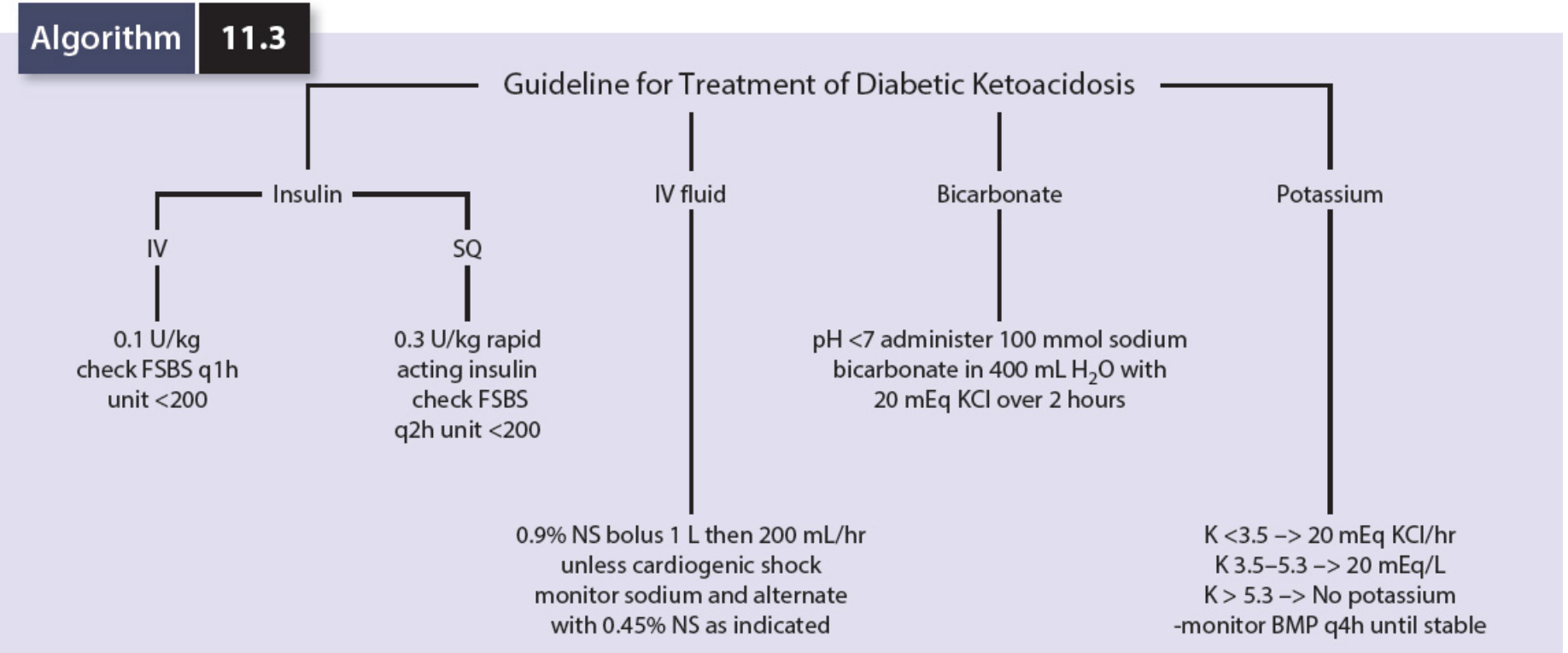
- Start fixed-rate IV insulin infusion at 0.1 units/kg/hr as soon as possible, OR a nurse-driven variable-rate protocol.
- Do NOT start insulin if K+ <3.3 mEq/L - correct hypokalemia first (risk of life-threatening hypokalemia). - Rosen's Emergency Medicine, Box 115.1
- Target glucose around ~200 mg/dL during treatment; continue insulin until ketoacidosis resolves, not just until glucose normalizes.
Mild-Moderate DKA (New 2024 Recommendation):
- Subcutaneous rapid-acting insulin analogues every 1-2 hours is now an acceptable alternative to IV insulin for mild-moderate uncomplicated DKA, with close nursing supervision.
- A 2024 systematic review and meta-analysis (6 RCTs, 8,444+ patients) confirmed no difference in time to DKA resolution, hypoglycemia risk, or mortality between subcutaneous and IV insulin in mild-moderate DKA (PMID: 39090718).
3. Potassium
This is the most critical electrolyte concern. Despite total body K+ depletion (deficit 3-10 mEq/kg), serum K+ appears normal or high due to acidosis shifting K+ out of cells. When insulin is given and acidosis corrects, K+ shifts back intracellularly rapidly - causing dangerous hypokalemia.
| Serum K+ | Action |
|---|---|
| <3.3 mEq/L | Hold insulin, give IV KCl 20-40 mEq/hr until K+ ≥3.3 |
| 3.3-5.3 mEq/L | Add 20-40 mEq KCl per liter of IV fluid; target K+ 4-5 mEq/L |
| >5.3 mEq/L | No potassium; monitor BMP every 4 hours |
- Continuous ECG monitoring when K+ replacement rate >10 mEq/hr.
- Oral K+ supplementation may be needed for several days after resolution. - Barash, p.4060
4. Other Electrolytes
Phosphate: Hypophosphatemia occurs with acidosis correction and insulin. Severe hypophosphatemia can impair ventilation (skeletal muscle weakness). Replace if symptomatic or severe.
Bicarbonate: Not routinely indicated.
- Consider only if: pH <6.9 (even without hemodynamic instability) OR hemodynamically unstable with pH <7.1.
- Multiple studies show no difference in acidosis resolution or time to discharge with routine bicarbonate use. - Barash Clinical Anesthesia
Monitoring During Treatment
| Parameter | Frequency |
|---|---|
| Capillary blood glucose | Every 1-2 hours |
| Electrolytes, phosphate, creatinine, BHB, venous pH | Every 4 hours until DKA resolves |
DKA Resolution Criteria
DKA is considered resolved when ALL of the following are met:
- BHB <0.6 mmol/L (or anion gap normalized)
- Venous pH ≥7.3 AND bicarbonate ≥18 mmol/L
- Patient able to tolerate oral intake
Transition to Subcutaneous Insulin
- Do not stop IV insulin without giving subcutaneous insulin first (overlap by ~1-2 hours for long-acting insulin, 15-30 min for rapid-acting).
- If IV dextrose was running, discontinue it when insulin infusion stops.
- Restart/initiate the patient's usual insulin regimen once eating.
Precipitants to Treat Concurrently
- Infection (most common) - obtain cultures, start antibiotics if indicated
- Insulin omission
- New-onset T1DM
- SGLT2 inhibitor use (euglycemic DKA - glucose may be ≤300 mg/dL in up to 18% of cases)
- Myocardial infarction, pancreatitis, medications (steroids, antipsychotics)
SGLT2 Inhibitor-Associated (Euglycemic) DKA
An important emerging entity: patients on SGLT2 inhibitors (dapagliflozin, empagliflozin, canagliflozin) can develop DKA with normal or near-normal glucose. High clinical suspicion is needed. Management is the same, but glucose targets for insulin adjustment need modification since glucose is already near-normal.
Key 2024 Updates vs. Prior Guidance
| Area | Old Approach | 2024 Update |
|---|---|---|
| Ketosis marker | Urine/serum ketones (nitroprusside) | Prefer BHB ≥3.0 mmol/L |
| Fluid choice | 0.9% NaCl preferred | Balanced crystalloids equally acceptable |
| Insulin for mild-moderate DKA | IV insulin standard | Subcutaneous rapid-acting insulin now recommended option |
| Monitoring | BG every 1-2h | Also BHB every 4h for resolution tracking |
Sources: 2024 ADA Consensus Report on Hyperglycemic Crises (PMID 40032308) | Rosen's Emergency Medicine, 10e | Goldman-Cecil Medicine | Barash Clinical Anesthesia, 9e | Meta-analysis on SQ vs. IV insulin (PMID 39090718)
2026 update
Searching for any 2025-2026 DKA updates now.
Searching sources...
Searching PubMed
"diabetic ketoacidosis" AND management
Searching the Web
DKA diabetic ketoacidosis guidelines update 2025 2026 ADA consensus
Good finds - ADA Standards of Care 2026 (published Dec 2025) and a 2026 EM Ottawa DKA update. Let me extract more detail from these sources and get the key 2026 paper.
Reading Web Page
https://emottawablog.com/2026/01/insulin-on-the-run-manageme…
Reading Article
PMID: 41656026
Reading Article
PMID: 39746727
Excellent - I now have direct content from the ADA Standards of Care 2026 (Diabetes Care, Vol 49, Supplement 1, January 2026) and the EM Ottawa 2026 DKA update. Here's the full 2026 update:
DKA Management: 2026 Updates
Primary source: ADA Standards of Care 2026 (Diabetes Care, Vol 49, Supplement 1, January 2026 - published Dec 8, 2025), supplemented by the 2026 EM review in Endocrinology & Metabolism Clinics of North America (PMID: 41656026).
What's New vs. the 2024 Consensus Report
1. Basal Insulin Added Alongside IV Insulin Infusion (New 2026 Recommendation)
This is the headline change. The 2026 ADA Standards of Care now state:
"Administration of a low dose (0.15-0.3 units/kg) of basal insulin analog in addition to IV insulin infusion may reduce the duration of insulin infusion and length of hospital stay and prevent rebound hyperglycemia without increased risk of hypoglycemia."
- This is particularly emphasized for Type 1 diabetes patients, to protect against DKA if the IV insulin infusion is inadvertently stopped for a prolonged period.
- The ADA Standards of Care 2026 designate this an emerging recommendation, not yet a firm protocol change, pending broader institutional adoption.
2. Fluid Choice: Balanced Crystalloids Now Explicitly Preferred Over 0.9% NaCl in Severe DKA
The 2026 guidance (supported by the RINSE-DKA trial, PMID: 39077895) makes Lactated Ringer's / Ringer's Lactate the preferred fluid over normal saline in severe DKA, where large volumes are required. 0.9% NaCl remains acceptable but carries higher risk of hyperchloremic metabolic acidosis with large volumes.
3. Subcutaneous Insulin Protocol Refined - Mild DKA
The ADA 2026 now provides explicit SC insulin dosing for mild DKA in uncomplicated patients:
- 0.1 units/kg rapid-acting insulin analog as an SC bolus, then:
- 0.1 units/kg every 1 hour, OR
- 0.2 units/kg every 2 hours
This is more specific than the 2024 consensus guidance of "rapid-acting SC insulin every 1-2 hours."
4. Mild DKA Insulin Dosing for IV Route Also Adjusted
For mild DKA via IV:
- 0.05 units/kg/hr fixed-rate infusion (down from 0.1 units/kg/hr used for moderate-severe DKA)
- This reflects a tiered insulin dosing approach by severity.
| DKA Severity | IV Insulin Rate | SC Option |
|---|---|---|
| Mild | 0.05 units/kg/hr | 0.1 units/kg bolus then q1h or 0.2 units/kg q2h |
| Moderate/Severe | 0.1 units/kg/hr (fixed) or nurse-driven variable | Not first-line |
5. Potassium Protocol - Refined Thresholds
The 2026 guidance refines the K+ protocol with slightly different cut-offs:
| Serum K+ | Action |
|---|---|
| <3.5 mmol/L | Hold insulin; replace at 10-20 mmol/hr until K+ >3.5 (central venous access if ≤3.3 mmol/L in severe DKA) |
| 3.5-5.0 mmol/L | Start insulin; add K+ to IV fluids to keep serum K+ between 4 and 5 mmol/L |
| 3.3-4.0 mmol/L | KCl 40 mmol/L of IV fluid |
| 4.1-5.4 mmol/L | KCl 20 mmol/L of IV fluid |
| >5.0 mmol/L | Do not give K+; check serum K+ every 2 hours |
6. Monitoring Frequency
The 2026 ADA protocol specifies checking electrolytes, kidney function, venous pH, osmolality, and glucose every 2-4 hours (the 2024 consensus said every 4 hours - this tightens the range slightly for closer monitoring).
7. DKA Resolution Criteria - Clarified
The 2026 document specifies:
- Venous pH >7.3 OR bicarbonate >18 mmol/L AND plasma/capillary ketones <0.6 mmol/L
Resolution criteria should guide clinical judgment - the 2026 standards explicitly state do not delay discharge or step-down if these criteria are narrowly not met but the clinical picture is clear.
8. IV-to-SC Insulin Transition - Explicit Overlap Protocol
Continue IV insulin infusion for 1-2 hours after SC insulin is given before stopping the infusion. This prevents rebound ketosis.
9. Bicarbonate - Updated Threshold
The 2026 ADA Standards specify bicarbonate only if pH <7.0 (stricter than some older guidance using <7.1). Phosphate replacement only if phosphate <1.0 mmol/L with muscle weakness or respiratory compromise.
10. ADA/EASD 2026 Type 1 Diabetes Consensus (Presented Oct 2025)
A separate 2026 ADA/EASD consensus on Type 1 diabetes management (presented at EASD Vienna, Oct 2025) adds context:
- CGM and Automated Insulin Delivery (AID) systems recognized as mitigating DKA risk - AID is now preferred insulin delivery in T1DM.
- GLP-1 receptor agonists may now be used in T1DM with obesity (first-time recommendation), with education on DKA risk monitoring.
- Emphasis on DKA education at every hospitalization (discharge education now a graded recommendation, Level B).
Summary: 2024 vs. 2026 Comparison
| Feature | 2024 ADA Consensus | 2026 ADA Standards of Care |
|---|---|---|
| Fluid of choice | NS or balanced crystalloid (equal) | Balanced crystalloid preferred in severe DKA |
| IV insulin - mild DKA | 0.1 units/kg/hr | 0.05 units/kg/hr |
| SC insulin dosing | "Rapid-acting q1-2h" (vague) | 0.1 units/kg bolus, then 0.1 q1h or 0.2 q2h (specific) |
| Basal insulin during IV infusion | Not mentioned | 0.15-0.3 units/kg basal recommended alongside IV |
| Monitoring frequency | Every 4 hours | Every 2-4 hours |
| K+ target range | 4-5 mEq/L | 4-5 mmol/L (same, but cut-offs refined) |
| Bicarbonate threshold | pH <7.0 (some centres used <7.1) | pH <7.0 (standardized) |
| DKA resolution | BHB <0.6, pH ≥7.3, HCO3 ≥18 | Same, but do not delay discharge if borderline |
| IV-to-SC overlap | Not specified clearly | 1-2 hours overlap explicitly stated |
Sources: ADA Standards of Care 2026 (Diabetes Care, Vol 49, Suppl 1, Jan 2026) | EM Ottawa DKA Update Jan 2026 | Lowie & Bond, Endocrinol Metab Clin North Am 2026 (PMID 41656026) | Mehta & Zimmerman, Cleve Clin J Med 2025 (PMID 39746727)
This is a shared conversation. Sign in to Orris to start your own chat.