
Give a detailed answer of kennedys classification eith images for a 2nd bds studrnt for my viva
Reading File
Now let me search the medical library for Kennedy's classification.
Finding Sources
Searching the Web
Kennedy's classification of partially edentulous arches with images diagram
Finding Sources
Loading Image
Loading Image
Reading Web Page
https://www.edentalportal.com/blog/kennedys-classification-r…
Loading Image
Here is a complete, viva-ready answer on Kennedy's Classification for your 2nd BDS exam:
Kennedy's Classification of Partially Edentulous Arches
Introduction
Kennedy's classification was proposed by Dr. Edward Kennedy in 1925. It is the most widely accepted and commonly used system for classifying partially edentulous arches. It classifies arches based on the relationship of the edentulous (toothless) space to the remaining natural teeth.
Purpose / Why we classify:
- Simplifies communication between dentists and lab technicians
- Helps in treatment planning for Removable Partial Dentures (RPD)
- Allows easy visualization of the arch condition
- Differentiates between tooth-supported and tissue-supported (free-end) dentures
The 4 Main Classes
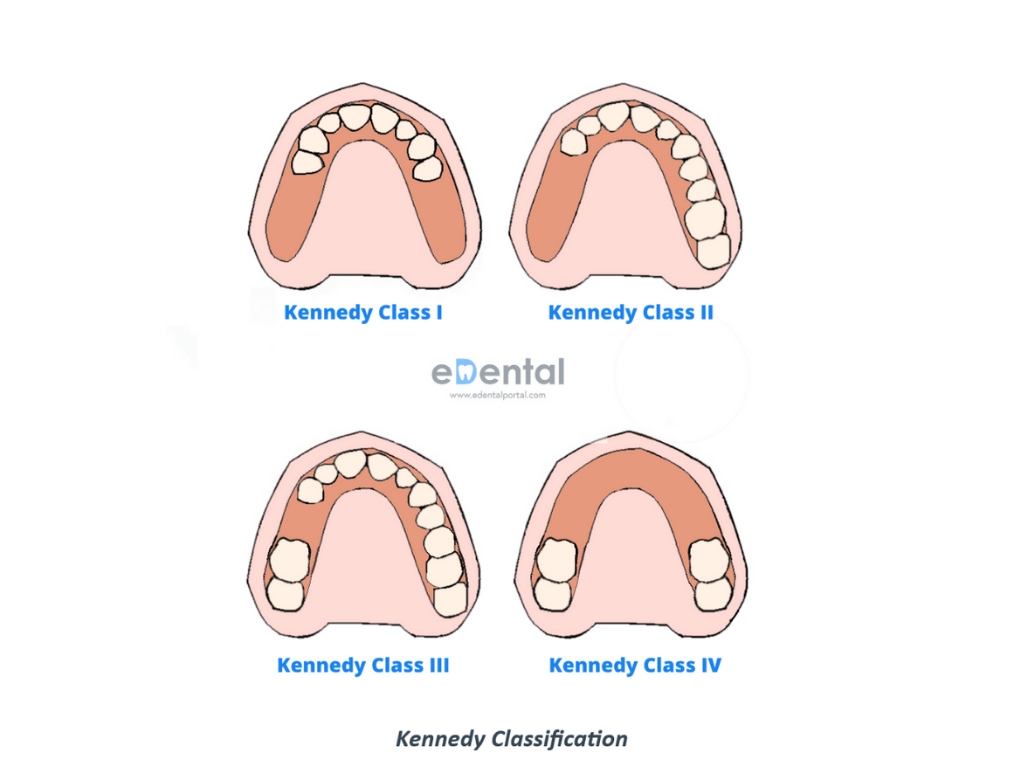
Class I - Bilateral Posterior Edentulous Areas (Free-End Saddle)
Definition: Edentulous areas are present on BOTH sides of the arch, located posterior to all remaining natural teeth.
- Type of support: Tooth + tissue supported (mucosal support distally, no posterior abutment)
- Also called: Bilateral distal extension base / Bilateral free-end saddle
- Most difficult class to manage prosthetically
- Example: All molars and premolars missing on both sides
Key viva point: This is the most challenging class because there is no posterior abutment tooth - the denture gets support only from the soft tissue (ridge) posteriorly, making it less stable.
Class II - Unilateral Posterior Edentulous Area (Free-End Saddle)
Definition: Edentulous area is present on ONE SIDE only, located posterior to all remaining natural teeth.
- Type of support: Tooth + tissue supported (on one side only)
- Also called: Unilateral distal extension base / Unilateral free-end saddle
- More common than Class I
- There is a natural tendency for the denture to tilt/rotate toward the edentulous side
Class III - Unilateral Posterior Tooth-Bounded Edentulous Area
Definition: Edentulous area is present on ONE SIDE, but there are natural teeth BOTH anterior AND posterior to the edentulous space (i.e., bounded on both sides).
- Type of support: Entirely tooth supported (abutment teeth on both sides)
- Also called: Unilateral bounded saddle
- Most favorable class - best prognosis
- Clasps can be placed on both sides of the gap
- Example: Second premolar and first molar missing, with first premolar anteriorly and second molar posteriorly still present
Class IV - Single Bilateral Anterior Edentulous Area (Crosses Midline)
Definition: A single edentulous area located anterior to all remaining teeth that crosses the midline.
- Type of support: Mostly tooth-supported (posterior abutment teeth available)
- The edentulous space involves both the right AND left sides of the front
- Important rule: Class IV has NO modifications - any additional edentulous area posterior to it changes the classification
- Aesthetic consideration is the primary concern here
- Example: Multiple upper front teeth missing
Summary Visual

Applegate's Modifications to Classes V & VI
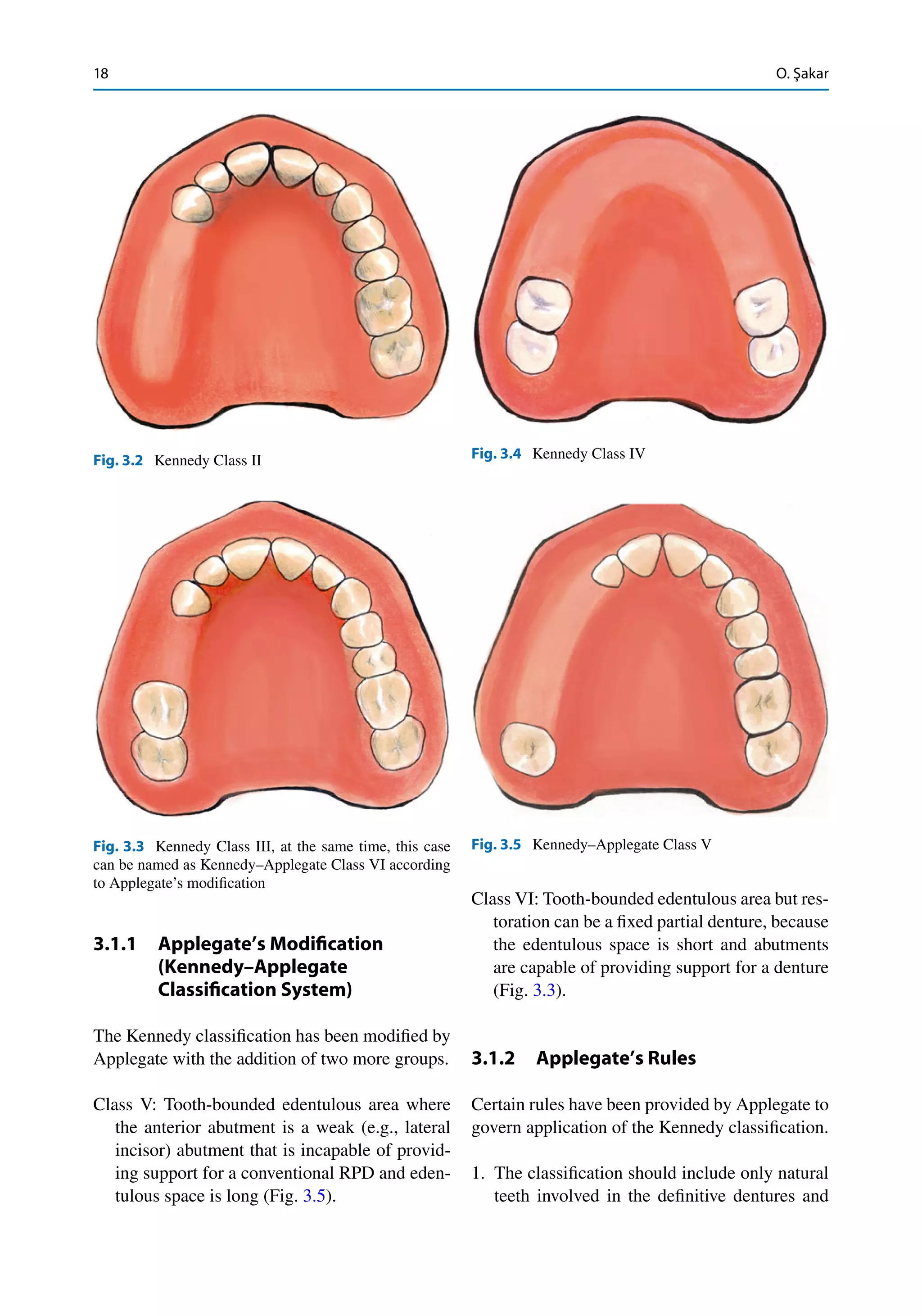
Applegate added 2 more classes to the original 4:
| Class | Description |
|---|---|
| Class V | Tooth-bounded edentulous area where the anterior abutment is weak (e.g., lateral incisor) and cannot support an RPD; edentulous space is long |
| Class VI | Tooth-bounded edentulous area where abutment teeth are strong and the space is short - can be restored with a Fixed Partial Denture (FPD/bridge) instead |
Applegate's 8 Rules for Applying Kennedy's Classification
These rules are extremely important for viva - examiners love to ask them!
| Rule | Statement |
|---|---|
| Rule 1 | Classification should be done AFTER extractions, not before (in case more teeth are to be extracted) |
| Rule 2 | A third molar that is missing and not to be replaced is not considered in classification |
| Rule 3 | A third molar that is present and will serve as an abutment IS included in classification |
| Rule 4 | A second molar that is missing and not to be replaced is not considered (e.g., if opposing tooth is also absent) |
| Rule 5 | The most posterior edentulous area always determines the classification |
| Rule 6 | Additional edentulous areas (other than the one that determines the class) are called modifications and are designated by number |
| Rule 7 | Only the number of additional edentulous spaces counts, not the number of missing teeth |
| Rule 8 | Class IV has NO modifications - any posterior edentulous area automatically changes the class |
Modifications (Sub-classes)
When additional edentulous areas exist apart from the one defining the class, they are called modifications and numbered (Mod 1, Mod 2, etc.).
- Only Classes I, II, and III can have modifications
- Class IV cannot have modifications (Rule 8)
- Example: Kennedy Class II Modification 1 = unilateral posterior free-end + one additional edentulous area somewhere else
Quick Memory Table for Viva
| Class | Space Location | Bilateral/Unilateral | Support Type | Modifications? |
|---|---|---|---|---|
| I | Posterior | Bilateral | Tooth + Tissue | Yes |
| II | Posterior | Unilateral | Tooth + Tissue | Yes |
| III | Posterior + Bounded | Unilateral | Tooth only | Yes |
| IV | Anterior (crosses midline) | Bilateral | Tooth only | No |
Most Common Viva Questions on Kennedy's Classification
Q: Which is the most common Kennedy's class?
A: Class III (most common), followed by Class II.
Q: Which class has no modifications?
A: Class IV.
Q: What does Rule 5 state?
A: The most posterior edentulous area always determines the classification.
Q: What is a free-end saddle?
A: An edentulous area that has no posterior abutment tooth - seen in Class I and Class II. These are the most challenging to restore because the denture is not supported by a tooth distally.
Q: What type of support does Class I RPD have?
A: It is a tooth + mucosa (tissue) supported denture - also called a distal extension base.
Q: Why is Class IV unique?
A: It is a single bilateral edentulous area crossing the midline. It has no modifications, and aesthetic concerns dominate treatment planning.
Good luck with your viva! The key points to remember are: the 4 classes, free-end vs. bounded saddles, Rule 5 (most posterior determines class), and that Class IV never has modifications.
This is a shared conversation. Sign in to Orris to start your own chat.