
Ependymal cells appearance
Reading File
Finding Sources
Finding Sources
Reading File
Reading File
Reading File
Loading Image
Loading Image
Loading Image
Ependymal Cells — Appearance
Ependymal cells are a type of glial cell that form an epithelium-like lining throughout the CNS ventricular system and spinal canal. Here is a comprehensive description of their appearance:
Light Microscopy
Shape & Arrangement
- Form a single layer of cuboidal-to-columnar cells lining the fluid-filled ventricles of the brain and the central canal of the spinal cord
- Cells are arranged in a continuous sheet resembling simple epithelium
- At the ventricular surface, they appear as a uniform row of tall, closely packed cells
Apical surface (facing the lumen)
- Bears cilia — the most distinctive feature, visible on H&E as a fuzzy/brush border at the luminal edge; these cilia beat to circulate CSF
- Bears long microvilli (involved in CSF absorption)
- Apical junctional complexes (like zonulae occludentes and adherentes) bind adjacent cells tightly
Basal surface (facing the neuropil)
- The basal ends of ependymal cells taper and extend branching processes that penetrate into the adjacent neuropil
- No basal lamina is present — a key distinction from true epithelia
- At the TEM level: numerous basal infoldings that interdigitate with astrocyte processes
Nuclei
- Oval to round, euchromatic nuclei located toward the basal pole of the cell
Histological Images
Fig. (a) — Cerebral ventricle lining, H&E ×100:
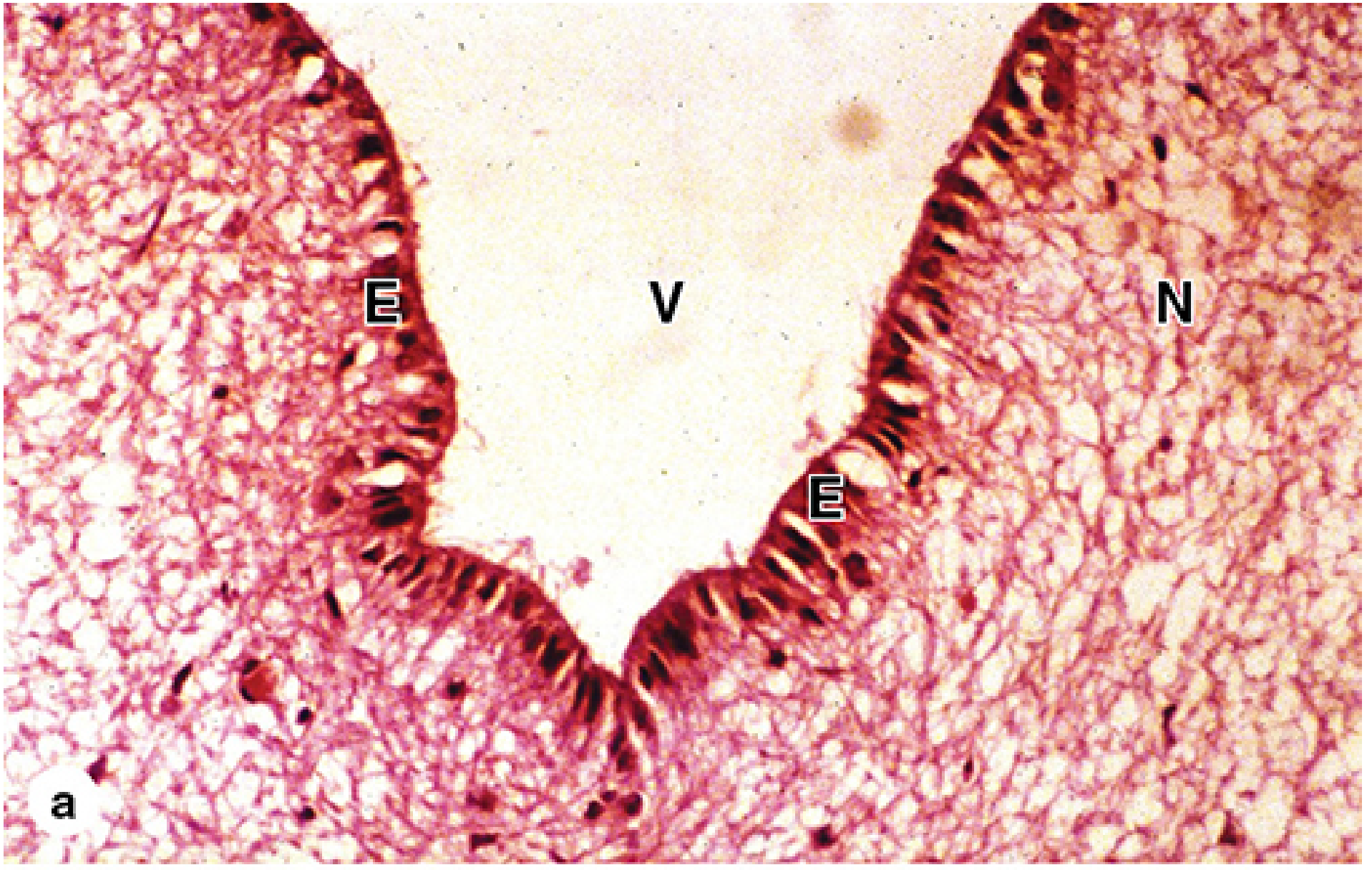
Columnar ependymal cells (E) line the ventricle (V), extending cilia into the lumen. Basal ends taper into the neuropil (N).
Fig. (b) — Central canal of spinal cord, H&E ×200:
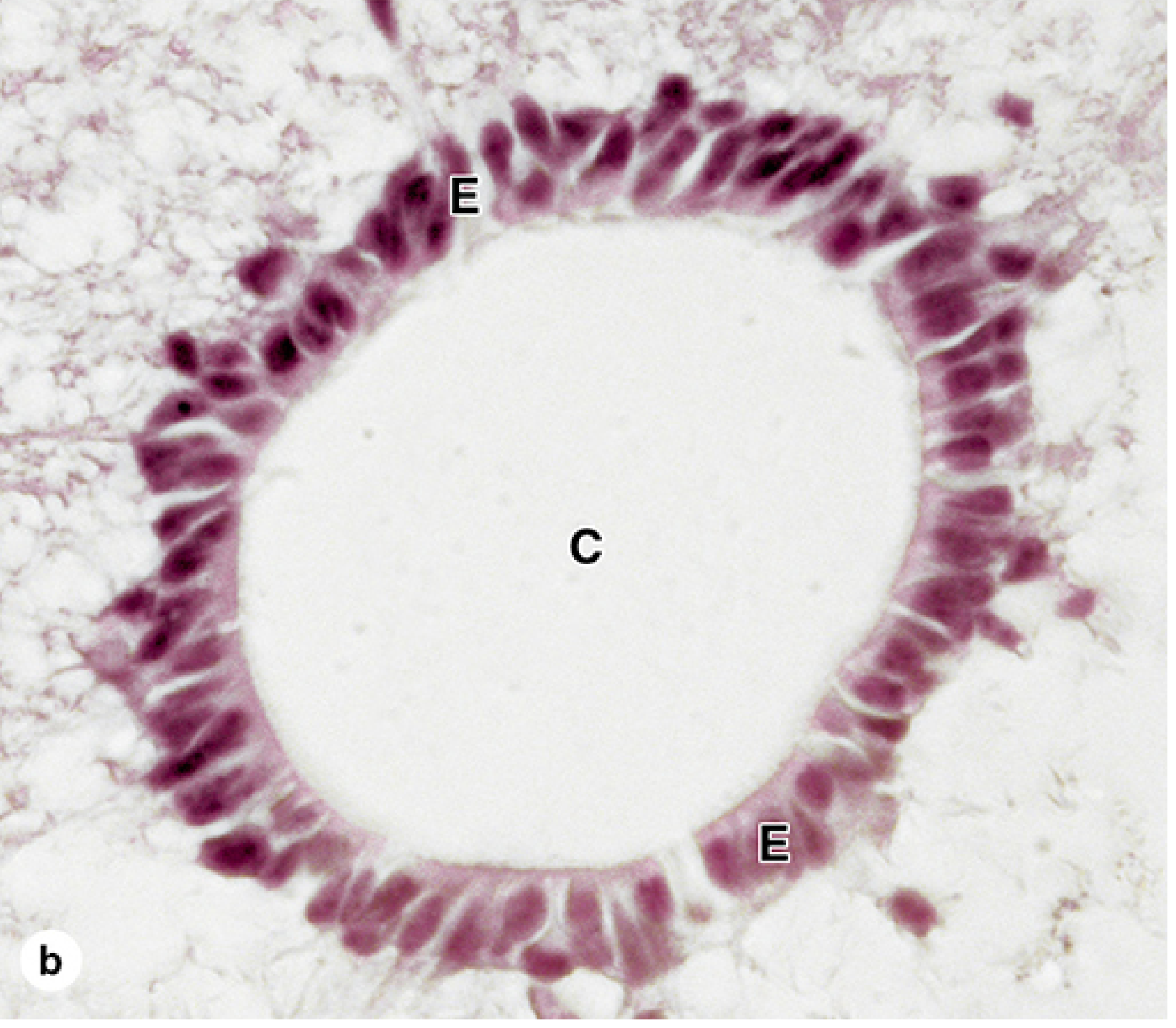
Ependymal cells (E) encircle the central canal (C) in a perfect single-layered ring with prominent apical cilia.
Fig. (c) — Light microscopy + TEM of ependymal lining:
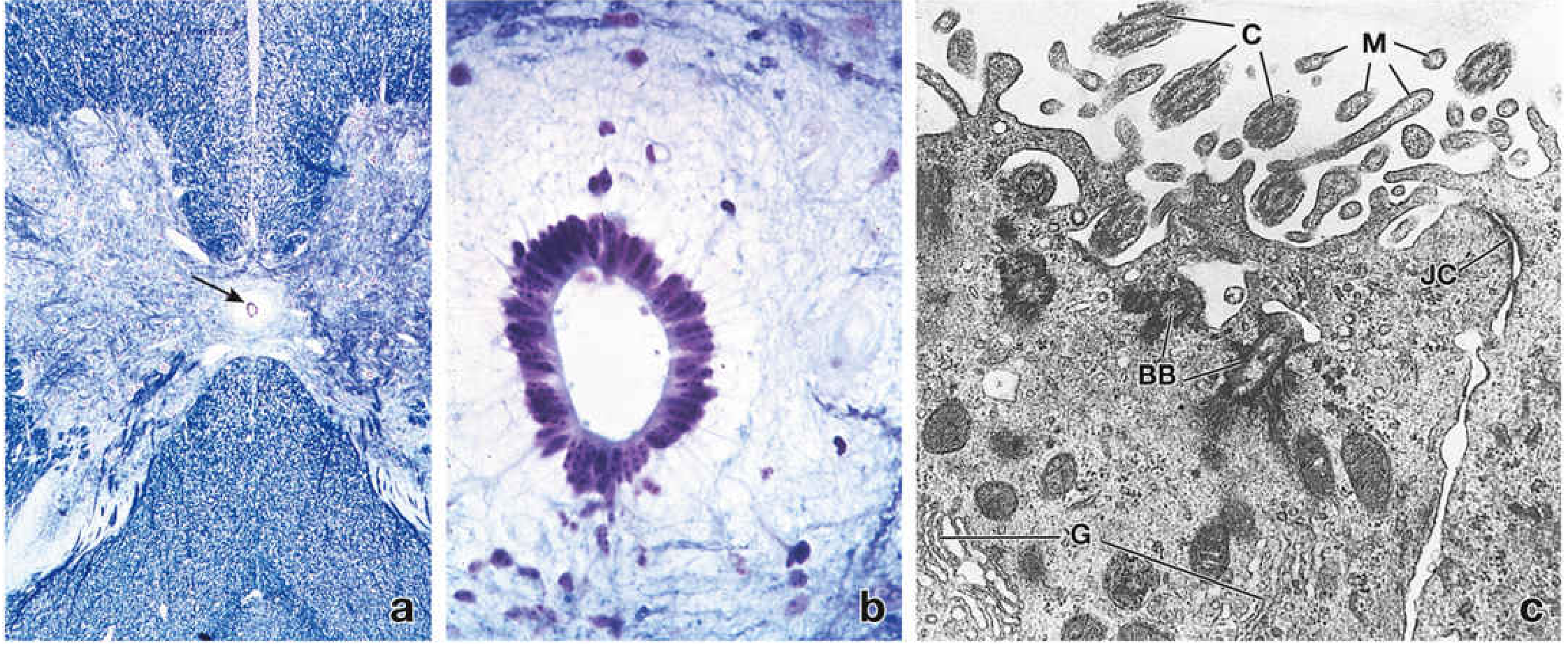
- (a) Toluidine blue at low power (×20): central canal seen in context of spinal cord
- (b) Higher magnification (×340): single layer of columnar ependymal cells clearly visible
- (c) TEM (×20,000): apical surface shows cilia (C) and microvilli (M), joined by a junctional complex (JC); basal bodies (BB) and Golgi apparatus (G) visible in apical cytoplasm
Key Distinguishing Features Summary
| Feature | Ependymal Cells |
|---|---|
| Shape | Cuboidal to columnar |
| Arrangement | Single layer (simple epithelium-like) |
| Apical surface | Cilia + microvilli |
| Lateral junctions | Junctional complexes (apical) |
| Basal lamina | Absent |
| Basal processes | Taper and branch into neuropil |
| Location | Ventricles of brain + central canal of spinal cord |
Specialized Variant: Tanycytes
A specialized subtype called tanycytes is found mainly in the floor of the third ventricle. They differ in that:
- They lack cilia on their free surface
- Their cell body gives rise to a long process projecting into the brain parenchyma
- They transport substances from CSF to the hypothalamo-portal blood circulation and are sensitive to glucose, potentially monitoring energy balance
— Junqueira's Basic Histology, p. 438–439; Histology: A Text and Atlas, p. 974
This is a shared conversation. Sign in to Orris to start your own chat.