
Acromegaly and gigantism features
I'll look up acromegaly and gigantism from the medical library for a thorough, textbook-quality answer.
Reading File
Now I'll search the library in parallel for both acromegaly/gigantism features and images.
Finding Sources
Finding Sources
Excellent - found great sources. Now I'll read the most comprehensive sections in parallel.
Reading File
Reading File
Reading File
Now let me read Harrison's detailed clinical features section and fetch the clinical images.
Reading File
Reading File
Now let me get Harrison's detailed clinical features text and fetch the key images in parallel.
Reading File
Loading Image
Loading Image
Loading Image
I now have excellent content and images from multiple textbooks. Let me compile the full answer.
Acromegaly and Gigantism: Clinical Features
Key Distinction
Both conditions result from excess Growth Hormone (GH) secretion, almost always due to a somatotroph (GH-secreting) pituitary adenoma. The timing relative to epiphyseal plate closure determines the syndrome:
| Gigantism | Acromegaly | |
|---|---|---|
| Onset | Before puberty (open epiphyses) | After puberty (closed epiphyses) |
| Linear growth | Extraordinary height (proportionate) | No increase in height |
| Soft-tissue/bony changes | Present + height | Present without height |
Etiology
Cause of GH excess (Harrison's 22e):
| Source | Prevalence |
|---|---|
| Pituitary adenoma (all types) | ~98% |
| - Densely/sparsely granulated GH cell adenoma | 60% |
| - Mixed GH + PRL cell adenoma | 25% |
| - Mammosomatotrope cell adenoma | 10% |
| Extrapituitary tumor (pancreatic islet, lymphoma) | <1% |
| Excess GHRH (central: hypothalamic; peripheral: carcinoid, small-cell lung) | <1% |
Associated syndromes include MEN-1 and McCune-Albright syndrome. GH co-secretes PRL in ~20-40% of cases (may cause hypogonadism and galactorrhea).
Gigantism - Features
- Occurs when GH excess arises before epiphyseal fusion (childhood/adolescence)
- The individual grows to extraordinary height - proportionate overall, but later develops acromegalic changes
- If untreated, features of acromegaly superimpose as the patient ages
- Increased length of long bones, enlarged head and feet (as shown below)
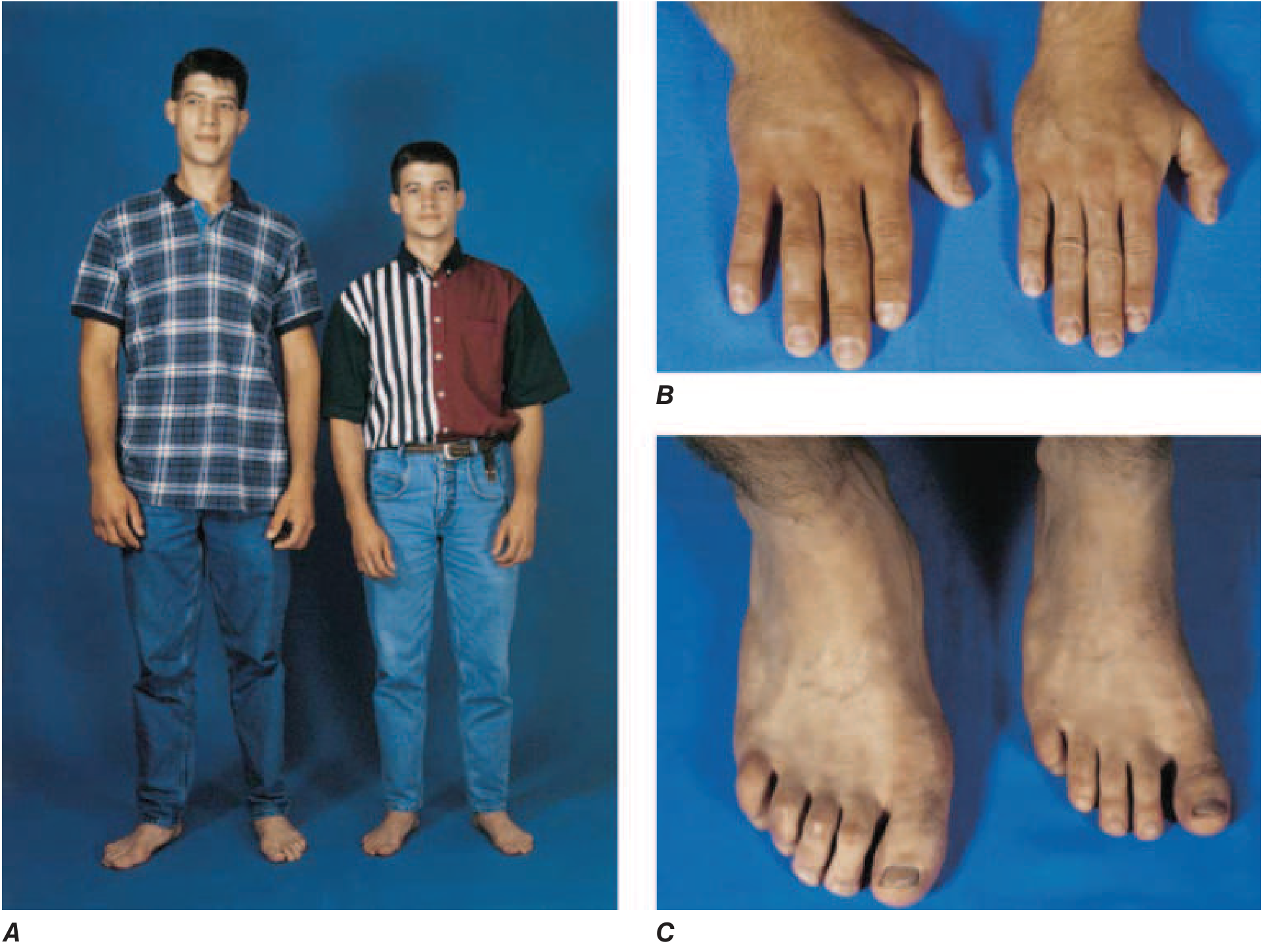
FIGURE: A 22-year-old man with gigantism (left) beside his identical twin (right). Note the increased height, prognathism, enlarged head, and enlarged feet. Clinical divergence began at age ~13. (Harrison's 22e, Fig. 392-7)
Acromegaly - Clinical Features
Onset is insidious (average delay of 7-10 years between onset and diagnosis). Features arise from GH/IGF-1 excess and local tumor mass effects.
1. Facial / Head Features
- Coarsening of facial features (most characteristic)
- Prognathism - jaw protrusion, leading to interdental separation and underbite
- Frontal bossing - prominent supraorbital ridges / brow protrusion
- Macroglossia - enlarged tongue
- Enlarged nose, lips, and ears
- Deepening of the voice (enlargement of larynx and sinuses)
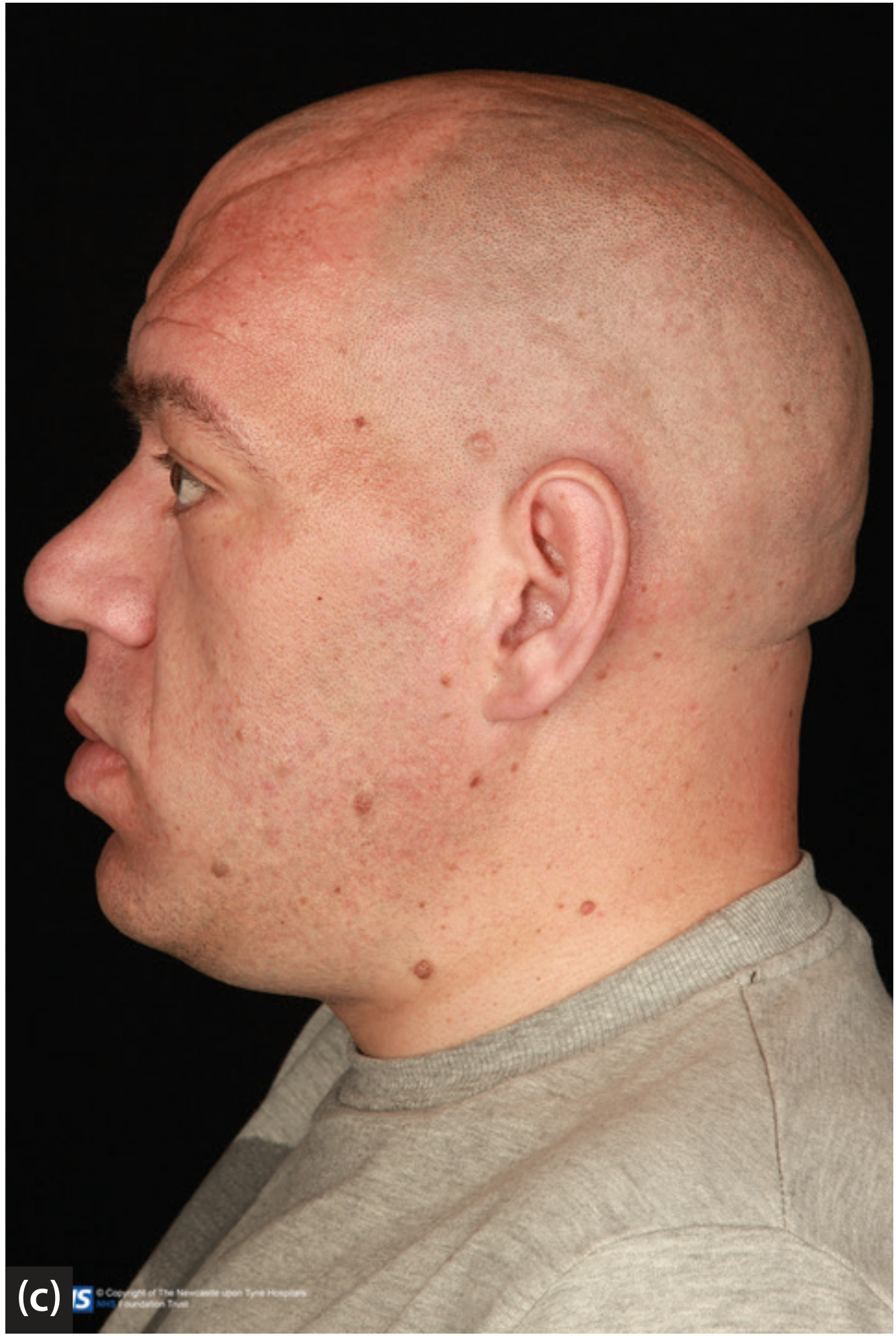
Lateral profile of a patient with acromegaly showing coarse facial features (Scott-Brown's ENT, Fig. 82.3c)
2. Extremities
- Enlarged hands and feet - "spade-like" or "shovel-like" hands; patients note increasing ring/glove/shoe size
- Soft-tissue swelling of the hands and feet
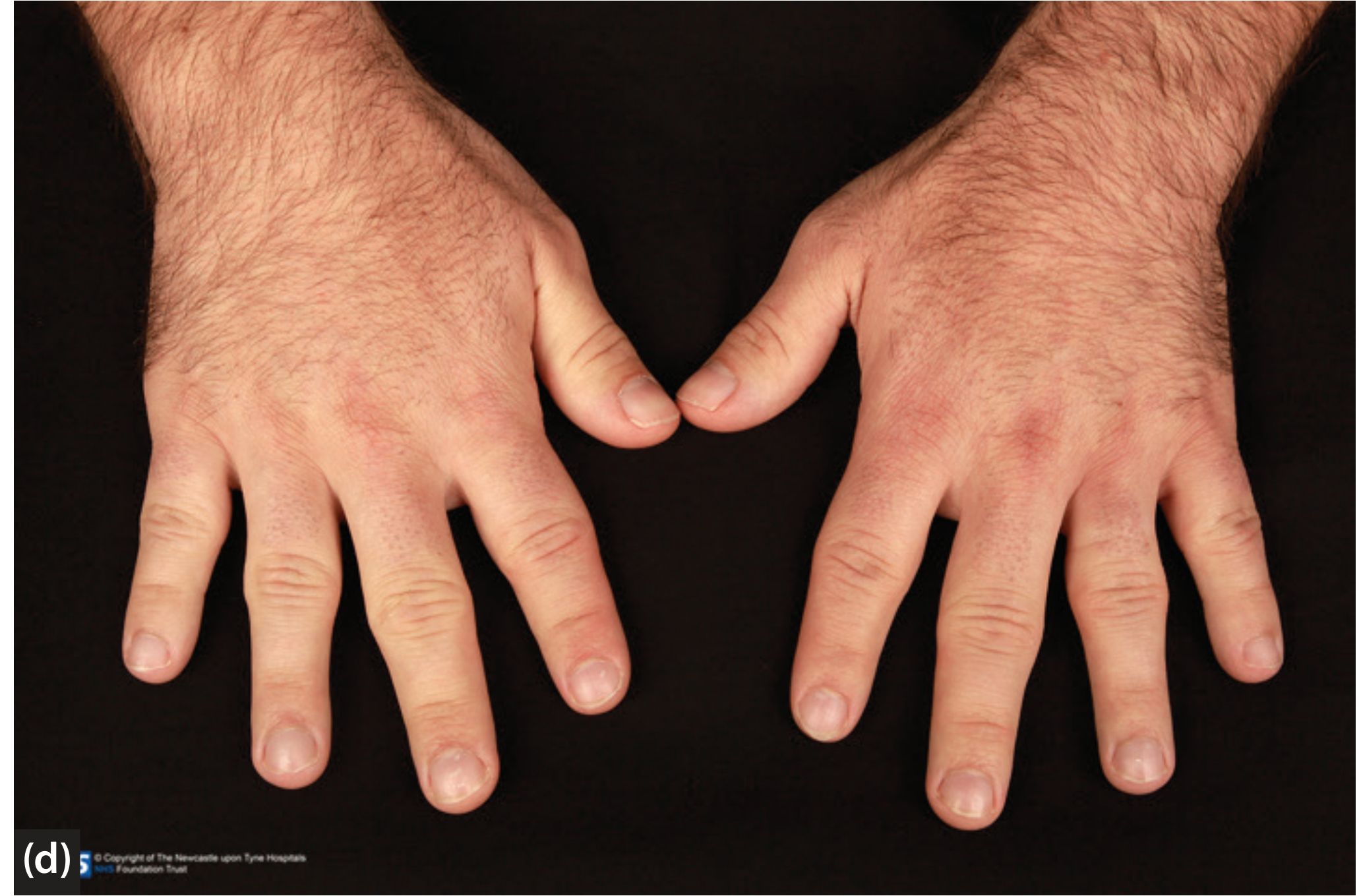
Enlarged, broadened hands ("spade hands") in acromegaly (Scott-Brown's ENT, Fig. 82.3d)
3. Musculoskeletal
- Degenerative osteoarthritis (vertebral changes, joint pain - arthralgia)
- Myopathy - proximal muscle weakness
- Kyphosis / vertebral changes
- Carpal tunnel syndrome (median nerve compression from soft-tissue swelling)
- Hearing loss (from bony changes)
4. Skin and Soft Tissue
- Excess sweating (hyperhidrosis) - one of the most common symptoms
- Hirsutism
- Oily skin, acne-like lesions
- Acanthosis nigricans
- Skin tags (acrochordons)
5. Metabolic
- Insulin resistance / Diabetes mellitus - GH is diabetogenic (anti-insulin effect); ~25% have abnormal glucose tolerance
- Hypercalciuria (GH stimulates renal 1α-hydroxylase → increased vitamin D activation → increased calcium absorption)
- Hyperprolactinemia in ~30% (co-secretion) - may cause galactorrhea in ~4% and hypogonadism
6. Cardiovascular (most common cause of death)
- Hypertension
- Cardiomegaly / cardiomyopathy
- Arrhythmias
- Congestive cardiac failure
- Ischaemic heart disease and cerebrovascular disease
- Premature cardiovascular disease is the leading cause of death
7. Respiratory
- Obstructive sleep apnoea (OSA) - common; from macroglossia, soft-tissue hypertrophy, and jaw changes
8. Gastrointestinal
- Colonic polyps (increased risk of colorectal neoplasia) - screening colonoscopy required at diagnosis
- Multinodular thyroid enlargement
9. Neurological / Local Tumor Effects
- Headaches (pituitary expansion)
- Visual field defects - bitemporal hemianopia from optic chiasm compression by macroadenoma
- Polyneuropathy (rare; described by Adams & Victor)
Summary Table (Scott-Brown's ENT, Table 84.5)
| Domain | Symptoms | Signs | Complications |
|---|---|---|---|
| Musculoskeletal | Arthralgia, increased shoe/hand size | Enlarged hands/feet, myopathy, osteoarthritis, prognathism, macroglossia | Carpal tunnel syndrome, hearing loss |
| Cardiovascular | - | Hypertension, cardiomyopathy | Ischaemic heart disease, CCF, cerebrovascular disease |
| Respiratory | - | OSA signs | Obstructive sleep apnoea |
| Metabolic | Sweating, headaches | Coarse features, hirsutism | Diabetes mellitus, metabolic syndrome |
| GI | - | - | Colonic polyps |
| Visual | - | Visual field defects | Blindness (if untreated) |
Diagnosis
- IGF-1 level (age/sex matched) - elevated; best screening test
- Oral glucose tolerance test (OGTT): GH fails to suppress to <1 μg/L after glucose load - confirmatory test
- MRI pituitary: demonstrates adenoma in 98% of cases
- Screen for associated conditions: diabetes, hypertension, OSA, colonic polyps, thyroid enlargement, cardiovascular disease
Treatment Overview
- Surgery: Transsphenoidal resection (first-line for most patients); remission ~70% for microadenomas, <50% for macroadenomas
- Somatostatin receptor ligands (SRLs): Octreotide, lanreotide - normalize GH/IGF-1 in ~50%
- GH receptor antagonist: Pegvisomant - for refractory cases
- Radiotherapy: Reserved for aggressive tumors not responding to surgery/medical therapy (slow response, 5-15 years; risk of hypopituitarism)
Sources: Harrison's Principles of Internal Medicine 22e; Scott-Brown's Otorhinolaryngology Head & Neck Surgery Vol. 1; Ganong's Review of Medical Physiology 26e; Tietz Textbook of Laboratory Medicine 7e
Gigantism features
Your credits are exhausted. You can purchase a top-up or subscribe to a plan to continue using Orris. If you're already subscribed, your daily credits will reset tomorrow.
Create a comparison chart: gigantism vs acromegaly
Your credits are exhausted. You can purchase a top-up or subscribe to a plan to continue using Orris. If you're already subscribed, your daily credits will reset tomorrow.
This is a shared conversation. Sign in to Orris to start your own chat.