
Cohort study
A cohort study is a type of observational study that follows a group of people over time to see who develops a particular outcome.
Searching sources...
Reading File
Searching the Web
cohort study design epidemiology types
Finding Sources
Park's Textbook of Preventive and Social Medicine is the ideal source. Let me pull multiple relevant sections at once.
Reading File
Reading File
Reading File
Reading File
Reading File
Reading File
Finding Sources
Finding Sources
Reading File
Reading File
Reading File
I now have comprehensive information from Park's Textbook of Preventive and Social Medicine. Let me also fetch the cohort study design diagram.
Loading Image
Here is a complete, structured overview of cohort studies based on Park's Textbook of Preventive and Social Medicine:
Cohort Study
Definition
A cohort study is an analytical (observational) study undertaken to obtain additional evidence to refute or support the existence of an association between a suspected cause and a disease. It is also known as a prospective study, longitudinal study, incidence study, or forward-looking study.
Distinguishing Features
- The cohorts are identified prior to the appearance of the disease under investigation
- The study groups are observed over a period of time to determine disease frequency
- The study proceeds forward from cause to effect
Concept of "Cohort"
In epidemiology, a cohort is a group of people who share a common characteristic or experience within a defined time period. Examples:
- Birth cohort - all persons born in the same year (e.g., birth cohort of 2010)
- Exposure cohort - persons exposed to a common drug, vaccine, or infection in a defined period
- Marriage cohort - persons married in the same period
- Disease cohort - e.g., all those who survived a myocardial infarction in one year
Framework (Basic Design)
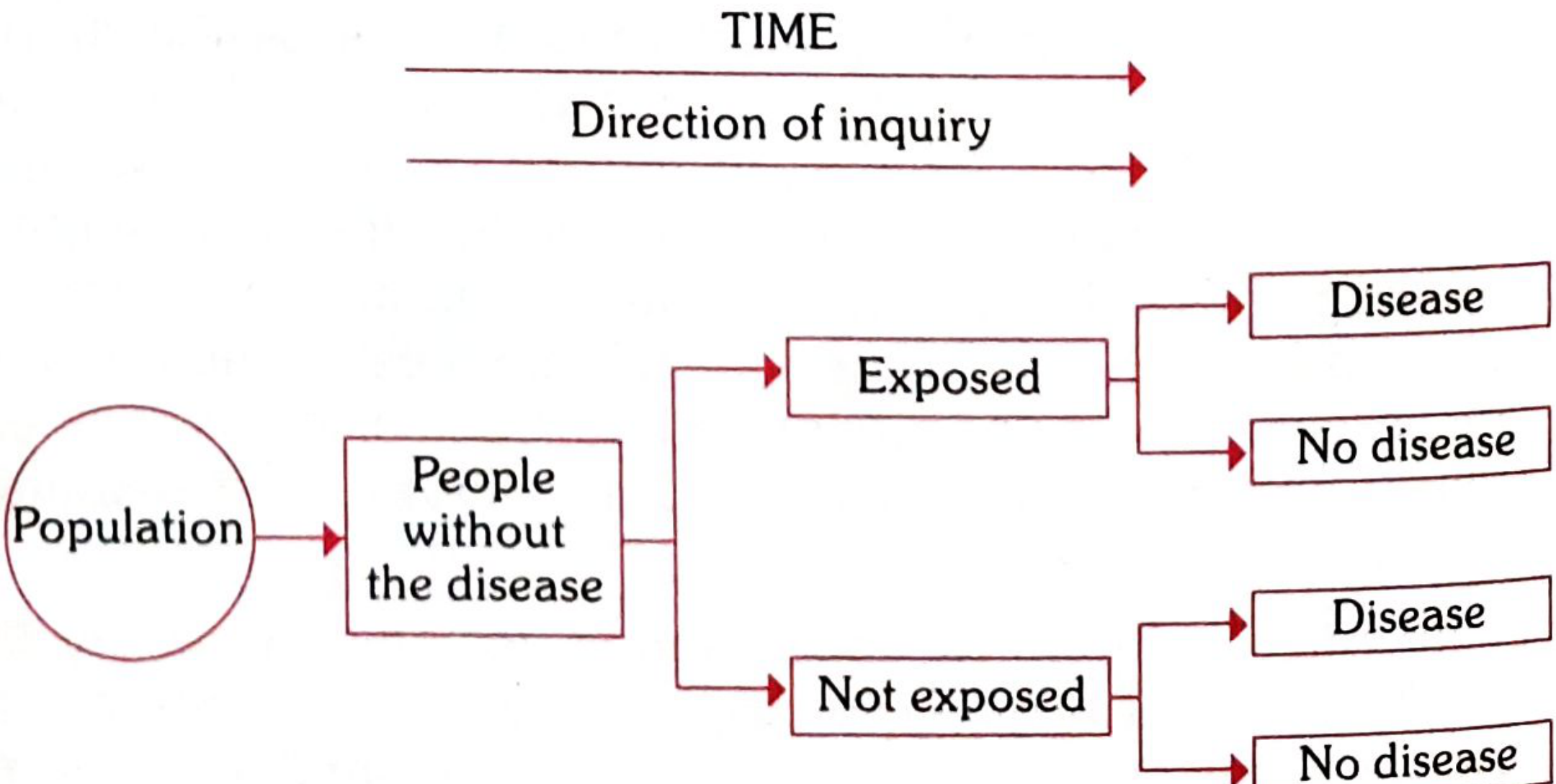
From a population free of the disease, two groups are identified:
| Cohort | Disease: Yes | Disease: No | Total |
|---|---|---|---|
| Exposed to putative aetiologic factor | a | b | a+b |
| Not exposed to putative aetiologic factor | c | d | c+d |
- Incidence in exposed = a/(a+b)
- Incidence in unexposed = c/(c+d)
- If a/(a+b) is significantly higher than c/(c+d), an association is suggested
A well-designed cohort study is considered the most reliable means of showing an association between a suspected risk factor and disease.
Types of Cohort Studies
1. Prospective Cohort Study (Current Cohort Study)
- The outcome has not yet occurred when the investigation begins
- Most begin in the present and continue into the future
- Examples: Framingham Heart Study, Doll & Hills study on smoking and lung cancer, Royal College of GPs study on oral contraceptives
2. Retrospective Cohort Study (Historical Cohort Study)
- Outcomes have already occurred before the study starts
- The investigator goes back 10-30 years using existing records (employment, medical), then traces subjects forward to the present
- Also called: historical cohort, prospective study in retrospect, non-concurrent prospective study
- Example: A 1978 study of 17,080 babies born 1969-1975 investigated effects of electronic foetal monitoring - neonatal death rate was 1.7x higher in unmonitored infants
- Generally more economical and produces results more quickly than prospective studies
3. Combination (Retrospective + Prospective)
- The cohort is identified from past records, assessed up to the present for outcome, then followed prospectively into the future
- Example: Court-Brown and Doll (1957) studied 13,352 patients who received radiation therapy for ankylosing spondylitis (1934-1954) and found substantially higher death rates from leukaemia/aplastic anaemia
Indications for Cohort Studies
Cohort studies are indicated when:
- (a) There is good evidence of an association between exposure and disease (from clinical observations, descriptive studies, and case-control studies)
- (b) Exposure is rare but incidence of disease is high among exposed (e.g., workers in industries, exposure to X-rays)
- (c) Attrition of study population can be minimized (easy follow-up, stable cohort)
- (d) Ample funds are available
Elements of a Cohort Study
- Selection of study subjects - from general population or special groups (professional groups, exposure groups)
- Obtaining data on exposure - documenting exposure status at baseline
- Selection of comparison groups - unexposed group comparable in all other variables
- Follow-up - both groups followed under identical conditions over time
- Analysis - incidence rates calculated and compared
Measures Derived from Cohort Studies
Relative Risk (RR)
- Ratio of incidence among exposed to incidence among unexposed
- RR = 1: no association; RR > 1: positive association; RR < 1: protective effect
- Example: RR = 10 means smokers are 10 times more likely to develop lung cancer than non-smokers
Attributable Risk (AR)
- Difference in incidence between exposed and unexposed groups
- Indicates what proportion of disease is attributable to the exposure
- Formula: (Incidence in exposed - Incidence in unexposed) / Incidence in exposed × 100
Population Attributable Risk
- Incidence in total population minus incidence among unexposed
Advantages
- (a) Incidence can be calculated directly
- (b) Multiple outcomes can be studied simultaneously (e.g., smoking cohorts revealed associations with lung cancer, coronary heart disease, peptic ulcer, oesophageal cancer)
- (c) Provides a direct estimate of relative risk
- (d) Dose-response ratios can be calculated
- (e) Certain forms of bias are minimized (e.g., misclassification of exposed vs. unexposed groups)
Disadvantages
- (a) Requires large numbers of subjects; unsuitable for rare diseases
- (b) Long follow-up often needed (20-30 years in cancer studies) - results are delayed
- (c) Administrative problems: loss of staff, funding, extensive record keeping
- (d) Loss to follow-up (migration, loss of interest, refusal)
- (e) Selection of truly representative comparison groups is difficult
- (f) Changes in diagnostic criteria during prolonged follow-up
- (g) Expensive
- (h) The study itself may alter participants' behaviour (Hawthorne-like effect)
- (i) Ethical problems - as evidence accumulates, investigators are obliged to intervene
- (j) Limited to a finite number of factors that can be studied
Cohort Study vs. Case-Control Study
| Feature | Case-Control Study | Cohort Study |
|---|---|---|
| Direction | Effect → Cause | Cause → Effect |
| Starting point | Starts with the disease | Starts with exposure |
| Use | First approach to testing a hypothesis | Testing precisely formulated hypotheses |
| Sample size | Fewer subjects | Larger subjects |
| Time | Relatively quick results | Long follow-up, delayed results |
| Rare diseases | Suitable | Not suitable |
| Cost | Less expensive | Expensive |
| Bias | Recall bias likely | Less recall bias |
| RR | Only odds ratio (estimate of RR) | Direct RR calculation |
Classic Examples
| Study | Exposure | Outcome |
|---|---|---|
| Framingham Heart Study (USA) | Multiple cardiovascular risk factors | Coronary heart disease |
| Doll & Hills (UK, 1951) | Smoking (British doctors) | Lung cancer |
| Royal College of GPs study | Oral contraceptives | Various health outcomes |
| Court-Brown & Doll (1957) | Radiation for ankylosing spondylitis | Leukaemia/aplastic anaemia |
| Uranium miners study | Uranium mining | Lung cancer |
Source: Park's Textbook of Preventive and Social Medicine
This is a shared conversation. Sign in to Orris to start your own chat.