
Prepare a lecture on "Foreign Body in Nose"
Reading File
Finding Sources
Finding Sources
Reading File
Finding Sources
Reading File
Finding Sources
Reading File
Reading File
Reading File
Reading File
Reading File
Loading Image
I have rich content from multiple sources. Now let me compile the comprehensive lecture.
Lecture: Foreign Body in Nose
Learning Objectives
By the end of this lecture, students should be able to:
- Define and classify nasal foreign bodies
- Identify the typical age group and types of objects involved
- Recognize the clinical features and complications
- Describe the diagnostic approach
- Outline the management strategies including specific removal techniques
- Discuss special considerations (button batteries, rhinoliths, live insects)
1. Definition and Introduction
A foreign body in the nose is any object or substance that is inappropriately situated within the nasal cavity or sinuses. It is one of the most common ENT emergencies, especially in children.
Key points:
- Foreign bodies in the ear predominate, followed by nasal foreign bodies, then throat
- Nasal foreign bodies are almost exclusively a pediatric problem, though psychiatric and intellectually disabled adults are also at risk
- Children explore using their mouths and nostrils, putting them at risk of inserting objects
Sources: Scott-Brown's Otorhinolaryngology Vol 2; Tintinalli's Emergency Medicine
2. Epidemiology and Incidence
- Peak age of presentation: 2-4 years
- More common in males than females
- Increased risk in children with:
- Impaired behavioural development (neurological diagnosis)
- Attention deficit/hyperactivity disorder (ADHD)
- In adults: psychiatric illness, intellectual disability, neurological impairment
- The Susy Safe project is the largest active registry of non-food foreign body incidents in children
- Up to 43% of nasal foreign bodies are asymptomatic when first encountered
- Child abuse (neglect or non-accidental injury) should be considered in the differential
3. Classification of Nasal Foreign Bodies
By Type:
| Category | Examples |
|---|---|
| Inorganic / Inert | Beads, buttons, small toy parts, erasers, small stones, paper |
| Organic | Peas, corn kernels, seeds, nuts, vegetable matter, sponge |
| Corrosive / Hazardous | Button batteries, magnets |
| Live | Insects (cockroaches, mosquitoes, beetles - rare) |
| Long-standing | Rhinoliths (calcified deposits) |
By Location:
- Anterior nasal cavity (most common - accessible)
- Posterior nasal cavity (more difficult, risk of aspiration)
4. Pathophysiology
What happens when a foreign body is left in the nose?
- Acute phase (0-4 days): Object may be asymptomatic or cause mild irritation
- Subacute (4+ days): Mucosal inflammation → unilateral nasal discharge begins (typically takes a minimum of 4 days unless it is a button battery, which causes immediate discharge)
- Chronic phase: Granulation tissue forms around the object
- Very long-standing: Rhinolith formation - calcification around the foreign body consisting of calcium, magnesium phosphate and carbonate salts - these are radio-opaque
- Prolonged indwelling foreign body may even result in hypoplasia of the inferior turbinate
Button Battery - Special Mechanism:
- Causes immediate discharge (unlike other foreign bodies)
- Electrical current generates hydroxide ions at the negative pole
- Leads to liquefactive necrosis - can cause septal perforation in as little as 7 hours
- Any electrolyte-containing nasal drops accelerate damage via electrolysis
5. Clinical Features
Presenting Symptoms:
| Symptom | Frequency |
|---|---|
| Local pain | 23-55% |
| Nasal discharge | 7-36% |
| Epistaxis | Variable |
| Child's own admission | Variable |
| Asymptomatic | Majority |
Key Clinical Clue:
Persistent, unilateral, purulent, foul-smelling nasal discharge in a child aged 2-4 years = nasal foreign body until proven otherwise
Additional clues:
- Unilateral excoriation of the nasal rim
- Parent witnessed insertion
- Object found incidentally during routine child care
- Recurrent unilateral epistaxis
6. Diagnosis
Clinical Examination:
- Anterior rhinoscopy with good illumination - most nasal foreign bodies can be directly visualized
- Nasal speculum + headlight or otoscope
- Examine both nostrils
Imaging:
- Plain X-ray: useful for radio-opaque objects (metallic, rhinoliths, button batteries show as "double ring" sign)
- Many common objects (plastic, rubber, organic matter) are not radiopaque
- Consider X-ray when foreign body is not visualized but unilateral foul-smelling discharge is present
- CT scan: for suspected deep or complicated cases
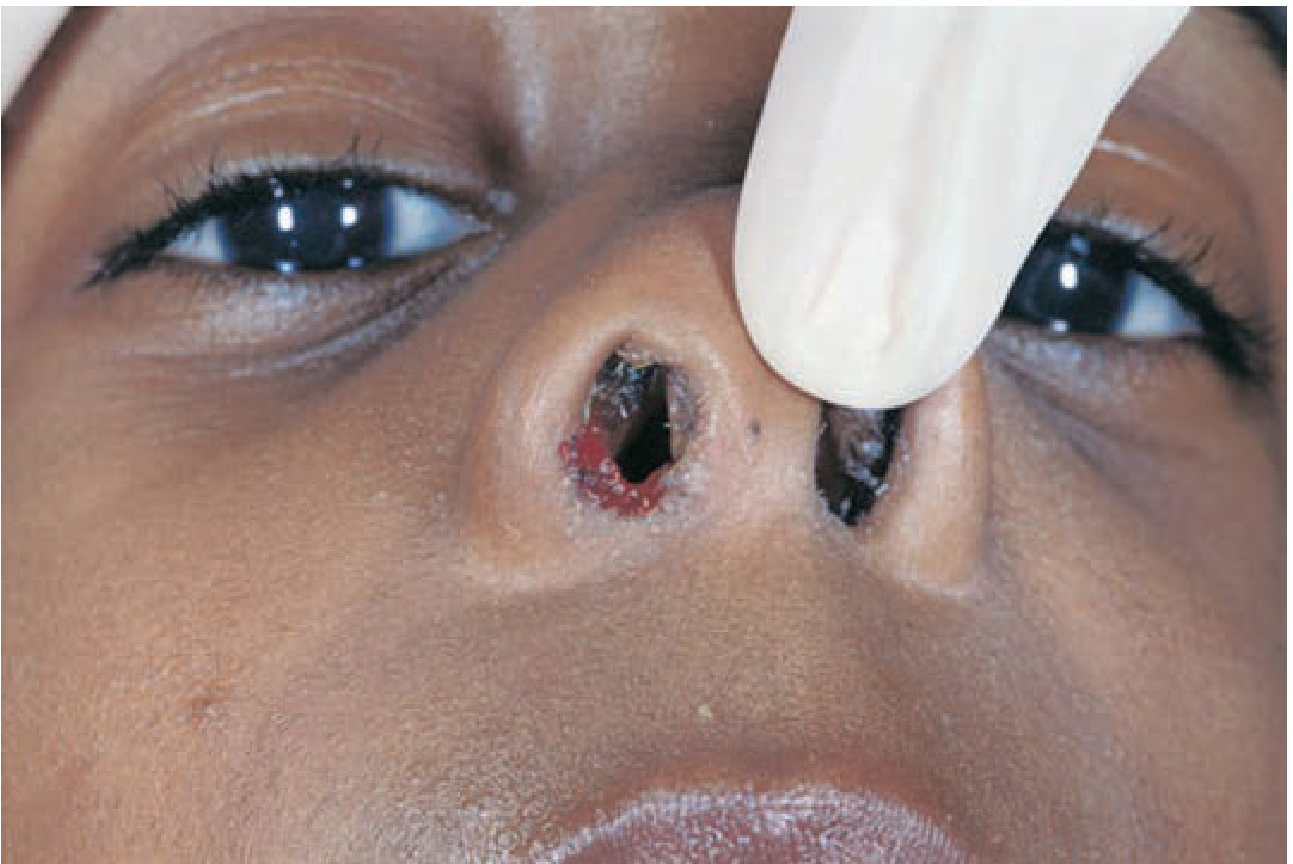
Clinical image showing nasal foreign body:
7. Complications of Untreated Foreign Body
- Infection and sinusitis - secondary bacterial infection of nasal mucosa
- Pressure necrosis of surrounding mucosa
- Septal perforation (especially with button batteries)
- Rhinolith formation (years of retention)
- Aspiration - migration posteriorly into the airway (risk is higher if gag reflex impaired)
- Turbinate hypoplasia - very long-standing cases
- Granuloma formation
- Inferior turbinate hypoplasia
8. Management
General Principles:
- Always attempt less invasive methods first before instrumentation
- The key to safe removal is patient immobilization (especially in children)
- Pretreat nasal mucosa with topical 1% lidocaine + 0.5% phenylephrine (shrinks inflamed mucosa, reduces procedural epistaxis, makes removal easier)
- Approximately 20% of patients require procedural sedation (most commonly ketamine) in the emergency department
- Place child in supine position for instrumentation
Removal Techniques (Step-by-Step):
A. Non-Instrumental (First-Line) Techniques:
These are preferred in cooperative patients as they are least traumatic.
- Nose blowing (older children): Ask the child to blow the nose while occluding the opposite (unaffected) nostril
- "Mother's Kiss" / "Parent Kiss": Parent covers the child's mouth with their own mouth, occludes the unaffected nostril, and blows a gentle puff of air. This may expel the foreign body in approximately 60% of cases. Hollow foreign bodies are more resistant to this technique.
- Bag-valve mask technique: Used in a similar manner to the parent kiss when the parent is unable to perform the technique
B. Instrumental Techniques:
| Technique | Indication | Notes |
|---|---|---|
| Hook / bent Jobson Horne probe | Standard first choice | Pass the hook over and behind the foreign body, then pull forward (never push posteriorly) |
| Alligator/crocodile forceps | Object near anterior nares, easily graspable | Risk of pulling apart friable objects |
| Fogarty balloon catheter (5-6 French Foley) | Non-graspable or round objects | Advance past object, inflate balloon with air, withdraw to bring foreign body forward |
| Suction catheter | Soft or semi-solid objects | Variable success |
| Wax hook | Small inert objects | Used under visualization |
Key principle: Always pass instruments over and behind the foreign body, then pull anteriorly (toward the nostril). Never push the object posteriorly as this risks inhalation.
C. Adjuncts:
- Nebulized adrenaline has been described to aid spontaneous expulsion
- Topical vasoconstrictors (phenylephrine, oxymetazoline) reduce mucosal swelling
D. Surgical / Specialist Referral:
- Very deep foreign bodies - may need ORL removal under general anaesthesia
- Alternative for deep foreign bodies in anaesthetized patients: push into pharynx (posterior displacement into oropharynx under controlled conditions) or break up in situ and remove in pieces
- Approximately 30% of children require general anaesthesia for safe removal
- If initial ED attempts fail, refer to otolaryngologist - studies show otolaryngologists have fewer complications on removal
9. Special Considerations
9a. Button Battery (Emergency!)
- Treat as an ENT emergency
- Remove as quickly as possible - do not wait for normal working hours
- Do NOT instill any nasal drops before removal (electrical charge causes electrolysis with electrolyte-rich fluid → severe alkaline burn)
- May not be directly visible due to extensive mucopurulent discharge and mucosal edema
- Get a plain X-ray to characterize - button battery shows double-ring sign on X-ray
- Septal perforation can occur in as little as 7 hours
9b. Rhinolith
- Calcareous concretion forming around a long-standing nasal foreign body
- Composition: calcium and magnesium phosphate and carbonate salts
- Location: usually anterior nasal cavity
- Radio-opaque on X-ray
- Requires ENT evaluation - often requires surgical removal
- Differential diagnosis includes nasal polyps, mucocele, encephalocele
9c. Live Insect
- Rare; usually related to sleeping on the floor or poor hygiene
- Cockroaches, mosquitoes, beetles reported
- First kill the insect with 2% lidocaine or mineral oil, then attempt removal
9d. Organic Foreign Bodies (Food Material)
- Seeds, peas, sponge, vegetable matter
- Do NOT irrigate - organic matter absorbs water and swells, making removal significantly harder
- Rapid action recommended as swelling worsens with time
9e. Magnets
- If two magnets are present across the septum, they can attract each other and cause septal perforation
- Requires urgent removal
10. Complications of Removal
Complications can occur during attempted removal:
- Failure to remove (incomplete extraction, residual fragments)
- Epistaxis (most common)
- Laceration of nasal mucosa
- Septal perforation (rare but serious)
- Aspiration of foreign body (if it migrates posteriorly)
- Swelling of organic foreign bodies if irrigated
The majority of complications of nasal foreign bodies occur during attempted removal, not from the foreign body itself. This is why technique matters.
11. Prognosis and Disposition
- Most foreign bodies can be safely removed in the ED with good technique
- It is generally safe to defer removal to normal working hours (under anaesthesia if needed) in neurologically normal children - the old teaching of "the sun should never set on a nasal foreign body" is not evidence-based for inert objects
- Exception: Button batteries - these require immediate emergency removal regardless of time of day
- After successful removal: reassess for any retained fragments, check mucosa for injury
- Antibiotics: generally not needed for uncomplicated removal; may be considered if infection/sinusitis present
12. Summary Table
| Feature | Details |
|---|---|
| Peak age | 2-4 years |
| Classic presentation | Unilateral, purulent, foul-smelling nasal discharge |
| Most common objects | Beads, paper, toy parts, peas, corn seeds |
| Minimum time for discharge | 4 days (except button batteries - immediate) |
| First-line technique | Mother's kiss / nose blowing |
| Standard instrument | Bent Jobson Horne probe / hook (pull anteriorly) |
| Success of mother's kiss | ~60% |
| Need for GA | ~30% of children |
| True emergency | Button battery (remove within hours) |
| Do NOT irrigate | Organic material, button batteries |
| Rhinolith | Long-standing FB, radio-opaque, Ca/Mg phosphate/carbonate |
Key Take-Home Points
- Think of nasal foreign body in any child with unilateral nasal discharge - it remains the most important clinical clue
- Always attempt non-instrumental techniques first (mother's kiss, nose blowing) before instrumentation
- Never push posteriorly - always pull the object toward the nostril
- Button battery = ENT emergency - liquefactive necrosis in 7 hours; no nasal drops; X-ray if not visible
- Organic matter + water = swells - never irrigate vegetable/organic material
- Sedate if needed - ketamine is preferred; a struggling child risks complications
- Refer early to otolaryngology for deep, uncooperative, or failed removal cases
Sources: Scott-Brown's Otorhinolaryngology Head & Neck Surgery Vol 2 (Chapter 34); Tintinalli's Emergency Medicine (Chapters 123 & 244); KJ Lee's Essential Otolaryngology; Pfenninger and Fowler's Procedures for Primary Care
This is a shared conversation. Sign in to Orris to start your own chat.