
Most common contraceptive methods world wide
Reading File
Finding Sources
Searching the Web
most common contraceptive methods worldwide prevalence statistics 2024
Searching PubMed
"contraception"[MeSH Terms] AND "prevalence"[MeSH Terms]
Finding Sources
Reading Web Page
https://www.who.int/news-room/fact-sheets/detail/family-plan…
Finding Sources
Searching the Web
UN world contraceptive use 2024 most used methods global statistics female sterilization IUD pill condom
Finding Sources
Reading File
Now I have enough information to compile a comprehensive answer. Let me fetch the contraceptive methods effectiveness image from the textbook.
Loading Image
Here is a comprehensive overview of the most common contraceptive methods worldwide, combining global epidemiology from the UN/WHO with clinical details from the medical literature.
Most Common Contraceptive Methods Worldwide
Global Overview (2021–2022 data, UN)
Of the 1.9 billion women of reproductive age (15–49) worldwide:
- 966 million use some form of contraception
- 874 million use a modern method
- 92 million use traditional methods
- 164 million have an unmet need
Ranking by Global Prevalence (among contraceptive users)
| Rank | Method | Share of Users |
|---|---|---|
| 1 | Female sterilization (tubal ligation) | ~23–25% |
| 2 | Male condom | ~22% |
| 3 | IUD (intrauterine device) | ~17–19% |
| 4 | Oral contraceptive pill | ~16% |
| 5 | Injectables + implants | ~10% |
| 6 | Traditional methods (withdrawal, rhythm) | ~9% |
| 7 | Male sterilization (vasectomy) | ~3–4% |
Female sterilization is the single most used method globally — contrary to the common assumption that it is the pill.
The Main Methods in Detail
1. Female Sterilization (~23–25%)
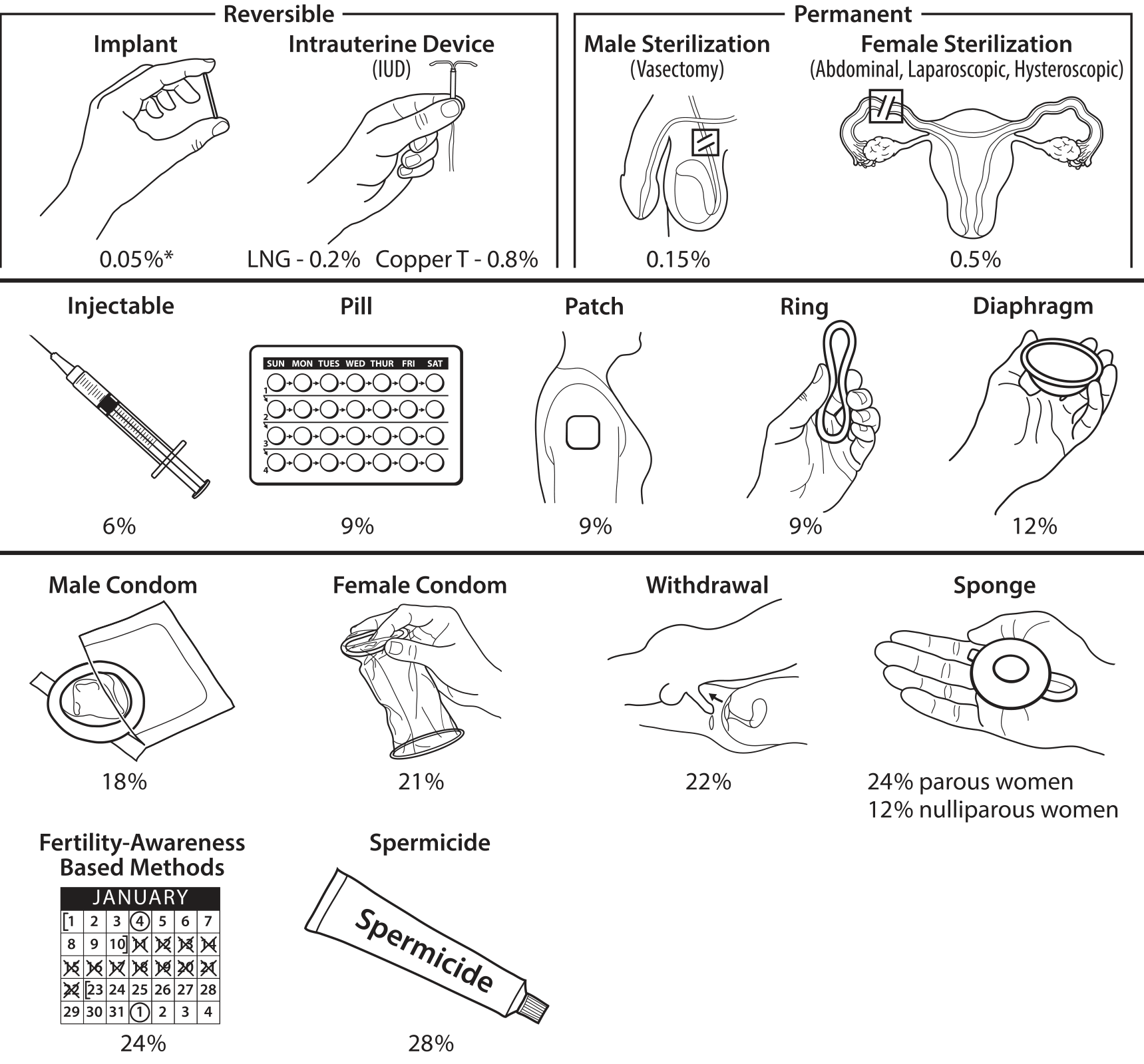
Permanent surgical method (tubal ligation — abdominal, laparoscopic, or hysteroscopic). Typical-use failure rate: 0.5%. Most prevalent in India (29%) and the Dominican Republic (31%), and dominant among married women over 35.
2. Male Condom (~22%)
The only method that protects against both pregnancy and STIs/HIV. Typical-use failure rate: 18% (perfect use: ~2%). Most common among unmarried women (37% of their contraceptive use) and younger populations globally.
3. IUD (~17–19%)
Long-acting reversible contraception (LARC). Two main types:
- Levonorgestrel IUD (LNG-IUD): hormonal, failure rate ~0.2%
- Copper-T IUD: non-hormonal, failure rate ~0.8%; also used as emergency contraception
Highest prevalence in North Korea (47%) and Uzbekistan (37%). Preferred in East Asia and Central Asia.
4. Oral Contraceptive Pill (~16%)
Combination estrogen-progestogen or progestogen-only pills. Typical-use failure rate: 9%. Most common in Western Europe, North America, and Latin America. Most widely used by unmarried women globally (~25% of their use).
5. Injectables (~6–8%)
Most common: depot-medroxyprogesterone acetate (DMPA), given every 3 months. Typical-use failure rate: 6%. Dominant in sub-Saharan Africa (>20% prevalence in Indonesia, Madagascar, Malawi, Namibia, South Africa).
6. Implants (~2–3%)
Sub-dermal progestogen rod (e.g., Nexplanon/Implanon), effective for 3–5 years. Failure rate: 0.05% — most effective reversible method available. Growing use in sub-Saharan Africa (e.g., Kenya 15%).
7. Male Sterilization / Vasectomy (~3%)
Permanent method with failure rate ~0.15%. Lower global prevalence than female sterilization, though more common in high-income countries.
8. Traditional Methods (~9%)
Includes withdrawal (coitus interruptus, typical-use failure 22%), fertility awareness-based methods (calendar/rhythm, symptothermal — 24% typical-use failure), and others. Still widely used globally.
Effectiveness Chart (Typical-Use Failure Rates)
Regional Patterns
| Region | Dominant Methods |
|---|---|
| South Asia (India) | Female sterilization (29% in India) |
| East Asia | IUD (historically dominant in China) |
| Sub-Saharan Africa | Injectables, implants |
| Western Europe / North America | Pill, condom, LARC |
| Latin America | Female sterilization, pill |
| Central Asia | IUD |
Married vs. Unmarried Women
- Married/partnered women (820 million users): primarily use permanent methods (48%) — female sterilization (25%) and IUD (19%)
- Unmarried women (146 million users): primarily use male condoms (37%) and the pill (25%); only 20% use permanent/long-acting methods
Key Takeaways
- Female sterilization leads globally, driven by large populations in India, China, and Latin America.
- The pill, often assumed to be #1, ranks 4th worldwide.
- LARCs (IUD + implants) offer the highest effectiveness among reversible methods.
- 257 million women who wish to avoid pregnancy still lack access to safe, modern contraception — concentrated in sub-Saharan Africa and parts of Asia.
- Only condoms prevent both pregnancy and STI transmission.
Sources: WHO Fact Sheet on Family Planning (2021–2022 data); UN World Contraceptive Use 2024; INED Contraception Across the World 2022; Textbook of Family Medicine, 9e (Rakel)
This is a shared conversation. Sign in to Orris to start your own chat.