
Clostridium tetani causes etiology pathology and signs and symptoms in orthopaedic infection investigation and treatment
Reading File
Now let me search the medical library for tetanus in orthopaedic context, running parallel searches:
Finding Sources
Finding Sources
Excellent. I have key sources. Let me now read the most relevant ones in parallel - Campbell's Orthopaedics, Bailey & Love's Surgery, and Tintinalli's Emergency Medicine:
Reading File
Reading File
Reading File
Excellent content retrieved. Let me read more from Tintinalli and Bailey & Love for investigation/treatment details, and fetch the risus sardonicus image:
Reading File
Reading File
Loading Image
I now have comprehensive data from Campbell's Operative Orthopaedics, Bailey & Love's Surgery, and Tintinalli's Emergency Medicine. Let me compile the full answer.
Clostridium tetani - Tetanus in Orthopaedic Infection
Etiology
Clostridium tetani is a motile, non-encapsulated, anaerobic gram-positive spore-forming bacillus. It occurs naturally in the intestines of humans and animals and in soil. Key etiological points:
- Spores are ubiquitous in soil, animal feces, and environmental surfaces - they can survive for years
- Enters the body through wounds (puncture wounds, open fractures, lacerations, abrasions, burns, frostbite, bite injuries)
- In agricultural areas, spores can be found on skin or in contaminated heroin
- No wound is identified in up to 10% of tetanus cases - it can also occur after surgical procedures, otitis media, or abortion
- Once inside the body, spores germinate into the toxin-producing vegetative form when tissue oxygen tension is reduced (anaerobic conditions)
Tetanus-prone wounds (as defined by the American College of Surgeons) include:
- Wound >6 hours old
- Stellate, avulsion, or crush injury
- Abrasion, bite, or needle wound
- Depth >1 cm
- Missile injury
- Burn or frostbite
- Foreign body under the skin
- Infected, devitalized, denervated, or ischemic tissue
- Contaminants (dirt, feces, soil, saliva) present in the wound
(Campbell's Operative Orthopaedics 15th Ed, eBOX 58.1)
Pathology / Pathophysiology
C. tetani produces two exotoxins:
- Tetanolysin - facilitates growth of the bacterial population by lysing red blood cells and disrupting surrounding tissue
- Tetanospasmin - a powerful neurotoxin responsible for ALL clinical manifestations of tetanus
Mechanism of tetanospasmin:
- Reaches the nervous system via hematogenous spread to peripheral nerves, then retrograde intraneuronal transport to the CNS
- Does NOT cross the blood-brain barrier directly - retrograde intraneuronal transport gives it CNS access
- Binds to neuromuscular junctions of CNS neurons, rendering them incapable of neurotransmitter release
- Prevents release of inhibitory neurotransmitters glycine and GABA from presynaptic nerve terminals
- This releases the nervous system from its normal inhibitory control, leading to failure of inhibition of motor reflex responses to sensory stimulation
- Agonist and antagonist muscles contract simultaneously, producing tetanic spasms
- Loss of inhibition also affects preganglionic sympathetic neurons, producing sympathetic overactivity and high circulating catecholamines
(Tintinalli's Emergency Medicine; Bailey & Love's 28th Ed)
Signs and Symptoms
Incubation period: Median 7 days (range: <24 hours to >1 month). Shorter incubation = more severe disease and worse prognosis.
Three Clinical Forms
1. Generalized Tetanus (~80% of cases)
- Most common presenting complaints: pain and stiffness in the masseter muscles ("lockjaw"/trismus)
- Progression is descending: facial muscles first (short axons), then neck, trunk, and extremities
- Risus sardonicus (sardonic smile) - the classic fixed grimace from facial muscle spasm:
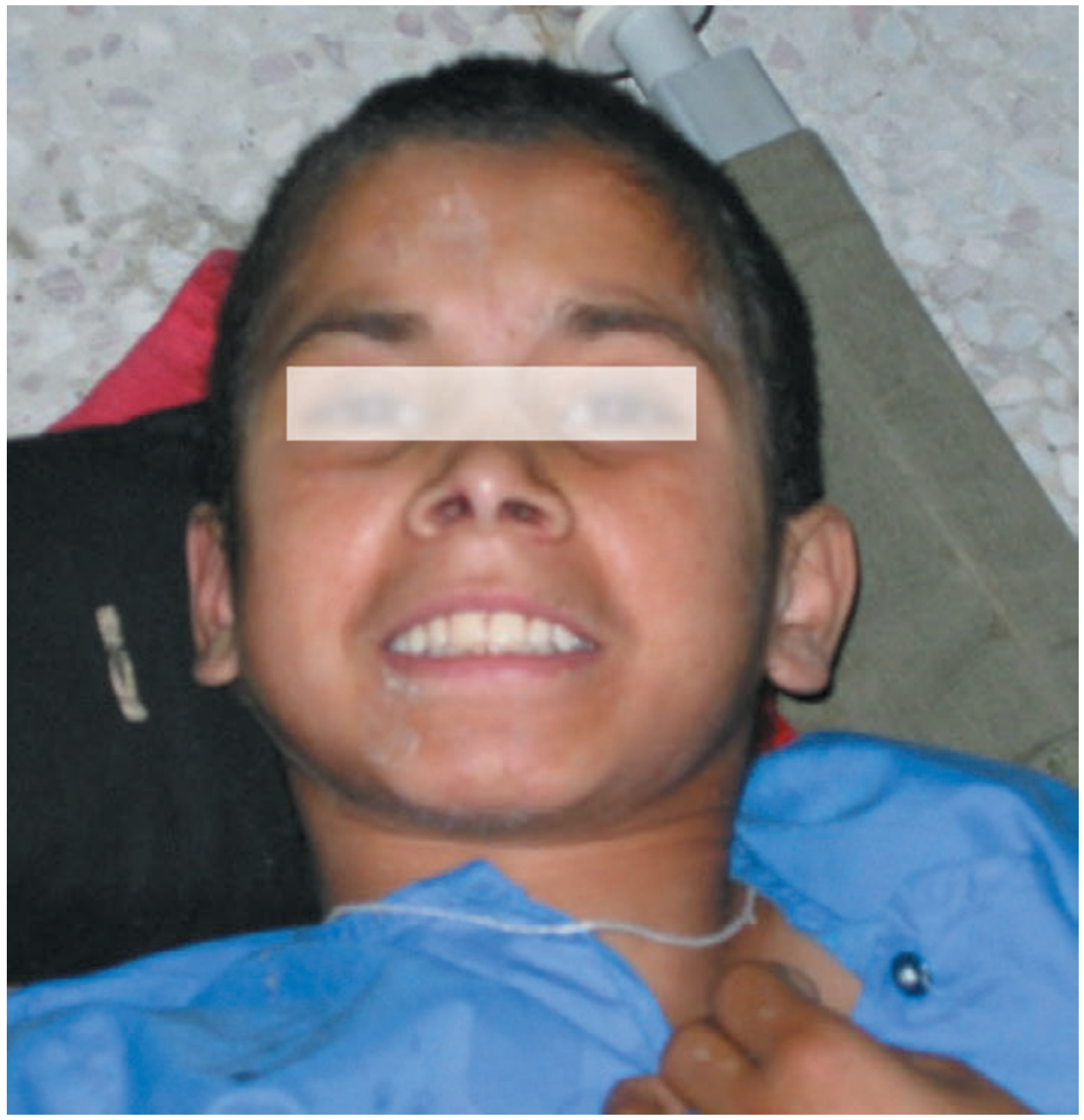
Figure: Risus sardonicus of 'lockjaw' (Bailey & Love's 28th Ed, Fig. 33.15)
- Opisthotonus - arching of the whole body from spasm of paravertebral and extensor limb muscles
- Reflex convulsive spasms and tonic contractions cause dysphagia, arm flexion, fist clenching, lower limb extension
- Laryngeal spasm leads to apnoea, asphyxia, and respiratory arrest
- Spasms triggered by the slightest sensory stimulus
- Spasms last 3-4 weeks; recovery may take months
- Mental status remains NORMAL (important differentiating feature) unless respiratory compromise occurs
- Autonomic dysfunction: tachycardia, labile hypertension, diaphoresis, arrhythmias
- Complications: rhabdomyolysis, long bone fractures from violent muscle contractions, aspiration pneumonia (present in 50-70% of autopsied cases)
2. Cephalic Tetanus
- Follows head injuries or otitis media
- Cranial nerve dysfunction, most commonly CN VII (facial nerve)
- Poor prognosis
3. Local Tetanus
- Muscle rigidity confined to the site of injury
- Usually resolves after weeks to months
- May progress to generalized form
- ~1% fatality rate
Investigation
Tetanus is a clinical diagnosis - no laboratory test confirms it.
Key investigative points:
- Serum antitoxin titers >0.01 IU/mL are usually protective, but tetanus can still occur even with protective levels
- An immunochromatographic dipstick test allows rapid assessment of immunity (88% sensitivity, 98% specificity) - useful in high-incidence regions
- Wound culture has limited value: C. tetani may be cultured from wounds without clinical disease, and may NOT be recovered in confirmed tetanus cases
- In the USA, 96% of cases occur in patients with unknown or inadequate immunization history
- The elderly, those on hemodialysis, and immunocompromised patients often have inadequate immunity
Differential Diagnosis:
| Condition | Distinguishing Feature |
|---|---|
| Strychnine poisoning | Most closely mimics generalized tetanus |
| Dystonic reaction (phenothiazines, metoclopramide) | Drug history |
| Hypocalcaemic tetany | Low calcium; no trismus |
| Malignant neuroleptic syndrome | Antipsychotic use, altered consciousness |
| Serotonin syndrome | Serotonergic drug use |
| Stiff person syndrome | Chronic, centrally mediated; proximal lower limbs |
| Rabies | Altered consciousness, hydrophobia |
| Meningitis / SAH | Neck stiffness, altered consciousness |
(Tintinalli's Emergency Medicine, Table 157-1)
Treatment
1. Prevention (most important)
Active immunization:
- 0.5 mL tetanus toxoid IM for wounds contaminated with soil or at risk
- Booster dose for patients previously immunized
- A full active immunization series must be started in unimmunized patients
Passive immunization:
- Human anti-tetanus globulin (ATG) / Human Tetanus Immunoglobulin (HTIG): 250-500 U IM for patients with tetanus-prone wounds or those not previously immunized
- Can be given simultaneously with toxoid - separate syringes and separate injection sites must be used
- ATG provides longer-lasting protection than equine antitoxin
- Wound debridement should be performed a few hours after ATG to minimize tetanospasmin release
Tetanus Prophylaxis Guide (Campbell's Operative Orthopaedics 15th Ed):
| Immunization History | Clean Minor Wound | All Other Wounds |
|---|---|---|
| Unknown or <3 doses | Toxoid + HTIG | Toxoid + HTIG |
| ≥3 doses, last booster <5 yrs | Toxoid only (if needed) | Nothing required |
| ≥3 doses, last booster 5-10 yrs | Nothing required | Toxoid only |
| ≥3 doses, last booster >10 yrs | Toxoid only | Toxoid only |
2. Local Wound Care
- Thorough wound debridement to eliminate the anaerobic environment, remove spores, and prevent further toxin production
- Remove all devitalized and ischemic tissue
- Wound closed using delayed primary or secondary closure techniques
- IV Penicillin G 10-24 million units/day for 10-14 days (metronidazole is an effective alternative)
3. Supportive Care for Established Disease
- ICU admission mandatory - free from strong sensory stimuli (minimize light, noise, touch)
- Immediate neuromuscular blockade and intubation for respiratory compromise
- Diazepam to prevent onset of spasms; if spasms become sustained, the patient is paralysed, intubated, and placed on a ventilator
- Gradual ventilator weaning under anticonvulsant cover
- Intrathecal antitoxin has been used for spasm control to avoid ventilatory support
- Provide tetanus immunization: the disease does NOT confer immunity
Human Tetanus Immunoglobulin (HTIG) in established disease:
- Neutralizes circulating toxin (cannot reverse toxin already bound to nerve terminals)
- 500 U IM is the recommended dose for active tetanus
Prognosis:
- Overall mortality ~45% in full-blown disease (Bailey & Love); 7% in developed countries with modern ICU care (CDC 2009-2017 data)
- Prognosis determined by incubation period and the interval from first symptom to first tetanic spasm - shorter intervals = worse prognosis
- Survivors may require several weeks of hospitalization
- Without access to mechanical ventilation, mortality remains very high
Sources:
- Campbell's Operative Orthopaedics 15th Ed 2026, eBOX 58.1 / eTable 58.1
- Bailey and Love's Short Practice of Surgery 28th Ed, Ch. 33
- Tintinalli's Emergency Medicine: A Comprehensive Study Guide, Ch. 157
This is a shared conversation. Sign in to Orris to start your own chat.