
Malaria
Reading File
The query "Malaria" is broad. Let me clarify what aspect you need before diving in.
Asking for Preferences
What aspect of malaria would you like to cover?
Every thing
Searching sources...
Reading File
Now let me run parallel searches across all major aspects of malaria simultaneously.
Finding Sources
Searching PubMed
"malaria"[MeSH Terms] AND "treatment"[MeSH Terms]
Searching the Web
malaria overview pathophysiology treatment WHO guidelines 2024 2025
Good. I found the key textbook sources. Let me now read the most comprehensive malaria sections in parallel - Robbins Pathology (pathophysiology), Rosen's Emergency Medicine (clinical/treatment), and Creasy & Resnik's (special populations/pregnancy).
Reading File
Reading File
Reading File
Finding Sources
Excellent material gathered. Now let me read the remaining critical sections - Goldman-Cecil on treatment, Katzung pharmacology, and Park's preventive medicine on diagnosis/treatment.
Reading File
Reading File
Reading File
Excellent - I now have very rich content from multiple textbooks. Let me fetch two key images and read the Goldman-Cecil diagnosis/treatment section more completely.
Loading Image
Reading File
Reading File
I now have comprehensive, authoritative content from multiple textbooks. Let me compose the full, detailed answer.
Malaria - Complete Overview
1. Epidemiology
Globally in 2024, there were an estimated 282 million malaria cases and 610,000 deaths across 80 countries, according to the WHO malaria fact sheet. The WHO African Region bears 95% of all cases and deaths; children under 5 account for ~75% of all malaria deaths. More than 41% of the world's population lives in malarial areas, including parts of Africa, Asia, Oceania, Central America, and South America.
2. Causative Agents - The Plasmodium Species
Malaria is caused by five species of protozoa of the genus Plasmodium, all transmitted by the bite of female Anopheles mosquitoes. Humans are the only natural reservoir.
| Species | Disease | Cycle | Notes |
|---|---|---|---|
| P. falciparum | Tertian (falciparum) malaria | 48 hrs | Most severe; highest fatality; predominant in Africa |
| P. vivax | Benign tertian malaria | 48 hrs | Hypnozoites cause relapses; common in Asia/Americas |
| P. ovale | Ovale malaria | 48 hrs | Enlarged erythrocytes with Schüffner dots |
| P. malariae | Quartan malaria | 72 hrs | Associated with nephrotic syndrome |
| P. knowlesi | Knowlesi malaria | 24 hrs | Zoonosis from macaque monkeys; Southeast Asia |
- Robbins & Kumar Basic Pathology, p. 392
3. Life Cycle & Pathogenesis
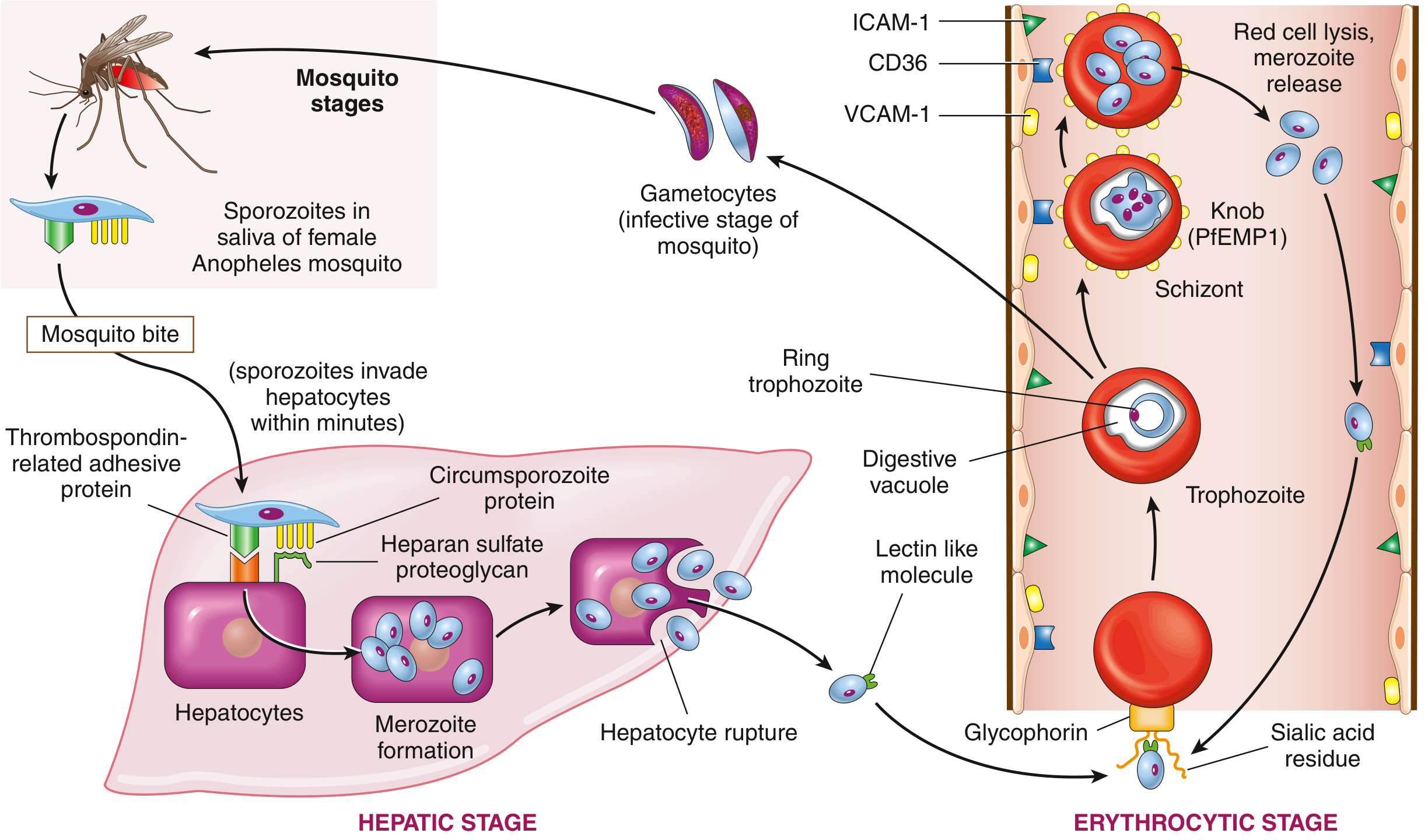
FIG. Life cycle of P. falciparum. ICAM-1 = intercellular adhesion molecule-1; PfEMP1 = P. falciparum erythrocyte membrane protein 1; VCAM-1 = vascular cell adhesion molecule-1. (Robbins & Kumar Basic Pathology)
Step-by-step life cycle:
1. Mosquito bite → Sporozoite injection
- Female Anopheles injects sporozoites into bloodstream while feeding
- Two sporozoite surface proteins - thrombospondin-related adhesive protein and circumsporozoite protein - bind to proteoglycans on hepatocytes
2. Hepatic (Pre-erythrocytic) Stage
- Sporozoites enter hepatocytes and differentiate into merozoites (hepatic schizonts)
- Incubation period: 1-4 weeks
- Infected hepatocytes rupture, releasing merozoites into the bloodstream
- P. vivax and P. ovale can form dormant hypnozoites in the liver, which cause relapses months to years later
3. Erythrocytic Stage
- A lectin-like molecule on the merozoite surface binds to sialylated glycophorin (a red cell transmembrane protein), allowing merozoite invasion into RBCs within a "digestive vacuole"
- Merozoites → ring trophozoites → trophozoites → two fates:
- Some become gametocytes (sexual stage; infective to mosquitoes)
- Most become schizonts, which express PfEMP1 in knob-like extensions on the RBC surface
- PfEMP1 binds to endothelial adhesion molecules: ICAM-1, VCAM-1, CD36 → parasitized RBCs are sequestered in capillary beds
- Schizonts rupture → new merozoites released → cycle repeats
4. Mosquito Stage (Sporogony)
-
Gametocytes are ingested when a mosquito bites; fertilization and sporogony occur in the mosquito gut, producing sporozoites that migrate to the salivary glands
-
Robbins & Kumar Basic Pathology, p. 392-393; Goldman-Cecil Medicine
4. Pathophysiology of Disease
Fever Pattern
- Episodic shaking chills and fever coincide with mass release of merozoites from lysed RBCs
- Every 24 hours: P. knowlesi
- Every 48 hours: P. vivax, P. ovale, P. falciparum
- Every 72 hours: P. malariae
Anemia
- Repeated cycles of RBC infection and destruction → hemolytic anemia
- A characteristic brown malarial pigment (hematin) derived from hemoglobin is released from ruptured RBCs and deposits in the spleen, liver, lymph nodes, and bone marrow
Splenomegaly & Hepatomegaly
- Activation of mononuclear phagocytes → marked hyperplasia → massive splenomegaly, occasional hepatomegaly
- Chronic malaria: hyperreactive malarial splenomegaly with hypersplenism
Cerebral Malaria (P. falciparum)
- PfEMP1-mediated sequestration of parasitized RBCs in cerebral capillaries → vascular engorgement and occlusion → altered consciousness, seizures, coma, death
- Most common severe complication in children
Cytoadherence in Pregnancy
-
The placenta uniquely expresses chondroitin sulfate A in the intervillous space, which is targeted by surface proteins of infected erythrocytes → placental sequestration
-
Results in inflammatory infiltrate, cytokine release, disordered angiogenesis → placental dysfunction → IUGR, preterm labour, stillbirth, low birth weight
-
Robbins & Kumar Basic Pathology; Goldman-Cecil Medicine; Creasy & Resnik's Maternal-Fetal Medicine
5. Clinical Features
Uncomplicated Malaria
- Fever (may be continuous early, then becomes paroxysmal and cyclical)
- Headache
- Chills and rigors
- Myalgia/arthralgia
- Nausea, vomiting, diarrhea
- Fatigue and malaise
Fever Stages (Classic Malaria Paroxysm)
- Cold stage - intense chills, rigor (15-60 min)
- Hot stage - high fever 39-41°C (2-6 hours)
- Sweating stage - profuse sweating, temperature falls, exhaustion (2-4 hours)
Severe/Complicated Malaria (predominantly P. falciparum)
| Feature | Notes |
|---|---|
| Cerebral malaria | Altered consciousness, seizures, coma, abnormal posturing; most common in children |
| Severe anemia | Especially in young children; from hemolysis + impaired erythropoiesis |
| Acute renal failure | More common in adults; hypoperfusion → acute tubular necrosis |
| Respiratory failure | Non-cardiogenic pulmonary edema; more common in adults |
| Hypoglycemia | Glucose consumption by parasites + impaired gluconeogenesis + quinine-induced insulin secretion |
| Metabolic/lactic acidosis | Common |
| Blackwater fever | Massive intravascular hemolysis, hemoglobinemia, hemoglobinuria, jaundice, renal failure |
| Coagulopathy | Consumption of clotting factors; marked thrombocytopenia |
| Splenic rupture | Can occur especially with P. vivax |
| Jaundice | From hemolysis or hepatic dysfunction |
| Bacterial sepsis | Can coexist with malaria |
- Goldman-Cecil Medicine; Rosen's Emergency Medicine
6. Diagnosis
Clinical
- High index of suspicion in anyone with fever + travel to/residence in endemic area
- Malaria fever pattern may be absent early; initial fever often continuous
- Travel history is essential (see Box 122.2 - Rosen's EM)
1. Thick Blood Smear (Gold Standard in endemic areas)
- Blood dried on slide, stained with Giemsa
- Identifies parasites; allows quantification (parasite density vs. leukocytes)
- Limitation: doesn't allow morphological characterisation of RBCs
- Needs trained microscopist
2. Thin Blood Smear (Preferred in non-endemic settings)
- Giemsa-stained; better morphological detail for species identification
- P. falciparum: ring-form trophozoites only (mature forms sequester in deep capillaries)
- P. vivax / P. ovale: enlarged RBCs with Schüffner dots
- P. malariae / P. knowlesi: elongate intraerythrocytic trophozoites
- P. falciparum gametocytes: characteristic crescent/banana shape
3. Rapid Diagnostic Tests (RDTs)
- Colorimetric antigen detection; minimal training required; results in minutes
- HRP2 (histidine-rich protein-2): P. falciparum only; long-lived antigen
- Risk: P. falciparum lacking HRP2 gene increasingly reported (South America, Horn of Africa)
- Lactate dehydrogenase / Aldolase: all Plasmodium species
- Some combo tests identify both P. falciparum and other species simultaneously
- One test approved in the USA
4. Molecular Assays (PCR)
- Highly sensitive; genus- and species-specific primers
- Loop-mediated isothermal amplification (LAMP): practical in field settings
- Limitations: time, cost, uncertain significance of low-level parasitemia in endemic areas
5. Serology
-
Identifies past infection only; not useful for acute diagnosis
-
Goldman-Cecil Medicine
7. Treatment
Uncomplicated Malaria
P. falciparum (and mixed infections)
Artemisinin-Based Combination Therapies (ACTs) are the WHO-recommended standard of care. Monotherapy is strongly discouraged to prevent resistance.
| ACT Regimen | Notes |
|---|---|
| Artemether-lumefantrine (Coartem) | First-line in most of Africa; FDA-approved in USA (2009) |
| Artesunate-amodiaquine | First-line in many African countries |
| Artesunate-mefloquine | Highly effective in Southeast Asia (high resistance area) |
| Dihydroartemisinin-piperaquine | First-line in some countries; increasing resistance in SE Asia |
| Artesunate + SP (sulphadoxine-pyrimethamine) | Used in India; SP resistance in NE India → use artemether-lumefantrine instead |
All ACTs are given for 3 days; the artemisinin component provides rapid action, the partner drug provides longer-lasting effect and protects against resistance.
Single dose primaquine (0.75 mg/kg on Day 2) is added for P. falciparum to reduce gametocyte carriage and transmission.
P. vivax
- Chloroquine 25 mg/kg divided over 3 days (in chloroquine-sensitive areas)
- Primaquine 0.25 mg/kg/day × 14 days to eliminate hypnozoites and prevent relapse
- Contraindicated in: G6PD deficiency (causes haemolysis), infants, pregnant women
- Test for G6PD deficiency before prescribing
Mixed Infections
- Treat as per P. falciparum protocol
Severe/Complicated Malaria
- IV artesunate - standard of care; superior to quinine (confirmed in clinical trials); FDA-approved for severe malaria
- For settings where IV artesunate unavailable: IV quinine or IV quinidine
- Supportive care: airway management, seizure control, blood transfusion for severe anaemia, dialysis for renal failure, glucose for hypoglycaemia
Special Situations
Pregnancy
| Trimester | P. falciparum | P. vivax |
|---|---|---|
| 1st trimester | Quinine (ACT not recommended) | Chloroquine |
| 2nd & 3rd trimester | ACT (artemether-lumefantrine or similar) | Chloroquine |
- Primaquine contraindicated throughout pregnancy
- ACT not recommended for infants <5 kg
Drug Resistance
-
Artemisinin resistance: delayed parasite clearance, initially in SE Asia (Cambodia, Vietnam), now emerging in East Africa - major concern
-
Resistance suspected if no clinical + parasitological response within 72 hours despite full treatment without vomiting → treat with quinine + tetracycline/doxycycline
-
Katzung Basic & Clinical Pharmacology, 16th Ed; Goldman-Cecil Medicine; Park's Textbook of Preventive & Social Medicine
8. Antimalarial Drug Pharmacology
Artemisinins (Artesunate, Artemether, Dihydroartemisinin)
- Mechanism: Iron-catalysed cleavage of endoperoxide bridge → free radical generation → kill parasites
- Action: Very rapidly acting blood schizonticides against all Plasmodium species; active against young (not mature) gametocytes; no effect on hepatic stages
- Half-life: 30-60 min (artesunate, DHA); 2-3 hr (artemether)
- All are rapidly metabolised to the active metabolite dihydroartemisinin
- Resistance: Kelch-13 mutations mediate delayed clearance
Chloroquine
- 4-aminoquinoline; concentrates in the parasite's food vacuole; inhibits haem polymerisation → toxic haem accumulation
- Widely resistant P. falciparum; still effective for P. vivax in most areas
Primaquine
- 8-aminoquinoline; active against hepatic hypnozoites (radical cure of vivax/ovale) and gametocytes
- Causes haemolytic anaemia in G6PD deficiency
- Contraindicated in pregnancy and infants
Mefloquine
- Blood schizonticide; neuropsychiatric adverse effects (vivid dreams, anxiety, psychosis)
Quinine/Quinidine
- Rapid-acting; used for severe malaria or resistance settings; causes hypoglycaemia (stimulates insulin secretion), cinchonism (tinnitus, vertigo, deafness)
Sulfadoxine-Pyrimethamine (SP)
-
Antifolate combination; used in intermittent preventive therapy in pregnancy (IPTp); widespread resistance in P. falciparum
-
Katzung Basic & Clinical Pharmacology, 16th Ed; Goodman & Gilman's Pharmacological Basis of Therapeutics
9. Complications Summary
| Complication | Mechanism | More common in |
|---|---|---|
| Cerebral malaria | Sequestration, vascular occlusion | Children |
| Severe anaemia | Haemolysis + bone marrow suppression | Children |
| Pulmonary oedema (ARDS) | Cytokine-mediated | Adults |
| Acute renal failure | Hypoperfusion, ATN | Adults |
| Hypoglycaemia | Parasite consumption, quinine effect | All |
| Blackwater fever | Massive intravascular haemolysis | Quinine-treated |
| Splenic rupture | Splenomegaly | P. vivax |
| Nephrotic syndrome | Immune complex deposition | P. malariae (chronic) |
| Placental malaria | CSA-mediated sequestration | Primigravidae |
10. Prevention
Personal Protection
- Insecticide-treated bed nets (ITNs) - most effective; Anopheles mosquitoes bite at dusk and overnight
- Indoor residual spraying (IRS) - insecticides on walls/ceilings
- Insect repellents (DEET-containing)
- Protective clothing (long sleeves, trousers at dusk/night)
Chemoprophylaxis (for travelers)
| Drug | Regimen | Notes |
|---|---|---|
| Atovaquone-proguanil (Malarone) | Daily; start 1-2 days before, continue 7 days after | Well tolerated; good for short trips |
| Mefloquine | Weekly; start 2 weeks before, continue 4 weeks after | Neuropsychiatric side effects |
| Doxycycline | Daily; start 2 days before, continue 4 weeks after | Photosensitivity; avoid in pregnancy |
| Chloroquine | Weekly (only for chloroquine-sensitive areas) | Few areas still sensitive |
Intermittent Preventive Treatment (IPT)
- IPTp (in pregnancy): SP given at each antenatal visit from 2nd trimester; reduces maternal anaemia and LBW
- IPTi (in infants): SP given at routine immunisation contacts
- SMC (seasonal malaria chemoprevention in children): SP + amodiaquine monthly during high-transmission season
- Mass Drug Administration (MDA): for population-level burden reduction in high-transmission settings
Vaccines
-
RTS,S/AS01 (Mosquirix): first approved malaria vaccine; targets P. falciparum circumsporozoite protein; provides partial protection (~30-40% efficacy); recommended by WHO for children in sub-Saharan Africa
-
R21/Matrix-M: newer vaccine showing higher efficacy (~75-77%) in trials; WHO-approved 2023; being rolled out
-
An encouraging development for reducing fatal cerebral malaria in children
-
Robbins & Kumar Basic Pathology; Goldman-Cecil Medicine; WHO Malaria Guidelines August 2025
11. Malaria in Special Populations
Pregnancy
- Increased risk of severe disease, especially in primigravidae in endemic areas
- Complications: severe anaemia, pulmonary oedema, seizures, coma, death
- Fetal complications: IUGR, LBW, preterm birth, miscarriage, stillbirth
- Mechanism: placental sequestration via CSA binding (unique to placenta)
- Prevention: IPTp (SP at each ANC visit from 16 weeks), ITNs
- Travel to malarious regions should be avoided if at all possible
Children
- Most vulnerable group; account for 75% of malaria deaths in Africa
- Cerebral malaria and severe anaemia are the leading killers
- ACTs are safe and effective; dose by weight
HIV Coinfection
- HIV disrupts acquired immunity to malaria → increased incidence and severity
- Acute malaria elevates HIV viral load
- Drug interactions between antiretrovirals and antimalarials
Travellers
-
Non-immune; at high risk of severe disease
-
Most falciparum malaria presents within 1-2 months of return from endemic areas
-
Longer-stay travellers without prophylaxis at highest risk
-
Goldman-Cecil Medicine; Creasy & Resnik's Maternal-Fetal Medicine; Rosen's Emergency Medicine
Quick Reference: Key Facts
- Vector: Female Anopheles mosquito
- Worst species: P. falciparum (causes cerebral malaria, blackwater fever, highest mortality)
- Relapsing species: P. vivax, P. ovale (hypnozoites in liver)
- Gold standard diagnosis: Giemsa-stained thick blood smear
- First-line treatment: ACT (artemisinin-based combination therapy)
- Severe malaria treatment: IV artesunate
- Contraindicated in G6PD deficiency: Primaquine (and dapsone)
- Fever periodicity: 48 hrs (vivax/falciparum/ovale), 72 hrs (malariae), 24 hrs (knowlesi)
- Vaccine: RTS,S (Mosquirix) and R21/Matrix-M approved for children in Africa
This is a shared conversation. Sign in to Orris to start your own chat.