
TB regimen in india and who
- Intensive phase (2 months): HRZE - Isoniazid (H) + Rifampicin (R) + Pyrazinamide (Z) + Ethambutol (E)
- Continuation phase (4 months): HR - Isoniazid + Rifampicin
- Total duration: 6 months for most cases
India NTEP TB treatment regimen 2024 2025 guidelines
https://tbcindia.mohfw.gov.in/wp-content/uploads/2025/01/Nat…
tuberculosis treatment regimen India guidelines
WHO tuberculosis treatment guidelines 2022 2023 drug sensitive MDR-TB regimen
TB Treatment Regimens - India (NTEP) and WHO
Drug Notation
| Letter | Drug |
|---|---|
| H | Isoniazid |
| R | Rifampicin |
| Z | Pyrazinamide |
| E | Ethambutol |
| S | Streptomycin |
| Bdq | Bedaquiline |
| Pa | Pretomanid |
| Lzd | Linezolid |
| Mfx | Moxifloxacin |
| Dlm | Delamanid |
| Eto | Ethionamide |
1. Drug-Susceptible TB (DS-TB)
Standard 6-month Regimen (NTEP / WHO standard)
| Phase | Drugs | Duration |
|---|---|---|
| Intensive | HRZE (daily FDC) | 2 months |
| Continuation | HR (or HRE per NTEP) | 4 months |
| Total | 6 months |
- India uses daily fixed-dose combinations (FDCs) under DOTS (Directly Observed Treatment, Short-course)
- The current NTEP continuation phase uses HRE (with ethambutol added) as per the Nov 2024 DR-TB guidelines document, noting treatment success rates of 85-87%
- Extension to 9 months is recommended for cavitary disease, delayed sputum conversion beyond 2 months, or if pyrazinamide was not completed
4-month Regimen (WHO conditional recommendation, 2022)
- 2HPZM → 2HPM (rifaPentine replaces rifampicin; Moxifloxacin added; no Ethambutol)
- The STREAM trial showed non-inferiority to 6-month HRZE
- Conditionally recommended by WHO; not yet adopted as national standard in India
2. Isoniazid-Resistant TB (Hr-TB)
| Phase | Drugs | Duration |
|---|---|---|
| Intensive + continuation | RZE + levofloxacin | 6 months |
3. MDR-TB / RR-TB (Multidrug-Resistant / Rifampicin-Resistant)
BPaLM Regimen - FIRST PREFERENCE (India NTEP Nov 2024 + WHO 2022)
| Drug | Dose | Duration |
|---|---|---|
| Bedaquiline (Bdq) | 400 mg daily x 2 wks, then 200 mg 3x/week | 26 weeks |
| Pretomanid (Pa) | 200 mg daily | 26 weeks |
| Linezolid (Lzd) | 600 mg daily | 26 weeks |
| Moxifloxacin (Mfx) | Standard dose | 26 weeks |
- Fully oral, 6-month (26-week) regimen
- India has adopted this for all eligible MDR/RR-TB patients including pre-XDR-TB
- Moxifloxacin is retained irrespective of fluoroquinolone resistance (supported by TB-PRACTECAL trial data)
- DST for Bdq/Pa/Lzd is done at baseline but BPaLM can be started while awaiting results
9-11 Month Shorter Oral Regimen (BPaL-based)
- Bedaquiline + linezolid-containing regimen (delamanid replaces pretomanid in pediatric cases)
- Replacement of ethionamide (Eto) with linezolid (Lzd) is a key 2022/2024 NTEP update
Longer Oral Regimen (18-20 months)
- For M/XDR-TB patients ineligible for BPaLM and 9-11 month regimen (resistance to Bdq/Pa/Lzd detected)
- Assessed at National/Designated DR-TB Treatment Centres (N/DDRTBC)
4. Pre-XDR and XDR-TB
BPaLM also covers pre-XDR-TB (additional FQ resistance)
- BDLLfxC regimen - a brand new WHO April 2025 recommendation for MDR/RR-TB with or without fluoroquinolone resistance (all-oral, 6 months; details pending NTEP adoption)
5. Latent TB Infection (LTBI) - Preventive Therapy
| Regimen | Duration | Notes |
|---|---|---|
| 3HP | Isoniazid + Rifapentine weekly | 3 months |
| 6H | Isoniazid daily | 6 months |
| 4R | Rifampicin daily | 4 months |
| 3HR | Isoniazid + Rifampicin daily | 3 months |
6. Special Situations
| Situation | Modification |
|---|---|
| TB + HIV | ART initiated within 2-8 weeks of starting TB treatment (2 weeks if CD4 <50); rifampicin interactions require dose adjustment of certain ARVs |
| Pregnancy | Avoid streptomycin, pyrazinamide use is debated; standard HRZE generally used |
| CNS/bone TB | Continuation phase extended (9-12 months total) |
| TB in renal failure | Avoid ethambutol or reduce dose with monitoring; pyrazinamide use with caution |
| Pericardial/meningeal TB | Add corticosteroids (dexamethasone or prednisolone) |
Key NTEP vs WHO Comparison
| Parameter | India NTEP (2024) | WHO (2022/2025) |
|---|---|---|
| DS-TB standard | 2HRZE + 4HRE (6 months, daily FDC) | 2HRZE + 4HR (6 months); 4-month regimen (2HPZM+2HPM) conditionally recommended |
| MDR/RR-TB 1st line | BPaLM 26 weeks | BPaLM 6 months (2022); new BDLLfxC 6 months (April 2025) |
| Pediatric MDR-TB | 9-11 month shorter oral regimen | 9-month all-oral regimen |
| Injection use | Eliminated (fully oral) | Eliminated (fully oral) |
| LTBI | 3HP and 6H | 3HP preferred; multiple options |
Summary of Key Recent Updates (2022-2025)
- Injection-free, fully oral DR-TB treatment is now standard in India
- BPaLM is now first preference for MDR/RR-TB (replaces older injectable-containing regimens)
- Ethionamide replaced by linezolid in shorter oral regimens
- Bedaquiline and delamanid extended to all age groups (including pediatric)
- WHO April 2025: New BDLLfxC regimen introduced as another 6-month oral option for MDR/RR-TB
- India's 100-day TB campaign (Dec 2024 - Mar 2025) accelerated case detection using AI-assisted chest X-rays and upfront NAAT (Xpert MTB/RIF)
SAM
WHO severe acute malnutrition SAM management guidelines 10 steps 2023 2024
severe acute malnutrition marasmus kwashiorkor child wasting edema
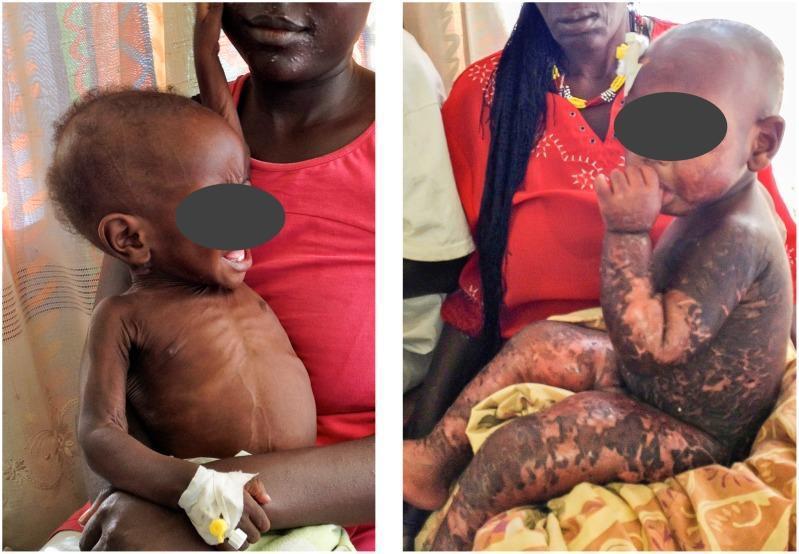
A side-by-side clinical photograph comparing two distinct presentations of severe acute malnutrition (SAM) in pediatric patients. The child on the left demonstrates non-oedematous malnutrition, also known as marasmus. Visual features include marked muscular wasting, loss of subcutaneous fat, and prominent skeletal structures, particularly the ribs. A peripheral venous cannula is secured to the child's left wrist. The child on the right demonstrates oedematous malnutrition, often referred to as kwashiorkor. Key clinical signs include generalized bilateral pitting oedema and extensive dermatological changes. These skin lesions present as a 'flaky paint' dermatosis, characterized by hyperpigmented patches with areas of desquamation, peeling, and underlying hypopigmentation distributed across the limbs and torso. The image serves as a teaching tool for distinguishing between marasmic wasting and the oedematous/skin-involved manifestations of kwashiorkor in global health and pediatric nutrition contexts.
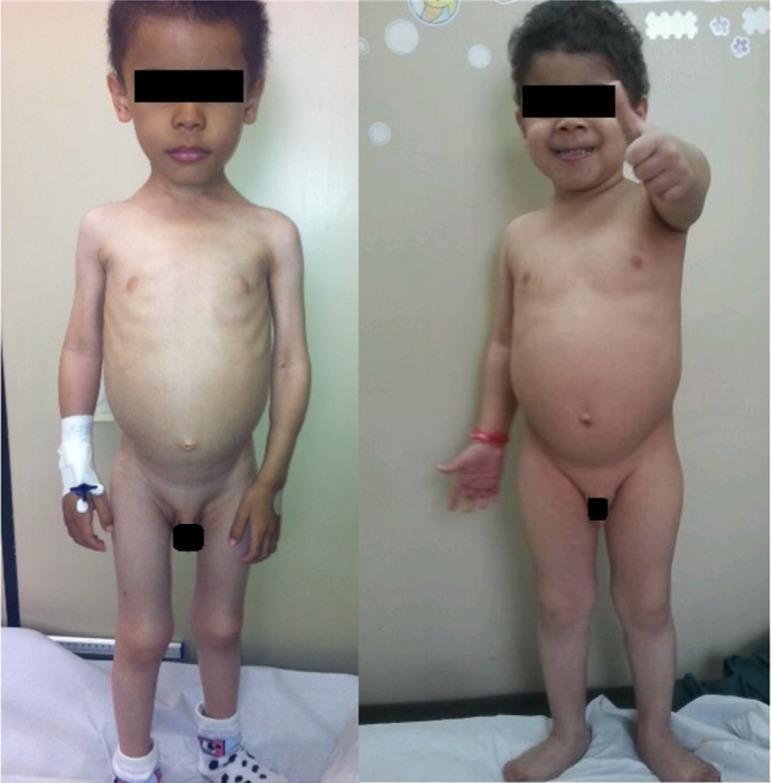
A clinical comparison photograph demonstrating the progression of nutritional recovery in a pediatric patient with severe protein-calorie malnutrition. The left image (initial consultation) shows a male child exhibiting signs of marasmus/kwashiorkor-like features: severe wasting of the limbs, prominent ribcage (skeletal prominence), and a distended, protuberant abdomen. The patient appears apathetic with an intravenous catheter in the right hand. The right image (two months post-intervention) shows the same patient after a high-calorie, high-protein dietary regimen. Visible clinical improvements include significant weight gain, replenishment of subcutaneous fat and muscle mass (limbs appear fuller, ribs no longer visible), and improved postural muscle tone. The patient's facial expression and a 'thumbs-up' gesture indicate improved mood and neurological status. This comparison illustrates the physical manifestations of successful nutritional rehabilitation in cases of severe malnutrition or neglect, serving as an educational example of catch-up growth and clinical recovery in pediatrics.
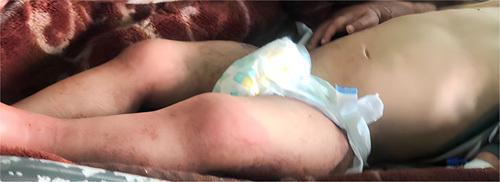
Clinical photograph of a 2-year-old child exhibiting dermatological and systemic manifestations of severe acute malnutrition (SAM). The image displays the torso and lower extremities of a pediatric patient with notable pallor. Significant pitting edema is visible in the lower limbs, particularly involving the legs and feet, giving the extremities a swollen, rounded appearance. The skin texture is markedly dry and xerotic with diffuse scaly areas. These cutaneous changes, including the scaly dermatosis and edema, are classic features of protein-energy malnutrition, specifically kwashiorkor or mixed-type SAM. The image also depicts a distended abdomen, which is frequently associated with underlying nutritional deficiencies, malabsorption syndromes like celiac disease, or hepatomegaly in malnourished populations. This visual serves as an educational reference for identifying the physical signs of severe nutritional failure and secondary skin disorders in a clinical pediatric setting.
Severe Acute Malnutrition (SAM)
Definition
- Weight-for-Height (WHZ): Z-score < -3 SD below WHO Child Growth Standards median
- MUAC: < 11.5 cm (some sources use <115 mm) in children 6-59 months
- Bilateral pitting edema (nutritional edema - regardless of weight)
Clinical Forms
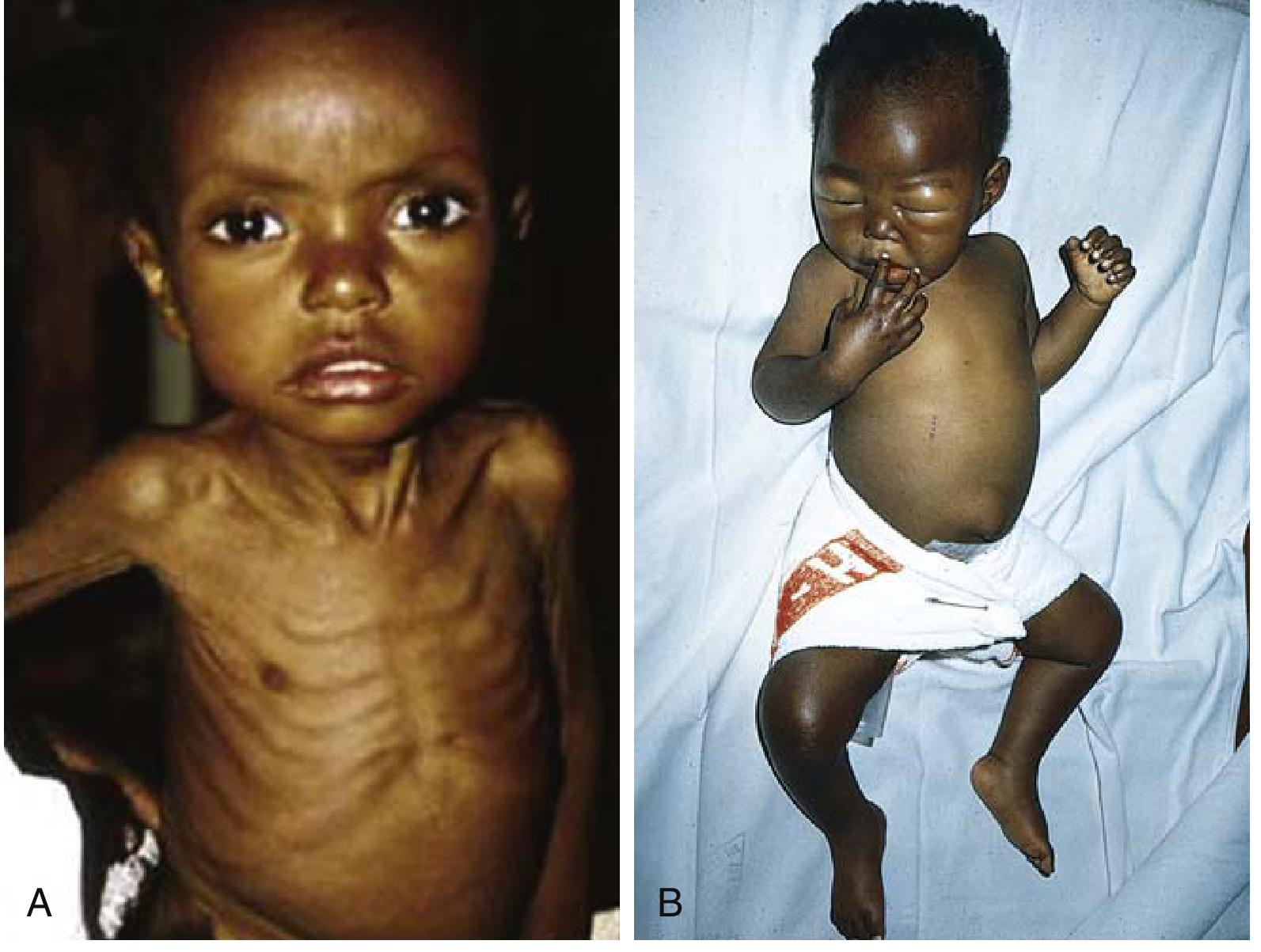
Marasmus (non-edematous SAM)
- Caused by inadequate total calories AND protein
- Somatic protein compartment (skeletal muscle) is severely depleted
- Visceral proteins (albumin) relatively preserved - serum albumin normal/slightly low
- Features:
- Severe muscle wasting and loss of subcutaneous fat
- Emaciated "old man" facies - head appears large for body
- Prominent ribs, "baggy pants" appearance (loss of gluteal fat)
- Irritable, alert (vs. apathetic in kwashiorkor)
- No edema
- Weight: <60% of expected
Kwashiorkor (edematous SAM)
- Caused by protein deprivation relatively greater than calorie reduction
- Visceral protein compartment depleted - severe hypoalbuminemia
- Features:
- Bilateral pitting edema (generalized / dependent) - hallmark
- Relatively spared subcutaneous fat and muscle (masked by edema)
- Distended, fatty liver (reduced apolipoprotein synthesis)
- Flaky paint dermatosis - alternating hyperpigmentation, desquamation, hypopigmentation
- Hair changes: depigmentation, flag sign (alternating bands), sparse, easily pluckable
- Apathy, listlessness, anorexia (vs. alert in marasmus)
- Weight: 60-80% of expected
Marasmic-Kwashiorkor
- Mixed form with features of both - most severe and has highest mortality
Pathophysiology (Key Mechanisms)
| Feature | Marasmus | Kwashiorkor |
|---|---|---|
| Primary deficit | Calories + protein | Protein >> Calories |
| Protein compartment affected | Somatic (muscle) | Visceral (liver/albumin) |
| Serum albumin | Normal / mildly low | Severely low |
| Edema | Absent | Present |
| Fatty liver | Absent | Present |
| Subcutaneous fat | Severely depleted | Relatively spared |
| Mood | Irritable, alert | Apathetic, listless |
- Leptin levels are low in marasmus, stimulating the HPA axis - high cortisol drives lipolysis
- Gut microbiome dysbiosis contributes to SAM pathogenesis (not just a consequence)
- Immune deficiency (especially T-cell mediated) - concurrent infections are very common
WHO 10-Step Management of SAM (Inpatient)
| Phase | Days | Steps |
|---|---|---|
| Stabilization | Days 1-2 | Steps 1-7 |
| Stabilization (continued) | Days 3-7 | Steps 1-7 continue |
| Rehabilitation | Weeks 2-6 | Steps 8-10 |
Step 1 - Treat/Prevent Hypoglycemia
- Blood glucose < 54 mg/dL (3 mmol/L)
- Give 10% glucose/sucrose 50 mL orally or by NG tube
- If unconscious: IV 10% dextrose 5 mL/kg
- Feed every 2-3 hours, day and night
- Do NOT give 50% dextrose (too concentrated, causes rebound hypoglycemia)
Step 2 - Treat/Prevent Hypothermia
- Temperature <35.5°C (axillary) or <36°C (rectal)
- Rewarm: cover with warm clothes/blanket, skin-to-skin (Kangaroo Mother Care)
- Feed immediately; treat hypoglycemia simultaneously
- Keep child covered at night
Step 3 - Treat/Prevent Dehydration
- Do NOT use standard IV fluid/ORS routinely
- Use ReSoMal (Rehydration Solution for Malnutrition) - lower Na, higher K, lower osmolarity than standard ORS
- ReSoMal: 5-10 mL/kg every 30 min for 2 hours, then 5-10 mL/kg/hour for 4-10 hours orally/NG
- IV fluids ONLY for shock: Ringer's lactate 15 mL/kg over 1 hour; reassess before repeating
- Do NOT give diuretics for edema - edema will resolve with treatment
Step 4 - Correct Electrolyte Imbalances
- All SAM children have excess body sodium but are deficient in potassium and magnesium
- Give extra potassium (3-4 mmol/kg/day) and magnesium (0.4-0.6 mmol/kg/day)
- Use low-sodium foods; do not add extra salt
- CMV (Combined Mineral-Vitamin) mix is added to feeds
Step 5 - Treat Infections
- Even without obvious signs of infection, give broad-spectrum antibiotics
- No complications: Amoxicillin orally for 5 days
- With complications (severe infection, hypoglycemia, hypothermia, skin lesions): Ampicillin + Gentamicin IV/IM for 7 days
- Add Metronidazole if anaerobic infection suspected
- Measles vaccine if not immunized and child ≥6 months
Step 6 - Correct Micronutrient Deficiencies
- Vitamin A (on Day 1 only): 200,000 IU if >12 months; 100,000 IU if 6-12 months; 50,000 IU if <6 months
- Folic acid: 1 mg/day (5 mg on Day 1)
- Zinc: 2 mg/kg/day
- Copper: 0.3 mg/kg/day
- Multivitamins daily
Step 7 - Start Cautious Feeding (Stabilization)
- Use F-75 therapeutic milk (75 kcal/100 mL, 0.9 g protein/100 mL)
- Do NOT use F-100 or RUTF in stabilization phase
- Feed every 2-3 hours (8-12 feeds/day), including at night
- Volume: 100 mL/kg/day in first 24-48 hrs, increased gradually
- Transition to F-100 only when appetite returns and edema improving
Step 8 - Achieve Catch-Up Growth (Rehabilitation)
- Transition to F-100 (100 kcal/100 mL, 2.9 g protein/100 mL)
- Increase feeds every 4 hours; target 150-220 kcal/kg/day
- Alternatively use RUTF (Ready-to-Use Therapeutic Food - Plumpy'Nut - 500 kcal/92g sachet)
- Weight gain >10 g/kg/day is the target
Step 9 - Provide Sensory Stimulation
- Loving care and play: structured play sessions
- Cheerful, stimulating environment
- Mother/caregiver involvement
- Motor and cognitive development support
Step 10 - Prepare for Follow-up
- Discharge criteria: MUAC ≥12.5 cm, no edema for 2 weeks, good appetite
- Community-based follow-up
- Educate caregiver on feeding, hygiene, immunization
- Return visit at 1 week post-discharge, then monthly
Therapeutic Foods
| Product | Kcal/100mL | Protein | Phase | Route |
|---|---|---|---|---|
| F-75 | 75 kcal | 0.9 g | Stabilization | Oral/NG |
| F-100 | 100 kcal | 2.9 g | Rehabilitation | Oral |
| RUTF (Plumpy'Nut) | ~500 kcal/sachet | High | Rehabilitation / OTP | Oral |
Outpatient Therapeutic Programme (OTP) - Community-Based Management
- Eligibility: MUAC <11.5 cm or WHZ <-3 SD, no bilateral edema, good appetite (passes appetite test), clinically alert
- Treatment: Weekly RUTF rations at home (therapeutic dose based on weight)
- Monitoring: Weekly clinic visits (weight, MUAC, edema, appetite)
- Routine meds: Amoxicillin, Vitamin A, measles vaccine, deworming (mebendazole/albendazole)
- Discharge: MUAC ≥12.5 cm for 2 consecutive weeks + no edema
Complications to Watch For
| Complication | Notes |
|---|---|
| Refeeding syndrome | Risk if feeds escalated too fast - hypo-phosphatemia, hypo-K, hypo-Mg |
| Cardiac failure | Excess IV fluids / over-rapid refeeding |
| Hypoglycemia | Common on admission and during treatment |
| Hypothermia | Poor thermoregulation |
| Sepsis / bacteremia | Immune suppression - fever may be absent |
| Lactic acidosis | Especially with metformin if diabetic mother's medications involved |
| Vitamin A deficiency | Xerophthalmia, Bitot's spots, night blindness |
India-Specific: Nutrition Rehabilitation Centres (NRCs)
- India's NRCs are inpatient facilities within district hospitals for facility-based management of SAM
- Target: children 6 months to 5 years
- POSHAN Abhiyan (National Nutrition Mission) - national program to reduce SAM/stunting
- SAM definition used in India (IMNCI/NRC): WHZ < -3 SD OR MUAC < 11.5 cm OR bilateral pitting edema
Key "Do NOTs" in SAM Management
- Do NOT give IV fluid routinely (only for shock)
- Do NOT give diuretics for edema
- Do NOT give iron in the stabilization phase
- Do NOT use F-100 or RUTF in the stabilization phase
- Do NOT use standard ORS - use ReSoMal
- Do NOT use high-sodium foods