
I want to revise a drug per day. So, let's start with antibiotics. As, I am General practitioner, I want to revise and get updates on each drugs . What do u say?
Which antibiotic class or specific drug would you like to start with today? · How detailed should the revision be?
penicillin amoxicillin clinical use resistance
penicillin antibiotic 2025 2026 clinical updates resistance GP prescribing
penicillin beta-lactam mechanism of action bacterial cell wall
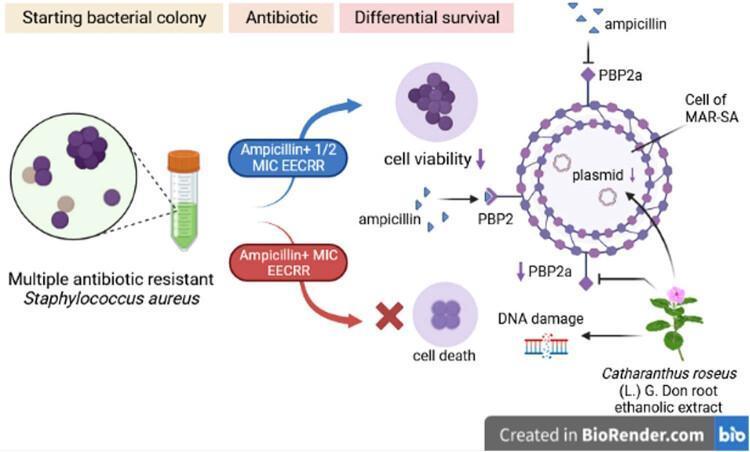
A medical pathophysiology diagram illustrating the mechanism of action of Catharanthus roseus root ethanolic extract (EECRR) in sensitizing multiple antibiotic-resistant Staphylococcus aureus (MAR-SA) to ampicillin. The flowchart transitions from left to right, starting with a bacterial colony of MAR-SA and a test tube representing the extract. It branches into two treatment pathways: 'Ampicillin + 1/2 MIC EECRR', which results in decreased cell viability, and 'Ampicillin + MIC EECRR', which leads to cell death (indicated by a red cross). The right side of the diagram provides a molecular level illustration of a MAR-SA cell. It demonstrates that the EECRR treatment inhibits penicillin-binding protein 2a (PBP2a), which normally blocks ampicillin. By suppressing PBP2a expression and causing plasmid DNA damage, the extract allows ampicillin to bind to PBP2, disrupting the bacterial cell wall integrity. Key labels include PBP2a, PBP2, ampicillin, plasmid, and DNA damage. This visual summarizes an antimicrobial research study on overcoming antibiotic resistance using botanical extracts.

A diagnostic biochemical image displaying a SDS-PAGE gel fluorescence scan from a Bocillin competition assay. The visual demonstrates the inhibition of Pseudomonas aeruginosa Penicillin-Binding Protein 3 (PBP3) by the cyclic boronate inhibitor, vaborbactam. The gel shows a series of horizontal protein bands representing PBP3 labeled with a fluorescent Bocillin reporter. From right to left, the lanes correspond to increasing concentrations of vaborbactam (0, 0.05, 0.1, 0.25, 0.5, 1.0, 1.25, 1.5, and 1.75 mM). A clear, concentration-dependent decrease in band intensity is visible; the highest fluorescence intensity is at 0 mM (absence of inhibitor), while the lowest intensity is observed at 1.75 mM. This trend illustrates competitive binding between vaborbactam and the fluorescent reporter for the PBP3 active site. The educational focus is on the biochemical validation of non-beta-lactam antibiotic inhibitors against bacterial cell wall synthesis targets.
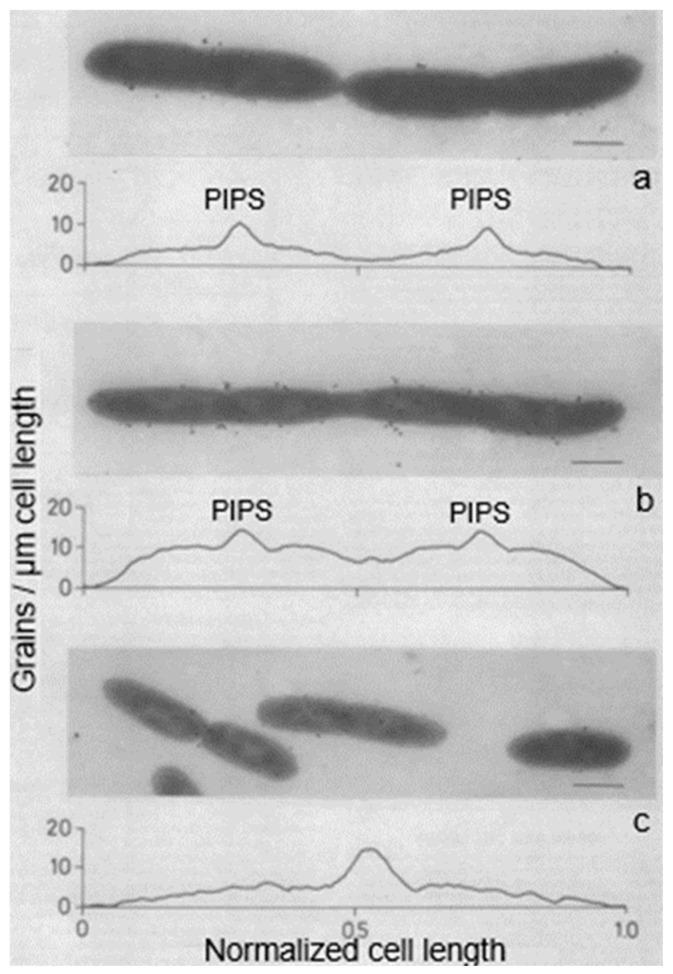
This composite educational graphic presents a microbiology analysis of bacterial cell wall synthesis using autoradiography and grain distribution profiling. It consists of three panels (a, b, and c), each featuring an electron micrograph of Escherichia coli alongside a corresponding quantitative graph. Panels (a) and (b) demonstrate filamentous bacteria exhibiting abnormal cell morphology with multiple visible constrictions. The associated line graphs, which plot 'Grains / µm cell length' against 'Normalized cell length', show two distinct peaks labeled 'PIPS' (Penicillin-Insensitive Peptidoglycan Synthesis). These peaks correlate spatially with the cellular constrictions, indicating localized peptidoglycan incorporation sites when Penicillin-Binding Protein 3 (PBP3) is inhibited or non-functional. Panel (c) displays normally dividing bacterial cells with shorter, rod-shaped morphology. The corresponding graph shows a single, sharp central peak at a normalized cell length of 0.5, representing focused peptidoglycan synthesis at the standard mid-cell division site. This comparison highlights the topography of cell envelope growth and the distinction between normal septal synthesis and penicillin-insensitive mechanisms in cell division mutants.
💊 Day 1 - Penicillins: The Complete GP Revision
Sources: Goodman & Gilman's Pharmacological Basis of Therapeutics | Katzung's Basic & Clinical Pharmacology 16e | CDC Antibiotic Stewardship Report 2025 | IDSA AMR Guidance 2026
1. CLASSIFICATION AT A GLANCE
| Class | Key Drugs | Spectrum |
|---|---|---|
| Natural penicillins | Penicillin G (IV), Penicillin V (oral), Benzathine Pen G (IM) | Narrow - Gram+, spirochetes |
| Antistaphylococcal | Oxacillin, Nafcillin, Dicloxacillin | Narrow - MSSA only |
| Aminopenicillins | Ampicillin, Amoxicillin | Broader - some Gram- added |
| + β-lactamase inhibitor | Amoxicillin-Clavulanate (Co-amoxiclav), Ampicillin-Sulbactam | Broad - overcomes resistance |
| Antipseudomonal | Piperacillin-Tazobactam (Pip-Taz) | Extended Gram- + Pseudomonas |
2. MECHANISM OF ACTION
- Irreversibly binding to Penicillin-Binding Proteins (PBPs) on the bacterial cell membrane
- PBPs are transpeptidase enzymes responsible for the final cross-linking step of peptidoglycan (the structural backbone of the bacterial cell wall)
- Inhibiting PBPs leads to accumulation of defective cell wall precursors → the bacteria cannot maintain osmotic integrity → cell lysis and death
3. PHARMACOKINETICS - DEEP DIVE
| Parameter | Details |
|---|---|
| Absorption | Amoxicillin - good oral bioavailability (~80%), can be taken with food. Ampicillin and Pen V - 30-55%, must be given on empty stomach (1-2 hrs before or after meals) |
| Distribution | Widely distributed into tissues, joint/pleural/pericardial fluid, bile. Poor penetration into: CSF (normal meninges <1% of plasma), prostate, phagocytic cells, intraocular fluid. CSF penetration improves to ~5% with meningeal inflammation |
| Protein binding | Variable. Nafcillin/Dicloxacillin - highly protein-bound. Amoxicillin/Ampicillin - lower binding |
| Metabolism | Minimal hepatic metabolism. Nafcillin is the exception - primarily biliary excretion |
| Elimination | Predominantly renal - glomerular filtration AND tubular secretion. Short half-life: 30-90 minutes for most penicillins |
| Dose adjustment | Reduce dose in significant renal impairment (except Nafcillin) |
| Probenecid interaction | Blocks renal tubular secretion of penicillins → prolongs half-life and raises drug levels. Still used occasionally for gonorrhoea or syphilis regimens |
- Goodman & Gilman's, p.1170
4. SPECTRUM OF ACTIVITY
Natural Penicillins (Pen G, Pen V, Benzathine Pen G)
- Gram-positive: Most streptococci (S. pyogenes, viridans group), penicillin-susceptible S. pneumoniae, non-β-lactamase staphylococci
- Gram-negative: Neisseria meningitidis (still very sensitive), some anaerobes (Clostridium spp., Actinomyces)
- Spirochetes: T. pallidum (syphilis), Borrelia, Leptospira - remain highly sensitive
- ⚠️ >90% of S. aureus is now resistant to natural penicillins due to β-lactamase production
- ⚠️ Penicillin-resistant S. pneumoniae is common in paediatric populations
Aminopenicillins (Amoxicillin, Ampicillin)
- All of the above, PLUS:
- H. influenzae (non-β-lactamase strains), E. coli, Proteus mirabilis, Salmonella, Enterococcus faecalis
- Amoxicillin is the most active oral β-lactam against S. pneumoniae with elevated MICs - use higher doses (80-90 mg/kg/day) for AOM in children
- ⚠️ Ampicillin-resistant H. influenzae widespread - use Co-amoxiclav instead
- ⚠️ No activity against Klebsiella, Enterobacter, Pseudomonas, Serratia, Citrobacter (intrinsic β-lactamases)
Amoxicillin-Clavulanate (Co-amoxiclav)
- Adds coverage for β-lactamase-producing H. influenzae, Moraxella catarrhalis, E. coli, Klebsiella, S. aureus (MSSA)
- Does NOT cover MRSA, Pseudomonas, Enterobacter
Piperacillin-Tazobactam
-
Extended Gram-negative coverage including Pseudomonas aeruginosa, most Enterobacterales (including some ESBL-producers), anaerobes
-
A hospital-level drug; not for GP outpatient prescribing typically
-
Katzung 16e, p.1244-1245
5. GP-RELEVANT CLINICAL INDICATIONS + DOSES
Amoxicillin
| Indication | Adult Dose | Duration | Notes |
|---|---|---|---|
| Streptococcal pharyngitis | 500 mg TDS or 1g BD | 5-7 days | Still first-line; penicillin V is an option |
| Community-acquired pneumonia (mild, low-risk) | 1g TDS | 5 days | For suspected pneumococcal; use with azithromycin if atypicals suspected |
| Acute otitis media | 500 mg TDS | 5-7 days | High-dose 80-90 mg/kg/day in children |
| Acute sinusitis (bacterial) | 500 mg TDS | 5 days | Only for bacterial, not viral |
| H. pylori eradication | As part of triple/quadruple therapy | 10-14 days | See regimens below |
Amoxicillin-Clavulanate (Co-amoxiclav)
| Indication | Adult Dose | Duration |
|---|---|---|
| Otitis media (treatment failure/severe) | 625 mg TDS or 1g BD | 5-7 days |
| Exacerbation of chronic bronchitis | 625 mg TDS | 5 days |
| Sinusitis (with β-lactamase risk) | 625 mg BD/TDS | 5 days |
| UTI (Co-amoxiclav, second-line) | 625 mg TDS | 7 days |
| Animal bites | 625 mg TDS | 5-7 days |
| Cellulitis (mild, community-acquired) | 625 mg TDS | 5-7 days |
2025-2026 Update (Wales/UK): National guidance now targets ≥75% of amoxicillin prescriptions to be 5-day courses rather than 7 days. Evidence shows equivalent clinical outcomes with reduced antibiotic exposure and AMR risk. (GOV.Wales AMR 2025-2027)
Benzathine Penicillin G (IM)
| Indication | Dose | Schedule |
|---|---|---|
| Streptococcal pharyngitis | 1.2 million units IM | Single dose |
| Syphilis (primary/secondary/latent early <1yr) | 2.4 million units IM | Single dose |
| Syphilis (late latent/>1yr) | 2.4 million units IM | Weekly x 3 weeks |
| Rheumatic fever prophylaxis | 1.2 million units IM | Every 3-4 weeks |
H. pylori Eradication (Amoxicillin component)
- PPI + Bismuth + Tetracycline + Metronidazole x 14 days
- If bismuth unavailable, Non-bismuth concomitant therapy (PPI + Amoxicillin + Clarithromycin + Metronidazole x 14 days) - recent 2026 meta-analysis (PMID: 41498306) confirms high eradication rates with this regimen.
6. RESISTANCE MECHANISMS - THE "BIG 3"
| Mechanism | Details | Clinical Example |
|---|---|---|
| β-lactamase production | Most common. Enzyme cleaves the β-lactam ring | S. aureus, H. influenzae, E. coli. Overcome with clavulanate/sulbactam/tazobactam |
| Altered PBPs | PBP mutations reduce penicillin binding affinity | MRSA (PBP2a - mecA gene); Penicillin-resistant S. pneumoniae. β-lactamase inhibitors do NOT help here |
| Efflux pumps / Reduced permeability | Drug pumped out or can't enter the cell | Gram-negative bacteria (P. aeruginosa); combined with β-lactamase |
2026 IDSA AMR Guidance note: ESBLs (Extended-Spectrum β-Lactamases) inactivate most penicillins, cephalosporins, and aztreonam. ESBL-producing Enterobacterales generally remain susceptible to carbapenems. (IDSA AMR Guidance 2026)
7. ADVERSE EFFECTS
| Effect | Frequency | Details |
|---|---|---|
| Hypersensitivity reactions | Most important | Ranges from maculopapular rash (~5%) to urticaria, serum sickness, to life-threatening anaphylaxis (<0.05%) |
| GI disturbance | Common with Co-amoxiclav | Nausea, diarrhoea - especially clavulanate component. Take with food for Co-amoxiclav |
| C. difficile | Less common than clindamycin/FQ | Still a risk, especially in elderly/hospitalized |
| Neurotoxicity (rare) | High-dose IV | Seizures with very high doses (e.g., >20 MU/day penicillin G), especially in renal impairment |
| Haematological | Rare | Haemolytic anaemia, neutropaenia, thrombocytopaenia with prolonged use |
| Electrolyte disturbance | IV formulations | High-dose IV piperacillin can cause hypokalaemia |
8. PENICILLIN ALLERGY - THE UPDATED PICTURE ⭐ (Critical GP Pearl)
- ~10% of patients self-report penicillin allergy
- <1% are truly allergic (CDC 2025)
- Most "allergies" are:
- Maculopapular rash from amoxicillin during EBV infection (misattributed allergy)
- Childhood GI side effects
- Family history
- Overall cross-reactivity: ~2-7% (likely an overestimate based on older data)
- True cross-reactivity is R-group side chain dependent, not just ring structure
- Patients with penicillin allergy + cephalosporin with different R-group: cross-reactivity <2%
- Patients with history of anaphylaxis to penicillin: cross-reactivity up to 50% - skin test or use alternative
- Penicillin vs. carbapenem: <1%
- Penicillin vs. monobactam (aztreonam): 0% (except aztreonam-ceftazidime share R-group)
- Washington Manual of Medical Therapeutics
9. KEY DRUG INTERACTIONS
| Drug | Interaction | Clinical Significance |
|---|---|---|
| Probenecid | Blocks tubular secretion → raises penicillin levels | Used intentionally for syphilis/gonorrhoea regimens |
| Warfarin / Anticoagulants | Broad-spectrum penicillins alter gut flora → reduce Vit K → potentiate anticoagulation | Monitor INR |
| Oral contraceptives | Theoretical reduction in efficacy (old data, largely dismissed) | Advise per local guidance |
| Methotrexate | Penicillins reduce renal MTX excretion → toxicity risk | Avoid combination or monitor MTX levels closely |
| Allopurinol | Increases incidence of ampicillin rash | Rash rate rises from 5% to ~20% |
10. PRESCRIBING PEARLS FOR GPS 🩺
- Amoxicillin with food - always fine. All other oral penicillins - empty stomach
- Amoxicillin for CAP: 1g TDS is now recommended over 500mg TDS due to rising pneumococcal MICs
- Co-amoxiclav for bites - ALWAYS the first choice for human/animal bites
- Benzathine penicillin for syphilis - never substitute with oral penicillin (incomplete absorption)
- Don't use ampicillin empirically for UTI or typhoid - resistance rates too high
- Shorter courses work: 5-day amoxicillin is as effective as 7 days for most community infections (2025-2026 guideline shift)
- Penicillin allergy de-labelling is a stewardship priority - most self-reported allergies are not true allergies
- MRSA coverage: No penicillin covers MRSA. If MRSA suspected, escalate
- Enterococcal endocarditis: Ampicillin + Ceftriaxone (preferred over Ampicillin + Gentamicin - same efficacy, less nephrotoxicity)
- Renal dose adjustment: Required for most penicillins except Nafcillin (biliary excretion)
11. MEMORY AID
PENICILLINS = "BLAST the Cell Wall"
B - Bactericidal (cell wall synthesis inhibitor)
L - β-Lactam ring is the pharmacophore
A - Allergy is the #1 concern (anaphylaxis possible)
S - Spectrum varies by subclass (narrow → broad)
T - Time-dependent killing (T > MIC is key PK/PD)
Quick Recall Card
| Natural Pen | Aminopenicillins | Co-amoxiclav | Antistaphylococcal | |
|---|---|---|---|---|
| MRSA? | No | No | No | No (only MSSA) |
| Pseudomonas? | No | No | No | No |
| H. influenzae? | No | Some strains | Yes | No |
| S. aureus (MSSA)? | No (resist) | No | Yes | Yes (DOC) |
| Streptococci? | Yes (DOC) | Yes | Yes | Yes |
| Spirochetes? | Yes (DOC) | Yes | Yes | No |
Time-dependent killing (T > MIC is key PK/PD)- what does this mean?
antibiotic pharmacodynamics time-dependent concentration-dependent killing MIC graph
⏱️ Time-Dependent Killing (T > MIC) - Explained
First, what is MIC?
- The lowest drug concentration that stops a bacterium from growing under lab conditions
- Think of it as the "floor" the drug must stay above to be effective
- Every bacterium has its own MIC for every antibiotic
- Example: S. pneumoniae may have an MIC of 0.06 mg/L for amoxicillin
The 3 PK/PD Models of Antibiotic Killing
| Model | What drives killing | Key parameter | Examples |
|---|---|---|---|
| Time-dependent | How long drug stays above MIC | T > MIC | Penicillins, Cephalosporins, Carbapenems, Macrolides, Linezolid |
| Concentration-dependent | How high the peak goes vs. MIC | Cmax : MIC | Aminoglycosides, Fluoroquinolones |
| AUC-dependent | Total drug exposure over time vs. MIC | AUC : MIC | Vancomycin, Daptomycin, Fluoroquinolones |
- Harrison's Principles of Internal Medicine 22e, p.1211 | Fishman's Pulmonary Diseases, p.2680
Time-Dependent Killing - The Core Concept
Scenario A: Give a HUGE dose once
Drug level: ████████████████░░░░░░░░░░░░░░░░░░░  (high peak, then drops below MIC)
                              ↑ MIC threshold
Effect: Kills bacteria during the high phase... then bacteria REGROW when drug drops

Scenario B: Give smaller doses MORE frequently (or spread out the same dose)
Drug level: ████░░████░░████░░████░░████░░████░░
                              ↑ MIC threshold
Effect: Drug stays above MIC for longer → sustained bacterial killing ✅
The Target: How long above MIC is "enough"?
| β-Lactam Group | Target (fT > MIC) | Meaning |
|---|---|---|
| Penicillins | 40-50% of dosing interval | Drug must be above MIC for ≥40-50% of the time between doses |
| Cephalosporins | 60-70% of dosing interval | |
| Carbapenems | ≥40% of dosing interval |
"f" stands for the free (unbound) fraction - only drug not bound to protein is active.
- Fishman's Pulmonary Diseases, p.2680
A Practical Example (Amoxicillin 500mg TDS)
Dose at 8am → 2pm → 8pm (every 8 hours = 480 min dosing interval)

Drug concentration over 8 hours:
         ↑ Peak
         |  \
         |   \
- - - - -|- - --------  ← MIC
         |         \
         |          \___  (falls below MIC near end of interval)

Time above MIC = ~4 hours out of 8 = 50% ✅ (just hits target for penicillins)
Why Does This Matter for Your Prescribing?
1. Frequency matters more than dose size (for β-lactams)
- Doubling the amoxicillin dose from 500mg to 1g does NOT double the bacterial kill if you're already above 4x MIC
- But increasing frequency (BD → TDS) or extending infusion time does improve efficacy
2. It explains why compliance matters so much
- Missing doses of amoxicillin/penicillin → drug level drops below MIC → bacteria regrow
- With concentration-dependent drugs (e.g., gentamicin), one big dose a day is fine - but not with penicillins
3. Extended/continuous IV infusions for severe infections
- In ICU settings, piperacillin-tazobactam is sometimes given as a 3-4 hour extended infusion (rather than a 30-min bolus) to maximize T > MIC - especially against organisms with higher MICs
- This is called pharmacodynamic optimisation
4. Rising MICs = shrinking T > MIC window
- As bacteria develop resistance → MIC rises → the same dose stays above MIC for a shorter fraction of the interval → treatment may fail even with the "right" antibiotic
- This is why high-dose amoxicillin (80-90 mg/kg/day) is used for AOM in children - to overcome modestly elevated pneumococcal MICs
Contrast with Concentration-Dependent (e.g., Gentamicin)
Summary - One-Line Memory Peg
🔑 Penicillins: "Keep it dripping, not spiking" - it's the time spent above the MIC that kills bacteria, not how high the peak goes.
| β-Lactams (Pen, Ceph) | Aminoglycosides (Gentamicin) | Vancomycin | |
|---|---|---|---|
| Key parameter | T > MIC | Cmax : MIC | AUC : MIC |
| Strategy | Dose frequently | Dose high, once daily | Monitor trough/AUC |
| Analogy | Slow sustained rain | One heavy downpour | Total rainfall over 24h |
Explain me the next two methods concentration and AUC dependent also like above.
📈 Concentration-Dependent & AUC-Dependent Killing - Explained
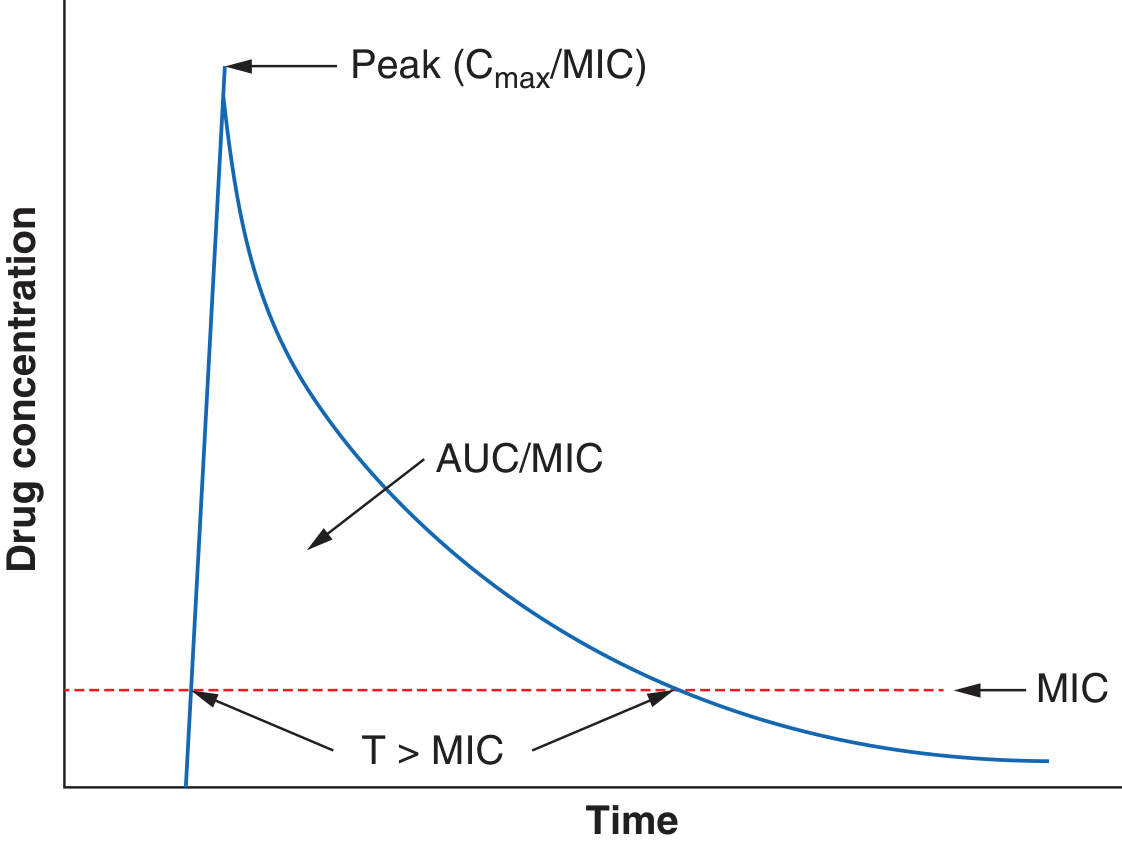
- Peak (Cmax/MIC) = how HIGH the peak goes above the MIC
- T > MIC = the window of time the drug stays above the MIC (what we covered last time)
- AUC/MIC = the entire shaded area under the curve, divided by the MIC
- Harrison's Principles of Internal Medicine 22e, p.1211
🔺 Method 2 - Concentration-Dependent Killing (Cmax : MIC)
The Core Concept
Low peak dose (e.g. 3mg/kg):
         ↑ Cmax (3x MIC)
         | \
- - - - -|- --------  ← MIC
         |       \___
Effect: Some killing, bacteria may survive and regrow ❌

High peak dose (e.g. 7mg/kg):
              ↑ Cmax (10x MIC)
              |  \
              |   \
- - - - - - - - - --------  ← MIC
                        \___
Effect: Rapid, massive bacterial kill ✅
Key Parameter
Why the Drug-Free Trough Helps
PAE = Even after drug concentration drops BELOW the MIC, bacteria remain stunned and suppressed for 1-4 hours before they start regrowing.
Once-daily gentamicin: HIGH peak (kill) → long trough (kidney recovery + PAE still working)
                                                         ↓
                                        LESS nephrotoxicity + BETTER killing ✅

Three-times-daily gentamicin (old approach): lower peaks + sustained drug in kidney
                                                         ↓
                                        MORE nephrotoxicity + LESS killing ❌
Examples of Concentration-Dependent Drugs
| Drug | Target Cmax:MIC | Dosing Strategy |
|---|---|---|
| Gentamicin | ≥8-10x | Once daily (5-7 mg/kg) |
| Amikacin | ≥8-10x | Once daily |
| Tobramycin | ≥8-10x | Once daily |
| Metronidazole | High Cmax | Standard dosing |
Prescribing Implication
-
Dose = 5-7 mg/kg once daily (not 1.7 mg/kg TDS as in old regimens)
-
Monitor trough level (drawn just before next dose) - must be <1 mg/L (ensures adequate drug-free interval = kidney recovery)
-
Monitor peak level if needed - drawn 1 hour after infusion
-
Fishman's Pulmonary Diseases, p.2684-2686
📊 Method 3 - AUC-Dependent Killing (AUC : MIC)
What is AUC?
Drug concentration
         ↑
         |████
         |██████
         |█████████
- - - - -|████████████- - -  ← MIC
         |          █████████
         |_____________________________→ Time

The AUC = the ENTIRE shaded area (█) above AND below the MIC line
AUC/MIC = this total area ÷ the MIC value
The Core Concept
Key Targets
| Drug | Organism | AUC/MIC Target |
|---|---|---|
| Vancomycin | MRSA, S. aureus | AUC₂₄ 400-600 mg·h/L |
| Fluoroquinolones | S. pneumoniae | AUC/MIC >30 |
| Fluoroquinolones | Gram-negative bacteria | AUC/MIC >125 |
Vancomycin - The Classic Example
- Just check trough level before next dose → target 15-20 mg/L
- Problem: High trough doesn't guarantee adequate AUC, and risks nephrotoxicity
- Target AUC₂₄ of 400-600 mg·h/L (with MIC typically = 1 mg/L → AUC/MIC of 400-600)
- Achieved by calculating dose using 2-point PK sampling or Bayesian software
- Lower risk of nephrotoxicity while ensuring efficacy
"Recent evidence strongly suggests moving away from serum trough vancomycin monitoring to a PK/PD target of AUC to MIC ratio. An AUC₂₄ of 400-600 mg·h/L is associated with clinical efficacy."
- Harriet Lane Handbook 23e
Fluoroquinolones - The True Hybrid
- Against S. pneumoniae: AUC/MIC >30 is the target
- Against Gram-negatives: AUC/MIC >125 is the target
- A Cmax/MIC of ≥12 for pneumococcus is also associated with optimal killing
Examples of AUC-Dependent Drugs
| Drug | Primary target | Monitoring |
|---|---|---|
| Vancomycin | AUC₂₄/MIC 400-600 | Trough OR AUC-guided (preferred now) |
| Levofloxacin | AUC/MIC >30 (GPC), >125 (GNR) | Clinical response |
| Ciprofloxacin | AUC/MIC >125 (GNR) | Clinical response |
| Moxifloxacin | AUC/MIC | Clinical response |
| Daptomycin | AUC/MIC | Clinical response |
| Tigecycline | AUC/MIC | Clinical response |
- Harrison's 22e, p.1211 | Fishman's Pulmonary Diseases, p.2680 | Harriet Lane 23e
🧠 All Three Methods - Side-by-Side Master Summary
| Time-Dependent | Concentration-Dependent | AUC-Dependent | |
|---|---|---|---|
| What drives killing | Duration above MIC | Height of peak vs. MIC | Total exposure (peak + duration) |
| Key parameter | T > MIC | Cmax : MIC | AUC : MIC |
| Ceiling effect? | YES - killing saturates at 4x MIC | NO - higher peak = more kill | NO - more exposure = more kill |
| Optimal dosing | Frequent small doses / extended infusion | Infrequent large doses | Once or twice daily |
| Drug-free trough? | Dangerous (bacteria regrow) | Fine - PAE covers the gap | Fine to have trough periods |
| PAE? | Minimal (β-lactams) | Long (aminoglycosides) | Moderate |
| Examples | Penicillins, Cephalosporins, Carbapenems | Gentamicin, Amikacin | Vancomycin, Fluoroquinolones, Daptomycin |
| Analogy | Steady drip irrigation | One powerful flood | Total rainfall measurement |
🎯 The "Why Does Any of This Matter to a GP?" Summary
| Scenario | PK/PD Lesson |
|---|---|
| Patient missed 2 doses of amoxicillin | Dangerous - T > MIC drops, bacteria regrow. Stress compliance |
| Prescribing ciprofloxacin for UTI | Once daily 500mg fine - AUC/MIC model means one big dose works |
| Gentamicin in hospital | Once-daily dosing is BETTER than TDS - higher kill, less toxicity |
| Patient on vancomycin for MRSA | Ask for AUC monitoring, not just trough levels (current 2025 standard) |
| Levofloxacin 500mg OD vs 250mg BD | Same total dose - but OD achieves higher Cmax/MIC AND similar AUC - OD preferred |
Memory Peg - All 3 Together
🅣 Time > MIC       = β-Lactams  → "Keep it STEADY" (drip, drip, drip)
🅒 Cmax/MIC         = Aminoglycosides → "Hit it HARD once" (one big punch)
🅐 AUC/MIC          = Vancomycin/FQ → "Total EXPOSURE matters" (count all hours)
Create a quick reference PDF comparing all 3 PK/PD models with dosing strategies
ls -la /tmp/workspace/ 2>/dev/null || mkdir -p /tmp/workspace && echo "workspace ready"
mkdir -p /tmp/workspace/pkpd-reference && cat > /tmp/workspace/pkpd-reference/generate_pdf.py << 'PYEOF' from reportlab.lib.pagesizes import A4 from reportlab.lib import colors from reportlab.lib.units import cm, mm from reportlab.lib.styles import getSampleStyleSheet, ParagraphStyle from reportlab.lib.enums import TA_CENTER, TA_LEFT, TA_JUSTIFY from reportlab.platypus import ( SimpleDocTemplate, Paragraph, Spacer, Table, TableStyle, HRFlowable, KeepTogether ) from reportlab.graphics.shapes import Drawing, Rect, Line, String, Polygon, Circle from reportlab.graphics import renderPDF from reportlab.graphics.charts.lineplots import LinePlot from reportlab.graphics.widgets.markers import makeMarker import math # ── Colour palette ────────────────────────────────────────────── C_NAVY = colors.HexColor('#1B2A4A') C_TEAL = colors.HexColor('#0F7C8A') C_AMBER = colors.HexColor('#E07B2A') C_GREEN = colors.HexColor('#2A7A3B') C_LRED = colors.HexColor('#C0392B') C_LTBLUE = colors.HexColor('#D6EAF8') C_LTAMBER = colors.HexColor('#FEF9E7') C_LTGREEN = colors.HexColor('#EAFAF1') C_LTYELL = colors.HexColor('#FDFEFE') C_GREY = colors.HexColor('#7F8C8D') C_LGREY = colors.HexColor('#F2F3F4') C_WHITE = colors.white C_BLACK = colors.HexColor('#1C1C1C') C_MICRED = colors.HexColor('#E74C3C') W, H = A4 # 595.27 x 841.89 pts # ── Document ───────────────────────────────────────────────────── doc = SimpleDocTemplate( '/tmp/workspace/pkpd-reference/PKPD_Antibiotic_Reference.pdf', pagesize=A4, leftMargin=1.5*cm, rightMargin=1.5*cm, topMargin=1.5*cm, bottomMargin=1.8*cm, title='Antibiotic PK/PD Models – Quick Reference', author='Orris Medical AI', subject='Pharmacokinetics / Pharmacodynamics' ) styles = getSampleStyleSheet() def sty(name, **kw): s = ParagraphStyle(name, **kw) return s S_TITLE = sty('Title2', fontName='Helvetica-Bold', fontSize=20, textColor=C_WHITE, alignment=TA_CENTER, spaceAfter=2) S_SUBTITLE = sty('Sub', fontName='Helvetica', fontSize=10, textColor=C_WHITE, alignment=TA_CENTER, spaceAfter=0) S_SECHEAD = sty('SecHead', fontName='Helvetica-Bold', fontSize=12, textColor=C_WHITE, alignment=TA_CENTER, spaceAfter=4) S_BODY = sty('Body2', fontName='Helvetica', fontSize=8.5, textColor=C_BLACK, leading=12, spaceAfter=3) S_BOLD = sty('Bold2', fontName='Helvetica-Bold', fontSize=8.5, textColor=C_BLACK, leading=12) S_SMALL = sty('Small', fontName='Helvetica', fontSize=7.5, textColor=C_GREY, leading=10) S_CELLHEAD = sty('CH', fontName='Helvetica-Bold', fontSize=8, textColor=C_WHITE, alignment=TA_CENTER) S_CELL = sty('CL', fontName='Helvetica', fontSize=8, textColor=C_BLACK, alignment=TA_LEFT, leading=11) S_CELLC = sty('CC', fontName='Helvetica', fontSize=8, textColor=C_BLACK, alignment=TA_CENTER, leading=11) S_PEARLS = sty('Pearl', fontName='Helvetica', fontSize=8, textColor=C_BLACK, leading=12, leftIndent=6) # ── Curve drawing helper ────────────────────────────────────────── def make_curve_drawing(model, w=160, h=90): """Draw a mini PK curve for each model.""" d = Drawing(w, h) pad_l, pad_b, pad_r, pad_t = 18, 14, 8, 8 gw = w - pad_l - pad_r gh = h - pad_b - pad_t mic_y = pad_b + gh * 0.28 # MIC line position def tx(t): return pad_l + t * gw # t in [0,1] def cy(c): return pad_b + c * gh # c in [0,1] # Axes d.add(Line(pad_l, pad_b, pad_l, pad_b+gh, strokeColor=C_GREY, strokeWidth=0.7)) d.add(Line(pad_l, pad_b, pad_l+gw, pad_b, strokeColor=C_GREY, strokeWidth=0.7)) # Axis labels d.add(String(2, pad_b+gh//2, 'Conc.', fontSize=5.5, fillColor=C_GREY, textAnchor='middle')) d.add(String(pad_l+gw//2, 1, 'Time', fontSize=5.5, fillColor=C_GREY, textAnchor='middle')) # MIC dashed line seg = 4 x = pad_l while x < pad_l + gw: d.add(Line(x, mic_y, min(x+seg, pad_l+gw), mic_y, strokeColor=C_MICRED, strokeWidth=0.9, strokeDashArray=[3,2])) x += seg*2 d.add(String(pad_l+gw+1, mic_y-2, 'MIC', fontSize=5, fillColor=C_MICRED, textAnchor='start')) if model == 'time': # Two doses showing T>MIC windows for offset in [0, 0.47]: pts = [] for i in range(60): t = i/59 raw = math.exp(-6*(t-0.08)**2) if t > 0.04 else 0 c = 0.55 * raw pts.append((tx(t*0.44 + offset), cy(c))) for i in range(len(pts)-1): d.add(Line(pts[i][0], pts[i][1], pts[i+1][0], pts[i+1][1], strokeColor=C_TEAL, strokeWidth=1.4)) # T>MIC bracket x1, x2 = tx(0.07), tx(0.38) d.add(Line(x1, mic_y+2, x2, mic_y+2, strokeColor=C_TEAL, strokeWidth=1.2, strokeDashArray=[2,1])) d.add(String((x1+x2)/2, mic_y+4, 'T > MIC', fontSize=5.5, fillColor=C_TEAL, textAnchor='middle')) elif model == 'conc': # Single high spike pts = [] for i in range(80): t = i/79 if t < 0.05: c = t/0.05 * 0.92 else: c = 0.92 * math.exp(-5*(t-0.05)) pts.append((tx(t), cy(c))) for i in range(len(pts)-1): d.add(Line(pts[i][0], pts[i][1], pts[i+1][0], pts[i+1][1], strokeColor=C_AMBER, strokeWidth=1.4)) # Cmax arrow peak_x = tx(0.05) peak_y = cy(0.92) d.add(Line(peak_x+2, peak_y, peak_x+2, mic_y, strokeColor=C_AMBER, strokeWidth=1, strokeDashArray=[2,2])) d.add(String(peak_x+4, (peak_y+mic_y)/2, 'Cmax/MIC', fontSize=5.5, fillColor=C_AMBER, textAnchor='start')) # PAE bracket # find where curve drops below MIC pae_start = tx(0.42) pae_end = tx(0.62) d.add(Line(pae_start, mic_y-5, pae_end, mic_y-5, strokeColor=C_GREEN, strokeWidth=1)) d.add(Line(pae_start, mic_y-3, pae_start, mic_y-7, strokeColor=C_GREEN, strokeWidth=0.8)) d.add(Line(pae_end, mic_y-3, pae_end, mic_y-7, strokeColor=C_GREEN, strokeWidth=0.8)) d.add(String((pae_start+pae_end)/2, mic_y-12, 'PAE', fontSize=5.5, fillColor=C_GREEN, textAnchor='middle')) elif model == 'auc': # Moderate curve, shade AUC pts = [] for i in range(80): t = i/79 if t < 0.07: c = t/0.07 * 0.72 else: c = 0.72 * math.exp(-3.5*(t-0.07)) pts.append((tx(t), cy(c))) # Fill AUC area (simplified - draw polygon) poly_pts = [(pad_l, pad_b)] for p in pts: poly_pts.append(p) poly_pts.append((tx(1), pad_b)) poly_flat = [] for p in poly_pts: poly_flat.extend(p) d.add(Polygon(poly_flat, fillColor=colors.HexColor('#D5F5E3'), strokeColor=None, fillOpacity=0.5)) for i in range(len(pts)-1): d.add(Line(pts[i][0], pts[i][1], pts[i+1][0], pts[i+1][1], strokeColor=C_GREEN, strokeWidth=1.4)) # AUC label inside shaded region d.add(String(tx(0.35), cy(0.18), 'AUC/MIC', fontSize=5.5, fillColor=C_GREEN, textAnchor='middle')) return d # ── PAGE BACKGROUND helper (via canvas) ────────────────────────── def header_footer(canvas, doc): canvas.saveState() # Top header bar canvas.setFillColor(C_NAVY) canvas.rect(0, H-2.6*cm, W, 2.6*cm, fill=1, stroke=0) # Title canvas.setFillColor(C_WHITE) canvas.setFont('Helvetica-Bold', 18) canvas.drawCentredString(W/2, H-1.5*cm, 'Antibiotic PK/PD Models – Quick Reference') canvas.setFont('Helvetica', 9) canvas.drawCentredString(W/2, H-2.1*cm, 'For General Practitioners | Time-Dependent · Concentration-Dependent · AUC-Dependent') # Bottom bar canvas.setFillColor(C_NAVY) canvas.rect(0, 0, W, 1.2*cm, fill=1, stroke=0) canvas.setFillColor(C_WHITE) canvas.setFont('Helvetica', 7.5) canvas.drawString(1.5*cm, 0.45*cm, 'Sources: Harrison\'s Principles 22e · Goodman & Gilman · Fishman\'s Pulmonary Diseases · Harriet Lane 23e') canvas.drawRightString(W-1.5*cm, 0.45*cm, 'Orris Medical AI | August 2026') canvas.restoreState() # ── Build content ───────────────────────────────────────────────── story = [] story.append(Spacer(1, 2.8*cm)) # space below header bar # ── INTRO ROW ──────────────────────────────────────────────────── intro_text = ( "Antibiotic efficacy depends not only on <b>which</b> drug you prescribe, but on <b>how</b> you dose it. " "Three pharmacodynamic (PD) models govern bacterial killing, each requiring a different dosing strategy. " "Understanding these models explains dosing frequency, monitoring parameters, and why the same total daily " "dose given differently can succeed or fail." ) intro_style = ParagraphStyle('intro', fontName='Helvetica', fontSize=9, textColor=C_BLACK, leading=13, alignment=TA_JUSTIFY, borderColor=C_TEAL, borderWidth=1, borderPadding=8, backColor=colors.HexColor('#EAF7FB')) story.append(Paragraph(intro_text, intro_style)) story.append(Spacer(1, 0.35*cm)) # ══════════════════════════════════════════════════════════════════ # SECTION CARDS – one per model # ══════════════════════════════════════════════════════════════════ models = [ { 'color': C_TEAL, 'light': colors.HexColor('#EAF7FB'), 'emoji': '⏱', 'title': 'Model 1 – Time-Dependent Killing', 'param': 'T > MIC', 'param_full': 'Time drug concentration stays above MIC', 'what': 'Killing rate saturates once concentration reaches ~4× MIC. Going higher adds nothing. Only staying ABOVE the MIC longer increases effect.', 'target': 'Penicillins: 40–50% · Cephalosporins: 60–70% · Carbapenems: ≥40% of dosing interval above MIC', 'drugs': [ ('Amoxicillin / Pen V', 'TDS or QDS', 'Must maintain T>MIC; TDS > BD'), ('Benzylpenicillin (IV)', 'q4–6h or CI', 'Short t½; continuous infusion in ICU'), ('Cephalexin', 'QDS', 'Higher freq than cefixime (longer t½)'), ('Ceftriaxone', 'OD–BD', 'Long t½ 6–9h allows once daily'), ('Meropenem (IV)', 'q8h or ext. infusion', 'Extended 3–4h infusion maximises T>MIC'), ('Piperacillin-Tazobactam', 'q6–8h or CI', 'Extended infusion for resistant organisms'), ], 'strategy': 'Dose FREQUENTLY or use extended/continuous IV infusions to keep drug above MIC.', 'trap': 'Doubling the dose without increasing frequency does NOT improve killing. Missing doses causes bacterial regrowth.', 'pae': 'Minimal PAE against Gram-negatives → cannot rely on drug-free interval.', 'monitoring': 'Clinical response; ensure compliance; extend infusion time for high-MIC organisms.', 'analogy': '🚿 Steady drip irrigation – constant water supply, not one big flood', 'curve': 'time', }, { 'color': C_AMBER, 'light': colors.HexColor('#FEF5E7'), 'emoji': '🔺', 'title': 'Model 2 – Concentration-Dependent Killing', 'param': 'Cmax : MIC', 'param_full': 'Peak drug concentration relative to MIC', 'what': 'The HIGHER the peak above MIC, the faster and more completely bacteria are killed. No ceiling – higher peak = better kill. Drug-free trough is safe (even beneficial).', 'target': 'Cmax/MIC ≥ 8–12× for aminoglycosides · Once-daily dosing achieves optimal peak', 'drugs': [ ('Gentamicin', '5–7 mg/kg OD (IV)', 'OD > TDS – higher peak, less nephrotoxicity'), ('Amikacin', '15–20 mg/kg OD (IV)', 'Monitor trough <5 mg/L; peak 56–64 mg/L'), ('Tobramycin', '5–7 mg/kg OD (IV)', 'Similar to gentamicin'), ('Metronidazole', 'Standard dosing', 'Some concentration-dependent features'), ], 'strategy': 'Give INFREQUENT but LARGE doses to maximise peak (Cmax). Once-daily > multiple small doses.', 'trap': 'Old TDS aminoglycoside dosing = lower peaks (less killing) + sustained trough (more nephrotoxicity). Avoid.', 'pae': 'Prolonged PAE 1–4h against Gram-negatives → drug-free trough is SAFE and reduces kidney exposure.', 'monitoring': 'Trough level before next dose: target <1 mg/L (gentamicin). Peak 1h post-infusion if needed.', 'analogy': '🥊 One powerful knockout punch – intensity matters, not duration', 'curve': 'conc', }, { 'color': C_GREEN, 'light': colors.HexColor('#EAFAF1'), 'emoji': '📊', 'title': 'Model 3 – AUC-Dependent Killing', 'param': 'AUC : MIC', 'param_full': 'Total drug exposure (area under curve) relative to MIC', 'what': 'Total drug exposure over 24h drives killing – accounts for BOTH peak height AND duration. Neither alone is sufficient; the integrated area under the concentration-time curve predicts efficacy.', 'target': 'Vancomycin: AUC₂₄/MIC 400–600 · Fluoroquinolones vs S. pneumoniae: >30 · vs Gram-negatives: >125', 'drugs': [ ('Vancomycin (IV)', 'Individualised dosing', 'AUC-guided monitoring now preferred over trough'), ('Levofloxacin', '500 mg OD', 'OD better than BD – higher AUC/MIC & Cmax/MIC'), ('Ciprofloxacin', '500–750 mg BD', 'AUC/MIC >125 for Gram-negatives'), ('Moxifloxacin', '400 mg OD', 'Superior tissue penetration; AUC-driven'), ('Daptomycin (IV)', '4–6 mg/kg OD', 'AUC/MIC + Cmax/MIC; OD dosing'), ('Tigecycline (IV)', '50 mg BD after LD', 'AUC-dependent; broad spectrum'), ], 'strategy': 'Optimise TOTAL EXPOSURE. OD or BD dosing achieves adequate AUC while maintaining practical schedule.', 'trap': 'Vancomycin: old trough-only monitoring (target 15–20 mg/L) is now replaced by AUC/MIC-guided dosing to balance efficacy and reduce nephrotoxicity.', 'pae': 'Moderate PAE; the drug-free interval is tolerated due to residual post-antibiotic suppression.', 'monitoring': 'Vancomycin: AUC₂₄ target 400–600 mg·h/L (2-point sampling or Bayesian). Fluoroquinolones: clinical response.', 'analogy': '🌧 Total rainfall over 24h – both the downpour and the drizzle count', 'curve': 'auc', }, ] for m in models: col = m['color'] bg = m['light'] items = [] # ── Section header bar ────────────────────────────────────── hdr_data = [[Paragraph(f"<b>{m['title']}</b>", S_SECHEAD)]] hdr_tbl = Table(hdr_data, colWidths=[doc.width]) hdr_tbl.setStyle(TableStyle([ ('BACKGROUND', (0,0), (-1,-1), col), ('ROWBACKGROUNDS', (0,0), (-1,-1), [col]), ('TOPPADDING', (0,0), (-1,-1), 6), ('BOTTOMPADDING', (0,0), (-1,-1), 6), ('LEFTPADDING', (0,0), (-1,-1), 8), ('ROUNDEDCORNERS', [4,4,0,0]), ])) items.append(hdr_tbl) # ── Two-column layout: curve + key facts ──────────────────── curve_d = make_curve_drawing(m['curve'], w=150, h=85) facts_para = Paragraph( f"<b>Key Parameter:</b> <font color='#{col.hexval()[1:]}' size=10><b>{m['param']}</b></font><br/>" f"<i>{m['param_full']}</i><br/><br/>" f"<b>How it works:</b> {m['what']}<br/><br/>" f"<b>Target:</b> <font color='#{col.hexval()[1:]}'>{m['target']}</font>", ParagraphStyle('facts', fontName='Helvetica', fontSize=8, leading=11.5, textColor=C_BLACK, spaceAfter=2) ) two_col = Table( [[curve_d, facts_para]], colWidths=[155, doc.width - 155] ) two_col.setStyle(TableStyle([ ('BACKGROUND', (0,0), (-1,-1), bg), ('VALIGN', (0,0), (-1,-1), 'MIDDLE'), ('TOPPADDING', (0,0), (-1,-1), 6), ('BOTTOMPADDING', (0,0), (-1,-1), 6), ('LEFTPADDING', (0,0), (0,-1), 6), ('RIGHTPADDING', (-1,0), (-1,-1), 8), ])) items.append(two_col) # ── Drug table ─────────────────────────────────────────────── drug_rows = [[ Paragraph('<b>Drug</b>', S_CELLHEAD), Paragraph('<b>Dosing Schedule</b>', S_CELLHEAD), Paragraph('<b>Clinical Note</b>', S_CELLHEAD), ]] for drug, dose, note in m['drugs']: drug_rows.append([ Paragraph(drug, S_CELL), Paragraph(f"<font color='#{col.hexval()[1:]}'><b>{dose}</b></font>", S_CELL), Paragraph(note, S_CELL), ]) drug_tbl = Table(drug_rows, colWidths=[doc.width*0.3, doc.width*0.28, doc.width*0.42]) row_colors = [bg if i%2==0 else C_WHITE for i in range(len(drug_rows))] ts = TableStyle([ ('BACKGROUND', (0,0), (-1,0), col), ('TEXTCOLOR', (0,0), (-1,0), C_WHITE), ('TOPPADDING', (0,0), (-1,-1), 4), ('BOTTOMPADDING', (0,0), (-1,-1), 4), ('LEFTPADDING', (0,0), (-1,-1), 5), ('RIGHTPADDING', (0,0), (-1,-1), 5), ('LINEBELOW', (0,0), (-1,-1), 0.3, colors.HexColor('#BFC9CA')), ('GRID', (0,0), (-1,-1), 0.3, colors.HexColor('#D5DBDB')), ]) for i in range(1, len(drug_rows)): if i%2==0: ts.add('BACKGROUND', (0,i), (-1,i), bg) else: ts.add('BACKGROUND', (0,i), (-1,i), C_WHITE) drug_tbl.setStyle(ts) items.append(drug_tbl) # ── Strategy / Traps / Monitoring row ──────────────────────── bottom_data = [[ Paragraph(f"<b>✅ Dosing Strategy</b><br/>{m['strategy']}", S_CELL), Paragraph(f"<b>⚠️ Common Trap</b><br/>{m['trap']}", S_CELL), Paragraph(f"<b>🔍 Monitoring</b><br/>{m['monitoring']}", S_CELL), ]] bot_tbl = Table(bottom_data, colWidths=[doc.width/3]*3) bot_tbl.setStyle(TableStyle([ ('BACKGROUND', (0,0), (0,-1), colors.HexColor('#EBF5FB')), ('BACKGROUND', (1,0), (1,-1), colors.HexColor('#FEF9E7')), ('BACKGROUND', (2,0), (2,-1), colors.HexColor('#EAFAF1')), ('TOPPADDING', (0,0), (-1,-1), 5), ('BOTTOMPADDING', (0,0), (-1,-1), 5), ('LEFTPADDING', (0,0), (-1,-1), 6), ('RIGHTPADDING', (0,0), (-1,-1), 6), ('LINEAFTER', (0,0), (1,-1), 0.5, C_LGREY), ('VALIGN', (0,0), (-1,-1), 'TOP'), ])) items.append(bot_tbl) # ── PAE + Analogy row ──────────────────────────────────────── pae_data = [[ Paragraph(f"<b>Post-Antibiotic Effect (PAE):</b> {m['pae']}", S_CELL), Paragraph(f"<b>Analogy:</b> {m['analogy']}", S_CELL), ]] pae_tbl = Table(pae_data, colWidths=[doc.width*0.55, doc.width*0.45]) pae_tbl.setStyle(TableStyle([ ('BACKGROUND', (0,0), (-1,-1), bg), ('TOPPADDING', (0,0), (-1,-1), 4), ('BOTTOMPADDING', (0,0), (-1,-1), 5), ('LEFTPADDING', (0,0), (-1,-1), 6), ('RIGHTPADDING', (0,0), (-1,-1), 6), ('LINEAFTER', (0,0), (0,-1), 0.5, C_LGREY), ('ROUNDEDCORNERS', [0,0,4,4]), ])) items.append(pae_tbl) story.append(KeepTogether(items)) story.append(Spacer(1, 0.4*cm)) # ══════════════════════════════════════════════════════════════════ # MASTER COMPARISON TABLE # ══════════════════════════════════════════════════════════════════ story.append(HRFlowable(width='100%', thickness=1.5, color=C_NAVY)) story.append(Spacer(1, 0.2*cm)) comp_head = ParagraphStyle('comphead', fontName='Helvetica-Bold', fontSize=11, textColor=C_NAVY, alignment=TA_CENTER, spaceAfter=6) story.append(Paragraph('Master Comparison Table', comp_head)) comp_rows = [ [ Paragraph('<b>Feature</b>', S_CELLHEAD), Paragraph('<b>⏱ Time-Dependent</b>', S_CELLHEAD), Paragraph('<b>🔺 Conc.-Dependent</b>', S_CELLHEAD), Paragraph('<b>📊 AUC-Dependent</b>', S_CELLHEAD), ], ['Key PD Parameter', Paragraph('<b>T > MIC</b>', ParagraphStyle('g', fontName='Helvetica-Bold', fontSize=8, textColor=C_TEAL, alignment=TA_CENTER)), Paragraph('<b>Cmax : MIC</b>', ParagraphStyle('g', fontName='Helvetica-Bold', fontSize=8, textColor=C_AMBER, alignment=TA_CENTER)), Paragraph('<b>AUC : MIC</b>', ParagraphStyle('g', fontName='Helvetica-Bold', fontSize=8, textColor=C_GREEN, alignment=TA_CENTER)), ], ['What drives killing', 'Duration above MIC', 'Height of peak vs. MIC', 'Total exposure over 24h'], ['Ceiling effect?', '✅ Yes – saturates at 4× MIC', '❌ No – higher peak = more kill', '❌ No – more total exposure = more kill'], ['Optimal dose schedule', 'Frequent (TDS/QDS) or extended infusion', 'Infrequent, large bolus (OD)', 'OD or BD to accumulate AUC'], ['Drug-free trough safe?', '❌ No – bacteria regrow', '✅ Yes – PAE covers gap', '✅ Yes – partial PAE'], ['PAE', 'Minimal (especially Gram-neg)', 'Prolonged 1–4h (Gram-neg)', 'Moderate'], ['Key examples', 'Penicillins, Cephalosporins, Carbapenems', 'Gentamicin, Amikacin, Tobramycin', 'Vancomycin, Fluoroquinolones, Daptomycin'], ['Monitoring focus', 'T>MIC %; compliance', 'Trough <1 mg/L; peak if needed', 'AUC₂₄/MIC 400–600 (vanco)'], ['Missing a dose harms?', '✅✅ Major harm', '⚠️ Moderate', '⚠️ Moderate'], ['Analogy', '🚿 Steady drip', '🥊 One knockout punch', '🌧 Total rainfall'], ] cw = [doc.width*0.22, doc.width*0.26, doc.width*0.26, doc.width*0.26] comp_tbl = Table(comp_rows, colWidths=cw) comp_ts = TableStyle([ ('BACKGROUND', (0,0), (-1,0), C_NAVY), ('TEXTCOLOR', (0,0), (-1,0), C_WHITE), ('FONTNAME', (0,0), (-1,0), 'Helvetica-Bold'), ('FONTSIZE', (0,0), (-1,-1), 8), ('ALIGN', (0,0), (-1,-1), 'CENTER'), ('VALIGN', (0,0), (-1,-1), 'MIDDLE'), ('TOPPADDING', (0,0), (-1,-1), 4), ('BOTTOMPADDING', (0,0), (-1,-1), 4), ('LEFTPADDING', (0,0), (-1,-1), 4), ('RIGHTPADDING', (0,0), (-1,-1), 4), ('GRID', (0,0), (-1,-1), 0.4, colors.HexColor('#AEB6BF')), ('FONTNAME', (0,1), (0,-1), 'Helvetica-Bold'), ('BACKGROUND', (1,2), (1,-1), colors.HexColor('#EAF7FB')), ('BACKGROUND', (2,2), (2,-1), colors.HexColor('#FEF5E7')), ('BACKGROUND', (3,2), (3,-1), colors.HexColor('#EAFAF1')), ('BACKGROUND', (0,2), (0,-1), C_LGREY), # Alternating slight shade on header col ]) # Alternating rows for feature col for i in range(1, len(comp_rows)): if i % 2 == 0: comp_ts.add('BACKGROUND', (0,i), (0,i), colors.HexColor('#D5DBDB')) comp_tbl.setStyle(comp_ts) story.append(comp_tbl) story.append(Spacer(1, 0.4*cm)) # ══════════════════════════════════════════════════════════════════ # GP CLINICAL PEARLS BOX # ══════════════════════════════════════════════════════════════════ pearls_head = ParagraphStyle('ph', fontName='Helvetica-Bold', fontSize=10, textColor=C_WHITE, alignment=TA_CENTER) pearls = [ "1. <b>Amoxicillin TDS ≠ Amoxicillin OD</b> – penicillins need T>MIC; once daily fails despite same total dose.", "2. <b>Gentamicin once-daily is standard</b> – one large dose achieves Cmax/MIC ≥8–12 AND reduces nephrotoxicity via drug-free trough.", "3. <b>Vancomycin monitoring has changed (2023–2026)</b> – AUC₂₄ 400–600 mg·h/L is now the target, not just trough 15–20 mg/L.", "4. <b>Levofloxacin 500 mg OD > 250 mg BD</b> – same total dose but OD achieves higher Cmax/MIC and adequate AUC/MIC.", "5. <b>Meropenem extended infusion (3–4h)</b> – in ICU for resistant Gram-negatives, extending the infusion time dramatically improves T>MIC.", "6. <b>Missing β-lactam doses = treatment failure</b> – bacteria regrow rapidly once T>MIC is lost; stress compliance at every consult.", "7. <b>Rising MICs shrink your T>MIC window</b> – this is why high-dose amoxicillin (80–90 mg/kg/day) is used for AOM in children.", ] pearl_paras = [[Paragraph(p, S_PEARLS)] for p in pearls] pearl_tbl = Table(pearl_paras, colWidths=[doc.width]) pearl_tbl.setStyle(TableStyle([ ('BACKGROUND', (0,0), (-1,-1), colors.HexColor('#F8F9FA')), ('TOPPADDING', (0,0), (-1,-1), 3), ('BOTTOMPADDING', (0,0), (-1,-1), 3), ('LEFTPADDING', (0,0), (-1,-1), 8), ('LINEBELOW', (0,0), (-1,-2), 0.3, colors.HexColor('#D5DBDB')), ])) pearl_header = Table( [[Paragraph('🩺 GP Clinical Pearls', pearls_head)]], colWidths=[doc.width] ) pearl_header.setStyle(TableStyle([ ('BACKGROUND', (0,0), (-1,-1), C_NAVY), ('TOPPADDING', (0,0), (-1,-1), 5), ('BOTTOMPADDING', (0,0), (-1,-1), 5), ('LEFTPADDING', (0,0), (-1,-1), 8), ])) story.append(KeepTogether([pearl_header, pearl_tbl])) # ── Memory peg ─────────────────────────────────────────────────── story.append(Spacer(1, 0.3*cm)) mem_text = ( "<b>Memory Peg:</b> " "<font color='#0F7C8A'>⏱ T > MIC = β-Lactams → Keep it STEADY (drip, drip, drip)</font> | " "<font color='#E07B2A'>🔺 Cmax/MIC = Aminoglycosides → Hit it HARD once (one big punch)</font> | " "<font color='#2A7A3B'>📊 AUC/MIC = Vancomycin/FQ → Total EXPOSURE matters (count all hours)</font>" ) story.append(Paragraph(mem_text, ParagraphStyle('mem', fontName='Helvetica', fontSize=8, leading=12, alignment=TA_CENTER, borderColor=C_NAVY, borderWidth=1, borderPadding=7, backColor=colors.HexColor('#F2F3F4')))) # ── Build ───────────────────────────────────────────────────────── doc.build(story, onFirstPage=header_footer, onLaterPages=header_footer) print("PDF generated successfully.") PYEOF echo "Script written."
cd /tmp/workspace/pkpd-reference && python generate_pdf.py
hexval() returns #0f7c8a but col.hexval()[1:] gives x0f7c8a (with the # already stripped but letter-cased wrong). I'll fix by using explicit hex strings instead.cat > /tmp/workspace/pkpd-reference/generate_pdf.py << 'PYEOF' from reportlab.lib.pagesizes import A4 from reportlab.lib import colors from reportlab.lib.units import cm from reportlab.lib.styles import ParagraphStyle from reportlab.lib.enums import TA_CENTER, TA_LEFT, TA_JUSTIFY from reportlab.platypus import ( SimpleDocTemplate, Paragraph, Spacer, Table, TableStyle, HRFlowable, KeepTogether ) from reportlab.graphics.shapes import Drawing, Line, String, Polygon import math # ── Colour palette ────────────────────────────────────────────── C_NAVY = colors.HexColor('#1B2A4A') C_TEAL = colors.HexColor('#0F7C8A') C_AMBER = colors.HexColor('#E07B2A') C_GREEN = colors.HexColor('#2A7A3B') C_MICRED = colors.HexColor('#E74C3C') C_GREY = colors.HexColor('#7F8C8D') C_LGREY = colors.HexColor('#F2F3F4') C_DGREY = colors.HexColor('#D5DBDB') C_WHITE = colors.white C_BLACK = colors.HexColor('#1C1C1C') # explicit hex strings for inline markup HEX_TEAL = '#0F7C8A' HEX_AMBER = '#E07B2A' HEX_GREEN = '#2A7A3B' HEX_NAVY = '#1B2A4A' W, H = A4 doc = SimpleDocTemplate( '/tmp/workspace/pkpd-reference/PKPD_Antibiotic_Reference.pdf', pagesize=A4, leftMargin=1.5*cm, rightMargin=1.5*cm, topMargin=2.8*cm, bottomMargin=1.8*cm, title='Antibiotic PK/PD Models – Quick Reference', author='Orris Medical AI', subject='Pharmacokinetics / Pharmacodynamics' ) def sty(name, **kw): return ParagraphStyle(name, **kw) S_SECHEAD = sty('SecHead', fontName='Helvetica-Bold', fontSize=12, textColor=C_WHITE, alignment=TA_CENTER) S_CELLHEAD = sty('CH', fontName='Helvetica-Bold', fontSize=8, textColor=C_WHITE, alignment=TA_CENTER) S_CELL = sty('CL', fontName='Helvetica', fontSize=8, textColor=C_BLACK, alignment=TA_LEFT, leading=11) S_PEARLS = sty('Pearl', fontName='Helvetica', fontSize=8, textColor=C_BLACK, leading=12, leftIndent=6) S_INTRO = sty('Intro', fontName='Helvetica', fontSize=9, textColor=C_BLACK, leading=13, alignment=TA_JUSTIFY, borderColor=C_TEAL, borderWidth=1, borderPadding=8, backColor=colors.HexColor('#EAF7FB')) def make_curve_drawing(model, w=150, h=88): d = Drawing(w, h) pad_l, pad_b, pad_r, pad_t = 20, 16, 10, 8 gw = w - pad_l - pad_r gh = h - pad_b - pad_t mic_y = pad_b + gh * 0.30 def tx(t): return pad_l + t * gw def cy(c): return pad_b + c * gh # Axes d.add(Line(pad_l, pad_b, pad_l, pad_b+gh, strokeColor=C_GREY, strokeWidth=0.7)) d.add(Line(pad_l, pad_b, pad_l+gw, pad_b, strokeColor=C_GREY, strokeWidth=0.7)) d.add(String(3, pad_b+gh//2, 'Conc', fontSize=5.5, fillColor=C_GREY, textAnchor='middle')) d.add(String(pad_l+gw//2, 2, 'Time', fontSize=5.5, fillColor=C_GREY, textAnchor='middle')) # MIC dashed line x = pad_l while x < pad_l + gw - 2: d.add(Line(x, mic_y, min(x+4, pad_l+gw), mic_y, strokeColor=C_MICRED, strokeWidth=0.9, strokeDashArray=[3,2])) x += 8 d.add(String(pad_l+gw+1, mic_y-2, 'MIC', fontSize=5, fillColor=C_MICRED)) if model == 'time': curve_col = C_TEAL for offset in [0.0, 0.48]: pts = [] for i in range(60): t = i/59 * 0.44 raw = math.exp(-7*(t-0.07)**2) if t > 0.02 else 0 c = 0.58 * raw pts.append((tx(t + offset), cy(c))) for i in range(len(pts)-1): d.add(Line(pts[i][0], pts[i][1], pts[i+1][0], pts[i+1][1], strokeColor=curve_col, strokeWidth=1.4)) # T>MIC bracket x1, x2 = tx(0.04), tx(0.37) d.add(Line(x1, mic_y+3, x2, mic_y+3, strokeColor=curve_col, strokeWidth=1.1, strokeDashArray=[2,1])) d.add(String((x1+x2)/2, mic_y+5.5, 'T > MIC', fontSize=5.5, fillColor=curve_col, textAnchor='middle')) elif model == 'conc': curve_col = C_AMBER pts = [] for i in range(80): t = i/79 c = (t/0.06) * 0.90 if t < 0.06 else 0.90 * math.exp(-4.5*(t-0.06)) pts.append((tx(t), cy(c))) for i in range(len(pts)-1): d.add(Line(pts[i][0], pts[i][1], pts[i+1][0], pts[i+1][1], strokeColor=curve_col, strokeWidth=1.4)) peak_x = tx(0.06); peak_y = cy(0.90) d.add(Line(peak_x+2, peak_y, peak_x+2, mic_y, strokeColor=curve_col, strokeWidth=0.9, strokeDashArray=[2,2])) d.add(String(peak_x+4, (peak_y+mic_y)/2+2, 'Cmax/MIC', fontSize=5.5, fillColor=curve_col)) # PAE bracket ps = tx(0.43); pe = tx(0.63) d.add(Line(ps, mic_y-6, pe, mic_y-6, strokeColor=C_GREEN, strokeWidth=1)) d.add(Line(ps, mic_y-3, ps, mic_y-9, strokeColor=C_GREEN, strokeWidth=0.7)) d.add(Line(pe, mic_y-3, pe, mic_y-9, strokeColor=C_GREEN, strokeWidth=0.7)) d.add(String((ps+pe)/2, mic_y-13.5, 'PAE', fontSize=5.5, fillColor=C_GREEN, textAnchor='middle')) elif model == 'auc': curve_col = C_GREEN pts = [] for i in range(80): t = i/79 c = (t/0.08)*0.74 if t < 0.08 else 0.74 * math.exp(-3.2*(t-0.08)) pts.append((tx(t), cy(c))) poly_flat = [pad_l, pad_b] for p in pts: poly_flat.extend(p) poly_flat.extend([tx(1), pad_b]) d.add(Polygon(poly_flat, fillColor=colors.HexColor('#D5F5E3'), strokeColor=None, fillOpacity=0.5)) for i in range(len(pts)-1): d.add(Line(pts[i][0], pts[i][1], pts[i+1][0], pts[i+1][1], strokeColor=curve_col, strokeWidth=1.4)) d.add(String(tx(0.38), cy(0.12), 'AUC/MIC', fontSize=5.5, fillColor=curve_col, textAnchor='middle')) return d def header_footer(canvas, doc): canvas.saveState() canvas.setFillColor(C_NAVY) canvas.rect(0, H-2.6*cm, W, 2.6*cm, fill=1, stroke=0) canvas.setFillColor(C_WHITE) canvas.setFont('Helvetica-Bold', 17) canvas.drawCentredString(W/2, H-1.45*cm, 'Antibiotic PK/PD Models – Quick Reference') canvas.setFont('Helvetica', 9) canvas.drawCentredString(W/2, H-2.05*cm, 'For General Practitioners | Time-Dependent · Concentration-Dependent · AUC-Dependent') canvas.setFillColor(C_NAVY) canvas.rect(0, 0, W, 1.2*cm, fill=1, stroke=0) canvas.setFillColor(C_WHITE) canvas.setFont('Helvetica', 7) canvas.drawString(1.5*cm, 0.45*cm, "Sources: Harrison's Principles 22e | Goodman & Gilman | Fishman's Pulmonary Diseases | Harriet Lane 23e") canvas.drawRightString(W-1.5*cm, 0.45*cm, 'Orris Medical AI | August 2026') canvas.restoreState() story = [] # Intro story.append(Paragraph( "Antibiotic efficacy depends not only on <b>which</b> drug you prescribe, but on <b>how</b> you dose it. " "Three pharmacodynamic (PD) models govern bacterial killing, each requiring a different dosing strategy. " "Understanding these models explains dosing frequency, monitoring parameters, and why the same total daily " "dose given differently can succeed or fail.", S_INTRO)) story.append(Spacer(1, 0.3*cm)) models = [ dict( col=C_TEAL, bg=colors.HexColor('#EAF7FB'), hex_col=HEX_TEAL, title='Model 1 – Time-Dependent Killing (T > MIC)', param='T > MIC', param_full='Time drug concentration stays above MIC', what='Killing rate <b>saturates</b> once concentration reaches ~4x MIC. Going higher adds nothing. Only staying ABOVE the MIC <b>longer</b> increases effect.', target='Penicillins: 40-50% | Cephalosporins: 60-70% | Carbapenems: 40%+ of dosing interval above MIC', drugs=[ ('Amoxicillin / Pen V', 'TDS or QDS', 'Must maintain T>MIC; TDS > BD for efficacy'), ('Benzylpenicillin (IV)', 'q4-6h or CI', 'Short t1/2; continuous infusion used in ICU'), ('Cephalexin', 'QDS', 'Higher freq needed; shorter t1/2 than ceftriaxone'), ('Ceftriaxone (IV/IM)', 'OD or BD', 'Long t1/2 6-9h allows once-daily dosing'), ('Meropenem (IV)', 'q8h or extended 3-4h', 'Extended infusion maximises T>MIC for resistant bugs'), ('Piperacillin-Tazobactam', 'q6-8h or CI', 'Extended infusion for high-MIC organisms in ICU'), ], strategy='Dose <b>FREQUENTLY</b> or use extended / continuous IV infusions to keep drug above MIC for target % of interval.', trap='Doubling the dose <b>without</b> increasing frequency does NOT improve killing once above 4x MIC. Missing doses causes rapid bacterial regrowth.', pae='Minimal PAE against Gram-negatives. Cannot rely on drug-free interval. Must maintain T>MIC.', monitoring='Clinical response + compliance. Extend infusion time for high-MIC resistant organisms.', analogy='Steady drip irrigation – constant supply, not one big flood', curve='time', ), dict( col=C_AMBER, bg=colors.HexColor('#FEF5E7'), hex_col=HEX_AMBER, title='Model 2 – Concentration-Dependent Killing (Cmax : MIC)', param='Cmax : MIC', param_full='Peak drug concentration relative to MIC', what='The <b>HIGHER</b> the peak above MIC, the faster and more completely bacteria are killed. No ceiling effect. Drug-free trough is safe and even reduces toxicity.', target='Aminoglycosides: Cmax/MIC >= 8-12x | Once-daily dosing achieves optimal peak concentration', drugs=[ ('Gentamicin (IV)', '5-7 mg/kg OD', 'OD beats TDS – higher peak + less nephrotoxicity'), ('Amikacin (IV)', '15-20 mg/kg OD', 'Trough target <5 mg/L; peak 56-64 mg/L'), ('Tobramycin (IV)', '5-7 mg/kg OD', 'Same model as gentamicin; monitor trough'), ('Metronidazole', 'Standard TDS/BD', 'Some concentration-dependent features; anaerobic cover'), ], strategy='Give <b>INFREQUENT but LARGE</b> doses. Maximise Cmax/MIC with once-daily bolus. Avoid splitting into smaller frequent doses.', trap='Old TDS aminoglycoside dosing = lower peaks (less killing) + sustained high trough (more nephrotoxicity). Once-daily is now standard.', pae='Prolonged PAE 1-4h against Gram-negatives. Drug-free trough is SAFE and allows kidney tubular cells to recover.', monitoring='Trough level before next dose: target <1 mg/L (gentamicin). Peak 1h post-infusion if needed (target 8-12x MIC).', analogy='One knockout punch – intensity matters, not duration', curve='conc', ), dict( col=C_GREEN, bg=colors.HexColor('#EAFAF1'), hex_col=HEX_GREEN, title='Model 3 – AUC-Dependent Killing (AUC : MIC)', param='AUC : MIC', param_full='Total drug exposure (area under curve) relative to MIC', what='Total drug exposure over 24h drives killing – accounts for BOTH peak height AND duration. Neither alone is sufficient. The integrated area under the concentration-time curve predicts efficacy.', target='Vancomycin: AUC24 400-600 mg.h/L | Fluoroquinolones vs S. pneumoniae: AUC/MIC >30 | vs Gram-negatives: >125', drugs=[ ('Vancomycin (IV)', 'Individualised AUC-guided', 'AUC/MIC monitoring NOW preferred over trough-only'), ('Levofloxacin', '500 mg OD', 'OD better than BD – higher Cmax/MIC + adequate AUC/MIC'), ('Ciprofloxacin', '500-750 mg BD', 'AUC/MIC >125 for Gram-negatives'), ('Moxifloxacin', '400 mg OD', 'Superior tissue penetration; AUC/MIC driven'), ('Daptomycin (IV)', '4-6 mg/kg OD', 'Combined AUC/MIC + Cmax/MIC; once-daily dosing'), ('Tigecycline (IV)', '50 mg BD after LD', 'AUC-dependent; broad-spectrum for resistant infections'), ], strategy='Optimise <b>TOTAL EXPOSURE</b>. OD or BD dosing accumulates adequate AUC. Bayesian dosing used for vancomycin.', trap='Vancomycin: old trough-only monitoring (15-20 mg/L) is now replaced by AUC/MIC-guided dosing (AUC24 400-600). Trough-only can miss under- or over-exposure.', pae='Moderate PAE. Drug-free interval tolerated due to residual post-antibiotic suppression of bacterial growth.', monitoring='Vancomycin: AUC24 target 400-600 mg.h/L via 2-point sampling or Bayesian software (2023+ standard). Fluoroquinolones: clinical response.', analogy='Total rainfall over 24h – both the downpour and the drizzle count', curve='auc', ), ] for m in models: col = m['col']; bg = m['bg']; hx = m['hex_col'] items = [] # Header hdr = Table([[Paragraph(f"<b>{m['title']}</b>", S_SECHEAD)]], colWidths=[doc.width]) hdr.setStyle(TableStyle([ ('BACKGROUND', (0,0), (-1,-1), col), ('TOPPADDING', (0,0), (-1,-1), 6), ('BOTTOMPADDING', (0,0), (-1,-1), 6), ('LEFTPADDING', (0,0), (-1,-1), 8), ])) items.append(hdr) # Curve + key facts facts = Paragraph( f"<b>Key Parameter:</b> <font color='{hx}' size='10'><b>{m['param']}</b></font><br/>" f"<i>{m['param_full']}</i><br/><br/>" f"<b>How it works:</b> {m['what']}<br/><br/>" f"<b>PD Target:</b> <font color='{hx}'>{m['target']}</font>", ParagraphStyle('facts', fontName='Helvetica', fontSize=8, leading=12, textColor=C_BLACK) ) two_col = Table([[make_curve_drawing(m['curve'], w=150, h=88), facts]], colWidths=[155, doc.width-155]) two_col.setStyle(TableStyle([ ('BACKGROUND', (0,0), (-1,-1), bg), ('VALIGN', (0,0), (-1,-1), 'MIDDLE'), ('TOPPADDING', (0,0), (-1,-1), 6), ('BOTTOMPADDING', (0,0), (-1,-1), 6), ('LEFTPADDING', (0,0), (0,0), 4), ('LEFTPADDING', (1,0), (1,0), 6), ('RIGHTPADDING', (0,0), (-1,-1), 6), ])) items.append(two_col) # Drug table drug_rows = [[Paragraph('<b>Drug</b>', S_CELLHEAD), Paragraph('<b>Dosing Schedule</b>', S_CELLHEAD), Paragraph('<b>Clinical Note</b>', S_CELLHEAD)]] for drug, dose, note in m['drugs']: drug_rows.append([ Paragraph(drug, S_CELL), Paragraph(f"<font color='{hx}'><b>{dose}</b></font>", S_CELL), Paragraph(note, S_CELL), ]) dtbl = Table(drug_rows, colWidths=[doc.width*0.30, doc.width*0.28, doc.width*0.42]) dts = TableStyle([ ('BACKGROUND', (0,0), (-1,0), col), ('TOPPADDING', (0,0), (-1,-1), 4), ('BOTTOMPADDING', (0,0), (-1,-1), 4), ('LEFTPADDING', (0,0), (-1,-1), 5), ('RIGHTPADDING', (0,0), (-1,-1), 5), ('GRID', (0,0), (-1,-1), 0.3, C_DGREY), ]) for i in range(1, len(drug_rows)): dts.add('BACKGROUND', (0,i), (-1,i), bg if i%2==0 else C_WHITE) dtbl.setStyle(dts) items.append(dtbl) # Strategy / Trap / Monitoring bot = Table([[ Paragraph(f"<b>Dosing Strategy</b><br/>{m['strategy']}", S_CELL), Paragraph(f"<b>Common Trap</b><br/>{m['trap']}", S_CELL), Paragraph(f"<b>Monitoring</b><br/>{m['monitoring']}", S_CELL), ]], colWidths=[doc.width/3]*3) bot.setStyle(TableStyle([ ('BACKGROUND', (0,0), (0,0), colors.HexColor('#EBF5FB')), ('BACKGROUND', (1,0), (1,0), colors.HexColor('#FEF9E7')), ('BACKGROUND', (2,0), (2,0), colors.HexColor('#EAFAF1')), ('TOPPADDING', (0,0), (-1,-1), 5), ('BOTTOMPADDING', (0,0), (-1,-1), 5), ('LEFTPADDING', (0,0), (-1,-1), 6), ('RIGHTPADDING', (0,0), (-1,-1), 6), ('LINEAFTER', (0,0), (1,0), 0.5, C_LGREY), ('VALIGN', (0,0), (-1,-1), 'TOP'), ])) items.append(bot) # PAE + Analogy pae = Table([[ Paragraph(f"<b>Post-Antibiotic Effect (PAE):</b> {m['pae']}", S_CELL), Paragraph(f"<b>Analogy:</b> {m['analogy']}", S_CELL), ]], colWidths=[doc.width*0.55, doc.width*0.45]) pae.setStyle(TableStyle([ ('BACKGROUND', (0,0), (-1,-1), bg), ('TOPPADDING', (0,0), (-1,-1), 4), ('BOTTOMPADDING', (0,0), (-1,-1), 5), ('LEFTPADDING', (0,0), (-1,-1), 6), ('RIGHTPADDING', (0,0), (-1,-1), 6), ('LINEAFTER', (0,0), (0,0), 0.5, C_LGREY), ])) items.append(pae) story.append(KeepTogether(items)) story.append(Spacer(1, 0.35*cm)) # ── Master comparison table ─────────────────────────────────────── story.append(HRFlowable(width='100%', thickness=1.5, color=C_NAVY)) story.append(Spacer(1, 0.15*cm)) story.append(Paragraph('<b>Master Comparison Table</b>', ParagraphStyle('mct', fontName='Helvetica-Bold', fontSize=11, textColor=C_NAVY, alignment=TA_CENTER, spaceAfter=5))) def cp(txt, col=None): c = col or C_BLACK return Paragraph(txt, ParagraphStyle('cp', fontName='Helvetica', fontSize=8, textColor=c, alignment=TA_CENTER, leading=11)) def lp(txt): return Paragraph(f'<b>{txt}</b>', ParagraphStyle('lp', fontName='Helvetica-Bold', fontSize=8, textColor=C_BLACK, alignment=TA_LEFT)) comp_rows = [ [Paragraph('<b>Feature</b>', S_CELLHEAD), Paragraph('<b>Time-Dependent</b>', S_CELLHEAD), Paragraph('<b>Conc.-Dependent</b>', S_CELLHEAD), Paragraph('<b>AUC-Dependent</b>', S_CELLHEAD)], [lp('Key parameter'), cp('T > MIC', C_TEAL), cp('Cmax : MIC', C_AMBER), cp('AUC : MIC', C_GREEN)], [lp('What drives killing'), cp('Duration above MIC'), cp('Height of peak vs. MIC'), cp('Total exposure over 24h')], [lp('Ceiling effect?'), cp('YES – saturates at 4x MIC'), cp('NO – higher peak = more kill'), cp('NO – more total exposure = more kill')], [lp('Dosing strategy'), cp('Frequent / extended infusion'), cp('Infrequent large bolus (OD)'), cp('OD or BD')], [lp('Drug-free trough safe?'), cp('NO – bacteria regrow'), cp('YES – PAE covers gap'), cp('YES – partial PAE')], [lp('PAE'), cp('Minimal (Gram-neg)'), cp('Prolonged 1-4h (Gram-neg)'), cp('Moderate')], [lp('Key examples'), cp('Penicillins, Cephalosporins, Carbapenems'), cp('Gentamicin, Amikacin, Tobramycin'), cp('Vancomycin, Fluoroquinolones, Daptomycin')], [lp('Monitoring'), cp('Compliance; T>MIC %'), cp('Trough <1 mg/L'), cp('AUC24 400-600 (vancomycin)')], [lp('Missing dose impact'), cp('Major harm'), cp('Moderate'), cp('Moderate')], [lp('Analogy'), cp('Steady drip'), cp('Knockout punch'), cp('Total rainfall')], ] cw = [doc.width*0.22, doc.width*0.26, doc.width*0.26, doc.width*0.26] ctbl = Table(comp_rows, colWidths=cw) cts = TableStyle([ ('BACKGROUND', (0,0), (-1,0), C_NAVY), ('FONTSIZE', (0,0), (-1,-1), 8), ('ALIGN', (0,0), (-1,-1), 'CENTER'), ('VALIGN', (0,0), (-1,-1), 'MIDDLE'), ('TOPPADDING', (0,0), (-1,-1), 4), ('BOTTOMPADDING', (0,0), (-1,-1), 4), ('LEFTPADDING', (0,0), (-1,-1), 4), ('RIGHTPADDING', (0,0), (-1,-1), 4), ('GRID', (0,0), (-1,-1), 0.4, C_DGREY), ('FONTNAME', (0,1), (0,-1), 'Helvetica-Bold'), ('ALIGN', (0,1), (0,-1), 'LEFT'), ]) for i in range(1, len(comp_rows)): cts.add('BACKGROUND', (1,i), (1,i), colors.HexColor('#EAF7FB') if i%2==1 else colors.HexColor('#D6EEF2')) cts.add('BACKGROUND', (2,i), (2,i), colors.HexColor('#FEF5E7') if i%2==1 else colors.HexColor('#FDEBD0')) cts.add('BACKGROUND', (3,i), (3,i), colors.HexColor('#EAFAF1') if i%2==1 else colors.HexColor('#D5F5E3')) cts.add('BACKGROUND', (0,i), (0,i), C_LGREY if i%2==1 else C_DGREY) ctbl.setStyle(cts) story.append(ctbl) story.append(Spacer(1, 0.35*cm)) # ── GP Clinical Pearls ──────────────────────────────────────────── pearl_hdr = Table( [[Paragraph('<b>GP Clinical Pearls</b>', ParagraphStyle('ph', fontName='Helvetica-Bold', fontSize=10, textColor=C_WHITE, alignment=TA_CENTER))]], colWidths=[doc.width]) pearl_hdr.setStyle(TableStyle([ ('BACKGROUND', (0,0), (-1,-1), C_NAVY), ('TOPPADDING', (0,0), (-1,-1), 5), ('BOTTOMPADDING', (0,0), (-1,-1), 5), ])) story.append(pearl_hdr) pearls = [ f"1. <b>Amoxicillin TDS not OD</b> – penicillins are time-dependent; once-daily fails despite the same total dose.", f"2. <b>Gentamicin once-daily is standard</b> – achieves Cmax/MIC >=8-12 AND reduces nephrotoxicity via the drug-free trough.", f"3. <b>Vancomycin monitoring (2023-2026 update)</b> – AUC<sub rise='2'>24</sub>/MIC target 400-600 mg.h/L is now preferred over trough-only monitoring.", f"4. <b>Levofloxacin 500 mg OD > 250 mg BD</b> – same total dose but OD gives higher Cmax/MIC and adequate AUC/MIC.", f"5. <b>Meropenem extended infusion (3-4h) in ICU</b> – for high-MIC resistant Gram-negatives; maximises T>MIC without extra dose.", f"6. <b>Missing beta-lactam doses = treatment failure</b> – bacteria regrow rapidly once T>MIC is lost. Stress compliance.", f"7. <b>Rising MICs shrink the T>MIC window</b> – reason for high-dose amoxicillin (80-90 mg/kg/day) in paediatric AOM.", ] pearl_rows = [[Paragraph(p, S_PEARLS)] for p in pearls] ptbl = Table(pearl_rows, colWidths=[doc.width]) ptbl.setStyle(TableStyle([ ('BACKGROUND', (0,0), (-1,-1), colors.HexColor('#F8F9FA')), ('TOPPADDING', (0,0), (-1,-1), 3), ('BOTTOMPADDING', (0,0), (-1,-1), 3), ('LEFTPADDING', (0,0), (-1,-1), 8), ('LINEBELOW', (0,0), (-1,-2), 0.3, C_DGREY), ])) story.append(ptbl) story.append(Spacer(1, 0.3*cm)) # Memory peg story.append(Paragraph( f"<b>Memory Peg:</b> " f"<font color='{HEX_TEAL}'>T>MIC = Beta-Lactams: Keep it STEADY</font> | " f"<font color='{HEX_AMBER}'>Cmax/MIC = Aminoglycosides: Hit it HARD once</font> | " f"<font color='{HEX_GREEN}'>AUC/MIC = Vancomycin/FQ: Total EXPOSURE matters</font>", ParagraphStyle('mem', fontName='Helvetica', fontSize=8.5, leading=12, alignment=TA_CENTER, borderColor=C_NAVY, borderWidth=1, borderPadding=7, backColor=C_LGREY))) doc.build(story, onFirstPage=header_footer, onLaterPages=header_footer) print("PDF generated successfully.") PYEOF cd /tmp/workspace/pkpd-reference && python generate_pdf.py
ls -lh /tmp/workspace/pkpd-reference/PKPD_Antibiotic_Reference.pdf
PKPD Antibiotic Reference
PDF Document · PDF
- Header with title and subtitle on a navy banner
- 3 colour-coded model sections (Teal = Time-dependent | Amber = Concentration-dependent | Green = AUC-dependent), each containing:
- A hand-drawn mini PK/PD curve showing T>MIC, Cmax/MIC, and AUC region respectively
- Key parameter + mechanism explanation
- Drug table with dosing schedules highlighted in the model's colour
- Dosing strategy | Common trap | Monitoring boxes side by side
- PAE + clinical analogy row
- Master Comparison Table - all 3 models head-to-head across 10 features
- 7 GP Clinical Pearls including the 2023-2026 vancomycin AUC monitoring update
- Memory Peg bar at the bottom
Create a quick reference PDF comparing all 3 PK/PD models with dosing strategies
PKPD Antibiotic Reference
PDF Document · PDF
- 3 colour-coded model sections with mini PK/PD curves, drug tables, dosing strategies, traps, and monitoring guidance
- Master Comparison Table - all 3 models across 10 features side by side
- 7 GP Clinical Pearls with 2023-2026 updates (including the vancomycin AUC monitoring shift)
- Memory peg bar at the bottom