
Slo sand filter - make it a cake walk for me... strictly from the park textbook spm
Reading File
The user is asking about "Slow Sand Filter" from Park's Textbook of Preventive and Social Medicine (SPM). This is a public health/environmental health topic, not strictly a clinical medical topic, but it's in the medical library under community medicine/PSM. Let me search for it.
Finding Sources
Finding Sources
Found it in Park's. Now let me read a broad section around that area to get all content on slow sand filters.
Reading File
Finding Sources
I have the key lines. Now let me read the full slow sand filter section - from the heading area all the way through the comparison table.
Reading File
Good content but truncated. Let me read further to get the complete section including the advantages, disadvantages, and comparison table.
Reading File
Reading File
Reading File
Reading File
Now let me get the comparison table which was around line 3488.
Reading File
I now have all the content I need. Let me also fetch the diagram image of the slow sand filter so I can include it.
Loading Image
Finding Sources
I now have everything I need. Let me also get the comparison table data from the FTS snippet I already have. Let me compile the full answer.
Finding Sources
Reading File
I now have everything. Let me compile the complete, well-organized answer from Park's textbook.
Slow Sand Filter (Biological Filter)
Park's Textbook of Preventive and Social Medicine
Historical Note
Slow sand filters were first used in 1804 in Scotland, then in London. During the 19th century their use spread worldwide. Even today they are generally accepted as the standard method of water purification (Park's, p. 811-813).
Filtration removes 98-99% of bacteria, apart from other impurities.
The 4 Elements of a Slow Sand Filter
Here is the diagram directly from Park's:
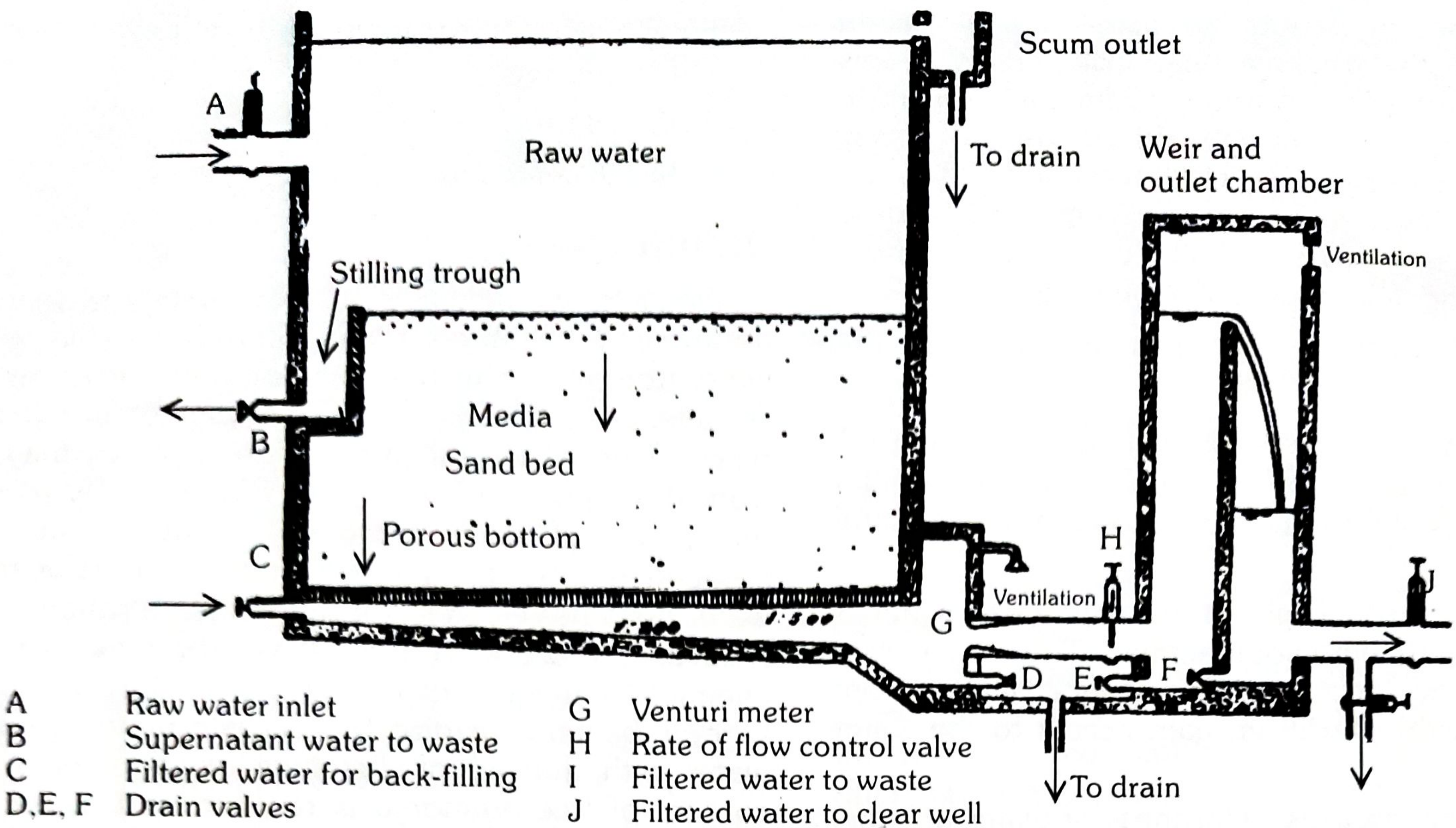
FIG. 4 - Slow Sand Filter (Park's SPM)
The filter box has 4 components (top to bottom):
(1) Supernatant (Raw) Water
- Depth: 1 to 1.5 metres above the sand bed
- Serves two purposes:
- Provides a constant head of water to overcome resistance and push water downward through the sand
- Provides a waiting period of some hours for further oxidation and particle agglomeration
- Level is always kept constant
(2) Sand Bed - THE MOST IMPORTANT PART
Dimensions:
- Thickness: ~1 metre (1.2 m in the filter box)
- Sand grain "effective diameter": 0.2 to 0.3 mm (finer than rapid sand filter)
- Sand must be clean, free from clay and organic matter, preferably rounded grains
- Below the sand: a layer of graded gravel 30-40 cm deep - supports the sand and prevents fine grains from entering drainage pipes
How purification happens in the sand bed:
Water percolates very slowly (takes 2 hours or more) and is subjected to:
- Mechanical straining
- Sedimentation
- Adsorption
- Oxidation
- Bacterial action
Rate of filtration: 0.1 to 0.4 m³/hour/m² of sand surface
The Vital Layer (Schmutzdecke) - THE HEART OF THE FILTER
This is the single most important examinable concept:
| Feature | Detail |
|---|---|
| Other names | Schmutzdecke, zoogleal layer, biological layer, vital layer |
| Nature | Slimy, gelatinous |
| Contents | Threadlike algae, plankton, diatoms, bacteria |
| Depth | Extends 2-3 cm into top portion of sand bed |
| Formation | Called "ripening" of the filter - takes several days |
| Functions | Removes organic matter; holds back bacteria; oxidizes ammoniacal nitrogen into nitrates; yields bacteria-free water |
Until the vital layer is fully formed, the first few days' filtrate is run to waste.
When newly laid, the filter acts only as a mechanical strainer - it is not truly "biological."
(3) Under-drainage System
- Located at the bottom of the filter bed
- Consists of porous or perforated pipes
- Dual purpose: (a) outlet for filtered water, and (b) supports the filter medium above
- Once laid, it cannot be seen
(4) Filter Control Valves
The filter box from top to bottom:
| Layer | Depth |
|---|---|
| Supernatant water | 1 to 1.5 m |
| Sand bed | 1.2 m |
| Gravel support | 0.30 m |
| Filter bottom | 0.16 m |
- Venturi meter - measures bed resistance ("loss of head")
- When loss of head exceeds 1.3 metres - uneconomical to run the filter
- Operator opens a regulating valve to maintain steady filtration rate
Filter Cleaning:
- Filter may run for weeks or even months without cleaning
- Cleaned by scraping the top 1-2 cm of sand - done by unskilled labourers or mechanical equipment
- After 20-30 scrapings, sand bed reduces to 0.5-0.8 m - then the plant is closed and a new bed is constructed (no backwashing like in rapid sand filter!)
Advantages of Slow Sand Filter
- Simple to construct and operate
- Cheaper to construct than rapid sand filters
- Physical, chemical, and bacteriological quality of filtered water is very high:
- Total bacterial count reduced by 99.9 to 99.99%
- E. coli reduced by 99 to 99.9%
Park's note: "A mistaken idea has grown that slow sand filtration is old fashioned and outdated - this is definitely not the case."
Comparison: Slow Sand vs Rapid Sand Filter
| Feature | Rapid Sand Filter | Slow Sand Filter |
|---|---|---|
| 1. Space | Occupies very little space | Occupies large area |
| 2. Rate of filtration | 200 m.g.a.d. | 2-3 m.g.a.d. |
| 3. Effective size of sand | 0.4-0.7 mm | 0.2-0.3 mm |
| 4. Preliminary treatment | Chemical coagulation + sedimentation | Plain sedimentation (storage) |
| 5. Washing | Backwashing | Scraping the sand bed |
| 6. Operation | Highly skilled | Less skilled |
| 7. Loss of head allowed | 6-8 feet (2-2.5 m) | 4 feet (1.5 m) |
| 8. Removal of turbidity | Good | Good |
| 9. Removal of colour | Good | Fair |
| 10. Removal of bacteria | 98-99% | 99.9-99.99% |
(Park's SPM, Table 3, p. 814-815)
Advantages of rapid sand filter OVER slow sand:
- Can deal with raw water directly - no preliminary storage needed
- Filter beds occupy less space
- Filtration is 40-50 times faster than slow sand
- Washing is easy (backwashing vs scraping)
- More flexibility in operation
Quick-Recall Memory Aid
Think "SMUDGE" for the Schmutzdecke/vital layer:
- Slimy gelatinous layer
- Microbial life (algae, diatoms, bacteria, plankton)
- Until formed, filtrate run to waste
- Depth: 2-3 cm into sand
- Grows during "ripening"
- Eliminates bacteria + oxidizes ammonia to nitrates
And remember the "0.2-0.3 rule" - slow sand uses finer sand (0.2-0.3 mm) vs rapid sand (0.4-0.7 mm).
This is a shared conversation. Sign in to Orris to start your own chat.