
SAQ on Dental Caries
Reading File
Now let me search the medical library for dental caries content.
Finding Sources
Finding Sources
Excellent. Now let me read the most relevant sections in parallel.
Reading File
Reading File
Reading File
Good. Let me read more of the microbiology text and the Scott-Brown continuation for treatment/prevention, plus fetch the cariogenesis diagram.
Reading File
Reading File
Loading Image
I now have comprehensive content from multiple authoritative textbooks. Let me also quickly read the microbiology section on prevention and the Jawetz text on plaque.
Reading File
Reading File
I now have more than sufficient content from multiple authoritative textbooks to write a thorough SAQ on dental caries. Let me compile the answer.
Short Answer Questions (SAQ): Dental Caries
Q1. Define dental caries and describe its pathophysiology.
Definition:
Dental caries is a dynamic, multifactorial, bacterial disease of teeth characterized by acid dissolution of calcified dental tissue, creating a dynamic imbalance between demineralization and remineralization in favour of the former. It results in progressive destruction of the mineralized tissues of the tooth progressing inward from the surface.
(Scott-Brown's Otorhinolaryngology Head & Neck Surgery)
Pathophysiology:
The process involves four interacting factors:
| Factor | Role |
|---|---|
| Dental plaque | Microbial biofilm adherent to tooth surface; creates a microenvironment that diminishes saliva's buffering/remineralizing action |
| Dental tissue | Risk factors include narrow fissures, pits, poor interdental contacts - all favour plaque accumulation |
| Saliva | Provides cleansing, antibacterial agents (lysozyme, sialoperoxidase, secretory IgA), and buffering/remineralization |
| Substrate | Refined carbohydrates (especially sucrose) fermented by plaque bacteria to produce organic acids |
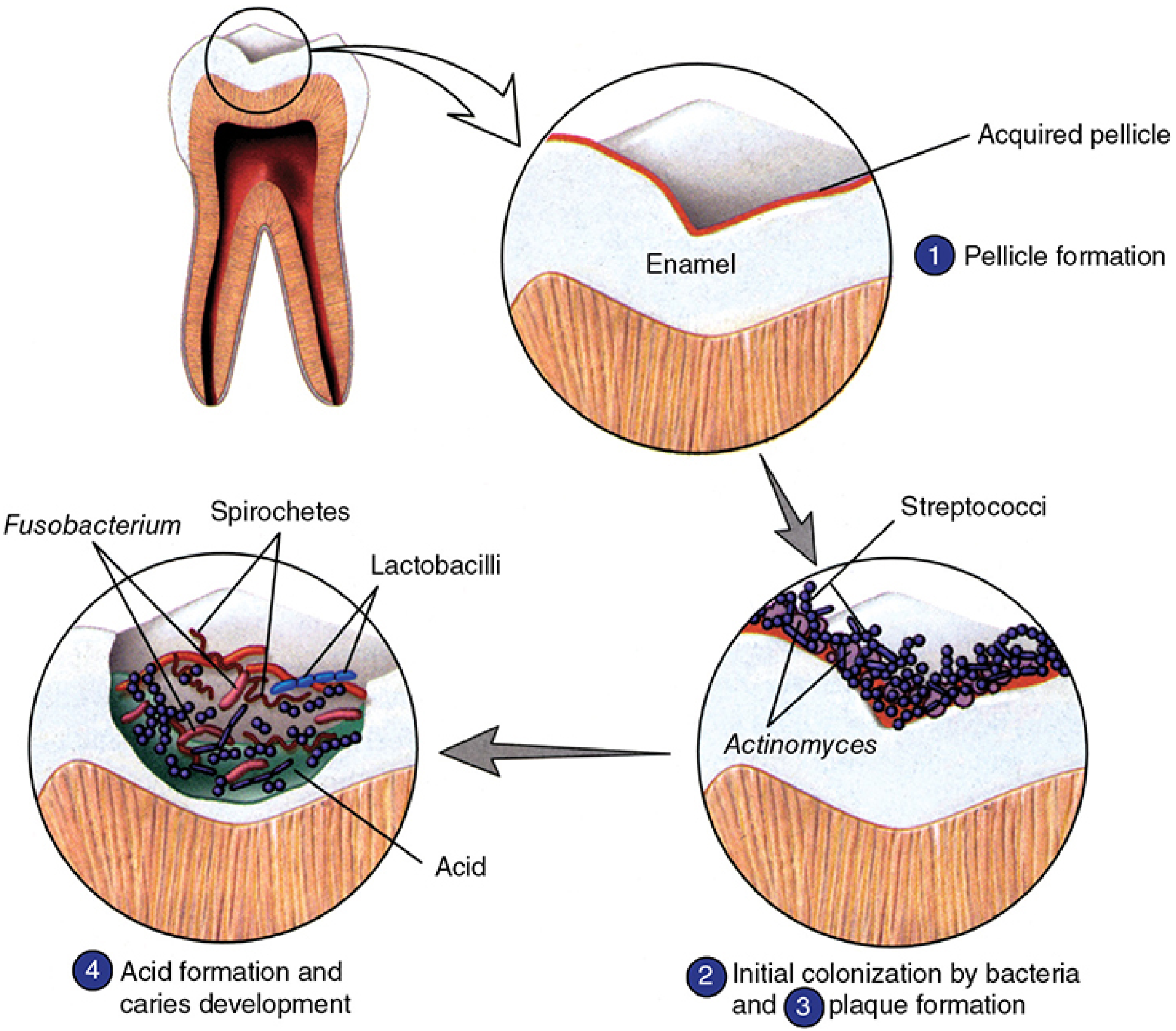
Stepwise process:
- Dental pellicle (salivary glycoproteins) forms on tooth surface
- Early colonization by streptococci and Actinomyces species
- Plaque biofilm matures (300-400 bacterial species)
- Bacteria (especially S. mutans) metabolize dietary carbohydrates - plaque pH drops below critical threshold - enamel hydroxyapatite dissolves to soluble calcium and phosphate ions
Q2. What are the stages of dental caries progression?
- Initial enamel lesion - acid permeates along enamel prism sheaths causing localized dissolution. No cavitation, no dentine involvement. This stage is reversible.
- Established enamel caries - lesion progresses toward the enamel-dentine junction
- Dentine caries - acid dissolution, proteolysis, and bacterial invasion of dentinal tubules
- Pulp involvement - infection and inflammation of dental pulp (pulpitis)
- Periapical spread - through root canals to periapical area: periapical abscess (acute), periapical granuloma (chronic non-suppurating), or sinus tract/cyst (chronic suppurating)
- Systemic spread - osteomyelitis of alveolar bone, fascial cellulitis of head and neck, or septic thrombophlebitis
(Sherris & Ryan's Medical Microbiology; Scott-Brown's Otorhinolaryngology)
Q3. What is the role of Streptococcus mutans in dental caries?
S. mutans is the dominant organism for initiation of caries. Its key virulence properties include:
- Efficient sucrose metabolism - metabolizes sucrose more efficiently than other oral bacteria
- Acid production - rapidly ferments dietary carbohydrates, dropping plaque pH to levels sufficient to demineralize hydroxyapatite
- Extracellular polyglycan synthesis - uses transferase enzymes to produce dextrans and levans from sucrose, promoting bacterial aggregation and adherence to tooth surface
- Intracellular glycogen storage - stores carbohydrate intracellularly, prolonging acidogenesis beyond oral clearance time of the dietary substrate
- Acid tolerance - survives long periods of sugar starvation and persists in low-pH environments
Other contributing organisms: S. salivarius, S. sanguis, S. sobrinus, Lactobacillus acidophilus, L. casei, Actinomyces viscosus, A. naeslundii.
(Sherris & Ryan's Medical Microbiology; Jawetz, Melnick & Adelberg's Medical Microbiology)
Q4. What is the demineralization-remineralization cycle?
- After carbohydrate intake, plaque bacteria produce acid rapidly - plaque pH drops, causing enamel demineralization
- As the substrate is exhausted, acid production stops and pH slowly returns to neutral
- Saliva provides calcium, phosphate and fluoride ions to remineralize the enamel surface
- With repeated snacking between meals, plaque pH may never return to normal - demineralization dominates and caries develops
- Foods high in sucrose that adhere to teeth (long oral clearance time) are more cariogenic than sugar-containing liquids
(Sherris & Ryan's Medical Microbiology)
Q5. What are the risk factors for dental caries?
Host factors:
- Newly erupted teeth (most susceptible before posteruptive maturation)
- Xerostomia (dry mouth) - loss of saliva's protective functions
- Narrow fissures, pits, poor interdental contact points
- Inadequate dental restoration margins
Microbial factors:
- Colonization by S. mutans and other acidogenic/aciduric organisms
- Mature plaque biofilm formation
Substrate factors:
- High intake of free/refined sugars (especially sucrose)
- Frequent snacking - repeated acid challenges
- Sticky, adherent foods with prolonged oral clearance time
Salivary factors:
- Reduced salivary flow (drugs, Sjogren's, radiation)
- Reduced buffering capacity
(Scott-Brown's; Sherris & Ryan's; Park's Preventive and Social Medicine)
Q6. What is the role of fluoride in prevention of dental caries?
Fluoride provides 50-60% reduction with water fluoridation and 35-40% reduction with topical application.
Mechanisms:
- Systemic fluoride - during tooth formation, fluoride ions replace hydroxyl ions in hydroxyapatite → forms fluorapatite, a more acid-resistant mineral phase
- Topical fluoride - surface dissolution of hydroxyapatite followed by recrystallization incorporating fluoride → more acid-resistant surface
- Inhibition of demineralization and promotion of remineralization of incipient carious lesions by fluoride ions in oral fluid - now considered the most important mechanism
"Fluoridation represents the most effective means known for rendering the tooth more resistant to the carious process."
(Sherris & Ryan's Medical Microbiology; Katzung's Pharmacology)
Q7. Outline the clinical diagnosis and management of dental caries.
Diagnosis:
- Visual and tactile inspection using blunt dental probes
- Dental radiographic examination
- Stages classified by surfaces involved: Class I (pits/fissures), Class II (interproximal), Class III/IV (anterior), Class V (cervical)
Management:
| Stage | Management |
|---|---|
| Initial enamel lesion (no cavitation) | Non-operative: fluoride application, plaque removal, dietary modification - reversible |
| Cavitated lesion with dentine involvement | Operative: removal of carious tissue + restoration to restore anatomy and prevent microbial ingress |
| Pulpitis | Root canal treatment or extraction |
| Periapical abscess | Drainage, antibiotics, root canal treatment or extraction |
| Spreading infection (cellulitis) | IV antibiotics, surgical drainage, hospital admission |
Prevention:
- Oral hygiene - toothbrushing, flossing, removal of plaque biofilm
- Dietary modification - reduce free sugar intake and snacking frequency
- Fluoride - water fluoridation, fluoride toothpaste, topical fluoride
- Fissure sealants for susceptible pits and fissures
- Regular dental review
(Scott-Brown's Otorhinolaryngology; Park's Preventive and Social Medicine; Sherris & Ryan's Medical Microbiology)
Q8. What are the complications of untreated dental caries?
Local complications:
- Pulpitis (reversible → irreversible)
- Pulp necrosis
- Periapical abscess
- Periapical granuloma
- Dental/periapical cyst (from epithelial rests of Malassez in periodontal ligament)
Spreading complications:
- Osteomyelitis of alveolar bone
- Facial cellulitis (fascial space infections of head and neck)
- Septic thrombophlebitis (via venous channels)
- Ludwig's angina (bilateral submandibular space infection)
Important note: Most oral infections from carious extension are mixed infections frequently including anaerobic organisms.
(Sherris & Ryan's Medical Microbiology)
Key Points Summary
- Dental caries = dynamic, multifactorial, bacterial disease driven by the plaque-acid-demineralization cycle
- Four factors: plaque, dental tissue, saliva, substrate
- Key organism: Streptococcus mutans (acidogenic, aciduric, adherent via glucans, prolongs acidogenesis via glycogen stores)
- Critical concept: demineralization-remineralization balance - tip it repeatedly toward demineralization = caries
- Reversible only at the enamel stage - once dentine is involved, operative treatment is required
- Fluoride is the most effective preventive measure
- Sucrose is the most cariogenic substrate
This is a shared conversation. Sign in to Orris to start your own chat.