
Scar ectopic pregnancy recent advances ni
I'll look up recent advances in cesarean scar ectopic pregnancy for you. Let me search the medical library and recent literature simultaneously.
Searching sources...
Reading File
Searching PubMed
cesarean scar ectopic pregnancy management
Searching the Web
cesarean scar ectopic pregnancy recent advances 2024 2025 treatment diagnosis
Now let me search the medical library and get key abstracts simultaneously.
Finding Sources
Reading Article
PMID: 37506758
Reading Article
PMID: 41061761
Finding Sources
Reading Article
PMID: 37379723
Reading Web Page
https://www.gynaecologyjournal.com/articles/1859/10-1-4-192.…
Let me now read the dedicated textbook section and fetch the ultrasound image.
Reading File
Reading File
Searching PubMed
cesarean scar pregnancy hysteroscopy HIFU uterine artery embolization
Now let me fetch the textbook ultrasound image and look for classification details.
Loading Image
Finding Sources
Searching PubMed
cesarean scar pregnancy classification ultrasound diagnosis 2024
Reading Article
PMID: 41449819
Reading Article
PMID: 38634558
Reading Article
PMID: 37326353
I now have excellent data from textbooks and latest literature. Here is a comprehensive, up-to-date review:
Cesarean Scar Ectopic Pregnancy (CSEP) - Recent Advances
Background & Rising Incidence
CSEP occurs when the embryo implants within the fibrotic tissue of a prior lower-segment cesarean incision. It was first documented in the 1970s but has become increasingly relevant as global cesarean rates have climbed - from 20.7% in 1996 to over 32% in recent years, a ~50% rise. Incidence among women with prior cesarean deliveries is now estimated at up to 1 in 500 pregnancies. CSEP is the rarest yet most dangerous form of ectopic pregnancy and is now recognized as a precursor to placenta accreta spectrum (PAS) if allowed to progress.
The 2026 comprehensive review by Farren et al. (Hum Reprod Update 2026) explicitly identifies the rapid rise in CSEP as one of the key developments requiring new terminology, classification, and management frameworks.
1. Pathogenesis - Recent Understanding
The fertilized ovum implants within the scar niche (isthmocele/uterine defect from prior CS). Two mechanisms are proposed:
- Microtracts theory: microscopic channels through the uterine scar allow trophoblast invasion
- Defective decidualization: the scar tissue lacks normal decidua, promoting deep trophoblastic invasion
The scar's poor vascularity and mechanical weakness predispose to uterine rupture and catastrophic hemorrhage.
2. Classification - Major Recent Development
The Delphi sonographic classification (Jordans et al., widely adopted 2023-2025) has replaced the older 2-type system and is now the internationally accepted framework:
| Type | Description | Growth Direction | Myometrial Thickness | Risk |
|---|---|---|---|---|
| Type 1 | Sac in niche, progressing toward uterine cavity | Endometrial cavity | >3.5 mm remaining | Lower |
| Type 2 | Sac embedded in niche, progressing toward bladder | Bladder wall | <=3.5 mm remaining | Higher |
| Type 3 | Sac deeply embedded in myometrium/niche | Bladder/serosa | Minimal/none | Highest |
A 2024 retrospective cohort by Yung et al. (J Ultrasound Med 2024, PMID 38634558) validated this system in 84 cases: Type 1 (71.4%), Type 2 (20.2%), Type 3 (8.3%). Surgical success was 97% vs 70% for medical management. Type 3 almost always required surgical resection with niche excision.
A landmark 2026 BJOG scoping review (Nijjar et al., PMID 41449819) found 8 different classification systems in the literature across 22 studies (1749 cases) and called for a universally accepted reference standard - this remains an ongoing challenge.
3. Diagnosis - Recent Advances
Transvaginal Ultrasound (TVS) - Gold Standard
TVS with color Doppler remains the primary and most accurate modality. Key diagnostic criteria:
- Gestational sac located at the anterior isthmus, at the level of the prior CS scar
- Empty uterine cavity and empty endocervical canal
- Surrounding circumferential color Doppler flow ("ring of fire" around sac)
- Minimal separation from the bladder wall
- Negative "sliding organs sign" - the sac does not move with gentle transducer pressure (highly specific, recently emphasized)
- Outward bulging of the gestational sac through the scar
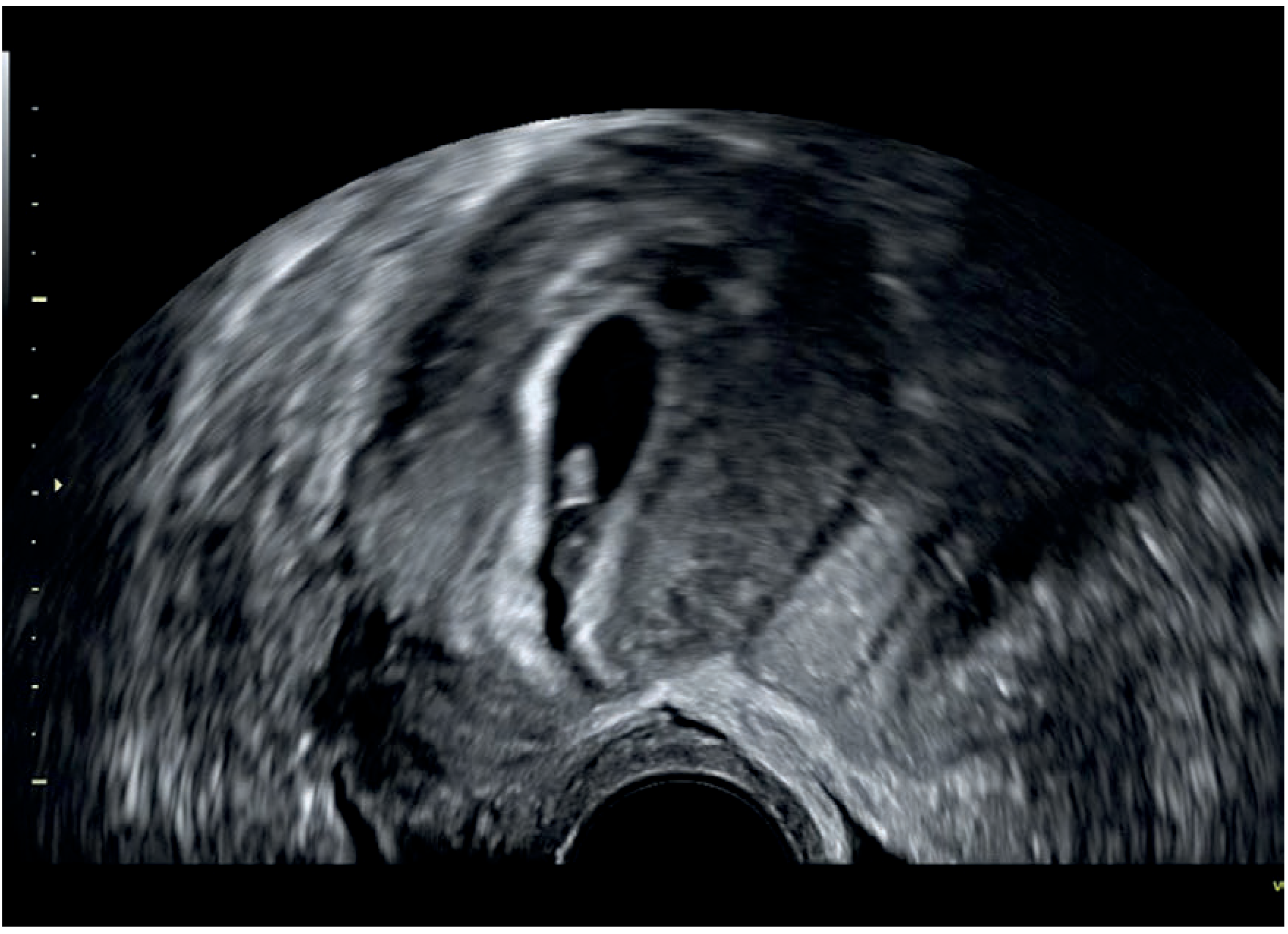
3D Ultrasound & SIS (Saline Infusion Sonography)
3D TVS allows better spatial mapping of the scar niche depth and residual myometrial thickness. This helps guide type classification and plan treatment.
MRI
Reserved for equivocal cases; particularly useful to delineate the extent of myometrial invasion and proximity to the bladder when PAS is suspected.
Emerging: AI-assisted Ultrasound
Pilot studies in 2024-2025 have explored machine-learning tools to improve first-trimester detection accuracy, though none are yet in routine clinical use.
4. Management - Recent Advances
No single treatment is universally superior. The approach is individualized by type, gestational age, cardiac activity, hemodynamic stability, and future fertility goals.
A. Medical Management
Methotrexate (MTX)
- Systemic MTX alone: ~56% success
- Local (intrasac) MTX injection: ~60% success
- Combined systemic + local MTX: ~77% success (best among medical-only options)
Recent AOGD 2025 data reports combined transvaginal KCl + MTX injection under ultrasound guidance as a promising approach for viable CSEPs with cardiac activity, directly eliminating cardiac function before MTX acts.
Key recent finding: MTX success is markedly lower for Type 2-3 CSPs, and for gestational ages >8 weeks with cardiac activity. MTX should only be offered to hemodynamically stable patients.
B. Surgical Management - Key Recent Advances
1. Hysteroscopic Resection (Biggest Recent Advance)
- The 2023 systematic review by Knapman et al. (Best Pract Res Clin Obstet Gynaecol, PMID 37379723) covering 6,720 CSP cases confirmed hysteroscopy as a major treatment modality, with vaginal and laparoscopic excisional approaches having the highest success rates.
- No-touch hysteroscopic mechanical resection (2025, Bademkiran et al.) - a novel single-session technique that avoids energy use and is emerging for early CSEPs.
- Hysteroscopy alone carries a ~62% risk of persistent trophoblastic disease; it should be combined with suction curettage.
2. Combined Double-Step Procedure (Increasingly Adopted)
- MTX (systemic) followed by vacuum aspiration (Type 1) OR resectoscopy (Type 2-3)
- The Damiani et al. 2024 series (PMID 37326353) reported this approach outperforming MTX alone or D&C alone
- For Type 2-3: UAE + resectoscopy is used to minimize hemorrhage risk
3. Ultrasound-Guided Vacuum Aspiration
- Success rate: ~76%, with 30% hemorrhage risk and 3% hysterectomy risk if performed alone (Berek & Novak's Gynecology)
- Best outcomes when preceded by MTX or UAE to reduce vascularity
4. Uterine Artery Embolization (UAE)
- UAE alone: ~81% success, 5% hemorrhage, 4% hysterectomy risk
- Used prophylactically before curettage/surgery in Type 2-3, or as rescue for hemorrhage
- MTX can be infused directly into uterine arteries at time of UAE (chemoembolization approach)
5. High-Intensity Focused Ultrasound (HIFU) - Emerging
- A 2025 retrospective cohort (Zhang et al.) compared HIFU vs UAE + laparoscopic excision for Type 3 CSEP and found comparable outcomes with HIFU being less invasive
- Not yet widely adopted; restricted to specialist centers in China
6. Laparoscopic/Open Excision with Scar Repair
- Reserved for Type 3 CSEPs, failed medical/minimally invasive treatment, or when fertility preservation is desired with simultaneous niche repair
- Advantage: removes the scar defect (niche), potentially reducing recurrence risk
7. Expectant Management
- The 2023 systematic review by Silva et al. (Eur J Obstet Gynecol, PMID 37421745) found expectant management viable only for non-viable, hemodynamically stable, declining beta-hCG CSEPs with close monitoring.
- Not appropriate for viable CSEPs; some cases proceed to term with extreme morbidity.
5. Special Situation: Heterotopic CSP
A 2025 systematic review (Sandulescu et al., Diagnostics) covering cases up to May 2025 identified heterotopic CSEP (coexisting intrauterine + scar ectopic) as a rising entity driven by ART use. Management is complex - the scar ectopic is treated with local KCl/MTX injection while preserving the intrauterine pregnancy.
6. Reproductive Outcomes
- Morlando et al. (Best Pract Res Clin Obstet Gynaecol 2023, PMID 37355427) reviewed reproductive outcomes after CSEP treatment: subsequent pregnancy is possible but carries elevated risks including PAS, uterine rupture, preterm delivery, and recurrent CSEP.
- Scar repair (niche resection) at time of CSEP excision may reduce recurrence risk - this concept is a growing focus of research.
- Repeat CSEP rate ranges from 4-22% in reported series.
7. Management Algorithm Summary
CSEP Diagnosed
     |
Hemodynamically unstable? --> Emergency UAE/Surgery/Hysterectomy
     |
     No
     |
Type 1 (niche, directed to cavity, myometrium >3.5mm)
  --> MTX (local ± systemic) OR vacuum aspiration ± MTX pretreatment
     |
Type 2 (bladder-directed, myometrium ≤3.5mm)
  --> Combined MTX + resectoscopy OR UAE + resectoscopy
     |
Type 3 (deeply embedded, viable, large)
  --> UAE + resectoscopy + niche repair OR laparoscopic/open excision
Key Points Summary
| Domain | Recent Advance |
|---|---|
| Classification | Delphi 3-type system (Jordans) now validated and widely adopted |
| Diagnosis | No universal reference standard yet; BJOG 2026 calls for consensus |
| Imaging | Negative sliding organs sign newly emphasized; 3D US and AI-assist emerging |
| Medical Rx | Combined local+systemic MTX shows ~77% success; KCl + MTX for viable CSEPs |
| Surgery | No-touch hysteroscopic resection (2025) is a novel single-session option |
| HIFU | Emerging alternative for Type 3 in specialist centers |
| UAE | Established as prophylactic/rescue; chemoembolization with MTX being explored |
| Expectant Rx | Viable in very selected non-viable CSEPs with declining hCG only |
| Fertility | Scar repair at time of excision may reduce recurrence; outcomes data growing |
Key References:
- Farren J et al. Hum Reprod Update 2026 (PMID 41061761) - comprehensive 2026 review
- Nijjar S et al. BJOG 2026 (PMID 41449819) - diagnostic criteria scoping review
- Yung KK et al. J Ultrasound Med 2024 (PMID 38634558) - Jordans classification validation
- Knapman BL et al. Best Pract Res Clin Obstet Gynaecol 2023 (PMID 37379723) - surgical management SR
- Lin R et al. Fertil Steril 2023 (PMID 37506758) - nuances in diagnosis & treatment
- Berek & Novak's Gynecology - CSP section, p. 1782
This is a shared conversation. Sign in to Orris to start your own chat.