
Mechanism of action and therapeutic uses of peripherally decarboxylase inhibitor... It's for four to 5 marks. Don't give too long, not too short.
Peripheral Decarboxylase Inhibitors (PDIs)
Mechanism of Action
- More levodopa reaches the brain (greater CNS bioavailability)
- Peripheral conversion to dopamine is markedly reduced
- Plasma half-life of levodopa is prolonged
- The required daily dose of levodopa is reduced by approximately 75% (fourfold to fivefold reduction)
Therapeutic Uses
-
Parkinson's Disease (primary use): PDIs are always co-administered with levodopa in Parkinson's disease (never used alone). The combination (levodopa + carbidopa) is considered first-line therapy and effectively reduces bradykinesia, rigidity, and tremors.
-
Reduction of peripheral side effects of levodopa: By preventing peripheral dopamine formation, PDIs significantly reduce levodopa-induced nausea, vomiting, postural hypotension, and cardiac arrhythmias.
-
Dose reduction: Allow substantially lower doses of levodopa to achieve the same therapeutic effect, minimizing dose-dependent toxicity.
-
Restless Legs Syndrome: The levodopa-carbidopa combination is also used in restless legs syndrome (RLS).
Key Point: PDIs have no therapeutic value on their own - their entire utility lies in enhancing the CNS delivery and tolerability of levodopa.
Can you give the mechanism of action in flowchart form? And, uh... Uses also not that long. Short to 6
A clean medical pharmacology flowchart showing the mechanism of action of peripheral decarboxylase inhibitors (carbidopa/benserazide). The flowchart should show: Levodopa given orally → without PDI: DOPA decarboxylase converts it to dopamine in periphery (cannot cross BBB, causes nausea, vomiting, arrhythmias) → with PDI (carbidopa/benserazide): peripheral decarboxylase is inhibited → more levodopa remains in blood → crosses blood-brain barrier → converted to dopamine in CNS by DOPA decarboxylase → dopamine acts on striatum → relieves Parkinson's symptoms. Clean white background, boxes and arrows, medical education style.
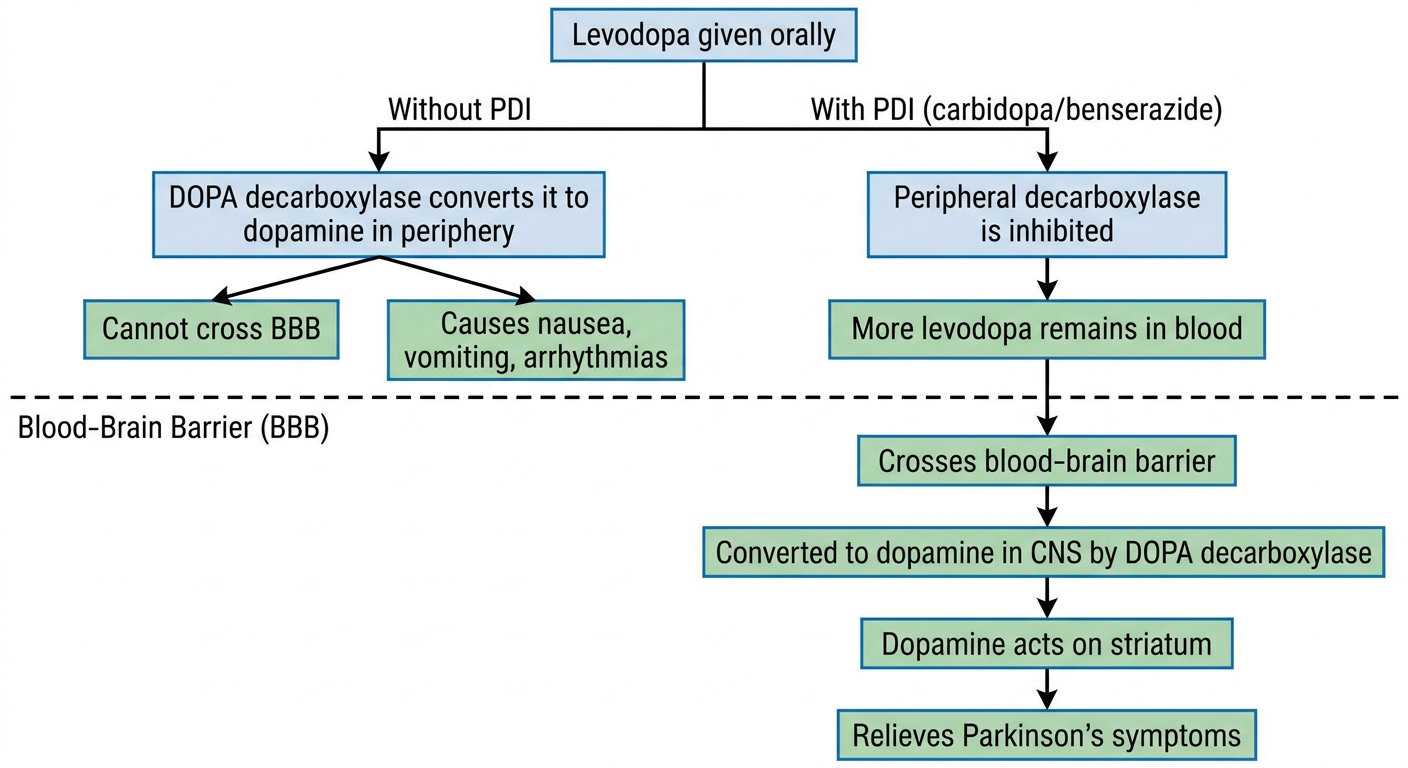
Therapeutic Uses (Short)
- Parkinson's disease - always combined with levodopa as first-line therapy
- Reduces peripheral side effects of levodopa (nausea, vomiting, hypotension, arrhythmias)
- Dose reduction - cuts levodopa requirement by ~75%
- Restless Legs Syndrome (RLS)
- Motor fluctuations in PD - extended-release forms help smooth "wearing-off" effects
- Post-encephalitic parkinsonism - parkinsonism secondary to other causes
I don't need the picture, you can give in the chat form. Mechanism of action of a peripherally decarboxylase inhibitor. And one more thing, in that, can I write? The mechanism of action of the levodopa?
Mechanism of Action of Peripheral Decarboxylase Inhibitors
- Nausea, vomiting
- Postural hypotension
- Cardiac arrhythmias
- More levodopa reaches the brain (CNS bioavailability ↑)
- Peripheral side effects ↓
- Dose of levodopa required reduced by ~75% (4-5 fold)
- Plasma half-life of levodopa prolonged
"See, the question is..." Write in detail about the Parkinson disease. And classification with example. Mechanism of action and therapeutic uses of peripherally decarboxylase inhibitor. So, I have learned all the Parkinson's part. I have to learn these, uh, mechanism of action and therapeutic uses. Recently, I have learned the levodopa mechanism of action, so I was thinking, "Can I write this?" But levodopa does not comes under the peripheral decarboxylase inhibitor. Carbidopa and benzodiazepines, uh, comes under the lev- peripheral decarboxylase inhibitor. So, that is why I am asking whether I can write or not.
How to write it in the exam:
"Levodopa, a precursor of dopamine, is given orally. It crosses the BBB and is converted to dopamine in the CNS. However, when given alone, most of it is decarboxylated to dopamine in the periphery."
"To overcome this, peripheral decarboxylase inhibitors like carbidopa and benserazide are co-administered. They inhibit DOPA decarboxylase in peripheral tissues without crossing the BBB, thus increasing CNS availability of levodopa and reducing peripheral side effects."
The rule to remember:
- Write levodopa MoA → only 1-2 lines, as background
- The bulk of your answer → PDI mechanism (that is what the examiner is asking)
- Do NOT write a full levodopa answer inside a PDI question - you will waste marks and time
Levodopa (oral) ↓ absorbed from gut ↓ crosses BBB via amino acid transporter ↓ converted to DOPAMINE by DOPA decarboxylase in CNS ↓ replenishes dopamine in striatum ↓ restores dopamine-acetylcholine balance → IMPROVEMENT of motor symptoms
Levodopa (oral)
    ↓ absorbed from gut
    ↓ ~97-99% converted to DOPAMINE in periphery
      by DOPA decarboxylase
    ↓ Peripheral dopamine CANNOT cross BBB
    → Nausea, vomiting, hypotension, arrhythmias
    → Very little levodopa reaches brain ❌
Levodopa (oral) + Carbidopa/Benserazide
    ↓
PDI inhibits DOPA decarboxylase in PERIPHERY
(PDI does NOT cross BBB - central enzyme spared)
    ↓
Less peripheral breakdown of levodopa
    ↓
More levodopa available in blood
    ↓
Crosses BBB via amino acid transporter
    ↓
Converted to DOPAMINE in CNS
    ↓
Replenishes dopamine in striatum
    ↓
Restores dopamine-acetylcholine balance
    → IMPROVEMENT of motor symptoms ✓
    → Peripheral side effects reduced ✓
    → Levodopa dose reduced by ~75% ✓
I am giving this for s- difference. Can you give this? Can you give the same for carboplatin? Enbrel, cerazette, I mean the pericaridyl carboxylase inhibitor. Mechanism of action.
- Carboplatin - this is a chemotherapy drug (cancer), not related to Parkinson's
- Enbrel - this is etanercept, a biologic for rheumatoid arthritis
- Cerazette - this is a contraceptive pill
- Carbidopa (combined with levodopa as Sinemet)
- Benserazide (combined with levodopa as Madopar)
- Difference between levodopa vs carbidopa (mechanism comparison) - which I can give as a side-by-side flowchart in text
- You meant a different drug name - could you say it again or spell it out?
Bro, I need flowchart. In charts form. Mechanism of action of a decarboxylase inhibitor and the therapeutic uses. Not too long, not too short, okay?
⚙️ MECHANISM OF ACTION
Peripheral Decarboxylase Inhibitors (Carbidopa / Benserazide)
Levodopa given orally
        ↓
Absorbed from small intestine
        ↓
WITHOUT PDI → DOPA decarboxylase (peripheral)
              converts levodopa → dopamine
              ↓
              Dopamine CANNOT cross BBB
              → Side effects (nausea, vomiting,
                hypotension, arrhythmias)
              → Very little reaches brain ❌

WITH PDI (Carbidopa/Benserazide)
        ↓
PDI inhibits DOPA decarboxylase in PERIPHERY
(PDI does NOT cross BBB → central enzyme intact)
        ↓
Peripheral breakdown of levodopa is blocked
        ↓
More levodopa survives in bloodstream
        ↓
Crosses BBB via amino acid transporter
        ↓
Converted to DOPAMINE in CNS
        ↓
Dopamine replenishes striatum
        ↓
Restores dopamine-acetylcholine balance
        ↓
   MOTOR SYMPTOMS IMPROVE ✓
💊 THERAPEUTIC USES
| Use | Detail |
|---|---|
| 1. Parkinson's disease | First-line; always combined with levodopa |
| 2. Reduce peripheral side effects | ↓ nausea, vomiting, hypotension, arrhythmias |
| 3. Dose reduction | Reduces levodopa dose by ~75% |
| 4. Restless Legs Syndrome (RLS) | Combined levodopa + carbidopa used |
| 5. Post-encephalitic parkinsonism | Secondary parkinsonism causes |
| 6. Motor fluctuations in PD | Extended-release forms reduce "wearing-off" |