
Cerebral resuscitation
Reading File
Cerebral resuscitation refers to the interventions aimed at limiting and reversing brain injury after cardiac arrest or other causes of global cerebral ischemia. Key concepts include targeted temperature management, restoration of cerebral perfusion, and neuroprotective strategies.
Searching sources...
Finding Sources
Finding Sources
Searching PubMed
cerebral resuscitation post-cardiac arrest neuroprotection
Good hits from Rosen's Emergency Medicine and Tintinalli's. Let me read those sections now.
Reading File
Reading File
Finding Sources
Searching PubMed
targeted temperature management cardiac arrest brain
Excellent content. Now let me read more of the Tintinalli post-cardiac arrest chapter and the Rosen's CPR section for TTM details, neurological prognostication, and post-resuscitation care.
Reading File
Reading File
Now let me get the TTM protocol details and neurological prognostication sections from Tintinalli, and the ventilation/oxygenation/ICP sections from Rosen's.
Reading File
Reading File
I now have comprehensive content. Let me fetch the diagram image from Tintinalli and compile the full answer.
Loading Image
Reading File
I now have all the content needed for a thorough, well-structured answer. Here is the comprehensive overview of cerebral resuscitation:
Cerebral Resuscitation
Cerebral resuscitation encompasses all strategies aimed at limiting secondary neurological injury and restoring neurological function after global cerebral ischemia - most commonly following cardiac arrest with return of spontaneous circulation (ROSC).
1. Pathophysiology: Ischemia-Reperfusion Injury
The brain is exquisitely sensitive to ischemia; cessation of blood flow for even a few minutes triggers a cascade of injury that may cause irreversible neurological damage.
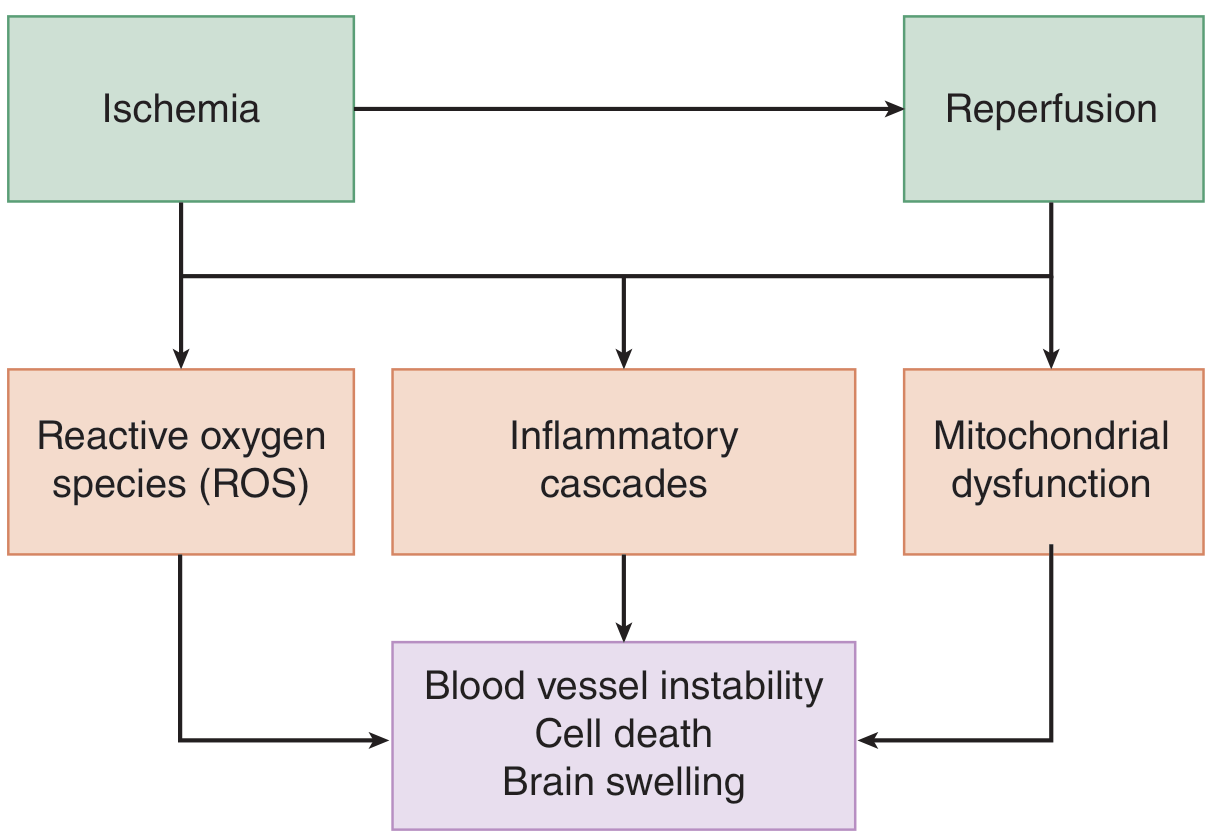
Figure: Postarrest pathophysiology (ischemia-reperfusion injury), showing how both ischemia and reperfusion drive three converging injury streams toward cell death and brain swelling. - Tintinalli's Emergency Medicine, Chapter 26
Cellular Level
- Mitochondrial dysfunction: cytochrome c release, disruption of oxidative phosphorylation, activation of programmed cell death pathways
- Reactive oxygen species (ROS): surge of superoxide and hydrogen peroxide overwhelms catalase and superoxide dismutase; lipid peroxidation and DNA damage
- Excitotoxicity: excess glutamate release leads to calcium influx and neuronal death
Humoral / Systemic Level
- Reperfusion triggers broad immune activation: IL-6, TNF-alpha elevation, aberrant neutrophil and platelet activation
- This "sepsis-like syndrome" (described by Adrie et al.) causes additional ROS production and vascular endothelial injury
- Vascular leak, loss of peripheral vascular resistance, intravascular volume depletion, and hypotension
Organ-Level Consequences
- Cerebral edema and raised intracranial pressure (ICP) - can cause herniation and death within the first 72 hours
- Myocardial stunning: global hypokinesis and reduced ejection fraction (usually transient, resolves over days)
- Post-resuscitation infection from bacterial translocation due to loss of intestinal integrity
- Adrenal insufficiency from ischemic adrenal injury
(Tintinalli's Emergency Medicine, Chapter 26; Rosen's Emergency Medicine, Chapter on CPR)
2. Priorities After ROSC
A. Restore and Maintain Cerebral Perfusion Pressure (CPP)
Cerebral autoregulation is frequently impaired after arrest; perfusion becomes passively dependent on systemic blood pressure. Hypotension dramatically worsens outcome.
| Target | Goal |
|---|---|
| MAP | >65 mm Hg (minimum); >80-100 mm Hg may be considered |
| SBP | >90 mm Hg |
| SpO2 | 94-98% (avoid hyperoxia) |
| PaCO2 | 35-45 mm Hg (avoid hypo- and hypercapnia) |
- Use IV fluids and vasopressors (norepinephrine preferred) to achieve MAP targets
- Avoid inducing hypertension due to risk of worsening vasogenic edema and disrupting the blood-brain barrier
- Loss of autoregulation means CBF changes of ~2% per 1 mm Hg PaCO2 change - hyperventilation acutely lowers ICP but causes cerebrovascular constriction and worsens ischemia if sustained
(Rosen's Emergency Medicine, p. 71-72)
B. Oxygenation and Ventilation
- Target normoxia - both hypoxia and hyperoxia worsen outcomes
- Target normocarbia (PaCO2 35-45 mm Hg)
- Hyperventilation (PaCO2 <30 mm Hg) reduces CBF by 2% per 1 mm Hg drop - appropriate only as a bridge to abort acute herniation, not as sustained therapy
- Titrated sedation (propofol preferred - reduces cerebral metabolic rate, clears rapidly for neurological assessment) or dexmedetomidine
- Avoid ventilator dyssynchrony and coughing (ICP spikes)
3. Targeted Temperature Management (TTM)
The cornerstone of cerebral resuscitation after cardiac arrest. Also called therapeutic hypothermia.
Mechanism of Benefit
Cooling reduces:
- Cerebral metabolic rate (8-13% per °C)
- Glutamate release and excitotoxicity
- Free radical production
- Cytoskeletal breakdown and blood-brain barrier disruption
- Inflammatory cascade activation
Evidence
The landmark European multicenter RCT showed that 24-hour TTM after out-of-hospital VF/VT arrest achieved a CPC score of 1-2 (awake, independent) in 55% of cooled patients vs. 39% controls (NNT ~8). Six-month mortality was 41% vs. 55%. (Tintinalli's, Chapter 26)
A subsequent large trial (TTM Trial) showed 32-33°C and 36°C produced similar outcomes - evidence favors preventing fever at minimum.
Target Temperature
- 32-36°C is the accepted range; most protocols target 33°C or 36°C
- Do not allow temperature to fall below 32°C (risk of arrhythmias)
- Maintain for 24 hours, then rewarm over 12-24 hours (rapid rewarming causes hypotension and electrolyte shifts)
Inclusion Criteria
- Post-ROSC with GCS motor score <6
- No other explanation for coma
- No DNR/DNI status
- Adult (age >17 years)
Exclusion Criteria
- Awake/alert after arrest
- Traumatic or hemorrhagic arrest
- Pre-arrest coma or vegetative state
- Pregnancy (relative)
(Not a contraindication: anticoagulation, non-shockable rhythm, long QT)
Practical Points
- Start cooling as early as possible in the ED; continue in the ICU/cath lab
- Use surface cooling devices or endovascular catheters with temperature probes (servo-control)
- Check electrolytes every 4 hours during cooling (hypokalemia from cold-mediated diuresis; hyperkalemia during rewarming)
- Maintain MAP >60 mm Hg throughout
- Prehospital cold saline infusion is NOT recommended - trials showed no benefit and possibly increased re-arrest rate
Complications
| More Common | Less Common |
|---|---|
| Bradycardia (often HR <50, usually benign) | Nonsustained VT |
| QT prolongation | Significant bleeding |
| Coagulopathy (PTT prolongation) | Skin ulceration |
| Hypokalemia (cooling) | |
| Hyperkalemia (rewarming) | |
| Shivering (treat with neuromuscular blockade if refractory) |
Special Populations
- Pediatric: No definitive benefit in children (unlike neonatal HIE where TTM is well-established). Avoid fever at minimum.
- Pregnancy: Multiple case reports of good outcomes; not an absolute exclusion.
- Cath lab: TTM can be safely continued during cardiac catheterization.
(Tintinalli's Emergency Medicine, Chapter 26)
4. ICP Management
Stepwise approach for elevated ICP in cerebral resuscitation:
- Head positioning: 30-degree head elevation; avoid flat position
- Analgesia and sedation: Fentanyl 25-50 mcg IV prn; propofol infusion (reduces CMRO2 and CBF); dexmedetomidine as alternative
- Normoventilation (PaCO2 35-45); brief hyperventilation (PaCO2 30-35) only for acute herniation as bridge
- Osmolar therapy: Mannitol (0.25-1 g/kg IV) or hypertonic saline (3% NaCl) - both draw water from brain
- CSF drainage via ventriculostomy if present
- Refractory ICP: Pentobarbital infusion (10 mg/kg load over 30 min, then 1-4 mg/kg/h) titrated to burst suppression on EEG; often requires vasopressors
- Surgical: Decompressive craniectomy for refractory cases (shown to reduce 6-month mortality by 22% in severe TBI, though without improvement in disability-free survival)
(Rosen's Emergency Medicine, pp. 71-72)
5. Neuroprognostication
Guidelines recommend waiting at least 72 hours before neurological prognostication (sedation and hypothermia confound neurological exam). Tools include:
| Tool | Notes |
|---|---|
| Clinical exam | Absent pupillary/corneal reflexes at 72h are concerning but not definitive |
| Head CT | Early - identify SAH, hematoma, degree of edema (early edema = poor sign) |
| EEG | Continuous monitoring; seizures in ~25% post-arrest; burst suppression pattern |
| Somatosensory evoked potentials (SSEPs) | Bilateral absence of N20 response at 48-72h = high specificity for poor outcome |
| NSE (neuron-specific enolase) | Serum biomarker; rising levels suggest injury severity |
| Brain MRI (DWI) | Most sensitive for anoxic injury; usually performed after 3-5 days |
Key principle: No single test in the ED can exclude full neurological recovery. Emergency physicians should actively prevent premature withdrawal of care based on an early pessimistic assumption. (Rosen's Emergency Medicine, p. 71)
6. Other Post-Resuscitation Care
- Early coronary angiography/PCI: Most appropriate for VF/VT arrest with suspected coronary occlusion; myocardial ischemia is the most common cause of SCA
- Glycemic control: Avoid hyperglycemia and hypoglycemia
- Seizure treatment: Treat clinical and electrographic seizures aggressively (benzodiazepines, levetiracetam, valproate); consider prophylaxis in selected cases
- Hemodynamic support: Echo to assess myocardial stunning; vasopressors/inotropes as needed; consider intra-aortic balloon pump or ECMO in refractory cardiogenic shock
- Fever avoidance: Hyperthermia (>37.6°C) after arrest dramatically worsens outcome; aggressive fever control even if full hypothermia is not initiated
Recent Evidence (2025-2026)
A 2025 systematic review (Seixas et al., Aust Crit Care 2025, PMID 40543347) confirmed that TTM remains a key strategy to minimize secondary brain injury after cardiac arrest. A parallel 2025 systematic review (Wang et al., Expert Rev Med Devices 2025, PMID 40693584) reviewed evolving cooling methods and devices. A 2026 systematic review (Parranto et al., Ther Hypothermia Temp Manag 2026, PMID 40956646) examined depth-dependent cytoprotection with therapeutic hypothermia for cerebral ischemia, supporting the view that deeper cooling may offer greater neuroprotection in select cases.
Summary: Cerebral resuscitation rests on four pillars - (1) restoring and maintaining adequate CPP with MAP >65 mm Hg, (2) normoxia and normocarbia, (3) targeted temperature management (32-36°C for 24h), and (4) stepwise ICP management. Neuroprognostication must wait at least 72 hours. No intervention in the early hours should be withheld based on an assumption of poor neurological outcome.
This is a shared conversation. Sign in to Orris to start your own chat.