
Functiona of muscarinic receptors
Reading File
Muscarinic receptors are G-protein-coupled receptors activated by acetylcholine (and muscarine), found throughout the body. They have 5 subtypes (M1-M5) with distinct functions. Let me get the full textbook details.
Searching sources...
Finding Sources
Finding Sources
Reading File
Reading File
Reading File
Reading File
Reading File
I now have comprehensive information. Let me compile the full answer.
Loading Image
Here is a complete, textbook-based answer on muscarinic receptor functions.
Functions of Muscarinic Receptors
Muscarinic receptors are G protein-coupled receptors (GPCRs) activated by acetylcholine (ACh) and muscarine. They are found on autonomic effector cells (primarily innervated by postganglionic parasympathetic neurons), in autonomic ganglia, vascular endothelium, and widely throughout the CNS. There are five subtypes - M1 through M5 - each encoded by a separate gene.
Signaling Mechanism
There are two major G-protein coupling patterns (see diagram below):
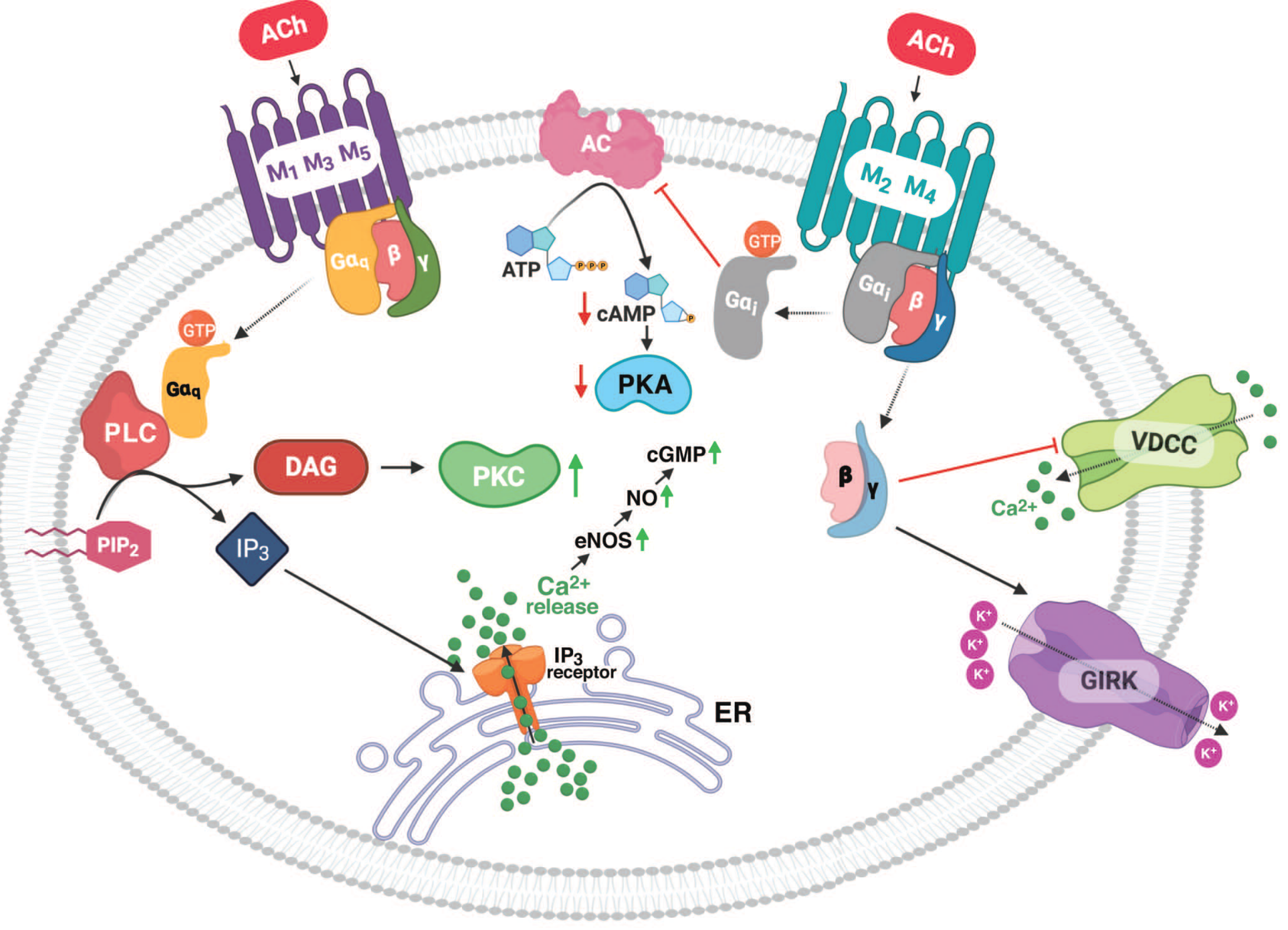
| Receptor Group | G-Protein | Downstream Pathway |
|---|---|---|
| M1, M3, M5 (odd) | Gq | Activates PLC → PIP2 hydrolysis → IP3 + DAG → ↑intracellular Ca²+ + PKC activation |
| M2, M4 (even) | Gi | Inhibits adenylyl cyclase → ↓cAMP → ↓PKA; also activates GIRK channels (K+ efflux) and inhibits VDCCs |
Cellular responses via muscarinic receptors are slow and prolonged compared to nicotinic receptors, because they are mediated through second messengers.
- Goodman & Gilman's Pharmacological Basis of Therapeutics, p. 227-228
- Medical Physiology (Boron & Boulpaep), p. 338
Subtype-Specific Functions
M1 - "Neural/Glandular"
- Located in: autonomic ganglia, CNS (hippocampus, cortex, striatum), gastric parietal cells
- Functions:
- CNS: involved in cognition, learning, and memory (major target in Alzheimer's disease research)
- Autonomic ganglia: modulates ganglionic transmission
- Gastric acid secretion: stimulates parietal cells to secrete HCl
- Coupling: Gq → PLC → ↑Ca²+ / PKC
M2 - "Cardiac"
- Located in: heart (SA node, AV node, atria), presynaptic terminals
- Functions:
- SA node: decreases heart rate (negative chronotropy) - hyperpolarizes cells, reduces spontaneous depolarization
- AV node: slows conduction velocity, prolongs refractory period (negative dromotropy)
- Atria: decreases contractility (negative inotropy), shortens action potential duration via ↑I(K-ACh)
- Presynaptic: acts as autoreceptor, inhibits further ACh release; also inhibits norepinephrine release
- Coupling: Gi → ↓cAMP; Gβγ → opens GIRK channels
M3 - "Smooth Muscle & Glandular"
- Located in: bronchial/tracheal smooth muscle, GI smooth muscle, detrusor (bladder), exocrine glands, vascular endothelium, iris (sphincter pupillae), ciliary muscle
- Functions:
- Respiratory: bronchoconstriction, increased tracheobronchial secretion
- Bladder: detrusor contraction (primary mediator of voiding/micturition)
- GI tract: increased motility, peristalsis, sphincter relaxation
- Salivary/lacrimal/sweat glands: stimulates secretion (main subtype)
- Vascular endothelium: activates eNOS → ↑NO → vasodilation (indirect, via endothelium)
- Eye: miosis (sphincter pupillae contraction), accommodation (ciliary muscle contraction)
- Coupling: Gq → PLC → ↑Ca²+
M4 - "CNS Modulation"
- Located in: CNS (striatum predominantly)
- Functions:
- Modulates dopaminergic activity in the basal ganglia
- Involved in motor control and pain modulation
- Like M2, acts as autoreceptor in some areas
- Coupling: Gi → ↓cAMP
M5 - "CNS/Vascular"
- Located in: CNS (substantia nigra, ventral tegmental area), iris, cerebral blood vessels
- Functions:
- Mediates ACh-induced dilation of cerebral blood vessels
- May modulate dopamine release in the midbrain reward pathways
- Least characterized subtype
- Coupling: Gq → PLC → ↑Ca²+
Organ-System Summary of Muscarinic Effects
| Organ | Effect | Primary Subtype |
|---|---|---|
| Heart (SA node) | ↓ Heart rate | M2 |
| Heart (AV node) | ↓ Conduction, ↑ refractory period | M2 |
| Bronchi | Bronchoconstriction, ↑ secretion | M3 |
| Bladder (detrusor) | Contraction (voiding) | M3 (+M2) |
| GI tract | ↑ Motility, ↑ secretion | M2, M3 |
| Exocrine glands | ↑ Salivation, lacrimation, sweating | M3 |
| Eye (iris) | Miosis (pupillary constriction) | M3 |
| Eye (ciliary) | Accommodation for near vision | M3 |
| Vascular endothelium | NO release → vasodilation | M3 |
| CNS | Cognition, memory, motor control | M1, M4, M5 |
Key Mnemonic
"M1 = Mind, M2 = Muscle of heart, M3 = Most organs (smooth muscle + glands)"
M4 and M5 are mainly CNS modulators with less established peripheral roles.
Clinical Relevance
- M2 blockade (atropine): treats bradycardia and AV block
- M3 blockade (tiotropium, ipratropium): treats COPD/asthma (bronchoconstriction)
- M3 blockade (oxybutynin, solifenacin): treats overactive bladder
- M1/M3 blockade causes dry mouth, constipation, urinary retention (classic anticholinergic side effects)
- M1 agonism/PAMs: under investigation for Alzheimer's disease
Goodman & Gilman's Pharmacological Basis of Therapeutics, pp. 226-231; Medical Physiology (Boron & Boulpaep), pp. 338-339
This is a shared conversation. Sign in to Orris to start your own chat.