
Learned Helplessness. SHORT NOTE 7MARKS ANSWER
"learned helplessness"
learned helplessness definition Seligman APA Dictionary Psychology
Learned Helplessness
Learned helplessness is a psychological state in which a person, after repeated exposure to unpleasant events that seem uncontrollable, learns to believe that their actions cannot change the outcome. They may then stop trying to escape, solve problems, or seek help, even when effective options later become available.
The concept was proposed by Martin Seligman. In classic animal experiments, dogs exposed to unavoidable electric shocks later failed to escape shocks even when escape was possible. They appeared passive and helpless.
Repeated uncontrollable failure or adversity produces the expectation: “Nothing I do will make a difference.” This expectation reduces motivation and effort. In humans, the effect is stronger when adverse events are interpreted as:
- Internal: “It is my fault.”
- Stable: “It will always be this way.”
- Global: “It affects every part of my life.”
- Reduced initiative and motivation
- Passivity and giving up easily
- Poor problem-solving
- Low self-esteem and feelings of inadequacy
- Hopelessness and pessimism
- Difficulty learning that a situation has changed
- Depressive symptoms, anxiety, and social withdrawal
A student who repeatedly fails examinations may stop studying because they think they can never succeed. A person in an abusive or highly controlling environment may feel unable to seek safety or support.
Learned helplessness is an important cognitive-behavioral model of depression. Uncontrollable negative experiences may lead to hopelessness, withdrawal, reduced activity, and depressed mood. However, it does not explain every case of depression.
- Encourage small, achievable goals and positive reinforcement
- Teach problem-solving and coping skills
- Challenge negative beliefs through cognitive-behavioral therapy
- Improve social support
- Help the person recognize areas where they have control
Add a simple diagram of Seligman’s experiment
Seligman learned helplessness experiment dogs uncontrollable shocks escape box
A simple educational diagram of Seligman's learned helplessness experiment. Show three labeled dog groups in a clean schematic: Group 1 no shock, Group 2 shock that can be stopped by pressing a panel, Group 3 unavoidable shock. Then show all groups in a shuttle box with a low barrier and a signal. Group 3 remains passive while Groups 1 and 2 jump across. Include arrows showing the experimental sequence. Avoid graphic depictions of suffering.
Simple diagram: Seligman’s Learned Helplessness Experiment
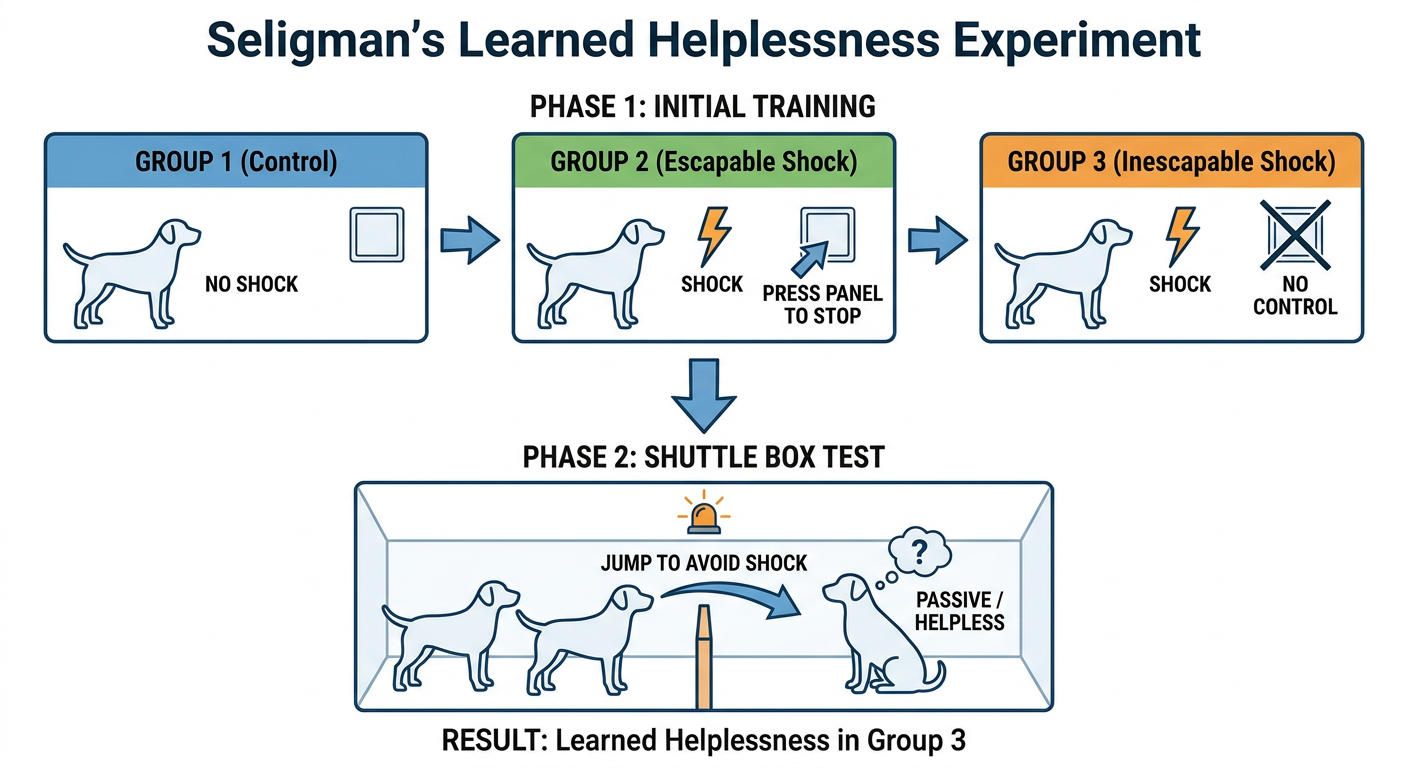
PHASE 1: Previous experience

Group 1                 Group 2                    Group 3
No shocks               Controllable shock          Uncontrollable shock
   │                    (action stops shock)        (action cannot stop shock)
   └──────────────┬───────────────┬──────────────────────┘
                  ↓

PHASE 2: Shuttle-box test
All dogs can escape the shock by jumping over a low barrier.

     Shocked side                 Safe side
  ┌─────────────────┐          ┌──────────────┐
  │       DOG       │  jump → │              │
  └─────────────────┘          └──────────────┘

Results:
Group 1 and Group 2  → attempt to escape
Group 3              → remains passive / does not attempt escape
                      ↓
              Learned helplessness
Raven's pragressive matrices 4page answer please
"Raven Progressive Matrices"
Raven's Progressive Matrices official assessment manual standard coloured advanced progressive matrices Pearson
Raven’s Progressive Matrices
Introduction
Definition
Simple representation of an item
   ○   ●   ○
   ●   ?   ●
   ○   ●   ○

Choose the figure that correctly completes the pattern.
Historical Background
- General factor (g factor): A general mental ability involved in all intellectual activities.
- Specific factors (s factors): Abilities that are specific to particular tasks.
Principle of the Test
- Observation
- Attention to detail
- Visual perception
- Pattern recognition
- Analogical reasoning
- Logical thinking
- Spatial reasoning
- Problem-solving
- Abstract reasoning
- Fluid intelligence
Example of the reasoning process
Figure 1 → Figure 2 → Figure 3

Small circle → Medium circle → Large circle

Rule: Size increases from left to right.
Therefore, the missing figure should be the next larger circle.
Types of Raven’s Progressive Matrices
1. Coloured Progressive Matrices (CPM)
- Young children
- Older adults
- Persons with intellectual disability
- Persons with language difficulties
- Individuals with neurological impairment
- Persons with limited educational exposure
2. Standard Progressive Matrices (SPM)
Set A → Set B → Set C → Set D → Set E
Easy                              Difficult
- School psychological assessment
- Educational guidance
- Selection and recruitment
- Group testing
- Research studies
- Assessment of non-verbal reasoning
3. Advanced Progressive Matrices (APM)
- Gifted students
- University students
- Professional selection
- Higher-level occupational assessment
- Research involving high-ability groups
Materials Required
- Test booklet
- Answer sheet
- Pencil or pen
- Stopwatch or clock, when timed administration is used
- Scoring key
- Manual with norms and interpretation guidelines
Administration
“In each pattern, one part is missing. Look carefully at the figures and choose the answer that best completes the pattern.”
Important points during administration
- The examinee should be seated comfortably in a quiet room.
- Adequate lighting should be provided.
- Visual impairment should be considered.
- Instructions should be standardized.
- The examiner should avoid coaching or prompting.
- The person should be encouraged to attempt every item.
- Behaviour during testing should be observed.
- Timing should follow the official manual for the selected form and purpose.
Scoring
Total raw score = Number of correct responses
- Age
- Educational level
- Cultural and language background
- Test version used
- Local population norms, when available
Example
Raw score: 45 out of 60

Interpretation:
The score must be compared with norms for the person's age group.
A score of 45 may have a different meaning in a 10-year-old,
a 20-year-old, and a 70-year-old.
Interpretation
High score may suggest
- Good abstract thinking
- Good non-verbal reasoning
- Ability to identify patterns quickly
- Strong problem-solving ability
- Good fluid intelligence
- Capacity to solve unfamiliar problems
Low score may be due to
- Low general intellectual functioning
- Poor attention or concentration
- Anxiety during testing
- Lack of motivation
- Visual impairment
- Neurological illness
- Fatigue
- Poor understanding of instructions
- Limited exposure to test-like tasks
- Severe psychiatric illness
Uses of Raven’s Progressive Matrices
1. Educational setting
2. Clinical psychology and psychiatry
- Intellectual disability
- Autism spectrum disorder
- Language disorder
- Hearing impairment
- Brain injury
- Dementia
- Delirium
- Schizophrenia
- Depression with cognitive slowing
- Neurological disorders
3. Occupational selection
4. Cross-cultural research
5. Neuropsychological assessment
Advantages
- Non-verbal: Requires minimal language ability.
- Easy to administer: Instructions are simple.
- Useful for groups: Can be given to several people at once.
- Wide age range: Different versions are available for different populations.
- Measures fluid reasoning: Assesses the ability to solve unfamiliar problems.
- Less dependent on formal schooling: Compared with heavily verbal tests, it places less emphasis on vocabulary and learned information.
- Useful in multicultural settings: Helpful where language barriers are present.
- Objective scoring: Answers are scored as correct or incorrect.
- Progressive difficulty: The arrangement of items helps assess a range of ability levels.
- Good research utility: Commonly used in psychological and cognitive research.
Limitations
- It does not measure all aspects of intelligence.
- It gives limited information about verbal intelligence, memory, academic achievement, practical skills, and social intelligence.
- It is not fully culture-free.
- Performance may be influenced by motivation, anxiety, fatigue, or poor attention.
- Visual impairment can affect test performance.
- Repeated testing may lead to practice effects.
- Incorrect interpretation may lead to unfair labeling.
- The test should not be used as the sole basis for diagnosis or major decisions.
- Proper norms are necessary for meaningful interpretation.
- Test materials and items are protected and should not be copied, publicly shared, or used without authorization.
Conclusion
Add a short comparison of CPM, SPM, and APM
Short Comparison: CPM, SPM and APM
| Feature | CPM | SPM | APM |
|---|---|---|---|
| Full form | Coloured Progressive Matrices | Standard Progressive Matrices | Advanced Progressive Matrices |
| Difficulty | Easy | Moderate | Difficult |
| Main target group | Young children, older adults, persons with intellectual or neurological difficulties | General population, school students, adolescents, and adults | Above-average and gifted adolescents/adults |
| Appearance | Uses coloured visual patterns | Uses black-and-white patterns | Uses complex black-and-white patterns |
| Main use | Assesses basic non-verbal reasoning | Assesses general non-verbal reasoning | Identifies high-level abstract reasoning ability |
| Ability range assessed | Lower range of ability | Average/general ability range | Higher range of ability |
| Clinical use | Useful where attention, language, or intellectual ability is limited | Commonly used in educational and psychological assessment | Useful in selection, giftedness assessment, and higher education settings |
CPM is for easier assessment, SPM is for the general population, and APM is for individuals with high intellectual ability. All three assess non-verbal abstract reasoning by asking the person to select the missing part of a visual matrix.
word document of what ever discussed so far.
~/
mkdir -p "/tmp/workspace/psychology-notes/src" "/tmp/workspace/psychology-notes/assets" "/tmp/workspace/psychology-notes/output" && curl -L "https://cdn.orris.care/image-gen/1345af2c880d440faa87c65dde30330b.png" -o "/tmp/workspace/psychology-notes/assets/seligman_experiment.png" && file "/tmp/workspace/psychology-notes/assets/seligman_experiment.png"
~/psychology-notes
python3 - <<'PY' from docx import Document from docx.shared import Inches, Pt, RGBColor from docx.enum.text import WD_ALIGN_PARAGRAPH from docx.enum.section import WD_SECTION from docx.enum.table import WD_TABLE_ALIGNMENT, WD_CELL_VERTICAL_ALIGNMENT from docx.oxml import OxmlElement from docx.oxml.ns import qn from docx.enum.style import WD_STYLE_TYPE from docx.enum.text import WD_BREAK from docx.enum.section import WD_ORIENT OUT='/tmp/workspace/psychology-notes/output/Psychology_Notes_Learned_Helplessness_and_Ravens_Progressive_Matrices.docx' IMG='/tmp/workspace/psychology-notes/assets/seligman_experiment.png' def set_cell_shading(cell, fill): tcPr=cell._tc.get_or_add_tcPr(); shd=OxmlElement('w:shd'); shd.set(qn('w:fill'), fill); tcPr.append(shd) def set_cell_text(cell, text, bold=False, color=None): cell.text=''; p=cell.paragraphs[0]; r=p.add_run(text); r.bold=bold if color: r.font.color.rgb=RGBColor(*color) r.font.size=Pt(10) def set_repeat_table_header(row): trPr=row._tr.get_or_add_trPr(); tblHeader=OxmlElement('w:tblHeader'); tblHeader.set(qn('w:val'),'true'); trPr.append(tblHeader) def add_page_number(paragraph): paragraph.alignment=WD_ALIGN_PARAGRAPH.CENTER run=paragraph.add_run('Page ') fld=OxmlElement('w:fldSimple'); fld.set(qn('w:instr'),'PAGE'); paragraph._p.append(fld) def add_bullets(doc, items): for x in items: doc.add_paragraph(x, style='List Bullet') doc=Document() sec=doc.sections[0] sec.top_margin=Inches(.7); sec.bottom_margin=Inches(.7); sec.left_margin=Inches(.75); sec.right_margin=Inches(.75) styles=doc.styles styles['Normal'].font.name='Arial'; styles['Normal']._element.rPr.rFonts.set(qn('w:eastAsia'),'Arial'); styles['Normal'].font.size=Pt(10.5) styles['Normal'].paragraph_format.space_after=Pt(5) for name,size,color in [('Title',22,(31,78,121)),('Heading 1',16,(31,78,121)),('Heading 2',13,(47,84,150)),('Heading 3',11,(47,84,150))]: s=styles[name]; s.font.name='Arial'; s.font.size=Pt(size); s.font.color.rgb=RGBColor(*color); s.font.bold=True s.paragraph_format.space_before=Pt(10); s.paragraph_format.space_after=Pt(5) # Header/footer header=sec.header.paragraphs[0]; header.text='PSYCHOLOGY NOTES'; header.alignment=WD_ALIGN_PARAGRAPH.RIGHT header.runs[0].font.size=Pt(9); header.runs[0].font.color.rgb=RGBColor(100,100,100) add_page_number(sec.footer.paragraphs[0]) # Cover t=doc.add_paragraph(); t.alignment=WD_ALIGN_PARAGRAPH.CENTER; t.space_after=Pt(14) r=t.add_run('PSYCHOLOGY NOTES'); r.bold=True; r.font.size=Pt(24); r.font.color.rgb=RGBColor(31,78,121) p=doc.add_paragraph(); p.alignment=WD_ALIGN_PARAGRAPH.CENTER r=p.add_run('Learned Helplessness and\nRaven’s Progressive Matrices'); r.font.size=Pt(18); r.bold=True; r.font.color.rgb=RGBColor(47,84,150) doc.add_paragraph('Short-note material plus expanded examination answer', style='Subtitle').alignment=WD_ALIGN_PARAGRAPH.CENTER doc.add_paragraph('\nPrepared from the discussion: definitions, Seligman’s experiment, applications, test forms, administration, scoring, uses, merits and limitations.').alignment=WD_ALIGN_PARAGRAPH.CENTER doc.add_paragraph('\n\n').alignment=WD_ALIGN_PARAGRAPH.CENTER doc.add_page_break() # LH doc.add_heading('1. Learned Helplessness', level=1) doc.add_heading('Definition', level=2) doc.add_paragraph('Learned helplessness is a psychological state in which a person, after repeated exposure to unpleasant events perceived as uncontrollable, comes to believe that personal actions cannot change the outcome. As a result, the person may stop trying to escape, solve problems, or seek help even when effective options later become available.') doc.add_heading('Origin and Basic Concept', level=2) doc.add_paragraph('The concept was developed by Martin Seligman from experimental work on avoidance learning. It was later used as an important cognitive-behavioural explanation for some depressive phenomena. The central learning is: “Nothing I do makes a difference.”') doc.add_heading('Seligman’s Experiment: Simple Diagram', level=2) p=doc.add_paragraph(); p.alignment=WD_ALIGN_PARAGRAPH.CENTER; p.add_run().add_picture(IMG, width=Inches(6.65)) cap=doc.add_paragraph('Figure 1. Simplified schematic of the learned helplessness experiment. The diagram is educational and does not reproduce test materials.'); cap.alignment=WD_ALIGN_PARAGRAPH.CENTER; cap.runs[0].italic=True; cap.runs[0].font.size=Pt(9) doc.add_paragraph('In the classic design, one group had no aversive stimulation, another experienced an event that could be stopped by an appropriate response, and a third experienced an event that could not be controlled. In a later shuttle-box task, escape was possible for all groups. Animals previously exposed to uncontrollable events often failed to attempt escape, whereas the other groups learned the escape response.') doc.add_heading('Mechanism', level=2) doc.add_paragraph('Repeated uncontrollable failure or adversity produces an expectation that outcomes are independent of one’s responses. This leads to three broad deficits:') add_bullets(doc,[ 'Cognitive deficit: expectation that effort will not alter the outcome.', 'Motivational deficit: reduced initiation, persistence and problem-solving.', 'Emotional deficit: hopelessness, anxiety, sadness or reduced emotional responsiveness.' ]) doc.add_heading('Attributional Reformulation', level=2) doc.add_paragraph('The effect is more likely to be associated with hopelessness and depression when adverse events are explained as:') add_bullets(doc,[ 'Internal: “It is because of me.”', 'Stable: “It will always be this way.”', 'Global: “It will affect every area of my life.”' ]) doc.add_heading('Clinical Features and Examples', level=2) add_bullets(doc,[ 'Passivity, low initiative and giving up easily.', 'Poor problem-solving and reduced effort despite opportunities for improvement.', 'Low self-esteem, pessimism and hopelessness.', 'Withdrawal from activities and reduced help-seeking.', 'A student who experiences repeated failures may stop studying because they assume success is impossible.', 'A person in an abusive or highly controlling environment may feel unable to seek safety or support.' ]) doc.add_heading('Relation to Depression', level=2) doc.add_paragraph('Learned helplessness is a model, not a complete explanation, of depression. Uncontrollable negative experiences may contribute to hopelessness, withdrawal, reduced activity and depressed mood. Depression is multifactorial and also involves biological, psychological and social influences.') doc.add_heading('Prevention and Management', level=2) add_bullets(doc,[ 'Set small, achievable goals so that the person experiences success and control.', 'Use positive reinforcement and graded tasks.', 'Teach coping and structured problem-solving skills.', 'Use cognitive-behavioural techniques to challenge negative and overgeneralized beliefs.', 'Strengthen social support and identify practical areas where control can be increased.' ]) # RPM doc.add_page_break() doc.add_heading('2. Raven’s Progressive Matrices', level=1) doc.add_heading('Introduction and Definition', level=2) doc.add_paragraph('Raven’s Progressive Matrices (RPM) is a standardized non-verbal, multiple-choice test of abstract reasoning. Developed by John C. Raven, it requires the examinee to identify the missing element in a pattern or matrix. The items progress from relatively simple to more difficult problems.') doc.add_paragraph('RPM mainly assesses non-verbal abstract reasoning, figural reasoning and fluid intelligence. It is often described as a measure of eductive ability: the ability to derive meaning, identify relationships and solve unfamiliar problems using logical analysis.') doc.add_heading('Theoretical Basis', level=2) doc.add_paragraph('The test is linked to Spearman’s concept of general intelligence, or the g factor. It is intended to assess a person’s capacity to recognise relationships and infer rules from unfamiliar visual material. It is not a complete measure of every aspect of intelligence.') doc.add_heading('Principle of the Test', level=2) doc.add_paragraph('Each item presents an incomplete pattern. The examinee studies changes in shape, direction, number, shading, size or position and selects the option that best completes the pattern. Difficulty increases as the number and complexity of underlying rules increase.') # sample boxed box=doc.add_table(rows=1, cols=1); box.alignment=WD_TABLE_ALIGNMENT.CENTER; cell=box.cell(0,0); set_cell_shading(cell,'EAF2F8'); set_cell_text(cell,'Example of rule: small circle → medium circle → large circle\nInference: size increases from left to right; choose the next larger circle.',False) doc.add_heading('Abilities Assessed', level=2) add_bullets(doc,['Visual perception and attention to detail','Pattern recognition and analogical reasoning','Logical and spatial reasoning','Abstract problem-solving','Fluid intelligence in a non-verbal format']) doc.add_heading('Main Forms of Raven’s Progressive Matrices', level=2) doc.add_paragraph('The principal forms are Coloured Progressive Matrices (CPM), Standard Progressive Matrices (SPM) and Advanced Progressive Matrices (APM). Selection depends on the examinee’s age, ability range, purpose of testing and the appropriate manual and norms.') table=doc.add_table(rows=1, cols=4); table.style='Table Grid'; table.alignment=WD_TABLE_ALIGNMENT.CENTER hdr=table.rows[0]; set_repeat_table_header(hdr) for c,txt in zip(hdr.cells,['Feature','CPM','SPM','APM']): set_cell_shading(c,'1F4E79'); set_cell_text(c,txt,True,(255,255,255)); c.vertical_alignment=WD_CELL_VERTICAL_ALIGNMENT.CENTER rows=[ ('Full form','Coloured Progressive Matrices','Standard Progressive Matrices','Advanced Progressive Matrices'), ('Difficulty','Easy','Moderate','Difficult'), ('Target group','Young children, older adults, and persons with limited ability or language difficulties','General population, school students, adolescents and adults','Above-average or gifted adolescents and adults'), ('Appearance','Coloured visual patterns','Usually black-and-white patterns','Complex black-and-white patterns'), ('Main use','Basic non-verbal reasoning','General non-verbal reasoning','High-level abstract reasoning'), ('Ability range','Lower range','Average/general range','Higher range'), ('Typical settings','Clinical and educational screening','Educational, psychological and research assessment','Giftedness, higher education and selection')] for row in rows: cells=table.add_row().cells for i,txt in enumerate(row): set_cell_text(cells[i],txt,bold=(i==0)); cells[i].vertical_alignment=WD_CELL_VERTICAL_ALIGNMENT.CENTER doc.add_heading('Administration', level=2) doc.add_paragraph('RPM can be administered individually or in groups. The examinee should be comfortable, able to see the material clearly and given standardized instructions. Practice items may be used according to the official manual. The examiner should avoid coaching and should observe attention, pace, frustration tolerance, impulsivity and method of problem-solving.') add_bullets(doc,['Quiet room with adequate lighting and minimal distraction.','Clear, simple and standardized instructions.','Use the version appropriate for the person and purpose.','Follow manual directions on timing, discontinuation and scoring.','Record behavioural observations as well as the final score.']) doc.add_heading('Scoring and Interpretation', level=2) doc.add_paragraph('Each correct response receives one mark. The total correct responses give a raw score. The raw score must be converted using current, appropriate normative data for the selected version. Interpretation may include percentile rank, standard score or grade, depending on the manual.') doc.add_paragraph('A high score supports stronger non-verbal abstract reasoning. A low score is non-specific and may reflect reduced reasoning ability, poor attention, anxiety, fatigue, visual impairment, low motivation, misunderstanding of instructions or neurological and psychiatric factors. RPM alone must not be used to diagnose intellectual disability, learning disorder, dementia or any psychiatric condition.') doc.add_heading('Uses', level=2) add_bullets(doc,['Educational assessment of non-verbal reasoning and learning support needs.','Assessment of giftedness and higher reasoning ability.','Clinical and neuropsychological assessment when verbal tests are unsuitable.','Assessment in language-diverse settings or with hearing/language difficulties.','Occupational selection and research.']) doc.add_heading('Advantages', level=2) add_bullets(doc,['Minimal language requirement.','Relatively simple administration and objective scoring.','Different forms cover a broad range of ability.','Useful where verbal assessment may be limited.','Focuses on solving unfamiliar visual problems.']) doc.add_heading('Limitations', level=2) add_bullets(doc,['Does not measure all aspects of intelligence, including verbal knowledge, memory, adaptive functioning and academic achievement.','Not entirely culture-free: education, familiarity with tests and socioeconomic context can influence performance.','Affected by attention, motivation, anxiety, fatigue and visual impairment.','Practice effects may occur with repeated testing.','Requires trained administration and interpretation with appropriate norms.']) doc.add_heading('Conclusion', level=2) doc.add_paragraph('Raven’s Progressive Matrices is an important non-verbal measure of abstract and fluid reasoning. CPM is best for easier assessment, SPM is intended for the general ability range, and APM is designed for higher ability ranges. Results are most meaningful when interpreted by a qualified professional together with history, behavioural observations and other psychological or clinical findings.') doc.add_page_break() doc.add_heading('Quick Revision Points',level=1) doc.add_heading('Learned Helplessness',level=2) add_bullets(doc,['Developed by Martin Seligman.','Repeated uncontrollable adverse events lead to a belief that responses do not influence outcomes.','Produces cognitive, motivational and emotional deficits.','Related to hopelessness and depression.','Management focuses on restoring agency through graded success, CBT, problem-solving and support.']) doc.add_heading('Raven’s Progressive Matrices',level=2) add_bullets(doc,['Developed by John C. Raven.','Non-verbal test of abstract reasoning and fluid intelligence.','Task: select the missing element in a visual matrix.','CPM = easy; SPM = general/average; APM = difficult/high ability.','Interpret raw scores only with appropriate standardized norms and clinical context.']) doc.add_heading('References',level=1) doc.add_paragraph('Kaplan & Sadock’s Comprehensive Textbook of Psychiatry. Sections on non-verbal and language-free ability tests, and learned helplessness model.') doc.add_paragraph('Pearson Clinical Assessment. Raven’s Progressive Matrices product and manual information.') doc.save(OUT) print(OUT) PY python3 - <<'PY' from docx import Document p='/tmp/workspace/psychology-notes/output/Psychology_Notes_Learned_Helplessness_and_Ravens_Progressive_Matrices.docx' d=Document(p) print('paragraphs',len(d.paragraphs),'tables',len(d.tables),'sections',len(d.sections)) print('size',__import__('os').path.getsize(p)) PY
- Learned Helplessness short note
- Seligman’s experiment diagram
- Raven’s Progressive Matrices detailed answer
- CPM, SPM, and APM comparison table
- Quick revision points and references
James lange theory of emotions short note and critically evaluated this....in detail
"James-Lange theory" emotion
James Lange theory of emotion critical evaluation Cannon Bard facial feedback interoception review
James-Lange Theory of Emotion
Introduction
We do not tremble because we are afraid. We feel afraid because we notice that we are trembling.
Central Proposition
Sequence of events
Emotion-producing stimulus
          ↓
Physiological and behavioural changes
          ↓
Perception of bodily changes
          ↓
Conscious emotional experience
Example: Seeing a snake
Snake is seen
     ↓
Heart rate increases, muscles tense, sweating occurs,
breathing becomes rapid, and the person moves away
     ↓
Person perceives these bodily changes
     ↓
Experience of fear
| Common-sense view | James-Lange view |
|---|---|
| See snake → feel fear → run and tremble | See snake → run and tremble → feel fear |
| Stimulus → emotion → bodily reaction | Stimulus → bodily reaction → emotion |
Meaning of “Bodily Changes”
- Increased or decreased heart rate
- Change in breathing rate
- Sweating
- Trembling
- Muscle tension or relaxation
- Changes in blood pressure
- Flushing or pallor
- Crying
- Facial expressions
- Changes in posture and body movement
- Sensations from internal organs, called visceral sensations
Examples
1. Fear
Threatening animal is seen
        ↓
Palpitations + sweating + trembling + running away
        ↓
Awareness of these responses
        ↓
Fear is felt
2. Sadness
Loss or disappointing event
        ↓
Crying + slow movements + reduced energy + bodily heaviness
        ↓
Awareness of these changes
        ↓
Feeling of sadness
3. Anger
Insult or frustration
        ↓
Muscle tension + clenched fists + flushed face + rapid pulse
        ↓
Awareness of bodily arousal
        ↓
Feeling of anger
Main Assumptions of the Theory
-
Emotion follows bodily response.
Physiological reactions are not merely effects of emotion. They are an important cause of the conscious emotional feeling. -
Different emotions are associated with different patterns of bodily response.
For example, fear, anger, sadness, and joy are assumed to involve different bodily sensations and actions. -
Awareness of the body is essential for emotional experience.
If bodily feedback is absent or greatly reduced, emotional experience should be weaker or altered. -
The body and brain are closely connected in emotional life.
Emotional feelings are influenced by sensory feedback from muscles, facial expressions, viscera, and the autonomic nervous system.
Critical Evaluation of James-Lange Theory
Merits and Supporting Points
1. It emphasized the role of the body in emotion
2. It laid the foundation for later emotion research
- Autonomic nervous system activity
- Facial expressions
- Body posture
- Interoception, meaning perception of internal bodily signals
- Brain-body interaction
- Physiological correlates of emotion
3. It is partly supported by facial-feedback findings
Smiling facial expression
        ↓
Feedback from facial muscles
        ↓
May slightly increase the feeling of positive emotion
4. It is consistent with the importance of interoception
5. It has practical relevance
Anxiety
   ↓
Slow breathing and muscle relaxation
   ↓
Reduced sympathetic arousal
   ↓
Possible reduction in anxious feeling
Criticisms and Limitations
1. Similar bodily arousal occurs in different emotions
- Fear
- Anger
- Excitement
- Sexual arousal
- Intense exercise
- Anxiety
- Joy
Rapid heartbeat + sweating
          ↓
Could mean fear, anger, excitement, anxiety, or exercise
2. Physiological changes may be too slow
3. Bodily changes are not sufficiently specific
| Bodily response | Possible emotional meaning |
|---|---|
| Fast heart rate | Fear, anger, excitement, joy, panic |
| Sweating | Anxiety, embarrassment, heat, exercise |
| Trembling | Fear, cold, anger, fatigue |
| Crying | Sadness, joy, pain, relief, frustration |
4. Emotion can occur even when bodily feedback is reduced
5. Artificially producing bodily arousal does not always produce a specific emotion
Bodily arousal + interpretation of situation
                  ↓
             Emotional label
6. The theory underestimates cognition and appraisal
Low examination score
      ↓
Student A: “I can improve next time.” → disappointment but motivation
Student B: “I am a complete failure.” → shame and hopelessness
Student C: “The marking was unfair.” → anger
7. It does not adequately explain complex emotions
- Guilt
- Shame
- Jealousy
- Pride
- Gratitude
- Nostalgia
- Moral outrage
- Embarrassment
8. The original theory is too linear
Stimulus → bodily response → emotion
Stimulus
   ↓
Brain appraisal and interpretation
   ↔
Autonomic arousal, facial expression, action tendency
   ↔
Awareness of body and conscious emotional feeling
- Brain systems
- Autonomic nervous system
- Hormonal responses
- Sensory feedback from the body
- Thoughts and appraisals
- Memory
- Social and cultural context
- Behaviour and facial expression
Comparison with Cannon-Bard Theory
| Feature | James-Lange Theory | Cannon-Bard Theory |
|---|---|---|
| Sequence | Stimulus → bodily response → emotion | Stimulus → emotion and bodily response occur together |
| Role of body | Bodily feedback produces the emotional feeling | Bodily response accompanies emotion but does not cause it |
| Main emphasis | Peripheral physiological feedback | Central brain processing |
| Example of fear | “I feel fear because I tremble.” | “I feel fear and tremble at the same time.” |
| Major limitation addressed | Does not explain rapid and cognitively interpreted emotions well | Does not fully explain the contribution of bodily feedback |
Present-Day View
Bodily sensations and physiological feedback influence the intensity, quality, and awareness of emotions.
- Body-based processes: autonomic arousal, facial expression, posture, hormonal changes, and interoception.
- Brain-based and cognitive processes: appraisal of the situation, memory, attention, meaning, language, and social context.
Conclusion
word docuemnt
~/
mkdir -p "/tmp/workspace/james-lange-theory/src" "/tmp/workspace/james-lange-theory/output" && python3 - <<'PY' from docx import Document from docx.shared import Inches, Pt, RGBColor from docx.enum.text import WD_ALIGN_PARAGRAPH from docx.enum.table import WD_TABLE_ALIGNMENT, WD_CELL_VERTICAL_ALIGNMENT from docx.oxml import OxmlElement from docx.oxml.ns import qn from docx.enum.style import WD_STYLE_TYPE import os OUT='/tmp/workspace/james-lange-theory/output/James_Lange_Theory_of_Emotion_Critical_Evaluation.docx' def shade(cell, fill): tcPr = cell._tc.get_or_add_tcPr(); shd = OxmlElement('w:shd'); shd.set(qn('w:fill'), fill); tcPr.append(shd) def set_cell(cell, text, bold=False, color=None): cell.text=''; p=cell.paragraphs[0]; r=p.add_run(text); r.bold=bold; r.font.size=Pt(9.5) if color: r.font.color.rgb=RGBColor(*color) def header(row): trPr=row._tr.get_or_add_trPr(); el=OxmlElement('w:tblHeader'); el.set(qn('w:val'),'true'); trPr.append(el) def add_page_no(p): p.alignment=WD_ALIGN_PARAGRAPH.CENTER; p.add_run('Page ') fld=OxmlElement('w:fldSimple'); fld.set(qn('w:instr'),'PAGE'); p._p.append(fld) def bullets(items): for item in items: doc.add_paragraph(item, style='List Bullet') def flow_box(lines, fill='EAF2F8'): tbl=doc.add_table(rows=1,cols=1); tbl.alignment=WD_TABLE_ALIGNMENT.CENTER c=tbl.cell(0,0); shade(c,fill); c.text='' for i,line in enumerate(lines): p=c.paragraphs[0] if i==0 else c.add_paragraph() p.alignment=WD_ALIGN_PARAGRAPH.CENTER; r=p.add_run(line); r.bold=True if line=='↓' else False; r.font.size=Pt(11) # page setup doc=Document(); s=doc.sections[0] s.top_margin=Inches(.65); s.bottom_margin=Inches(.65); s.left_margin=Inches(.78); s.right_margin=Inches(.78) normal=doc.styles['Normal']; normal.font.name='Arial'; normal._element.rPr.rFonts.set(qn('w:eastAsia'),'Arial'); normal.font.size=Pt(10.5); normal.paragraph_format.space_after=Pt(5) for n,sz,col in [('Title',23,(31,78,121)),('Heading 1',16,(31,78,121)),('Heading 2',13,(47,84,150)),('Heading 3',11,(47,84,150))]: st=doc.styles[n]; st.font.name='Arial'; st.font.size=Pt(sz); st.font.color.rgb=RGBColor(*col); st.font.bold=True; st.paragraph_format.space_before=Pt(10); st.paragraph_format.space_after=Pt(5) # header footer hp=s.header.paragraphs[0]; hp.text='PSYCHOLOGY NOTES'; hp.alignment=WD_ALIGN_PARAGRAPH.RIGHT; hp.runs[0].font.size=Pt(9); hp.runs[0].font.color.rgb=RGBColor(100,100,100) add_page_no(s.footer.paragraphs[0]) # cover p=doc.add_paragraph(); p.alignment=WD_ALIGN_PARAGRAPH.CENTER; r=p.add_run('JAMES-LANGE THEORY\nOF EMOTION'); r.bold=True; r.font.size=Pt(25); r.font.color.rgb=RGBColor(31,78,121) p=doc.add_paragraph(); p.alignment=WD_ALIGN_PARAGRAPH.CENTER; r=p.add_run('Detailed short note with critical evaluation'); r.italic=True; r.font.size=Pt(15); r.font.color.rgb=RGBColor(47,84,150) doc.add_paragraph('\nA structured examination answer covering the concept, sequence, examples, merits, criticisms, comparison with Cannon-Bard theory, and current view.').alignment=WD_ALIGN_PARAGRAPH.CENTER doc.add_paragraph('\nWilliam James (1884) and Carl Lange (1885)').alignment=WD_ALIGN_PARAGRAPH.CENTER doc.add_page_break() # content doc.add_heading('1. Introduction',1) doc.add_paragraph('The James-Lange theory is one of the earliest physiological theories of emotion. It was proposed independently by William James in 1884 and Carl Lange in 1885. The theory states that a person experiences an emotion after perceiving changes occurring in the body. Thus, bodily reactions are not merely the result of emotion; awareness of those reactions forms an important part of emotional experience.') doc.add_heading('2. Central Proposition',1) doc.add_paragraph('The central idea can be expressed as follows:') flow_box(['Emotion-producing stimulus','↓','Physiological and behavioural changes','↓','Perception of bodily changes','↓','Conscious emotional experience']) doc.add_paragraph('In simple words: we do not tremble because we are afraid; we feel afraid because we notice that we are trembling. This reverses the common-sense view that emotion comes first and the body reacts afterwards.') t=doc.add_table(rows=1,cols=2); t.style='Table Grid'; t.alignment=WD_TABLE_ALIGNMENT.CENTER; header(t.rows[0]) for cell,txt in zip(t.rows[0].cells,['Common-sense view','James-Lange view']): shade(cell,'1F4E79'); set_cell(cell,txt,True,(255,255,255)) for a,b in [('See a snake → feel fear → tremble/run','See a snake → tremble/run → feel fear'),('Stimulus → emotion → bodily response','Stimulus → bodily response → emotion')]: cells=t.add_row().cells; set_cell(cells[0],a); set_cell(cells[1],b) doc.add_heading('3. Bodily Changes Included',1) doc.add_paragraph('The theory gives importance to feedback from the body, including changes mediated by the autonomic nervous system and feedback from muscles and facial expression. These changes may include:') bullets(['Increased heart rate and blood pressure','Rapid or shallow breathing','Sweating and trembling','Muscle tension or relaxation','Flushing or pallor','Changes in posture, facial expression and movement','Crying, laughter and other expressive acts','Visceral sensations, such as a “butterflies in the stomach” feeling']) doc.add_heading('4. Examples',1) doc.add_heading('Fear',2) flow_box(['Threatening stimulus, for example a snake','↓','Palpitations, sweating, trembling, muscle tension and running away','↓','Awareness of these changes','↓','Experience of fear'],'FFF2CC') doc.add_heading('Anger',2) doc.add_paragraph('An insult or frustration may lead to clenched fists, tense muscles, a flushed face and a rapid pulse. The awareness of these bodily changes is experienced as anger.') doc.add_heading('Sadness',2) doc.add_paragraph('Loss or disappointment may be followed by crying, slow movements, reduced energy and a feeling of bodily heaviness. Perception of these changes contributes to the feeling of sadness in this theory.') doc.add_heading('5. Assumptions',1) bullets(['Bodily changes precede the conscious feeling of emotion.','Different emotions are assumed to have different patterns of bodily and behavioural changes.','Perception of bodily feedback is important for the emotional experience.','Emotion is closely linked to autonomic arousal, muscular activity, facial expression and visceral sensation.']) doc.add_heading('6. Critical Evaluation',1) doc.add_heading('A. Merits and Contributions',2) doc.add_heading('1. Emphasized the role of the body',3) doc.add_paragraph('The theory was important because it treated emotion as an embodied experience. It drew attention to the fact that emotion is commonly accompanied by palpitations, sweating, crying, changes in posture and facial expression, rather than being only a mental event.') doc.add_heading('2. Stimulated research',3) doc.add_paragraph('It encouraged research on autonomic arousal, facial feedback, interoception, emotional expression, and brain-body interaction. Modern emotion research still examines how awareness of heart rate, breathing, and other internal signals influences feeling states.') doc.add_heading('3. Interoception supports the broad idea',3) doc.add_paragraph('Interoception means sensing internal bodily signals. Individuals differ in how strongly they notice heartbeat, breathing and gastrointestinal sensations. Such differences can influence the intensity and awareness of emotions, supporting the broad idea that bodily feedback can shape emotional experience.') doc.add_heading('4. Practical relevance',3) doc.add_paragraph('Body-based approaches such as slow breathing, relaxation training, grounding and posture modification may reduce arousal and influence emotional experience. This supports the view that changing bodily state can affect feelings, although it does not prove that bodily feedback alone creates all emotions.') doc.add_heading('B. Limitations and Criticisms',2) doc.add_heading('1. Similar arousal occurs in different emotions',3) doc.add_paragraph('The same physiological pattern, such as a rapid heart rate, sweating and fast breathing, may occur in fear, anger, excitement, joy, exercise or panic. Therefore, bodily changes by themselves may indicate general arousal but often cannot identify a particular emotion.') t=doc.add_table(rows=1,cols=2); t.style='Table Grid'; t.alignment=WD_TABLE_ALIGNMENT.CENTER; header(t.rows[0]) for c,x in zip(t.rows[0].cells,['Bodily response','Possible meanings']): shade(c,'1F4E79'); set_cell(c,x,True,(255,255,255)) for a,b in [('Fast heart rate','Fear, anger, excitement, anxiety or physical exercise'),('Sweating','Anxiety, embarrassment, heat or exertion'),('Trembling','Fear, cold, anger or fatigue'),('Crying','Sadness, joy, pain, relief or frustration')]: c=t.add_row().cells; set_cell(c[0],a); set_cell(c[1],b) doc.add_heading('2. Physiological response may be slower than feeling',3) doc.add_paragraph('Some emotional reactions, such as startle, fear or anger, appear to arise very quickly. Visceral changes may develop after the initial conscious feeling. This challenges the strict claim that awareness of bodily change must always come first.') doc.add_heading('3. Bodily changes are not sufficiently specific',3) doc.add_paragraph('Walter Cannon argued that autonomic responses are often diffuse and generalized. If different emotions share similar bodily changes, physiological feedback cannot by itself explain the wide variety and subtle distinction of emotions.') doc.add_heading('4. Emotion can persist despite reduced bodily feedback',3) doc.add_paragraph('Cannon noted observations in people with spinal-cord injury and experiments involving interruption of some sensory pathways. Emotional experience could still occur despite greatly reduced feedback from parts of the body. This does not show that bodily feedback is unimportant, but it shows that it is not the only necessary cause of emotion.') doc.add_heading('5. Artificial arousal does not produce one fixed emotion',3) doc.add_paragraph('Exercise, fever, caffeine or drugs may produce palpitations, tremor and sweating without producing a single specific emotion. The same arousal may be interpreted as normal exertion, excitement, fear or anxiety according to the situation.') flow_box(['Bodily arousal + interpretation of the situation','↓','Experienced emotional label'],'E2F0D9') doc.add_heading('6. Underestimates cognition and appraisal',3) doc.add_paragraph('The theory gives insufficient weight to thoughts, memories, expectations and interpretation. The same event may produce disappointment, anger, shame or motivation in different individuals, depending on the meaning they assign to the situation.') doc.add_heading('7. Inadequate for complex social emotions',3) doc.add_paragraph('Complex emotions such as guilt, shame, pride, jealousy, gratitude, embarrassment and moral outrage require self-evaluation, social norms, language, memory and cultural context. Bodily changes may accompany them, but cannot completely explain them.') doc.add_heading('8. Original formulation is too linear',3) doc.add_paragraph('The strict sequence “stimulus → bodily response → emotion” is too simple. Current views describe reciprocal interactions among the brain, body, cognitive appraisal, behaviour, memory and social context.') doc.add_heading('7. Comparison with Cannon-Bard Theory',1) t=doc.add_table(rows=1,cols=3); t.style='Table Grid'; t.alignment=WD_TABLE_ALIGNMENT.CENTER; header(t.rows[0]) for c,x in zip(t.rows[0].cells,['Feature','James-Lange theory','Cannon-Bard theory']): shade(c,'1F4E79'); set_cell(c,x,True,(255,255,255)) for row in [ ('Sequence','Stimulus → bodily response → emotion','Stimulus → emotional feeling and bodily response together'), ('Role of body','Perception of bodily feedback produces emotion','Bodily response accompanies emotion but does not cause it'), ('Main emphasis','Peripheral physiological feedback','Central neural processing'), ('Fear example','“I feel fear because I tremble.”','“I feel fear and tremble at the same time.”')]: c=t.add_row().cells for i,x in enumerate(row): set_cell(c[i],x, bold=(i==0)) doc.add_heading('8. Present-Day View',1) doc.add_paragraph('The original James-Lange theory is not accepted in a strict form. It is insufficient to state that every emotion is merely awareness of bodily changes. However, its enduring insight remains important: body signals can influence the intensity, quality and awareness of emotion.') doc.add_paragraph('Modern accounts view emotion as an integrated process involving:') bullets(['Brain processing and cognitive appraisal','Autonomic arousal, hormones and visceral sensations','Facial expression, posture and action tendency','Attention, memory and previous learning','Language, relationships, culture and social context']) doc.add_heading('9. Conclusion',1) doc.add_paragraph('The James-Lange theory states that emotion follows awareness of physiological and behavioural changes in the body. It made an important contribution by showing that emotional life is closely related to bodily feedback. Its major weaknesses are the non-specific nature of arousal, the importance of cognition and appraisal, the speed of some emotional feelings, and evidence that emotion can occur despite reduced bodily feedback. The most balanced modern conclusion is that bodily changes are important contributors to emotion but are neither the only cause nor a complete explanation of emotion.') doc.add_heading('10. Quick Revision Points',1) bullets(['Proponents: William James and Carl Lange.','Core sequence: stimulus → bodily changes → perception of changes → emotion.','Example: “I feel afraid because I tremble.”','Merit: highlights body feedback and interoception.','Criticism: same arousal can represent different emotions.','Cannon-Bard: emotion and bodily arousal occur almost simultaneously.','Modern view: emotion arises from interaction between body, brain, appraisal and context.']) doc.add_heading('References',1) doc.add_paragraph('Neuroscience: Exploring the Brain, Fifth Edition, pp. 1634-1635, section “Emotional Experience and Expression.”') doc.add_paragraph('Cannon, W. B. The James-Lange theory of emotions: A critical examination and an alternative theory (1927).') doc.save(OUT) print(OUT, os.path.getsize(OUT)) PY python3 - <<'PY' from docx import Document import os p='/tmp/workspace/james-lange-theory/output/James_Lange_Theory_of_Emotion_Critical_Evaluation.docx' d=Document(p) print('exists',os.path.exists(p),'size',os.path.getsize(p),'paragraphs',len(d.paragraphs),'tables',len(d.tables)) print('title:', d.paragraphs[0].text) PY
James Lange Theory of Emotion Critical Evaluation
Word Document · DOCX
word doucment of Learned helplessness answer
~/
mkdir -p "/tmp/workspace/learned-helplessness-answer/src" "/tmp/workspace/learned-helplessness-answer/assets" "/tmp/workspace/learned-helplessness-answer/output" && cp "/tmp/workspace/psychology-notes/assets/seligman_experiment.png" "/tmp/workspace/learned-helplessness-answer/assets/seligman_experiment.png" && python3 - <<'PY' from docx import Document from docx.shared import Inches, Pt, RGBColor from docx.enum.text import WD_ALIGN_PARAGRAPH from docx.enum.table import WD_TABLE_ALIGNMENT from docx.oxml import OxmlElement from docx.oxml.ns import qn import os out='/tmp/workspace/learned-helplessness-answer/output/Learned_Helplessness_Short_Note.docx' img='/tmp/workspace/learned-helplessness-answer/assets/seligman_experiment.png' def shade(cell, val): tcpr=cell._tc.get_or_add_tcPr(); shd=OxmlElement('w:shd'); shd.set(qn('w:fill'),val); tcpr.append(shd) def page_num(p): p.alignment=WD_ALIGN_PARAGRAPH.CENTER; p.add_run('Page ') fld=OxmlElement('w:fldSimple'); fld.set(qn('w:instr'),'PAGE'); p._p.append(fld) def bullets(items): for x in items: doc.add_paragraph(x, style='List Bullet') def box(text,fill='EAF2F8'): t=doc.add_table(rows=1,cols=1);t.alignment=WD_TABLE_ALIGNMENT.CENTER;t.style='Table Grid';c=t.cell(0,0);shade(c,fill);c.text=text for p in c.paragraphs: p.alignment=WD_ALIGN_PARAGRAPH.CENTER doc=Document(); sec=doc.sections[0] sec.top_margin=Inches(.7);sec.bottom_margin=Inches(.7);sec.left_margin=Inches(.8);sec.right_margin=Inches(.8) for n,size,color in [('Normal',10.5,(0,0,0)),('Title',24,(31,78,121)),('Heading 1',16,(31,78,121)),('Heading 2',13,(47,84,150))]: st=doc.styles[n];st.font.name='Arial';st.font.size=Pt(size);st._element.rPr.rFonts.set(qn('w:eastAsia'),'Arial');st.font.color.rgb=RGBColor(*color) doc.styles['Normal'].paragraph_format.space_after=Pt(5) h=sec.header.paragraphs[0];h.text='PSYCHOLOGY SHORT NOTE';h.alignment=WD_ALIGN_PARAGRAPH.RIGHT;h.runs[0].font.size=Pt(9);h.runs[0].font.color.rgb=RGBColor(100,100,100) page_num(sec.footer.paragraphs[0]) p=doc.add_paragraph();p.alignment=WD_ALIGN_PARAGRAPH.CENTER;r=p.add_run('LEARNED HELPLESSNESS');r.bold=True;r.font.size=Pt(25);r.font.color.rgb=RGBColor(31,78,121) p=doc.add_paragraph();p.alignment=WD_ALIGN_PARAGRAPH.CENTER;r=p.add_run('Short Note - 7 Marks');r.italic=True;r.font.size=Pt(15);r.font.color.rgb=RGBColor(47,84,150) doc.add_paragraph('\nA structured answer with definition, Seligman’s experiment, features, relation to depression and management.').alignment=WD_ALIGN_PARAGRAPH.CENTER doc.add_page_break() doc.add_heading('Definition',1) doc.add_paragraph('Learned helplessness is a psychological state in which a person, after repeated exposure to unpleasant events perceived as uncontrollable, learns to believe that personal actions cannot change the outcome. The person may then stop trying to escape, solve problems or seek help, even when an effective response later becomes available.') box('Repeated uncontrollable adversity\n↓\nBelief: “Nothing I do will make a difference.”\n↓\nPassivity, reduced effort and hopelessness','FFF2CC') doc.add_heading('Origin',1) doc.add_paragraph('The concept was developed by Martin Seligman from experiments on avoidance learning. It later became an important psychological model for explaining some features of depression, especially hopelessness, reduced initiative and withdrawal.') doc.add_heading('Seligman’s Experiment',1) p=doc.add_paragraph();p.alignment=WD_ALIGN_PARAGRAPH.CENTER;p.add_run().add_picture(img,width=Inches(6.55)) p=doc.add_paragraph('Figure: Simplified educational representation of Seligman’s learned helplessness experiment.');p.alignment=WD_ALIGN_PARAGRAPH.CENTER;p.runs[0].italic=True;p.runs[0].font.size=Pt(9) doc.add_paragraph('In the first phase, one group had no aversive event, another could terminate the aversive event by an action, and a third was exposed to an event that could not be controlled. In a later shuttle-box task, all groups could escape by crossing a low barrier. The group with prior uncontrollable experience frequently did not attempt to escape, even though escape was possible.') doc.add_heading('Mechanism',1) doc.add_paragraph('The person learns that outcomes are independent of their responses. This learning produces three types of deficit:') bullets(['Cognitive deficit: expectation that actions will not change the outcome.','Motivational deficit: reduced effort, initiative and persistence.','Emotional deficit: hopelessness, sadness, anxiety or reduced emotional responsiveness.']) doc.add_heading('Attributional Reformulation',1) doc.add_paragraph('Helplessness is especially likely to lead to hopelessness when the person explains negative events as:') bullets(['Internal: “It is my fault.”','Stable: “It will always be this way.”','Global: “It affects every area of my life.”']) doc.add_heading('Clinical Features',1) bullets(['Passivity and giving up easily.','Low motivation and reduced initiative.','Poor problem-solving and reduced help-seeking.','Low self-esteem and feelings of inadequacy.','Hopelessness, pessimism and social withdrawal.','Difficulty recognizing that a situation has changed or that control is now possible.']) doc.add_heading('Examples',1) bullets(['A student who repeatedly fails examinations may stop studying because they believe that success is impossible.','A person living in an abusive or highly controlling environment may feel unable to seek safety or support.','Repeated unemployment or repeated treatment failures may lead a person to stop applying, planning or asking for assistance.']) doc.add_heading('Relation to Depression',1) doc.add_paragraph('Learned helplessness is a cognitive-behavioural model of depression. Repeated experiences of uncontrollable negative events can contribute to hopelessness, withdrawal, inactivity and depressed mood. It does not explain every case of depression, which has biological, psychological and social contributors.') doc.add_heading('Prevention and Management',1) bullets(['Use small, achievable goals to rebuild the sense of control.','Give positive reinforcement for effort and success.','Teach problem-solving and coping skills.','Use cognitive-behavioural techniques to challenge negative, stable and global beliefs.','Improve social support and reduce genuinely uncontrollable stressors where possible.','Encourage graded participation in activities that provide mastery and confidence.']) doc.add_heading('Conclusion',1) doc.add_paragraph('Learned helplessness describes the tendency to become passive after repeated uncontrollable adversity. Seligman’s work showed that prior loss of control may reduce later attempts to escape even when escape becomes possible. The concept helps explain hopelessness and reduced motivation in depression, and it can be addressed by restoring realistic control, success experiences, coping skills and support.') doc.add_heading('Quick Revision Points',1) bullets(['Proponent: Martin Seligman.','Core idea: uncontrollable events teach that responses do not matter.','Deficits: cognitive, motivational and emotional.','Depression link: hopelessness, withdrawal and reduced activity.','Management: restore control, graded tasks, CBT, problem-solving and support.']) doc.add_heading('Reference',1) doc.add_paragraph('Kaplan and Sadock’s Synopsis of Psychiatry, section on psychosocial theories and learned helplessness.') doc.save(out) print(out,os.path.getsize(out)) PY python3 - <<'PY' from docx import Document import os p='/tmp/workspace/learned-helplessness-answer/output/Learned_Helplessness_Short_Note.docx' d=Document(p) print('exists:',os.path.exists(p),'size:',os.path.getsize(p),'paragraphs:',len(d.paragraphs),'tables:',len(d.tables),'inline_shapes:',len(d.inline_shapes)) PY
Learned Helplessness Short Note
Word Document · DOCX
write a note on the intelligent tests used for children in India.” short note 7marks
India intelligence tests children Bhatia battery Malin's intelligence scale for Indian children MISIC Seguin Form Board Indian adaptation
child intelligence tests India
Intelligence Tests Used for Children in India
Introduction
Main Intelligence Tests Used in Indian Children
1. Binet-Kamat Test of Intelligence (BKT)
- Suitable for children approximately 3 to 22 years of age.
- It assesses abilities such as language, comprehension, memory, reasoning, calculation, and practical judgment.
- The child performs tasks arranged according to increasing age levels.
- It provides Mental Age (MA) and Intelligence Quotient.
Formula
IQ = Mental Age / Chronological Age × 100
It is useful in evaluating developmental delay and intellectual disability, especially when mental age estimation is required.
It is language dependent and may be influenced by education, culture, and the child’s familiarity with the test content.
2. Malin’s Intelligence Scale for Indian Children (MISIC)
- Used mainly for children aged about 6 to 15 years 11 months.
- It is an individually administered test.
- It gives:
- Verbal IQ
- Performance IQ
- Full-Scale IQ
Verbal subtests include:
- Information
- Comprehension
- Arithmetic
- Similarities
- Vocabulary
- Digit span
Performance subtests include:
- Picture completion
- Block design
- Object assembly
- Coding
- Mazes
It provides a profile of verbal and non-verbal abilities and can identify relative strengths and weaknesses.
It takes considerable time, requires trained administration, and its norms must be interpreted carefully in view of changing educational and cultural conditions.
3. Bhatia’s Battery of Performance Tests of Intelligence
- Mainly used for children and adolescents, often around 11 to 16 years.
- It is particularly useful for children with:
- Language difficulties
- Hearing impairment
- Speech problems
- Limited formal education
- Cultural or linguistic barriers
- Kohs Block Design Test
- Alexander’s Pass-Along Test
- Pattern Drawing Test
- Picture Construction Test
- Immediate Memory Test
It is less dependent on language and verbal ability than verbal intelligence tests.
It mainly assesses performance and non-verbal reasoning, so it does not provide a complete assessment of all intellectual abilities.
4. Seguin Form Board Test
- The child has to place blocks of different shapes into their corresponding spaces on a board.
- It assesses:
- Visual perception
- Eye-hand coordination
- Motor speed
- Attention
- Non-verbal problem-solving
It is useful in preschool children, children with language limitations, hearing impairment, or developmental delay.
It is quick, simple, and minimally dependent on language.
It is only a screening or supplementary measure and should not be the sole basis for determining IQ.
5. Raven’s Progressive Matrices
- Coloured Progressive Matrices (CPM): for young children and children with lower ability levels
- Standard Progressive Matrices (SPM): for the general population
- Advanced Progressive Matrices (APM): for children or adolescents with high ability
- Minimal language requirement
- Useful in children from different language backgrounds
- Assesses abstract and non-verbal reasoning
It does not assess verbal ability, adaptive functioning, academic achievement, or all domains of intelligence.
6. Indian Child Intelligence Test (ICIT)
- Verbal reasoning
- Non-verbal reasoning
- Memory
- Spatial ability
- Perceptual skills
- Concept formation
Associated Assessment: Vineland Social Maturity Scale
- Self-help in eating and dressing
- Communication
- Mobility
- Socialization
- Occupation
- Self-direction
SQ = Social Age / Chronological Age × 100
- Intellectual functioning or IQ
- Adaptive functioning
General Principles in Test Selection
- Child’s chronological age
- Language spoken at home
- Educational background
- Hearing and visual ability
- Motor disability
- Cultural background
- Reason for referral
- Availability of appropriate Indian norms
Conclusion
i have read alll theories of intelligence -no need to explain but i need a short note on their application in Psychiatry.”
psychiatric assessment intelligence theory applications intellectual disability neuropsychological assessment child psychiatry
intelligence psychiatric assessment
Applications of Theories of Intelligence in Psychiatry
1. Assessment of intellectual disability
2. Identifying an uneven cognitive profile
- Good verbal ability but poor visuospatial skills
- Good reasoning but poor working memory
- Average overall IQ with marked academic weakness in reading, writing, or mathematics
3. Choosing appropriate intelligence tests
- General-factor approach: broad IQ tests such as MISIC or Binet-Kamat Test.
- Fluid intelligence: Raven’s Progressive Matrices for novel, non-verbal reasoning.
- Crystallized intelligence: verbal knowledge, vocabulary and information subtests.
- Non-verbal/performance ability: Bhatia Battery or Seguin Form Board for children with speech, hearing, language, or educational limitations.
4. Assessment in children with communication or sensory difficulties
5. Assessment of learning disorders
- Establish overall cognitive level
- Identify strengths and weaknesses
- Exclude global intellectual disability
- Plan individualized educational intervention
6. Neuropsychological and organic psychiatric assessment
- Fluid intelligence and problem-solving may decline early in brain dysfunction.
- Previously acquired vocabulary and factual knowledge, representing crystallized intelligence, may remain relatively preserved initially.
7. Treatment planning and communication
- Use short, concrete instructions for persons with low intellectual functioning.
- Use repetition, visual aids, behavioural methods, and caregiver involvement where needed.
- Assess whether the person can understand illness, treatment, risks, and benefits.
- Modify psychotherapy according to abstract reasoning, insight, language and problem-solving ability.
8. Vocational guidance and rehabilitation
- Educational placement
- Vocational rehabilitation
- Supported employment
- Training in activities of daily living
- Realistic goal-setting
9. Forensic and disability evaluation
Conclusion
“What are the various intelligence tests? Critically evaluate its advantages and disadvantages? How scales are developed and validated?”
intelligence testing validity
intelligence testing reliability validity standardization norms scale development psychological testing APA
Intelligence Tests: Types, Advantages, Disadvantages, Development and Validation
Introduction
I. Various Intelligence Tests
A. Individual Intelligence Tests
| Test | Main features and use |
|---|---|
| Stanford-Binet Intelligence Scales | Derived from the Binet-Simon tradition. Measures broad intellectual abilities and can provide IQ and mental-age related information. Useful from early childhood onward, depending on version. |
| Wechsler scales | Common scales include WPPSI for preschool children, WISC for children, and WAIS for adults. They provide an overall IQ and domain scores such as verbal comprehension, working memory, perceptual/visual-spatial reasoning, and processing speed. |
| Malin’s Intelligence Scale for Indian Children (MISIC) | Indian adaptation of an earlier WISC, used commonly in India for children. It provides Verbal IQ, Performance IQ, and Full-Scale IQ. |
| Binet-Kamat Test of Intelligence | Indian adaptation of the Stanford-Binet approach. It is useful for estimating mental age and IQ, particularly in assessment of developmental delay and intellectual disability. |
| Kaufman Assessment Battery for Children (KABC) | Assesses cognitive processing and achievement-related abilities, with attempts to reduce dependence on acquired verbal knowledge. |
| Leiter International Performance Scale / TONI | Non-verbal measures useful in children or adults with language, hearing, speech, or cultural barriers. |
B. Group Intelligence Tests
- Army Alpha Test
- Army Beta Test
- Otis Group Intelligence Scale
- School ability and scholastic aptitude batteries
- Usually paper-and-pencil or computer-based
- Economical and rapid
- Less detailed than individual tests
- Not ideal for young children, persons with severe psychiatric illness, intellectual disability, or communication difficulties
C. Verbal Intelligence Tests
- Verbal sections of MISIC/WISC
- Stanford-Binet
- Binet-Kamat Test
D. Performance or Non-Verbal Intelligence Tests
| Test | Main application |
|---|---|
| Bhatia Battery of Performance Tests of Intelligence | Used in India, particularly where language-based testing is difficult. Includes performance tasks such as block design and picture construction. |
| Raven’s Progressive Matrices | Tests non-verbal abstract reasoning by asking the person to complete a visual matrix. CPM, SPM, and APM are available for different ability ranges. |
| Seguin Form Board Test | Simple test of visuoperceptual and motor performance; useful in young children and in suspected intellectual disability. |
| Leiter International Performance Scale | Non-verbal assessment, useful in children with hearing, speech, or language difficulties. |
| Test of Non-Verbal Intelligence (TONI) | Language-minimal test of abstract reasoning. |
E. Culture-Fair or Culture-Reduced Tests
- Raven’s Progressive Matrices
- Cattell Culture Fair Intelligence Test
- Leiter International Performance Scale
- Bhatia Battery
II. Advantages of Intelligence Tests
1. Standardized and objective assessment
2. Helps identify intellectual disability
3. Identifies cognitive strengths and weaknesses
4. Useful in specific learning disorder assessment
5. Assists assessment of developmental and neurocognitive disorders
- Developmental delay
- Intellectual disability
- Autism spectrum disorder
- Attention-deficit/hyperactivity disorder
- Specific learning disorder
- Dementia and other neurocognitive disorders
- Traumatic brain injury
- Epilepsy and other neurological conditions
6. Guides treatment and rehabilitation
7. Useful in research and service planning
III. Disadvantages and Limitations of Intelligence Tests
1. Intelligence is broader than IQ
2. Cultural and language bias
3. Influence of education and socioeconomic status
4. A single score can conceal an uneven profile
5. Scores are affected by clinical state
- Anxiety and depression
- Psychosis or severe behavioural disturbance
- Fatigue, sleep deprivation, or pain
- Delirium or intoxication
- Poor attention and motivation
- Hearing, vision, speech, or motor impairment
- Medication effects
6. Risk of labeling and stigma
7. Practice effects
8. Requires trained administration and interpretation
9. Limited ecological validity
IV. Development of an Intelligence Scale
1. Define the construct
- General intelligence
- Fluid reasoning
- Verbal comprehension
- Working memory
- Visual-spatial ability
- Processing speed
- Non-verbal reasoning
2. Blueprint or test specification
- Domains to be measured
- Number of items in each domain
- Difficulty levels
- Item format
- Time limits
- Method of scoring
- Whether verbal, performance, or both types of tasks are included
3. Item generation
- Relevant to the defined construct
- Clear and age-appropriate
- Free from ambiguous wording
- Suitable for the intended culture and language
- Neither too easy nor too difficult
- Free from offensive or unfair content
4. Content review by experts
- Relevance
- Clarity
- Representativeness
- Developmental appropriateness
- Cultural fairness
- Possible bias
5. Pilot study or pretesting
- Unclear instructions
- Items that are too easy or too hard
- Time problems
- Cultural misunderstanding
- Scoring difficulties
- Problems caused by administration conditions
6. Item analysis
Important item characteristics
The proportion of people who answer an item correctly. Very easy and very difficult items may contribute little to discrimination.
The extent to which an item distinguishes higher-scoring from lower-scoring individuals.
Whether an item is consistent with the total score of the scale.
7. Standardization and norm development
- Age
- Sex/gender, when relevant
- Region
- Urban and rural background
- Language
- Education
- Socioeconomic status
- Cultural group
- Disability status, when appropriate
- IQ
- Percentile rank
- Standard score
- T score
- Scaled score
- Mental age, in some age-scale tests
Mean IQ = 100
Standard deviation = 15
V. Validation of an Intelligence Scale
1. Reliability
Types of reliability
| Type | Meaning |
|---|---|
| Test-retest reliability | Stability of scores when the same person is tested again after a suitable interval |
| Inter-rater reliability | Agreement between different examiners, especially for subjective scoring |
| Internal consistency | Whether items intended to measure the same ability are reasonably related |
| Split-half reliability | Consistency between two comparable halves of the test |
| Alternate-form reliability | Agreement between scores on equivalent forms of the test |
2. Validity
a. Face validity
b. Content validity
c. Construct validity
- Factor analysis showing expected cognitive domains
- Appropriate relationship with other intelligence measures
- Lower correlation with unrelated constructs
- Expected differences across age or developmental level
d. Criterion-related validity
- Concurrent validity: comparison with an established intelligence test administered at the same time.
- Predictive validity: ability to predict future outcomes such as school performance, need for learning support, or vocational functioning.
e. Convergent and discriminant validity
- Convergent validity: the new test correlates with other measures of similar constructs.
- Discriminant validity: it does not correlate too highly with unrelated constructs.
f. Cross-cultural validity and fairness
3. Establishing cut-offs and interpretation rules
4. Manual preparation and ongoing revision
- Purpose and target population
- Administration instructions
- Scoring method
- Normative tables
- Reliability data
- Validity evidence
- Standard error of measurement
- Limitations and cautions
- Guidance for interpretation
- Evidence on cultural and linguistic fairness
Conclusion
Describe the one test commonly used for measuring intelligence which has been standardized for use in India.”
Malin's Intelligence Scale for Indian Children MISIC standardised India age range subtests Arthur Malin 1969
"Malin Intelligence Scale"
Malin’s Intelligence Scale for Indian Children (MISIC)
Age Range
Nature of the Test
- Verbal scale
- Performance scale
- Verbal IQ (VIQ)
- Performance IQ (PIQ)
- Full-Scale IQ (FSIQ)
Subtests of MISIC
A. Verbal Scale
| Subtest | Main ability assessed |
|---|---|
| Information | General knowledge acquired from home, school, and environment |
| Comprehension | Social judgment, practical understanding, and verbal reasoning |
| Arithmetic | Mental calculation, concentration, and numerical reasoning |
| Similarities | Abstract verbal reasoning and concept formation |
| Vocabulary | Word knowledge and verbal expression |
| Digit Span | Attention, concentration, and immediate auditory memory |
B. Performance Scale
| Subtest | Main ability assessed |
|---|---|
| Picture Completion | Visual attention and ability to recognize missing details |
| Block Design | Visuospatial analysis, constructional ability, and non-verbal reasoning |
| Object Assembly | Visual organization and ability to form a whole from parts |
| Coding | Attention, processing speed, visual-motor coordination, and learning |
| Mazes | Planning, visuomotor coordination, and anticipation of consequences |
Administration
- MISIC is administered individually by a trained clinical psychologist.
- Standard instructions, materials, scoring procedures, and time limits prescribed in the manual must be followed.
- It usually takes about 2 to 2½ hours, although duration varies with the child’s age, cooperation, attention, and clinical condition.
- The examiner should observe the child’s behaviour during testing, including distractibility, impulsivity, frustration tolerance, motivation, comprehension, anxiety, and approach to problem-solving.
Scoring and Interpretation
- Developmental history
- Educational opportunity
- Language spoken by the child
- Socioeconomic and cultural background
- Hearing, vision, speech, and motor abilities
- Attention, motivation, anxiety, and psychiatric symptoms
- Adaptive functioning in daily life
Uses of MISIC
- Assessment of suspected intellectual disability
- Evaluation of developmental delay
- Assessment of children with poor school performance
- Differentiation of global intellectual impairment from specific learning disorder
- Identification of verbal and performance strengths and weaknesses
- Educational planning and special-school placement
- Vocational guidance and rehabilitation planning in older children
- Assessment as part of evaluations for neurodevelopmental disorders, including autism spectrum disorder and ADHD
Advantages
- Standardized for use in Indian children.
- Gives Verbal, Performance, and Full-Scale IQ.
- Provides a cognitive profile rather than only one global score.
- Includes both language-based and non-verbal tasks.
- Useful in clinical assessment of intellectual disability and learning problems.
- Individual administration allows observation of the child’s test behaviour.
Limitations
- It is time-consuming and requires trained administration.
- Verbal subtests are influenced by language, education, family background, and cultural exposure.
- Children with hearing impairment, severe language delay, autism, marked inattention, anxiety, depression, or behavioural disturbance may perform below their actual potential.
- A low IQ score alone does not establish intellectual disability.
- MISIC is based on an older WISC edition and its norms are old; results should therefore be interpreted carefully and, where possible, corroborated with current locally appropriate measures and functional assessment.
Conclusion
A. Social quotient — 2011 short notes
Vineland Social Maturity Scale social quotient formula social age chronological age India clinical assessment
"Vineland Social Maturity Scale"
Social Quotient (SQ)
Formula
- Social Age (SA): Level of social functioning achieved by the child, expressed in years or months.
- Chronological Age (CA): Actual age of the child.
Example
Assessment Tool
Domains Assessed by VSMS
- Self-help general
- Self-help eating
- Self-help dressing
- Self-direction
- Locomotion
- Occupation
- Communication
- Socialization
Clinical Uses
- Assessment of adaptive functioning in children with developmental delay.
- Helps in diagnosis of intellectual disability, together with IQ assessment and developmental history.
- Identifies practical deficits in self-care, communication, social interaction, and independence.
- Helps differentiate low academic performance from global impairment in daily functioning.
- Assists in planning special education, behavioural training, rehabilitation, and caregiver guidance.
- Useful for monitoring improvement in adaptive skills over time.
- Has relevance in disability certification and determination of support needs, according to applicable local regulations.
Importance in Intellectual Disability
Assessment of intellectual disability
              ↓
Intellectual functioning (IQ)
              +
Adaptive functioning / social maturity (SQ)
              +
Onset during developmental period
Limitations
- SQ may be influenced by parental overprotection, opportunities for learning, schooling, family expectations, culture, and socioeconomic background.
- Caregiver reports may be inaccurate or biased.
- It should not be interpreted in isolation.
- Social maturity is not identical to intelligence. A child may have adequate IQ but poor adaptive skills due to autism, behavioural problems, psychiatric illness, or adverse environment.
- The scale should be administered and interpreted by a trained professional using appropriate norms.
Conclusion
Montreal Cognitive Assessment — 2018
"Montreal Cognitive Assessment"
Montreal Cognitive Assessment MoCA official instructions scoring 30 points education correction cutoff
Montreal Cognitive Assessment (MoCA)
Features
- Administered in about 10 minutes
- Total score: 30 points
- Assesses multiple cognitive domains
- Available in many languages and alternate forms
- Useful in psychiatry, neurology, geriatric medicine, stroke, Parkinson disease, traumatic brain injury, and memory clinics
Cognitive Domains Assessed
| Domain | MoCA tasks |
|---|---|
| Visuospatial and executive function | Trail-making, cube copying, clock drawing |
| Naming | Naming animals |
| Attention and concentration | Digit span, vigilance, serial subtraction |
| Language | Sentence repetition and verbal fluency |
| Abstraction | Identifying similarities between paired items |
| Memory | Delayed recall of five words |
| Orientation | Date, month, year, place, and city |
Scoring
- Maximum score = 30
- In the original validation approach, a score of 26 or above was considered within the normal range.
- For the standard full MoCA, one point is added to the total score for individuals with 12 years or fewer of formal education, provided the obtained score is below 30.
Uses
- Screening for mild cognitive impairment
- Early detection and follow-up of dementia, especially Alzheimer disease
- Assessment of cognitive impairment in depression, psychosis, substance-use disorders, stroke, Parkinson disease, epilepsy, traumatic brain injury, and HIV-associated neurocognitive disorder
- Monitoring cognitive change over time
- Determining the need for detailed neuropsychological assessment
Advantages
- Quick and easy to administer
- More sensitive than MMSE for executive dysfunction and mild cognitive impairment
- Includes executive, visuospatial, attention, abstraction, and delayed-recall tasks
- Assesses several cognitive domains, not merely orientation and memory
- Alternate forms may reduce practice effects on repeated testing
Limitations
- It is a screening tool, not a diagnosis of dementia or any psychiatric disorder.
- Scores are influenced by education, literacy, language, culture, hearing or visual impairment, fatigue, depression, anxiety, delirium, and motor disability.
- A low score must be interpreted along with daily functioning, history from caregivers, mental-state examination, and medical evaluation.
- Fixed cutoffs may produce false-positive results, particularly in persons with low education or when appropriate local norms are unavailable.
- Proper training and use of authorized test materials are required.
Conclusion
Wechsler Adult Intelligence Scale (WAIS)
"Wechsler Adult Intelligence Scale"
Wechsler Adult Intelligence Scale WAIS-5 official age range index scores Pearson
Wechsler Adult Intelligence Scale (WAIS)
Age Range
- Traditionally, WAIS-IV: 16 to 90 years 11 months
- The current international edition, WAIS-5, is for ages 16 years to 90 years 11 months.
Main Areas Assessed
- Full Scale IQ (FSIQ): Overall intellectual functioning
- Verbal IQ and Performance IQ: Reported in older editions
| Index | Cognitive ability assessed |
|---|---|
| Verbal Comprehension | Vocabulary, verbal reasoning, general knowledge, comprehension |
| Visual-Spatial Ability | Visual analysis, construction, spatial organization |
| Fluid Reasoning | Logical reasoning and solving unfamiliar problems |
| Working Memory | Attention, concentration, mental manipulation of information |
| Processing Speed | Speed and accuracy of visual scanning, coding, and simple decision-making |
Examples of Subtests
Verbal-type subtests
- Vocabulary
- Similarities
- Information
- Comprehension
- Arithmetic
- Digit Span
Performance/non-verbal-type subtests
- Block Design
- Matrix Reasoning
- Visual Puzzles
- Picture Completion
- Coding
- Symbol Search
Administration and Scoring
- WAIS is administered individually by a trained clinical psychologist.
- It requires standardized instructions, prescribed materials, timing, and scoring.
- Raw scores are converted into age-corrected scaled scores and composite scores.
- The overall IQ has a mean of 100 and standard deviation of 15.
Uses in Psychiatry
- Assessment of intellectual functioning in adults
- Evaluation of suspected intellectual disability, together with adaptive functioning and developmental history
- Assessment of cognitive profile in schizophrenia, mood disorders, substance-use disorders, and neurodevelopmental disorders
- Neuropsychological evaluation in dementia, traumatic brain injury, epilepsy, stroke, and other brain disorders
- Identification of relative strengths and deficits, for example low working memory or processing speed
- Planning rehabilitation, vocational guidance, and educational support
- Forensic assessment, where relevant and performed by qualified professionals
Advantages
- Widely recognized and well-structured test
- Gives both an overall IQ and a detailed cognitive profile
- Useful in identifying specific cognitive deficits
- Covers verbal and non-verbal abilities
- Helpful in psychiatric and neurological assessment
- Individual testing allows observation of effort, anxiety, distractibility, impulsivity, and problem-solving style
Limitations
- Time-consuming and requires a qualified examiner
- Performance is influenced by education, language, culture, socioeconomic opportunity, motivation, fatigue, anxiety, depression, psychosis, and sensory or motor impairment
- Full Scale IQ can hide marked differences between cognitive domains
- Does not measure all aspects of intelligence, such as creativity, social functioning, practical wisdom, or emotional intelligence
- A low score alone does not diagnose intellectual disability
- Appropriate, current local norms are essential, especially in Indian settings