

IMG_1189.jpeg
Small pustule like elevations throughout scalp and old goes and new arises, pain itching present, management
analyse_media
Reading File
The image shows a central scalp area with hair thinning/alopecia but the AI vision didn't detect clear pustules in this view. Based on the clinical description (recurring pustules throughout scalp, pain, itching, old resolving while new ones arise), this fits folliculitis/furunculosis of the scalp - likely bacterial or possibly a chronic recurrent form.
Searching sources...
Finding Sources
Finding Sources
Searching PubMed
scalp folliculitis treatment management
The PubMed result for Folliculitis Decalvans (PMID 41146582) is highly relevant - this condition matches the presentation perfectly. Let me get more details and textbook content.
Finding Sources
Reading Article
PMID: 41146582
Finding Sources
Excellent - I now have strong textbook matches. Let me read the detailed sections on Folliculitis Decalvans from Dermatology 5e and the treatment section.
Reading File
Reading File
I now have comprehensive information. Let me also fetch the clinical image for visual reference.
Finding Sources
Loading Image
I now have all the information needed for a thorough answer. Here is the complete clinical response:
Likely Diagnosis: Folliculitis Decalvans (FD)
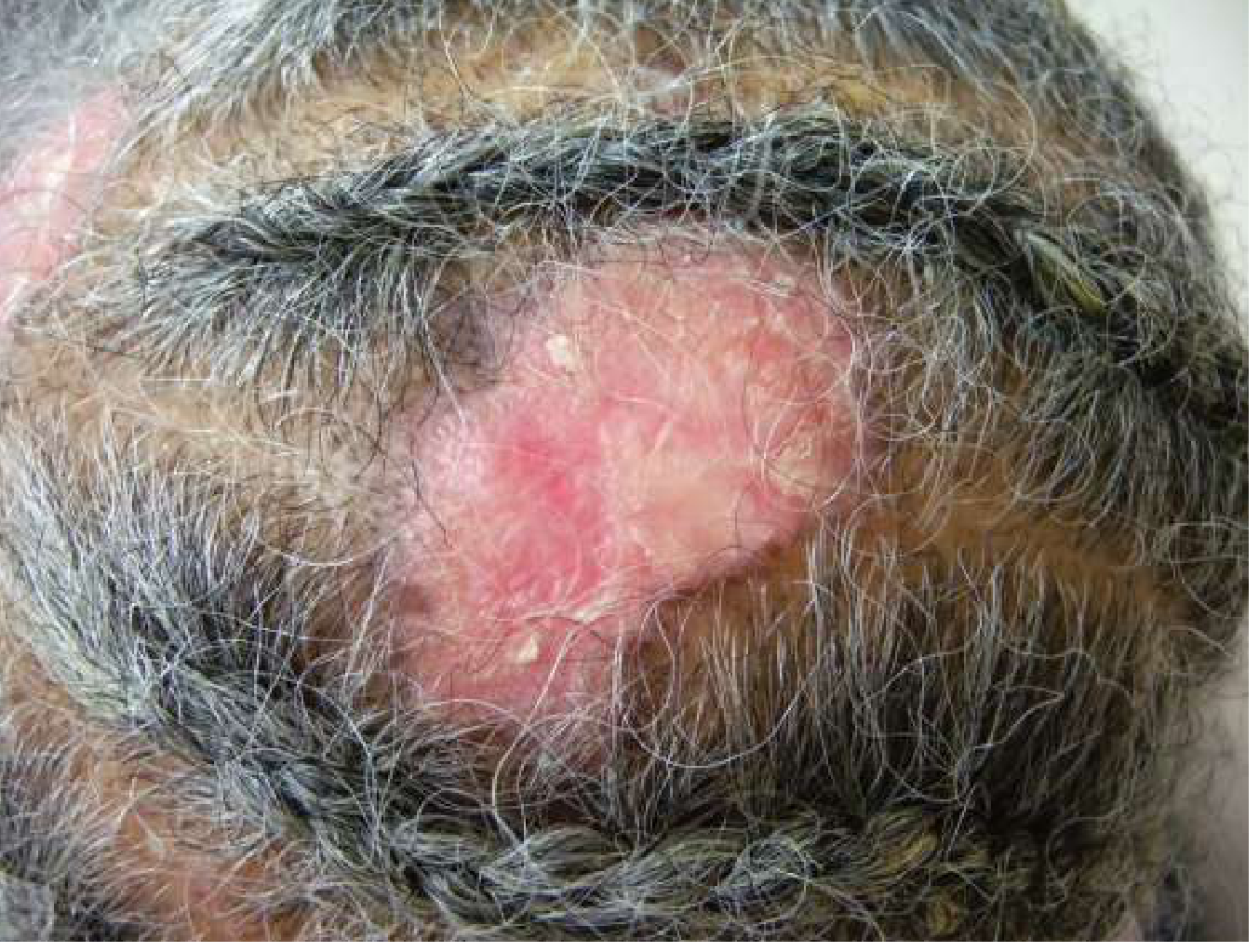
The clinical picture - recurring pustule-like follicular lesions throughout the scalp, pain, pruritus, with old ones resolving and new ones continuously arising - is the classic presentation of Folliculitis Decalvans, a neutrophilic primary cicatricial (scarring) alopecia. The image shows early-stage hair thinning/alopecia along the central scalp, consistent with early FD progression.
Below is a textbook image of more advanced FD showing the characteristic erythematous scarring patch with pustules at the active margin:
Key Clinical Features of Folliculitis Decalvans
| Feature | Detail |
|---|---|
| Who | Young/middle-aged adults, predominantly men |
| Sites | Vertex and occipital scalp most commonly |
| Lesions | Recurrent follicular pustules, perifollicular erythema, scaling, hemorrhagic crusts |
| Hallmark | "Tufted folliculitis" - 5-20 hairs emerging from one follicular unit |
| Course | Pustules arise and resolve cyclically; coalescence leads to scarring patches |
| Cause | Abnormal host immune response to follicular microbiome; Staphylococcus aureus isolated in 20-75% of cases |
- Dermatology 2-Volume Set 5e, p. 3836
Management
First-Line: Antibiotic Combination Therapy (Best Evidence)
Clindamycin + Rifampin is the regimen with the longest documented disease remission:
- Clindamycin 300 mg twice daily
- Rifampin 300 mg twice daily
- Duration: 8-10 weeks
- This combination may be repeated if disease relapses
Alternative antibiotics with shorter remission times:
-
Doxycycline (monotherapy or combination)
-
Trimethoprim-sulfamethoxazole (TMP-SMX 160/800 mg/day)
-
Azithromycin (shorter remission)
-
Long-term tetracyclines (sustained response reported)
-
Goldman-Cecil Medicine, p. 1474; Dermatology 5e, p. 3843; Andrews' Diseases of the Skin
Supplemental/Topical Therapy
- Topical corticosteroids - to reduce perifollicular inflammation
- Topical calcineurin inhibitors - supplemental anti-inflammatory
- Intralesional corticosteroids - for localized active areas
Second-Line / Refractory Cases
- Isotretinoin - sometimes effective but evidence remains controversial
- Cyclosporine - immunosuppressive option
- TNF-alpha inhibitors: adalimumab, infliximab (low evidence, biologic option)
- Secukinumab (IL-17 inhibitor)
- Apremilast (PDE4 inhibitor)
- JAK inhibitors - emerging evidence
- Photodynamic therapy
- Laser therapies
A 2025 systematic review of 728 patients (PMID 41146582) found that combination therapy (systemic antibiotics + topical and/or other systemic agents) outperforms antibiotic monotherapy, with biologics and laser therapy playing a growing role.
Practical Approach Summary
- Confirm diagnosis - swab pustules for bacterial culture/sensitivity (rule out MRSA)
- Start Clindamycin 300 mg BD + Rifampin 300 mg BD for 10 weeks
- Add topical potent corticosteroid (e.g. clobetasol) to active margins
- Trichoscopy at follow-up to assess response
- Warn patient: this is a chronic relapsing condition; repeat antibiotic courses are often needed, and scarred areas will not regrow hair
- If no response after two courses, escalate to isotretinoin or dermatology referral for biologic therapy
Differential Diagnoses to Consider
- Dissecting cellulitis of the scalp - painful boggy nodules with draining sinuses, also causes scarring alopecia
- Acne keloidalis nuchae - folliculitis at nape with keloid formation, overlaps in some patients
- Tinea capitis - fungal; look for broken hairs, KOH prep will confirm
- Lichen planopilaris - scarring alopecia without prominent pustules
- Bacterial furunculosis - isolated furunculosis without progressive cicatricial pattern
Note: If pustules are predominantly superficial and non-scarring without the cyclic recurrence pattern described, simple bacterial folliculitis (from S. aureus) is also possible and responds to shorter antibiotic courses (10-14 days).
Folliculitis Decalvans, management
The first-line treatment for Folliculitis Decalvans (FD) is the clindamycin + rifampin combination for 8-10 weeks. Topical corticosteroids are added as supplemental therapy. Refractory cases may need isotretinoin, biologics (adalimumab), or JAK inhibitors. It is a chronic relapsing condition - repeat courses are often necessary.
Searching sources...
Finding Sources
Searching PubMed
folliculitis decalvans treatment
Excellent - there is a 2025 EADV consensus/position statement (PMID 40230058) which is highly valuable. Let me read all the key textbook sections and the EADV abstract in parallel.
Reading File
Reading File
Reading File
Reading Article
PMID: 40230058
Reading Article
PMID: 41146582
Now I also want the main treatment section from Dermatology 5e and the clinical image.
Reading File
Loading Image
Loading Image
I now have comprehensive data from 4 textbooks plus the 2025 EADV position statement and 2025 systematic review. Here is the full, structured management guide:
Folliculitis Decalvans (FD) - Management
The most common primary neutrophilic scarring alopecia (~11% of primary cicatricial alopecias). Course is chronic and relapsing - the goal of all therapy is to control inflammation and prevent further hair loss. Hair regrowth in scarred areas cannot be expected.
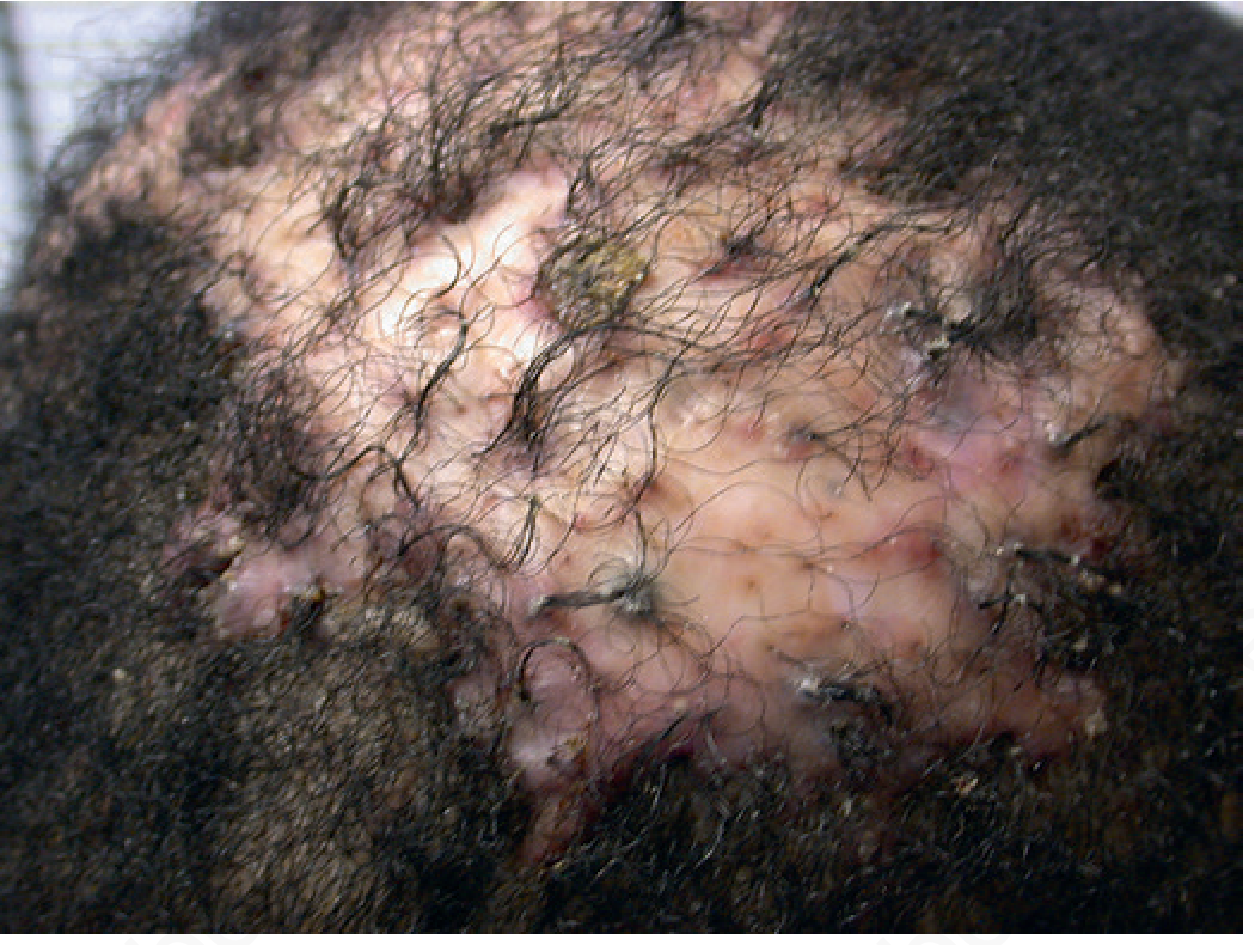
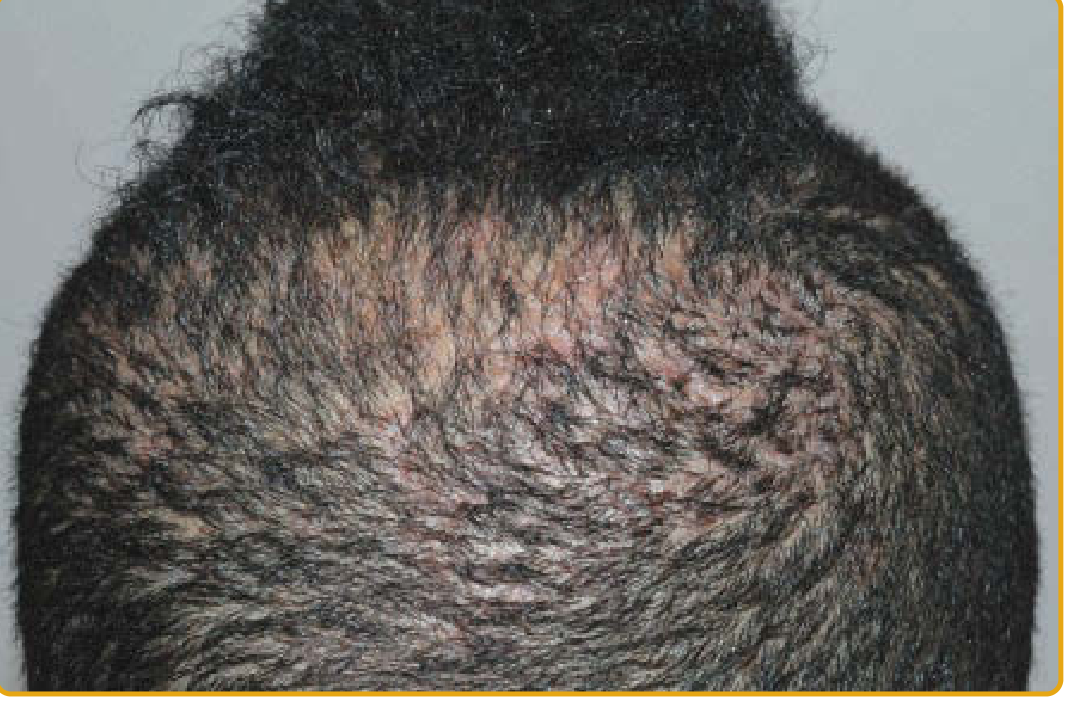
Clinical appearance - active disease with pustules, crusting, erythema, and early scarring patches:
Step 1: Initial Workup (Before Treatment)
- Bacterial swab of pustules - culture and sensitivity (to identify S. aureus and guide antibiotic choice, rule out MRSA)
- Intranasal swab - S. aureus nasal carriage is a reservoir for recurrence
- Trichoscopy to assess active vs. burned-out disease
- Scalp biopsy if diagnosis is uncertain
Treatment Algorithm (Based on 2025 EADV Position Statement + Textbooks)
Mild Active Disease (perifollicular erythema, hyperkeratosis, NO pustules or crusts)
- Oral isotretinoin - first-line for mild disease (0.5-1 mg/kg/day)
- Topical potent corticosteroids to active areas
- Add topical antibiotics (mupirocin, fusidic acid)
Moderate-to-Severe Active Disease (active pustules, crusts, expanding alopecia)
Best evidence: Clindamycin + Rifampin combination
| Drug | Dose | Duration |
|---|---|---|
| Clindamycin | 300 mg twice daily | 10 weeks |
| Rifampin | 300 mg twice daily | 10 weeks |
- This combination gives the longest period of disease remission of all antibiotic regimens
- Note: rifampin must never be used as monotherapy (promotes resistance)
- Courses may be repeated on relapse
Alternative systemic antibiotics (shorter remission times):
- Doxycycline 100 mg BD (long-term; antineutrophilic + antimicrobial action; long-term use sustains response)
- Minocycline, erythromycin, cephalosporins, TMP-SMX (160/800 mg/day)
- Azithromycin (shorter remission)
- Oral fusidic acid (alone or in combination)
- Oral zinc sulfate (adjunctive)
For highly active disease - add a short course of oral glucocorticosteroids to rapidly reduce inflammation while antibiotics take effect
Topical and Local Therapies (add to all systemic regimens)
- Topical antibiotics: mupirocin, 1.5% fusidic acid, 2% erythromycin
- Antibacterial cleansers / selenium sulfide shampoo
- Intralesional triamcinolone acetonide 10 mg/mL every 4-6 weeks - reduces itching, burning, pain at active margins
- Topical potent corticosteroids (e.g. clobetasol) to active areas
- Intranasal mupirocin - to eradicate S. aureus nasal carriage and reduce recurrence
Refractory / Persistent Disease
| Agent | Notes |
|---|---|
| Isotretinoin (oral) | Effective in some; also recommended for persistent inflammatory lesions post-antibiotics |
| Adalimumab (preferred biologic) | TNF-alpha inhibitor; 2025 EADV recommends as preferred biologic |
| Infliximab | Anti-TNF alternative |
| JAK inhibitors | Emerging evidence; growing role |
| Secukinumab | IL-17 inhibitor |
| Apremilast | PDE4 inhibitor |
| Cyclosporine | Immunosuppressive; low evidence |
| Dapsone (oral) | EADV 2025 recommends |
| Hydroxychloroquine | EADV 2025 recommends |
| Photodynamic therapy (PDT) | Low evidence but reported effective |
| Laser therapy | Useful adjunct |
| Topical tacrolimus 0.1% | Second-line topical; calcineurin inhibitor |
| Topical dapsone 5% | Second-line topical per EADV 2025 |
Long-Term / Maintenance Strategy
- Many patients need long-term low-dose antibiotics for years (especially doxycycline or tetracyclines) to prevent relapse
- "Treatment extended beyond resolution of active lesions" is recommended to avoid recurrence (2025 EADV position statement)
- Combination therapy (systemic + topical + local) consistently outperforms monotherapy in remission duration
Surgical Options (Inactive Disease Only)
- Hair transplantation - only in patients with proven inactive disease (no active pustules or inflammation for at least 1-2 years)
- Surgical excision of affected areas in localised cases
Patient Counselling Points
- This is a chronic relapsing condition - long-term management is necessary
- Scarred areas will NOT regrow hair - goal is to stop further loss
- Antibiotic courses are frequently repeated on relapse
- Compliance with topical + systemic treatment simultaneously is important
- Regular dermatology follow-up with trichoscopy to monitor disease activity
Sources: - Dermatology 2-Volume Set 5e, p. 3843 | Fitzpatrick's Dermatology Vol. 1-2, p. 1559 | Andrews' Diseases of the Skin, p. 3755 | Goldman-Cecil Medicine, p. 1474 | EADV Task Force Position Statement 2025 (PMID 40230058) | Systematic Review of FD Management, 728 patients, 2025 (PMID 41146582)
This is a shared conversation. Sign in to Orris to start your own chat.