
Depression
Reading File
The query "Depression" is broad - it could cover many angles. Let me clarify before diving in.
Asking for Preferences
What aspect of depression are you most interested in? · Who is this for?
I'll provide a comprehensive clinical overview of depression covering diagnosis, pathophysiology, and treatment - pulling from authoritative medical textbooks and recent evidence.
Searching sources...
Finding Sources
Searching PubMed
"major depressive disorder"[MeSH Terms] AND treatment
Good - I have strong sources. Let me now pull the key clinical content from the Family Medicine textbook and Neurology textbook in parallel.
Reading File
Reading File
Finding Sources
Excellent - I have key psychiatric textbooks. Let me pull the core content from Kaplan & Sadock's and Stahl's Psychopharmacology now.
Reading File
Reading File
Now let me get the core DSM-5 diagnostic criteria and pathophysiology from Kaplan & Sadock's and Kandel's Neural Science.
Finding Sources
Finding Sources
Let me pull the full DSM-5 criteria and antidepressant sections from these books.
Reading File
Reading File
I now have rich content from multiple authoritative sources. Let me also fetch the brain circuit diagram from Stahl's and get the pathophysiology content.
Finding Sources
Loading Image
I have comprehensive content now. Let me compile the full clinical overview.
Depression (Major Depressive Disorder) - Clinical Overview
What Is Depression?
Major Depressive Disorder (MDD) is a mood disorder characterized by one or more major depressive episodes causing significant distress or functional impairment. It is one of the most prevalent and disabling medical conditions worldwide. It is distinct from normal sadness - the low mood is persistent, pervasive, and accompanied by a cluster of cognitive, vegetative, and behavioral changes.
DSM-5 Diagnostic Criteria
A major depressive episode requires at least 5 of the following 9 symptoms present for a minimum of 2 weeks, with at least one being depressed mood or anhedonia:
| # | Symptom | Notes |
|---|---|---|
| 1 | Depressed mood (most days, nearly every day) | May be irritability in children/adolescents |
| 2 | Anhedonia - markedly diminished interest or pleasure | In most activities |
| 3 | Significant weight loss/gain or appetite change | >5% body weight in a month |
| 4 | Insomnia or hypersomnia | Hypersomnia: may sleep 12-14 hrs/day |
| 5 | Psychomotor agitation or retardation | Observable by others, not just subjective |
| 6 | Fatigue or loss of energy | |
| 7 | Feelings of worthlessness or excessive/inappropriate guilt | |
| 8 | Diminished concentration or indecisiveness | |
| 9 | Recurrent thoughts of death, suicidal ideation, or a suicide attempt | Must always be assessed |
- Symptoms must cause clinically significant distress or impairment in social, occupational, or other functioning.
- Symptoms must not be attributable to a substance or another medical condition.
- The episode must not be better explained by a psychotic disorder (e.g., schizoaffective disorder).
(Rosen's Emergency Medicine, p. 5140; Kaplan & Sadock's Synopsis of Psychiatry)
Types of Depressive Disorders (DSM-5)
| Disorder | Key Feature |
|---|---|
| Major Depressive Disorder (MDD) | One or more discrete major depressive episodes |
| Persistent Depressive Disorder (Dysthymia) | Chronically depressed mood for ≥2 years (adults), with ≥2 additional symptoms; ~20% progress to MDD |
| Premenstrual Dysphoric Disorder (PMDD) | Mood symptoms tied to luteal phase of menstrual cycle |
| Disruptive Mood Dysregulation Disorder | Persistent irritability with temper outbursts in children |
| Substance/Medication-Induced Depressive Disorder | Directly caused by a substance or medication |
| Depressive Disorder Due to Another Medical Condition | e.g., hypothyroidism, stroke, Parkinson's disease |
Subtypes / Specifiers
Clinically important specifiers affect treatment choice:
- With melancholic features: profound anhedonia, worse in the morning, early-morning awakening, psychomotor changes, excessive guilt - responds better to TCAs or ECT
- With atypical features: mood reactivity preserved, hypersomnia, leaden paralysis, hyperphagia, rejection sensitivity - responds better to MAOIs
- With psychotic features: hallucinations/delusions accompanying the depression - requires antidepressant + antipsychotic, or ECT; often needs hospitalization
- With anxious distress: ≥2 of: feeling tense, increased motor tension, difficulty concentrating due to worry, fear something awful will happen
- With peripartum onset (postpartum depression): onset during pregnancy or within 4 weeks of delivery
- With seasonal pattern: recurrent episodes tied to a particular time of year (usually winter) - light therapy is first-line
Pathophysiology & Neurobiology
The Monoamine Hypothesis
The classical explanation: a functional deficit of serotonin (5-HT), norepinephrine (NE), and/or dopamine (DA) at central synapses underlies depression. This is supported by the mechanism of most antidepressants (which boost these neurotransmitters) and the mood-lowering effect of monoamine depletion.
Brain Circuit Model
Modern neuroscience maps specific depressive symptoms to specific brain circuits (from Stahl's Essential Psychopharmacology):
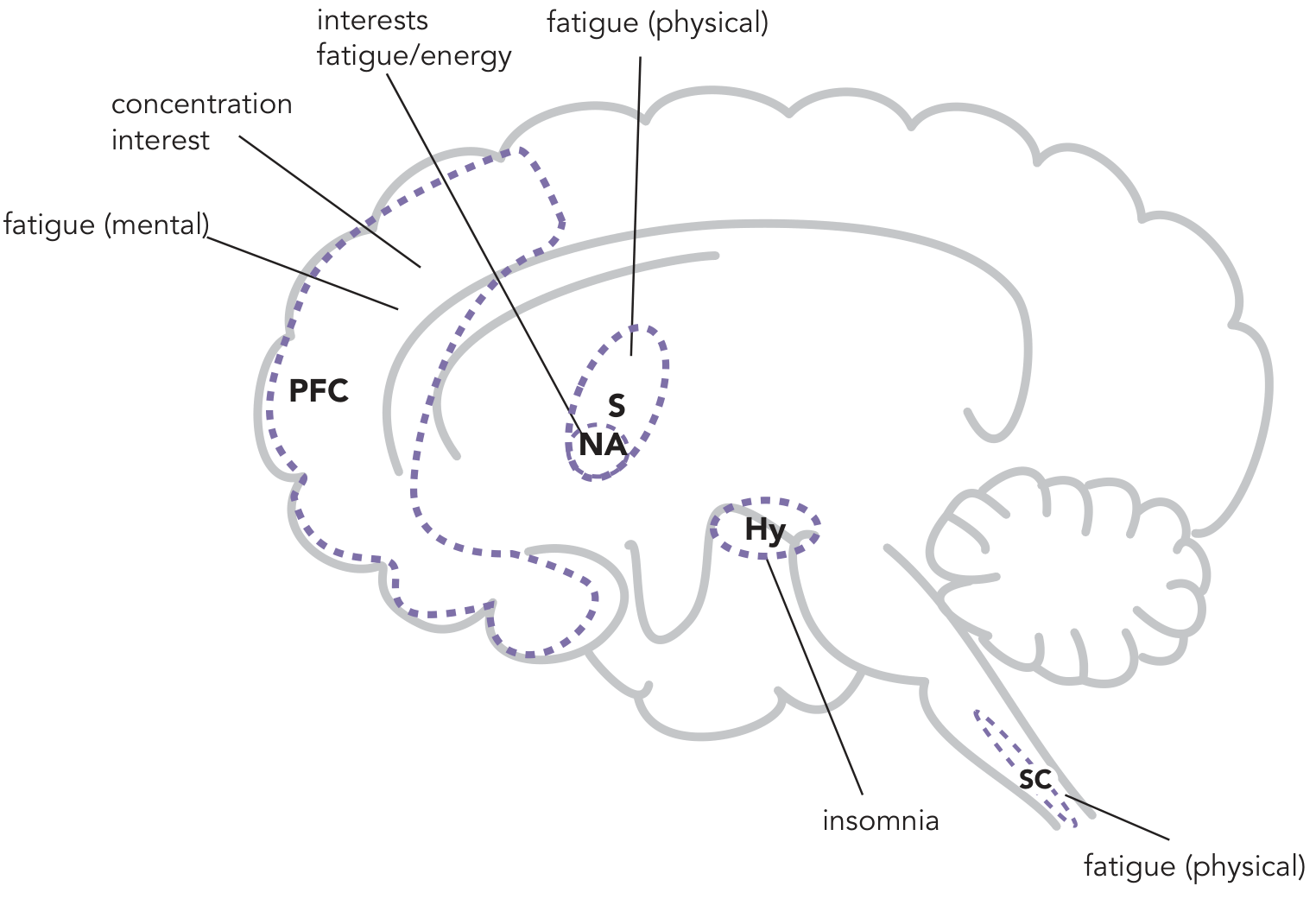
| Brain Region | Symptoms Mediated |
|---|---|
| Prefrontal Cortex (PFC) | Concentration, interest, mental fatigue, executive function |
| Nucleus Accumbens (NA) + Striatum (S) | Interest/reward, physical fatigue, motivation |
| Hypothalamus (Hy) | Insomnia, appetite changes, libido |
| Spinal Cord (SC) | Physical fatigue, somatic symptoms |
- Fatigue and poor concentration are regulated by NE and DA - addressed by agents boosting NE/DA (SNRIs, bupropion, stimulants).
- Sleep disturbance is regulated by serotonin, GABA, and histamine - addressed by agents that boost GABA or block 5-HT/histamine (mirtazapine, trazodone).
(Stahl's Essential Psychopharmacology, Neuroscientific Basis)
Other Contributing Mechanisms
- HPA axis dysregulation: elevated cortisol; CRH hypersecretion; reduced negative feedback
- Neuroplasticity: decreased BDNF, reduced hippocampal neurogenesis (the target of ketamine's rapid antidepressant effect via NMDA antagonism)
- Inflammation: elevated pro-inflammatory cytokines (IL-6, TNF-α) in many patients
- Genetic factors: heritability ~40%; a 2025 trans-ancestry GWAS identified 697 genetic associations with MDD implicating specific cell types and pharmacological targets
Treatment
1. General Principles
- The goal is full remission - not just partial response - and return to prior functioning.
- Pharmacotherapy combined with psychotherapy is superior to either alone.
- Antidepressant response typically takes 3-6 weeks; full remission may require 12-14 weeks (STAR*D trial data).
- Antidepressant classes have comparable overall efficacy; choice is driven by side effect profile, patient history, cost, and comorbidities.
- Response rates across trials: approximately 50-75% for patients on active treatment.
(Textbook of Family Medicine, 9e)
2. Pharmacotherapy
First-Line: SSRIs (Selective Serotonin Reuptake Inhibitors)
All SSRIs share the same mechanism and are considered equally effective. Failure of one SSRI does not predict failure of another.
| Drug | Notable Feature |
|---|---|
| Fluoxetine (Prozac) | Long half-life, useful in non-adherent patients; FDA-approved for pediatric MDD |
| Sertraline (Zoloft) | Widely used first-line; good tolerability |
| Escitalopram (Lexapro) | Also approved for GAD; clean side effect profile |
| Citalopram (Celexa) | QTc prolongation risk at higher doses |
| Paroxetine (Paxil) | More anticholinergic; significant discontinuation syndrome |
SNRIs (Serotonin-Norepinephrine Reuptake Inhibitors)
- Venlafaxine, Duloxetine, Desvenlafaxine, Levomilnacipran
- Duloxetine also FDA-approved for diabetic neuropathic pain, fibromyalgia, GAD
- Useful when NE symptoms (fatigue, concentration, pain) are prominent
Other Agents
| Drug | Mechanism | Key Feature |
|---|---|---|
| Bupropion (Wellbutrin) | NE/DA reuptake inhibitor | No sexual side effects; smoking cessation; avoid in seizure disorder/bulimia |
| Mirtazapine (Remeron) | α2 antagonist, 5-HT2/3 blocker | Sedating, appetite-stimulating - useful in insomnia/weight loss |
| Trazodone | 5-HT2 antagonist/reuptake inhibitor | Often used off-label for insomnia |
| Tricyclics (TCAs) | NE/5-HT reuptake inhibitor | Effective but dangerous in overdose; 2nd/3rd line |
| MAOIs | Monoamine oxidase inhibition | Atypical depression; dietary tyramine restrictions; rarely used |
Newer/Augmenting Agents
- Ketamine/Esketamine (Spravato): NMDA receptor antagonist; rapid onset (hours); used for treatment-resistant depression (TRD) and acute suicidality. A 2025 systematic review and meta-analysis confirmed efficacy of esketamine in adults with MDD.
- Theta Burst Stimulation (TBS): A 2024 network meta-analysis supported TBS as an effective non-invasive brain stimulation approach for depression.
- Atypical antipsychotics (aripiprazole, quetiapine, brexpiprazole): used as augmentation in partial responders
- Lithium augmentation: well-established for TRD
3. Psychotherapy
| Modality | Description |
|---|---|
| Cognitive-Behavioral Therapy (CBT) | Addresses negative thought patterns and maladaptive behaviors; strongest evidence base |
| Interpersonal Therapy (IPT) | Focuses on improving relationships and role transitions |
| Psychodynamic Therapy | Explores unconscious conflicts; longer-term |
| Behavioral Activation | Increases engagement in rewarding activities; can be as effective as medication alone in mild-moderate depression |
Psychotherapy alone may be as effective as medication for mild-to-moderate depression.
4. Neuromodulation
| Modality | Indication |
|---|---|
| ECT (Electroconvulsive Therapy) | Psychotic depression, severe/refractory, acute suicidality, pregnancy - most effective for severe MDD |
| rTMS (repetitive Transcranial Magnetic Stimulation) | Treatment-resistant depression; non-invasive |
| Theta Burst Stimulation (TBS) | Newer, faster form of TMS; evidence growing |
| Light Therapy | Seasonal Affective Disorder (SAD) - first-line |
5. Lifestyle & Adjunctive
- Exercise: Reduces depressive symptoms; a 2024 systematic review and meta-analysis supports yoga specifically for depressive disorders.
- Sleep hygiene: Critical; sleep disturbance perpetuates depression.
- Social support: Family involvement in treatment initiation is beneficial.
Suicide Risk Assessment
Every depressed patient must be assessed for suicidal ideation. Suicidal thoughts range from passive (vague feeling life isn't worth living) to active (specific plan, intent, means). Risk factors include prior attempt, male sex, hopelessness, social isolation, comorbid substance use, access to lethal means, and recent loss. Patients with active suicidal intent or psychotic features typically require hospitalization.
Differential Diagnosis
Key conditions to rule out before diagnosing MDD:
- Bipolar disorder: prior manic/hypomanic episodes - critical to identify because antidepressant monotherapy can precipitate mania
- Hypothyroidism: always check TSH
- Substance use disorders: alcohol/opioid/stimulant withdrawal can mimic depression
- Bereavement: grief vs. MDD - duration, severity, and functional impairment help distinguish
- Adjustment disorder with depressed mood: stressor-linked, doesn't meet full MDD criteria
- Dementia (esp. in elderly): see table below distinguishing depression from dementia
| Feature | Major Depression | Dementia |
|---|---|---|
| Onset | Acute, nonprogressive | Insidious, progressive |
| Symptom sequence | Affective before cognitive | Cognitive before affective |
| Memory complaints | Patient complains | Patient minimizes |
| Effort on testing | Gives up | Makes obvious effort |
| Orientation | Intact | Impaired |
| Diurnal variation | Better at night | Sundowning (worse at night) |
(Bradley and Daroff's Neurology in Clinical Practice)
Key Clinical Pearls
- One SSRI failure ≠ all SSRI failure - patients may respond preferentially to a different SSRI.
- The STAR*D study showed that only ~1/3 of patients achieve remission on the first antidepressant; sequential trials are often needed.
- Psychotic depression always requires antidepressant + antipsychotic (or ECT) - monotherapy with either is insufficient.
- Antidepressants in bipolar depression - never use without a mood stabilizer; can trigger mania or rapid cycling.
- Residual symptoms (insomnia, fatigue, poor concentration) are the most common reason for incomplete remission and must be specifically targeted by pharmacological mechanism.
- Genetics: A landmark 2025 trans-ancestry GWAS (PMID 39814019) identified 697 genetic loci for depression, pointing toward specific cell types (e.g., glutamatergic neurons, oligodendrocytes) as biological targets.
Sources: Rosen's Emergency Medicine | Textbook of Family Medicine, 9e | Kaplan & Sadock's Synopsis of Psychiatry | Kaplan & Sadock's Comprehensive Textbook of Psychiatry | Stahl's Essential Psychopharmacology (Neuroscientific Basis) | Bradley and Daroff's Neurology in Clinical Practice | Recent PubMed meta-analyses (2024-2025)
If asked for a 10 mark question what and all can I write
Here's a structured 10-mark answer template on Depression that covers all the right headings an examiner expects:
Depression – 10 Mark Answer
1. Definition (½ mark)
Major Depressive Disorder (MDD) is a mood disorder characterized by persistent depressed mood and/or anhedonia lasting ≥2 weeks, causing significant functional impairment.
2. Epidemiology (½ mark)
- One of the leading causes of disability worldwide
- Lifetime prevalence ~15–20%; women affected 2x more than men
- Peak onset: 20–40 years
3. Etiology / Risk Factors (1 mark)
- Biological: genetic predisposition (heritability ~40%), monoamine deficiency (5-HT, NE, DA), HPA axis dysregulation, neuroinflammation
- Psychological: negative cognitive schemas, learned helplessness, prior trauma
- Social: loss events, poor social support, chronic stress, unemployment
4. Clinical Features (2 marks)
DSM-5: ≥5 of 9 symptoms for ≥2 weeks; must include depressed mood OR anhedonia
| Symptom | Detail |
|---|---|
| Depressed mood | Most of the day, nearly every day |
| Anhedonia | Loss of interest/pleasure |
| Sleep disturbance | Insomnia or hypersomnia |
| Appetite/weight change | Loss or gain >5% in a month |
| Psychomotor changes | Retardation or agitation |
| Fatigue | Loss of energy |
| Worthlessness/guilt | Excessive or inappropriate |
| Poor concentration | Indecisiveness |
| Suicidal ideation | Passive to active |
5. Types / Subtypes (1 mark)
- Persistent Depressive Disorder (Dysthymia) – chronic low mood ≥2 years
- With melancholic features – profound anhedonia, worse in morning, responds to ECT/TCAs
- With atypical features – mood reactivity preserved, hypersomnia, hyperphagia; responds to MAOIs
- With psychotic features – hallucinations/delusions; needs antidepressant + antipsychotic or ECT
- Postpartum depression – onset within 4 weeks of delivery
- Seasonal Affective Disorder (SAD) – winter pattern; light therapy first-line
6. Investigations (½ mark)
To rule out organic causes:
- TFTs (hypothyroidism)
- CBC, LFTs, RFTs
- Blood glucose
- Cortisol (if Cushing's suspected)
- Drug screen
- Rating scales: PHQ-9, HAM-D, MADRS
7. Management (3 marks)
A. Pharmacotherapy (first-line)
| Class | Examples | Notes |
|---|---|---|
| SSRIs | Fluoxetine, Sertraline, Escitalopram | First-line; equally effective; onset 3–6 weeks |
| SNRIs | Venlafaxine, Duloxetine | Better for pain comorbidity |
| Bupropion | NE/DA reuptake inhibitor | No sexual side effects |
| Mirtazapine | α2 antagonist | Useful for insomnia + weight loss |
| TCAs | Amitriptyline, Imipramine | Effective but dangerous in overdose; 2nd-line |
| MAOIs | Phenelzine | Atypical depression; dietary restrictions |
- Combination of pharmacotherapy + psychotherapy > either alone
- Treatment duration: continue for 6–12 months after remission; ≥2 years if recurrent
B. Psychotherapy
- CBT – most evidence-based; targets negative thought patterns
- IPT – interpersonal functioning
- Behavioral Activation – especially for mild-moderate depression
- Psychodynamic therapy
C. Neuromodulation
- ECT – severe/psychotic/treatment-resistant depression; most effective
- rTMS – non-invasive; treatment-resistant cases
- Light therapy – seasonal depression
D. Lifestyle
- Regular aerobic exercise (strong evidence)
- Sleep hygiene
- Psychoeducation, social support
8. Suicide Risk Assessment (½ mark)
Every patient must be assessed. Risk ↑ with: prior attempt, hopelessness, male sex, substance use, social isolation, access to lethal means. Active suicidal intent or psychotic features → hospitalization.
9. Prognosis (½ mark)
- ~50% recover from first episode within 6 months
- ~35% develop recurrent episodes
- Risk of recurrence increases with each episode
- Untreated depression → worse outcomes, higher suicide risk, functional decline
Tips for 10 Marks
| What to include | How much space |
|---|---|
| Definition + Epi | 3–4 lines |
| Etiology | 4–5 lines |
| Clinical features (table) | Full DSM-5 list |
| Types/specifiers | 5–6 bullet points |
| Investigations | Brief list |
| Management | Biggest section - use drug table + psychotherapy + ECT |
| Prognosis + Suicide | Closing lines |
Examiner tip: Always mention the STAR*D trial (sequential antidepressant trials), PHQ-9 as the screening tool, and that ECT is the most effective treatment for severe/psychotic depression - these signal advanced knowledge.
This is a shared conversation. Sign in to Orris to start your own chat.