
Normal during day, fever at night
Fever that occurs only at night (or worsens at night) while the person feels normal during the day is called nocturnal fever or evening/night fever. Here are the key points from memory while I search deeper:
- Classic causes include tuberculosis, lymphoma, endocarditis, and other chronic infections
- The pattern is well-recognized in "B symptoms" of lymphoma (night sweats + fever)
- Malaria often produces cyclic fever with nighttime peaks
- This pattern can also reflect normal circadian rhythm amplifying a low-grade fever that's undetectable during the day
Searching sources...
Reading File
Finding Sources
Finding Sources
Searching the Web
fever only at night normal during day causes differential diagnosis
Finding Sources
Reading File
Reading File
Loading Image
Reading File
Here is a thorough answer based on Harrison's, Frameworks for Internal Medicine, Bailey & Love, and other textbook sources:
Fever Normal During the Day, Present Only at Night
This pattern is called intermittent fever (or specifically nocturnal/evening fever) - temperature spikes at night and returns to normal during the day. It is a well-recognized clinical sign that narrows the differential diagnosis considerably.
Why Does Fever Peak at Night?
Body temperature follows a circadian rhythm: it is lowest in the early morning (~36°C) and highest in the late afternoon/evening (~37.7°C). An underlying illness can amplify this normal variation so the fever only becomes detectable (>38°C) at night, while daytime temperature looks normal. The hypothalamus - which regulates temperature - is also more active during sleep cycles.
Causes to Consider (by Category)
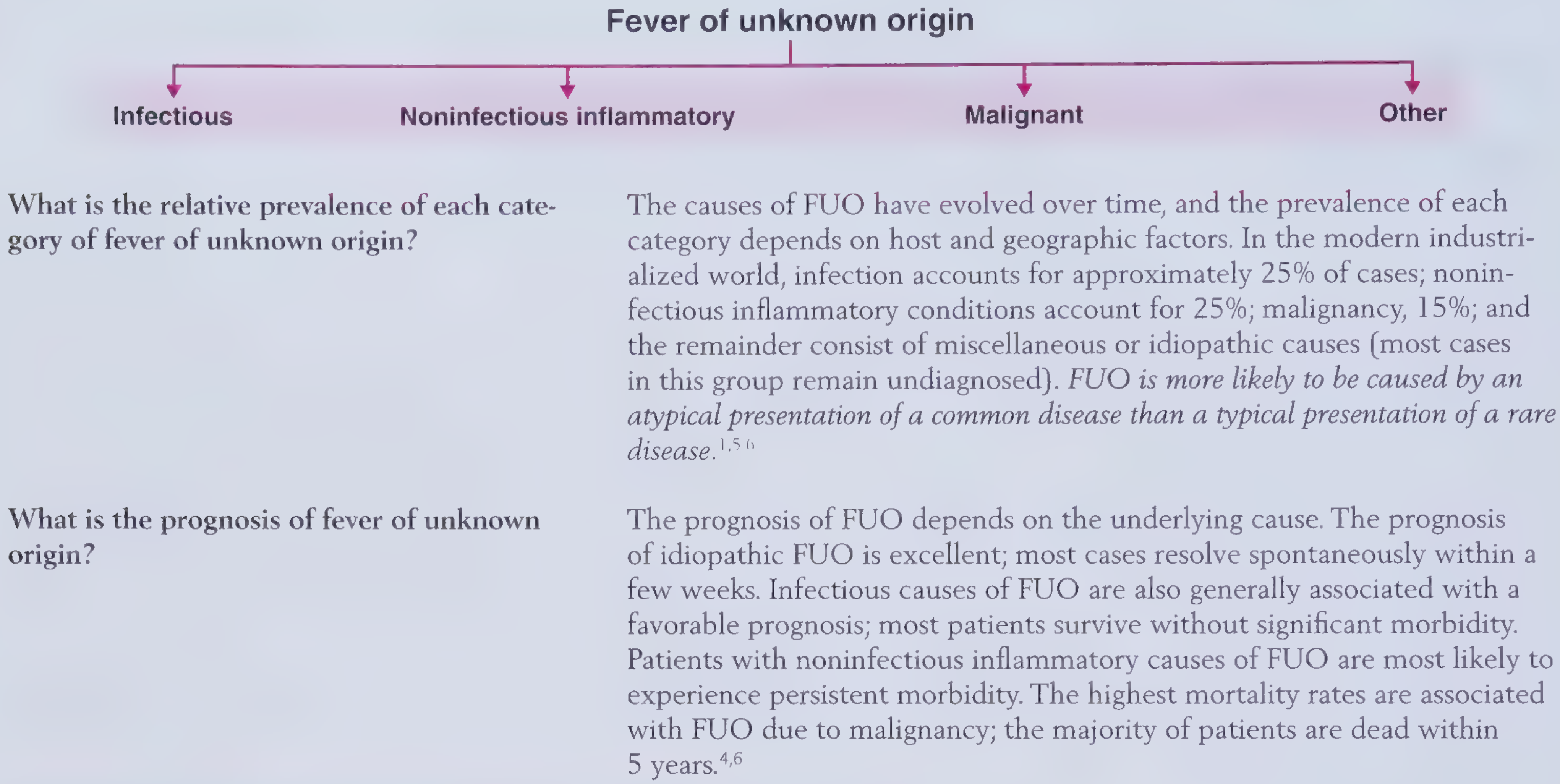
(Frameworks for Internal Medicine - FUO is classified as Infectious, Noninfectious Inflammatory, Malignant, or Other)
1. Infectious Causes (~25% of prolonged cases)
| Disease | Key Clue |
|---|---|
| Tuberculosis | Classic "evening fever" + weight loss, night sweats, chronic cough. Intestinal TB: abdominal pain, alternating bowel habits - Bailey & Love |
| Brucellosis (undulant fever) | Nocturnal fever pattern lasting weeks to months, body aches, headache, anorexia, up to 20 kg weight loss - Sherris Medical Microbiology |
| Infective Endocarditis | Low-grade intermittent fever, new murmur, embolic phenomena |
| Malaria | Cyclic fevers - P. vivax every 3rd day, P. malariae every 4th day - Harrison's |
| HIV/AIDS | Chronic low-grade nocturnal fever, weight loss |
| Intra-abdominal abscess | Post-surgical or post-diverticulitis, focal tenderness |
| Schistosomiasis / Katayama fever | Nocturnal fever, cough, wheezing, myalgia, after parasite exposure - Rosen's Emergency Medicine |
| Tropical pulmonary eosinophilia | Nocturnal cough and wheezing + fever, high eosinophils - Campbell-Walsh Urology |
2. Malignant Causes (~15%)
| Disease | Key Clue |
|---|---|
| Hodgkin Lymphoma | Pel-Ebstein fever: alternating 3-10 days of fever followed by 3-10 afebrile days - Harrison's, Goldman-Cecil |
| Non-Hodgkin Lymphoma / Leukemia | "B symptoms": fever + night sweats + >10% weight loss |
| Renal Cell Carcinoma | Can present purely as FUO without urologic symptoms |
| Hepatocellular Carcinoma / Myelodysplastic syndrome | Less common malignant FUO causes |
3. Noninfectious Inflammatory (~25%)
| Disease | Key Clue |
|---|---|
| Rheumatoid Arthritis / Adult Still's Disease | Evening fever spike, salmon-colored rash, arthralgia |
| Systemic Lupus Erythematosus (SLE) | Multi-system involvement, photosensitivity, ANA positive |
| Temporal Arteritis / Vasculitis | Elderly patients, headache, elevated ESR |
| Inflammatory Bowel Disease | Crohn's: nocturnal fever flares |
| Sarcoidosis | Lymphadenopathy, bilateral hilar infiltrates |
4. Other / Miscellaneous
| Entity | Notes |
|---|---|
| Periodic fever syndromes | Familial Mediterranean Fever, TRAPS, PFAPA - Harrison's |
| Drug fever | Temporal relation to starting a medication |
| Factitious fever | Temperature-pulse dissociation (relative bradycardia) is a clue |
| Cyclic neutropenia | Fevers every 21 days with neutropenia counts |
Red Flags That Require Urgent Evaluation
- Fever persisting >3 weeks with no clear source (= Fever of Unknown Origin by classical definition: >38.3°C on multiple occasions, undiagnosed after 1 week of investigation) - Frameworks for Internal Medicine
- Associated drenching night sweats (soak the bedclothes) - strongly suggests lymphoma or TB
- Unexplained weight loss >10%
- Lymphadenopathy, hepatosplenomegaly
- Travel to malaria-endemic or TB-endemic areas
- Immunocompromised state (HIV, steroids, chemotherapy)
Basic Workup
- CBC with differential (eosinophilia - parasites; lymphocytosis - viral/lymphoma; leukopenia - typhoid, viral)
- Blood cultures x3 (before antibiotics)
- ESR, CRP, LDH, uric acid
- Chest X-ray (TB, sarcoid, lymphoma mediastinal nodes)
- Peripheral smear (malaria if travel history)
- Mantoux/IGRA (TB screening)
- HIV serology
- ANA, RF if inflammatory suspected
- CT chest/abdomen/pelvis if FUO workup is negative
Key Teaching Point
As noted in Frameworks for Internal Medicine: "FUO is more likely to be caused by an atypical presentation of a common disease than a typical presentation of a rare disease." Always think TB, endocarditis, and lymphoma before exotic diagnoses.
The combination of night fever + drenching sweats + weight loss is the classic triad that should immediately prompt TB and lymphoma workup.
This is a shared conversation. Sign in to Orris to start your own chat.