
Dengue warning signs
Reading File
Dengue warning signs are clinical features that indicate progression toward severe dengue and require urgent medical attention. Key warning signs include abdominal pain, persistent vomiting, mucosal bleeding, fluid accumulation, and rapid clinical deterioration.
Searching sources...
Finding Sources
Searching PubMed
dengue warning signs severe dengue
Finding Sources
Reading File
Reading File
Finding Sources
Reading File
Reading File
Reading File
I now have comprehensive textbook content to compile a thorough answer. Let me also fetch the dengue course diagram.
Loading Image
Here is a complete, textbook-sourced overview of dengue warning signs.
Dengue Warning Signs
WHO 2009 Classification (3 Tiers)
The WHO 2009 classification divides dengue into three severity tiers:
| Tier | Definition |
|---|---|
| Dengue without warning signs | Fever + ≥2 of: nausea/vomiting, rash, aches and pains, leukopenia, positive tourniquet test |
| Dengue with warning signs | Above criteria + any warning sign (see below) |
| Severe dengue | Any of: severe plasma leakage/shock, severe bleeding, severe organ dysfunction |
The 7 Warning Signs (WHO)
These appear in the late febrile phase (days 3-7), typically around the time of or just after defervescence:
- Abdominal pain or tenderness - severe, persistent epigastric or right upper quadrant pain
- Persistent vomiting - prevents adequate oral intake or rehydration
- Clinical fluid accumulation - ascites, pleural effusion (especially right-sided), pericardial effusion detected clinically or on imaging
- Mucosal bleeding - gum bleeding, epistaxis, vaginal bleeding, blood in urine/stool
- Lethargy or restlessness - altered mental status, may indicate reduced brain perfusion
- Liver enlargement >2 cm - hepatomegaly beyond 2 cm below the costal margin
- Rising hematocrit with rapid decline in platelet count - hemoconcentration (hematocrit rise ≥20% from baseline) concurrent with rapidly falling platelets
Patients with warning signs will probably recover with early IV rehydration, but without prompt action some progress to severe dengue. - Park's Textbook of Preventive and Social Medicine
The Three Phases of Dengue Illness
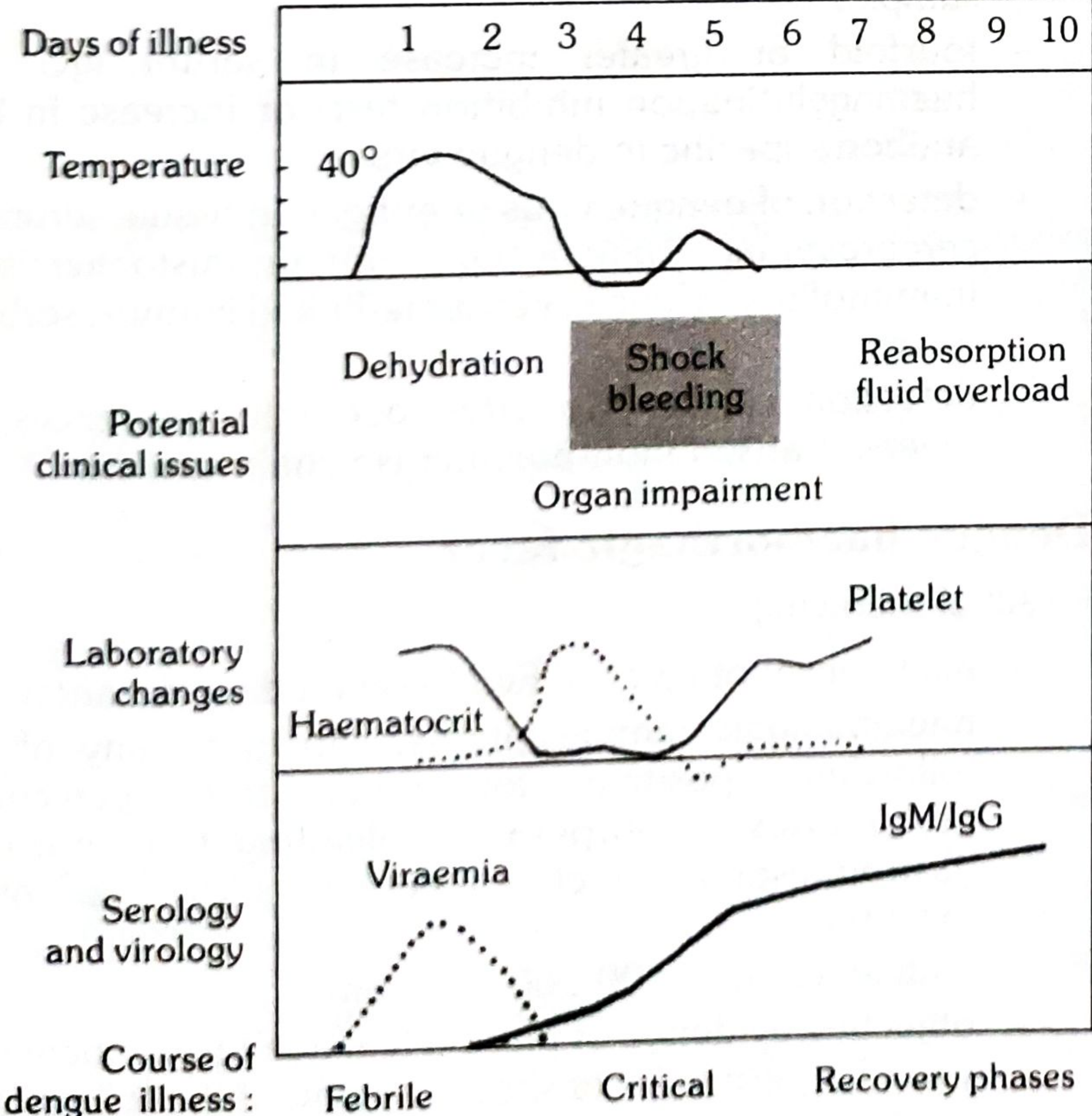
Phase 1: Febrile (Days 1-3)
- Sudden high fever (up to 40-41°C), facial flushing, severe headache
- Retro-orbital pain, myalgia/arthralgia ("breakbone fever")
- Anorexia, vomiting, epigastric discomfort
- Positive tourniquet test (≥10 petechiae per 2.5x2.5 cm square), maculopapular rash
Phase 2: Critical (Days 3-7) - when warning signs emerge
- Fever defervesces to ≤37.5-38°C
- Plasma leakage begins due to increased capillary permeability
- Hematocrit rises as intravascular fluid leaks out
- Platelet count drops rapidly (thrombocytopenia, often <100,000 cells/mm³)
- Pleural effusions and ascites may develop
- Shock and hemorrhage can occur if plasma leakage is severe
- Critical plasma leakage phase lasts only 24-48 hours
Phase 3: Recovery
- Gradual reabsorption of extravasated fluid
- Risk of fluid overload (especially if IV fluids were overcorrected)
- Platelet count recovers, hematocrit may fall (from hemodilution as fluid re-enters circulation)
Criteria for Severe Dengue
Severe dengue is diagnosed when any of the following are present:
- Severe plasma leakage leading to dengue shock syndrome (DSS) or fluid accumulation with respiratory distress
- Severe bleeding as assessed by a clinician
- Severe organ dysfunction: AST or ALT ≥1,000 IU/L, impaired consciousness, cardiac failure, or other organ failure
Dengue Shock Syndrome (DSS) - Signs to Recognize
- Tachycardia, cool extremities, delayed capillary refill, weak/thready pulse
- Lethargy or restlessness (reduced brain perfusion)
- Pulse pressure ≤20 mmHg with raised diastolic pressure (e.g., 100/80 mmHg)
- Frank hypotension (late and ominous sign)
Special Populations at Higher Risk of Severe Disease
- Infants of dengue-immune mothers
- Children >1 year old
- Patients with second or subsequent dengue infection (heterotypic reinfection - immune enhancement)
- Females more commonly affected than males
- After age 12, susceptibility to severe dengue drops considerably
Tourniquet Test (Capillary Fragility Test)
Inflate BP cuff to midpoint between systolic and diastolic pressure for 5 minutes. A positive result is ≥10 petechiae per 2.5x2.5 cm area. In DHF, typically ≥20 petechiae are seen.
Sources:
- Red Book 2021 (AAP Committee on Infectious Diseases), p. 520-521
- Park's Textbook of Preventive and Social Medicine, p. 292-293
- Harrison's Principles of Internal Medicine, 22nd Ed. (2025)
- Tintinalli's Emergency Medicine: A Comprehensive Study
This is a shared conversation. Sign in to Orris to start your own chat.