
In a patient with cerebral stroke and Motor power zero which sensory receptors are compromised and which aren't
Reading File
Now let me search the medical library for the relevant content on sensory pathways in stroke and motor/sensory receptor classification.
Finding Sources
Finding Sources
Finding Sources
Finding Sources
Finding Sources
Finding Sources
Reading File
Finding Sources
Excellent - I have the key table. Let me also fetch the sensory pathway diagrams and read slightly more of the neuroanatomy text for complete context.
Reading File
Loading Image
I now have all the information needed. Let me compile the comprehensive answer.
This is a conceptually rich question that requires understanding the difference between peripheral sensory receptors (which remain structurally intact in cerebral stroke) and the central pathways that carry their signals to the cortex (which are damaged). Here is the full breakdown:
Sensory Receptors in Cerebral Stroke with Motor Power Zero
The Core Concept
A cerebral stroke damages the central nervous system - specifically the cortex (primary motor cortex, primary somatosensory cortex) and/or the corticospinal and sensory tracts running through the internal capsule. The peripheral sensory receptors themselves are not damaged - they are located in skin, muscles, joints, and viscera, far from the brain lesion.
However, whether a sensory modality is lost depends on whether the stroke involves the sensory cortex or thalamus, because all conscious sensory perception requires the cortical termination of these pathways.
Classification of All Sensory Receptors
Based on the Neuroanatomy through Clinical Cases textbook (Table 7.2):
| Receptor | Fiber Type | Modality | Pathway to Cortex |
|---|---|---|---|
| Muscle spindle (Ia, II) | Aα, Aβ | Proprioception | Posterior column - medial lemniscal |
| Golgi tendon organ | Aα | Proprioception (tension) | Posterior column - medial lemniscal |
| Merkel's receptor | Aβ | Slow pressure, vibration 5-15 Hz | Posterior column - medial lemniscal |
| Meissner's corpuscle | Aβ | Light touch, vibration 10-50 Hz | Posterior column - medial lemniscal |
| Pacinian corpuscle | Aβ | Transient touch, vibration 200-300 Hz | Posterior column - medial lemniscal |
| Ruffini ending | Aβ | Deep touch, skin stretch | Posterior column - medial lemniscal |
| Hair follicle receptor | Aβ | Light touch (hair movement) | Posterior column - medial lemniscal |
| Free/bare nerve endings | Aδ, C | Pain, temperature, crude touch | Anterolateral (spinothalamic) |
What Is Compromised vs. Not Compromised
RECEPTORS THEMSELVES: All Structurally Intact
Every peripheral receptor listed above - muscle spindles, Golgi tendon organs, Meissner's corpuscles, Pacinian corpuscles, Merkel's discs, Ruffini endings, free nerve endings - is physically unaffected by a cerebral stroke. The receptor organs sit in peripheral tissues and their cell bodies are in the dorsal root ganglia, which are not touched by the stroke.
SENSORY PERCEPTION: What's Lost vs. Preserved
This depends on the stroke's location:
If the stroke involves the primary somatosensory cortex (postcentral gyrus) or internal capsule (posterior limb):
| Modality | Receptors Involved | Status |
|---|---|---|
| Proprioception (joint position, muscle length/tension) | Muscle spindles, Golgi tendon organs | LOST - the signal cannot reach consciousness |
| Vibration sense | Pacinian corpuscles, Meissner's, Merkel's | LOST |
| Fine/discriminative touch, two-point discrimination | Meissner's, Merkel's, Ruffini, Pacinian | LOST |
| Pain and temperature | Free nerve endings (Aδ and C fibers) | LOST |
| Crude touch | Free nerve endings | LOST |
In a large cortical or internal capsule stroke, all conscious somatosensory modalities on the contralateral side are lost - both dorsal column (vibration, proprioception, fine touch) and anterolateral (pain, temperature) pathways terminate in the somatosensory cortex.
Preserved (unaffected) in ALL stroke patients, regardless of location:
| Function | Reason |
|---|---|
| The receptor organs themselves (spindles, corpuscles, etc.) | Peripheral structures - not damaged |
| Reflex arcs mediated spinally | Muscle spindle → Ia afferent → spinal cord → motor neuron - this loop is entirely spinal. This is why deep tendon reflexes are hyperreflexic after a cerebral stroke (UMN lesion removes cortical inhibition) |
| Pain reflexes (withdrawal) | Spinal polysynaptic reflex - intact |
| Autonomic/visceral receptors | Generally unaffected (bilateral cortical representation) |
| Special senses (vision, hearing, smell, taste) | Separate cranial nerve pathways, usually not affected |
The Special Case: Motor Power Zero and Sensory Receptors
When motor power is 0/5 (complete paralysis), it means the corticospinal tract is completely interrupted. This is important for understanding sensory receptor function:
-
Muscle spindles and Golgi tendon organs: These receptors are still being activated by passive limb movement and muscle stretch. Their signals travel to the spinal cord normally. However:
- The efferent control of spindle sensitivity via gamma motor neurons is disrupted (gamma neurons lose their cortical drive), which is why muscle tone initially is flaccid, then becomes spastic
- The conscious perception of proprioception is lost if the sensory cortex or posterior limb of internal capsule is damaged
- The stretch reflex arc itself remains intact - hence hyperreflexia in UMN stroke
-
Cutaneous receptors (Meissner's, Pacinian, free nerve endings): These continue to transduce stimuli normally. It is only the conscious awareness at the cortical level that is abolished.
Summary Table
| Receptor | Structurally Intact? | Peripheral Signal Generated? | Conscious Perception Possible? |
|---|---|---|---|
| Muscle spindle | Yes | Yes | No (if somatosensory cortex involved) |
| Golgi tendon organ | Yes | Yes | No |
| Meissner's corpuscle | Yes | Yes | No |
| Pacinian corpuscle | Yes | Yes | No |
| Merkel's disc | Yes | Yes | No |
| Ruffini ending | Yes | Yes | No |
| Hair follicle receptor | Yes | Yes | No |
| Free nerve endings (Aδ, C) | Yes | Yes | No (pain/temp) |
| Spinal reflex arc using spindles | Yes | Yes | Reflex preserved (hyperreflexia) |
Key Pathways Involved (from Neuroanatomy through Clinical Cases, Table 7.1)
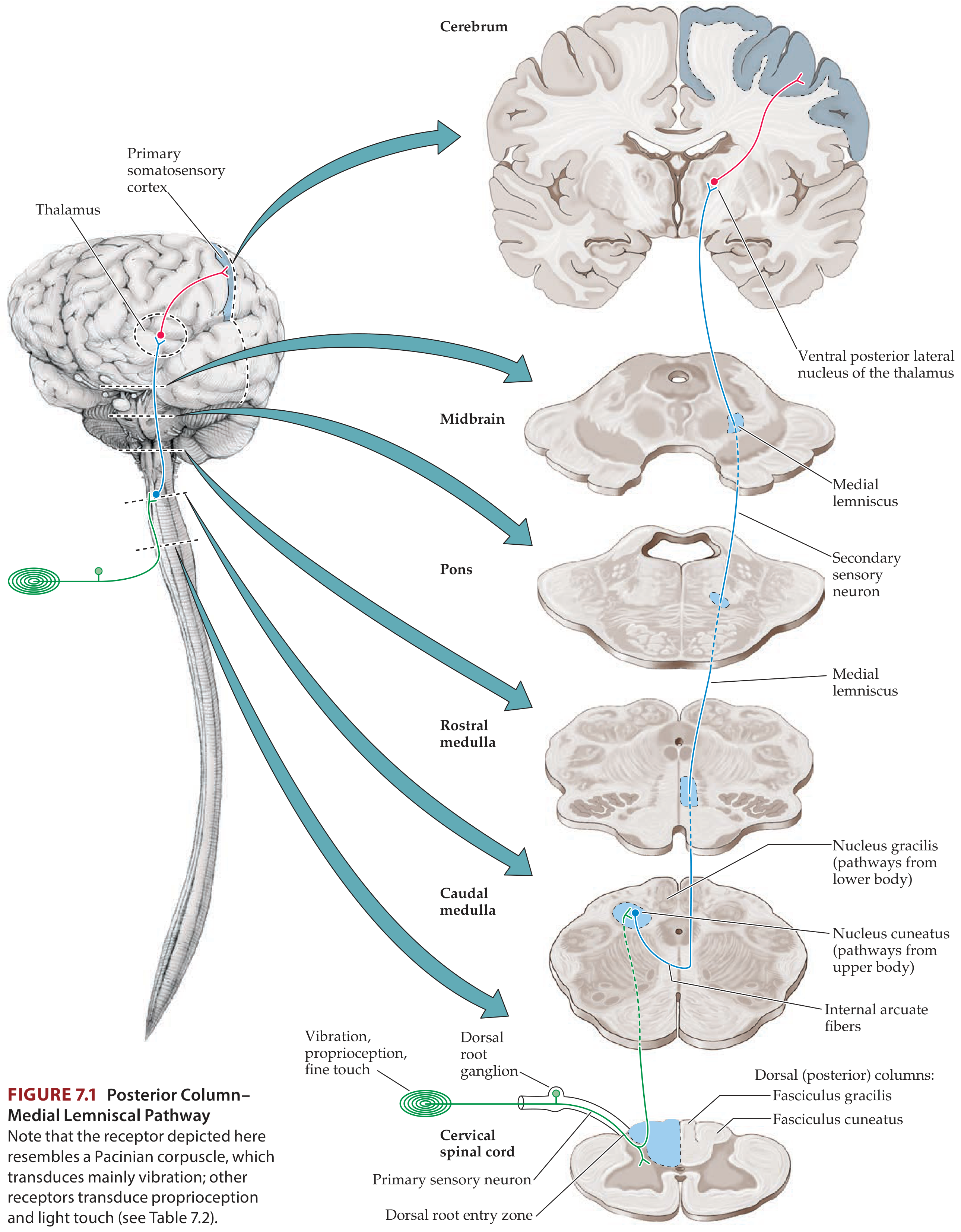
Two main sensory pathways converge on the contralateral somatosensory cortex:
-
Posterior column - medial lemniscal pathway: Carries proprioception (muscle spindles, GTOs), vibration, and fine touch. Decussates at the lower medulla (internal arcuate fibers). Damaged in cortical/capsular stroke → loss of these modalities contralaterally.
-
Anterolateral (spinothalamic) pathway: Carries pain, temperature, and crude touch from free nerve endings. Decussates at the spinal cord (anterior commissure). Also damaged in cortical/capsular stroke → loss of pain and temperature contralaterally.
Both pathways relay through the ventral posterolateral (VPL) nucleus of the thalamus before reaching the somatosensory cortex (postcentral gyrus, areas 3, 1, 2).
Clinical Bottom Line
-
No peripheral sensory receptor is damaged in a cerebral stroke - they are all structurally intact and continue to transduce stimuli
-
Conscious sensory perception of all modalities (proprioception, vibration, fine touch, pain, temperature) is lost on the contralateral side if the stroke involves the somatosensory cortex or posterior limb of internal capsule
-
Spinal reflexes mediated by these receptors (deep tendon reflexes) are intact and exaggerated (hyperreflexia, upgoing plantar = Babinski sign) - this is the hallmark of UMN lesion
-
The gamma motor neuron system controlling spindle sensitivity loses its descending modulation, contributing to the development of spasticity days to weeks after the initial flaccid paralysis
-
Neuroanatomy through Clinical Cases 3rd Edition, Tables 7.1 and 7.2, pp. 300-302
This is a shared conversation. Sign in to Orris to start your own chat.