
Gigantism
Reading File
Finding Sources
Finding Sources
Searching PubMed
gigantism acromegaly growth hormone excess
Reading File
Reading File
Reading File
Reading File
Finding Sources
Reading File
Reading File
Loading Image
I now have all the material needed for a thorough answer. Here is the complete coverage:
Gigantism
Definition
Gigantism is the clinical syndrome resulting from excess growth hormone (GH) secretion before closure of the epiphyseal plates in prepubertal children. The same excess GH occurring after epiphyseal closure produces acromegaly instead. In most cases, gigantism eventually transitions into acromegaly once the growth plates fuse, so both conditions coexist in the same patient. - Robbins & Kumar Basic Pathology
Etiology and Pathophysiology
The fundamental defect is uncontrolled, excessive GH secretion. Sources include:
- Pituitary somatotroph adenoma - the cause in the vast majority of cases. These are the second most common type of functioning pituitary adenoma (~10% of all pituitary adenomas). - Robbins & Kumar
- Ectopic GH production - rare; seen with islet cell tumors, lymphomas.
- Ectopic GHRH production - bronchial carcinoid tumors, small cell lung cancer, medullary thyroid cancer, pheochromocytoma. - Goldman-Cecil Medicine
- Hypothalamic GHRH-secreting tumors - rare.
Genetic associations:
- MEN1 gene (codes for menin): associated with syndromic acromegaly/gigantism, parathyroid hyperplasia, pancreatic and anterior pituitary adenomas. Pituitary adenomas develop in ~50% of MEN1 patients; 10% secrete GH.
- Gs-alpha activating mutations: cause ligand-independent cAMP elevation and GH hypersecretion. - Goldman-Cecil
Mechanism: Excess GH stimulates hepatic IGF-1 (somatomedin C) secretion. GH and IGF-1 together drive:
- Longitudinal bone growth (when epiphyses are open) → gigantism
- Overgrowth of bones, soft tissues, and viscera (after epiphyseal closure) → acromegaly - Ganong's Review of Medical Physiology
GH also exerts anti-insulin effects, increases hepatic glucose output, and is ketogenic, explaining the metabolic complications.
Clinical Features
Gigantism (Prepubertal Onset)
- Extraordinary height - generalized increase in body size
- Disproportionately long arms and legs
- Usually accompanied by acromegalic features once puberty is completed - Robbins & Kumar
Acromegaly features (often co-present or develop later)
- Hands/feet: Large, doughy hands; broad, thickened fingers; increased ring, shoe, and hat size
- Face: Frontal bossing, enlarged nose, macroglossia, prognathism (protruding jaw), splayed teeth, mandibular overbite
- Voice: Coarse and resonant
- Skin: Hyperhidrosis at rest, skin tags (associated with colonic polyps and colon cancer)
- Soft tissue/viscera: Carpal tunnel syndrome (nerve entrapment), sleep apnea (pharyngeal soft tissue overgrowth), organomegaly
- Metabolic: Diabetes mellitus (~25% have abnormal glucose tolerance), peripheral insulin resistance
- Cardiovascular: Hypertension, myocardial hypertrophy, ischemic heart disease, heart failure
- Hormonal: Co-secretion of prolactin in 20-40% (causing galactorrhea); gonadal dysfunction
- Neurological: Headaches (up to 60%), temporal hemianopsia (bitemporal visual field loss from optic chiasm compression, ~10%) - Goldman-Cecil Medicine, Ganong's
The image below shows serial photos of a patient with acromegaly (GH excess after epiphyseal fusion) over 9 years alongside her pituitary MRI - demonstrating the progressive coarsening of features:
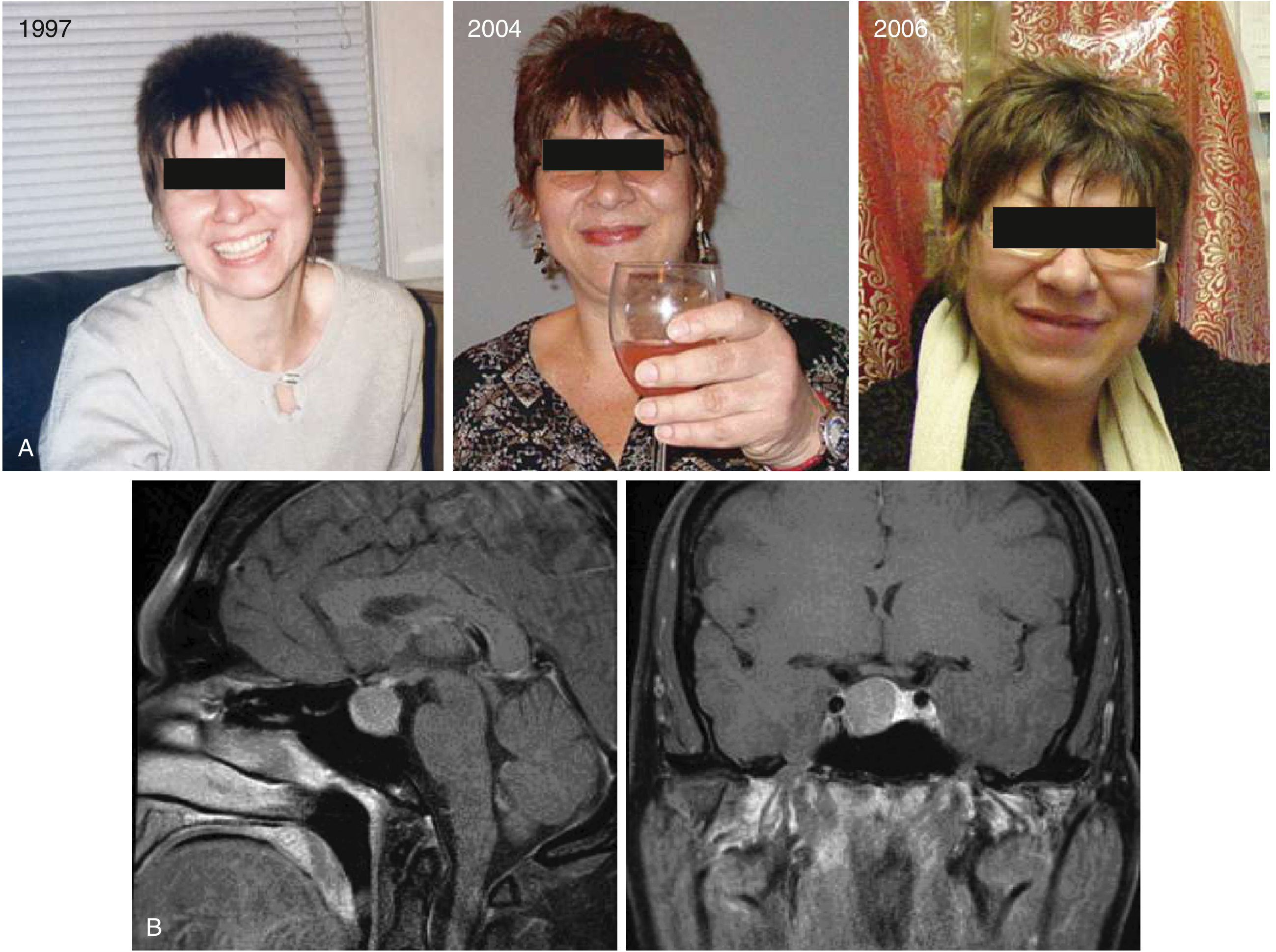
Serial photographs (1997-2006) showing progressive coarsening of facial features and the corresponding pituitary macroadenoma on MRI - Goldman-Cecil Medicine
Diagnosis
Why random GH is not useful: GH is secreted in pulses with high amplitude. Random levels are therefore unreliable.
Key diagnostic tests:
| Test | Finding in Gigantism/Acromegaly |
|---|---|
| Serum IGF-1 | Elevated - best screening test; correlates with daily GH secretion |
| Oral glucose tolerance test (75g, 2 hr) | GH fails to suppress to <1 ng/mL (polyclonal assay) or <0.4 ng/mL (chemiluminescent IRMA) |
| Pituitary MRI | Shows adenoma in ~90%; 75% are macroadenomas at diagnosis (due to delayed recognition ~5-10 years) |
| Prolactin | Measured because co-secretion has implications for dopamine agonist therapy |
- Goldman-Cecil Medicine
Treatment
Goals: shrink the tumor, normalize GH and IGF-1, prevent tumor mass effects, avoid hypopituitarism, and reduce mortality.
1. Surgery - First-line
Transsphenoidal resection is the primary treatment:
- Microadenomas: GH normalized in 80-90%
- Macroadenomas: cure rate <30%, but GH is substantially reduced
- Goldman-Cecil Medicine
2. Medical Therapy - Adjunctive or when surgery is not curative
| Drug | Mechanism | Notes |
|---|---|---|
| Somatostatin analogues (octreotide, lanreotide, pasireotide LAR) | Inhibit GH secretion | Normalize IGF-1 in ~50-60%; reduce tumor size in ~50%. Pasireotide LAR (40 or 60 mg IM q28 days) is superior to other analogues. Oral octreotide is available for partial/complete responders to injectable form. Side effects: diarrhea, cholelithiasis |
| Pegvisomant | GH receptor antagonist (biosynthetic GH analogue) | Normalizes IGF-1 in >90%; does NOT shrink the tumor. Used in refractory cases. Watch for elevated liver enzymes |
| Cabergoline (dopamine agonist) | Reduces GH and IGF-1 | Normalizes levels in only ~30% as monotherapy; useful adjunct in co-secretors of prolactin |
3. Radiation Therapy - Adjunctive only
- Not effective as primary treatment (GH normalization delayed 5-10 years)
- High risk of hypopituitarism
- Stereotactic radiotherapy (radiosurgery) may benefit persistent macroadenomas after surgery + medical therapy - Goldman-Cecil Medicine
Prognosis
- Patients achieving GH suppression to <1 ng/mL on OGTT and normal IGF-1 levels have mortality similar to the general population.
- Larger tumors and higher GH levels predict lower surgical remission rates.
- Arthropathy may progress in ~1/3 of patients even with treatment.
- Untreated: gross disfigurement, cardiac disease, cancer risk, metabolic complications, and increased mortality. - Goldman-Cecil Medicine
Key Distinctions: Gigantism vs. Acromegaly
| Feature | Gigantism | Acromegaly |
|---|---|---|
| Age of GH excess onset | Before epiphyseal closure (prepubertal) | After epiphyseal closure (adult) |
| Linear growth | Markedly increased | Not possible |
| Body proportions | Disproportionately long limbs | Thickened bones, enlarged extremities |
| Common presentation | Extraordinary height in a child | Coarse facial features, large hands/feet in an adult |
| Cause | Same (usually pituitary somatotroph adenoma) | Same |
In practice, most patients with gigantism develop acromegalic features as they age. - Robbins & Kumar Basic Pathology; Ganong's Review of Medical Physiology
This is a shared conversation. Sign in to Orris to start your own chat.