
x ray tube
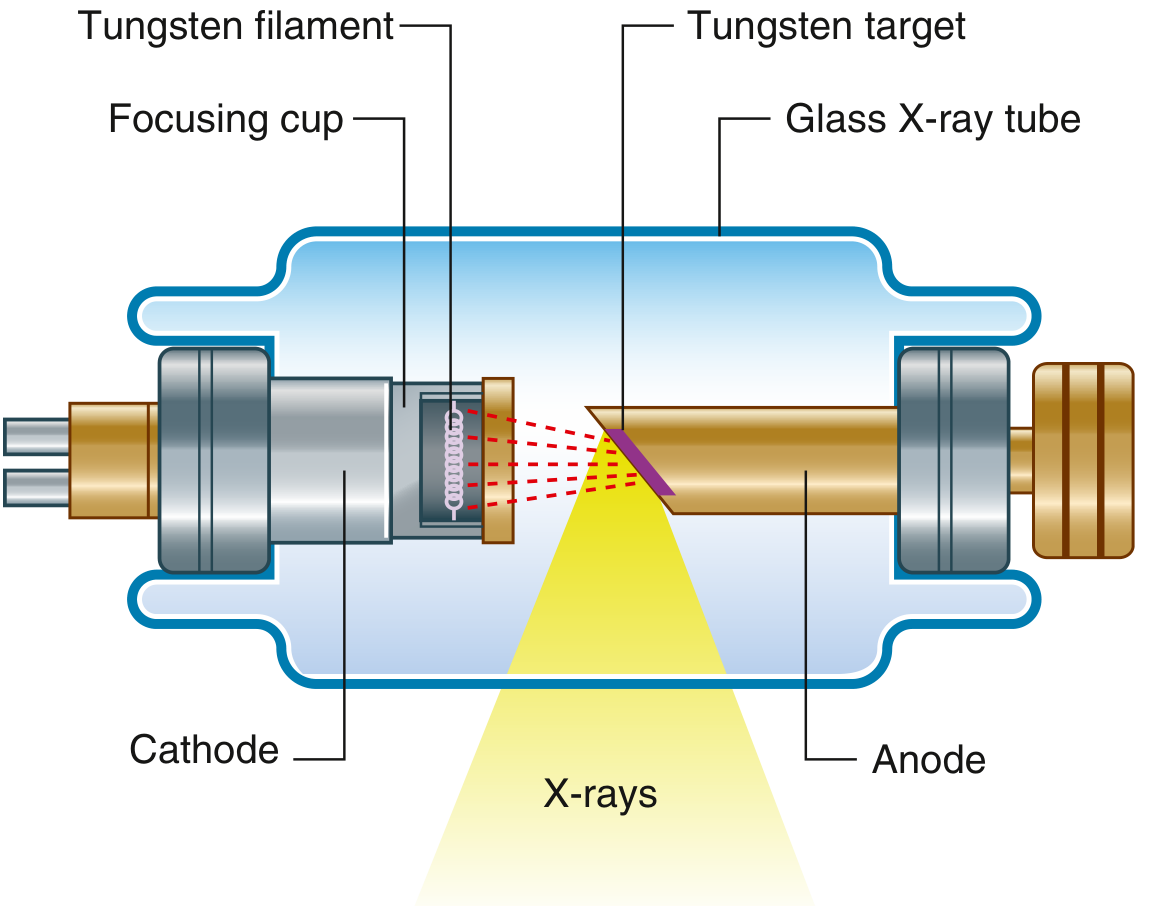
The X-ray tube is a vacuum tube that converts electrical energy into X-rays. It has two main electrodes: a cathode (with a heated filament that emits electrons via thermionic emission) and an anode (a tungsten target). High voltage accelerates electrons from cathode to anode; when they strike the target, ~99% of energy becomes heat and ~1% becomes X-rays via bremsstrahlung and characteristic radiation. The anode is angled to direct the X-ray beam and is often rotating to spread heat load.
Searching sources...
Reading File
Finding Sources
Searching the Web
X-ray tube construction components working principle radiology
Finding Sources
Reading Web Page
https://radiopaedia.org/articles/x-ray-tube-1?lang=us
Finding Sources
Reading File
Reading File
Loading Image
Reading Web Page
https://radiologykey.com/the-x-ray-tube-2
Here is a thorough breakdown of the X-ray tube:
X-ray Tube
The X-ray tube is a high-vacuum electronic diode that converts electrical energy into X-ray photons. It was first used by Wilhelm Roentgen in 1895 to produce the first radiographic image.
Construction
The general-purpose X-ray tube consists of three major components enclosed in a glass or metal vacuum envelope:
| Component | Description |
|---|---|
| Cathode | Negative electrode; contains a tungsten filament and focusing cup |
| Anode | Positive electrode; contains the tungsten target; rotates in modern tubes |
| Induction motor | Half inside, half outside the envelope; drives anode rotation |
The whole assembly sits inside a protective housing (lead-lined) to contain leakage radiation and provide oil cooling.
Cathode
- Contains a tungsten filament coiled to maximize surface area for electron emission
- Surrounded by a focusing cup (molybdenum), which is negatively charged and electrostatically focuses the electron beam toward the anode target
- When current flows through the filament, it heats up (~2200°C) and releases electrons by thermionic emission
- Tube current (mA) controls the number of electrons (and thus X-ray quantity)
Anode
- The positive electrode, made of a tungsten-rhenium alloy disc embedded in a molybdenum core
- Tungsten is chosen because it has a high atomic number (Z=74) for efficient X-ray production and an extremely high melting point (~3422°C)
- In rotating anode tubes (standard in modern use), the disc spins at ~3000-10,000 RPM to spread heat over a larger focal track rather than concentrating it on one spot
- Stationary anodes are only used in low-output applications (e.g., dental X-ray)
- Angled at typically 5-15° to define the effective focal spot (line-focus principle)
X-ray Production
Two mechanisms generate X-rays when high-energy electrons hit the tungsten target:
1. Bremsstrahlung ("braking radiation") - ~90% of output
- An electron passes close to a tungsten nucleus, decelerates and changes direction
- Kinetic energy is converted to a photon (X-ray) with a range of energies
- Produces a continuous spectrum of X-ray energies
2. Characteristic radiation - ~10% of output
- An incident electron ejects an inner-shell electron from a tungsten atom
- An outer-shell electron drops in to fill the vacancy, emitting a photon of fixed energy
- Produces discrete X-ray energies characteristic of tungsten
Efficiency is very low - only ~1% of energy becomes X-rays; ~99% becomes heat.
Key Parameters and Controls
| Parameter | Controlled by | Effect |
|---|---|---|
| kVp (kilovoltage peak) | Generator voltage | Controls X-ray energy (penetrating power/quality) |
| mA (milliamperes) | Filament current | Controls number of electrons (X-ray quantity) |
| Exposure time | Timer | Controls total dose |
| mAs | mA × time | Total X-ray output |
Important Concepts
Focal spot:
- The actual area on the anode where electrons strike is the actual focal spot
- Due to the angled anode (line-focus principle), the projected area toward the patient is smaller - this is the effective focal spot (desirable for image sharpness)
- Smaller focal spots give sharper images but generate more concentrated heat
Anode heel effect:
- X-ray intensity is not uniform across the beam
- Intensity is lower on the anode side and higher on the cathode side
- Used clinically by placing the thicker part of a body part under the cathode side
Heat management:
- Heat capacity is a major limiting factor in X-ray tube design
- Rotating anodes spread heat over the focal track
- Oil cooling dissipates heat from the housing
- Heat units (HUs) = kVp × mA × time - used to track thermal loading
Clinical Context
The X-ray tube is the core of all plain radiography, fluoroscopy, CT scanning, and cardiac catheterization angiography. In CT, the tube rotates around the patient, typically at 0.3-0.5 seconds per revolution, generating enormous heat loads which is why CT tubes need especially high heat capacity ratings.
- Gray's Anatomy for Students, Fig. 1.2
- Fuster and Hurst's The Heart, 15th Edition, p. 116
- X-ray Production - StatPearls/NCBI
skull radiological positioning
Skull radiograph positioning involves several standard views: PA (posteroanterior), AP, lateral, and special views like Towne's (for occiput/foramen magnum) and submentovertex (base of skull). Key reference lines include the orbitomeatal line (OML) and the infraorbitomeatal line (IOML). Each view is angled differently to project specific anatomical structures without superimposition.
Searching sources...
Finding Sources
Searching the Web
skull radiological positioning views PA lateral Towne submentovertex radiography
Finding Sources
Finding Sources
Finding Sources
Reading Web Page
https://radiopaedia.org/articles/skull-towne-view-1?lang=us
Finding Sources
Searching the Web
skull radiograph positions PA Caldwell Waters Towne lateral SMV positioning angles anatomy demonstrated
Reading File
Reading Web Page
https://ce4rt.com/positioning/radiographic-positioning-of-th…
Searching the Web
skull lateral view radiograph positioning OML central ray anatomy shown
Loading Image
Here is a complete guide to skull radiological positioning:
Skull Radiological Positioning
Reference Lines (Essential for all skull views)
Before positioning, understand these key reference lines:
| Line | Abbreviation | Definition |
|---|---|---|
| Orbitomeatal line | OML | From outer canthus of eye to centre of external auditory meatus (EAM) |
| Infraorbitomeatal line | IOML | From inferior orbital margin to EAM (~7-8° below OML) |
| Mentomeatal line | MML | From mental point (chin) to EAM |
| Glabellomeatal line | GML | From glabella to EAM |
| Midsagittal plane | MSP | Vertical plane dividing skull into equal left and right halves |
Standard / Basic Skull Series
1. Lateral View
| Feature | Detail |
|---|---|
| Patient position | Erect or recumbent; side of interest closest to IR |
| Part positioning | MSP parallel to IR; IOML parallel to bottom edge of IR; interpupillary line perpendicular to IR (no rotation) |
| Central ray | Perpendicular to IR; directed to a point 2 cm superior to the EAM |
| SID | 100 cm |
| Anatomy demonstrated | Entire cranium in profile - sella turcica, frontal/parietal/occipital bones, anterior/posterior clinoids, sphenoid wings, floor of anterior/middle cranial fossa, calvarium thickness |
| Used for | Pituitary fossa assessment, raised intracranial pressure (copper-beaten skull), vault fractures |
2. PA (Occipitofrontal, OF) View - 0°
| Feature | Detail |
|---|---|
| Patient position | Erect or prone, facing IR |
| Part positioning | Nose and forehead touching IR; OML perpendicular to IR; MSP perpendicular to IR |
| Central ray | Perpendicular to IR; exits at nasion; no angulation |
| Anatomy demonstrated | Frontal bone, sagittal/coronal sutures, inner skull table, overall cranial contour |
| Evaluation criteria | Equal distance from lateral skull to lateral orbit on both sides (no rotation); petrous ridges fill orbits |
3. PA Axial - Caldwell Method (OF 15°)
| Feature | Detail |
|---|---|
| Patient position | Erect or prone, facing IR |
| Part positioning | Nose and forehead against IR; OML perpendicular to IR |
| Central ray | 15° caudad to exit the nasion |
| Anatomy demonstrated | Frontal bone, frontal/anterior ethmoid sinuses, superior orbital margins, crista galli, greater/lesser sphenoid wings, superior orbital fissures |
| Evaluation criteria | Petrous ridges project into the lower third of the orbits |
| Note | At 30° caudad (exaggerated Caldwell), petrous ridges fall below orbit floors |
4. AP / AP Fronto-Occipital View
| Feature | Detail |
|---|---|
| Patient position | Supine (for trauma patients who cannot be prone) |
| Part positioning | OML perpendicular to IR; MSP perpendicular to IR |
| Central ray | Perpendicular to IR; enters glabella |
| Anatomy demonstrated | Same as PA but with slight magnification due to increased OFD; frontal bone, orbital rims |
| Note | Preferred in trauma when patient cannot be moved to prone |
5. AP Axial - Towne's View (Half-Axial)
| Feature | Detail |
|---|---|
| Patient position | Supine or seated, facing the tube |
| Part positioning | OML perpendicular to IR; chin tucked; MSP perpendicular to IR |
| Central ray | 30° caudad to OML (or 37° caudad if using IOML); directed ~2.5 cm above supraorbital margins, passing through foramen magnum |
| Anatomy demonstrated | Occipital bone, foramen magnum, dorsum sellae and posterior clinoid processes (projected inside foramen magnum), petrous pyramids, petrous ridges, occipital condyles |
| Evaluation criteria | Dorsum sellae centered within foramen magnum; symmetric petrous ridges = no rotation |
| Used for | Occiput fractures, posterior fossa |
6. PA Axial - Haas Method (Reverse Towne)
| Feature | Detail |
|---|---|
| Patient position | Prone (PA direction) |
| Part positioning | OML perpendicular to IR; MSP centred |
| Central ray | 25° cephalad from below; enters 6 cm below external occipital protuberance |
| Anatomy demonstrated | Occipital bone, foramen magnum, posterior clinoids/dorsum sellae within foramen magnum - same as Towne but for patients who cannot lie supine |
7. Occipitomental - Waters View
| Feature | Detail |
|---|---|
| Patient position | Erect or prone, facing IR |
| Part positioning | OML at 37° to IR (chin extended, raised off IR); MML perpendicular to IR; centering to acanthion |
| Central ray | Perpendicular to IR; enters at acanthion |
| Anatomy demonstrated | Maxillary sinuses (best view), frontal sinuses, inferior orbital rims, orbital floors, zygoma and zygomatic arches, nasal septum, maxillae |
| Used for | Midface fractures, sinusitis; in Tintinalli's - "Waters' view safely replaces multiple views in traditional facial series for midfacial fractures" |
8. Submentovertex (SMV) - Schuller Method (Basilar View)
| Feature | Detail |
|---|---|
| Patient position | Supine (neck hyperextended) or seated with head tilted back |
| Part positioning | IOML parallel to IR; MSP perpendicular to IR; vertex on IR |
| Central ray | Perpendicular to IOML; enters between angles of mandible; directed to sella turcica |
| Anatomy demonstrated | Base of skull - sphenoid sinuses, mandible, foramina of skull base, petrous ridges, zygomatic arches, carotid canals, odontoid process |
| Used for | Skull base fractures, zygomatic arch assessment, mandibular condyles |
| Caution | Contraindicated in suspected cervical spine injury; high radiation dose to lens |
Summary Table
| View | Direction | CR Angle | Key Structure Shown |
|---|---|---|---|
| Lateral | Side-to-side | 0° | Sella turcica, vault profile |
| PA (OF 0°) | PA | 0° | Frontal bone, sagittal suture |
| Caldwell (OF 15°) | PA | 15° caudad | Frontal sinus, sphenoid wings |
| AP | AP | 0° | Frontal bone (trauma) |
| Towne's | AP | 30° caudad (OML) | Occiput, foramen magnum |
| Haas | PA | 25° cephalad | Occiput (can't lie supine) |
| Waters | PA | OML 37° from IR | Maxillary sinuses, mid-face |
| SMV | Inferior-superior | 0° to IOML | Skull base, zygomatic arches |
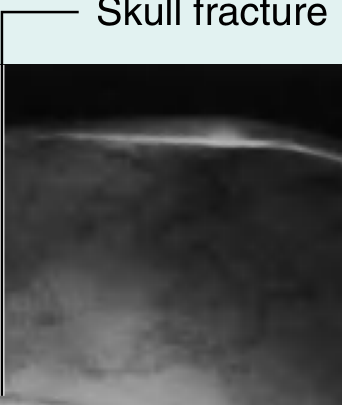
Radiograph: Skull Fracture on Plain Film
Clinical Notes
- Skull X-rays are largely replaced by CT for trauma, but plain radiography is still used in certain trauma settings and resource-limited environments
- For trauma, the standard three views are: lateral, PA, and Towne's - as noted in Gray's Anatomy for Students
- Petrous ridge position on the PA/Caldwell is the key evaluation criterion for correct angulation
- Dorsum sellae within the foramen magnum on Towne's confirms correct positioning
- Always remove hair clips, earrings, and dentures before exposure
- Radiation protection: use a thyroid collar; gonadal shielding where applicable
Sources: Gray's Anatomy for Students; Cummings Otolaryngology; CE4RT Skull Positioning; Radiology Key
This is a shared conversation. Sign in to Orris to start your own chat.