
Explain the steps involved in neurotransmitter of ANS for 6 marks
Reading File
Finding Sources
Finding Sources
Reading File
Reading File
Reading File
Loading Image
Reading File
I now have comprehensive information to give a well-structured 6-mark answer. Let me compile it.
Neurotransmitters of the Autonomic Nervous System (ANS)
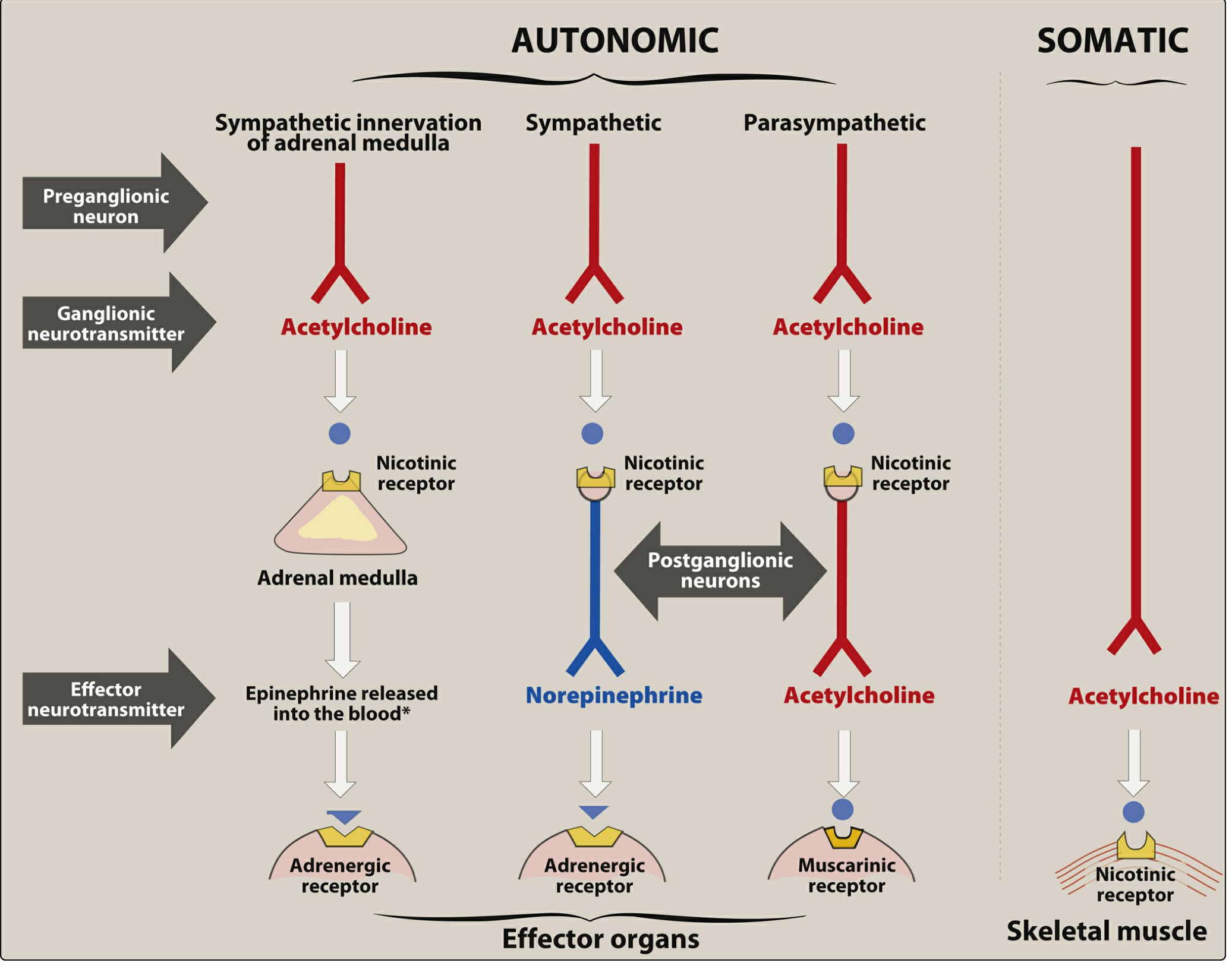
Overview
The ANS is traditionally classified based on the primary transmitter released from nerve terminals — acetylcholine (ACh) or norepinephrine (NE). Five key features govern neurotransmitter function: synthesis → storage → release → receptor action → termination.
1. Cholinergic Fibers (Release Acetylcholine)
Fibers that release ACh include:
- All preganglionic fibers (both sympathetic and parasympathetic)
- All parasympathetic postganglionic fibers
- Sympathetic postganglionic fibers to sweat glands
- Somatic motor fibers to skeletal muscle
Steps in Cholinergic Transmission:
| Step | Details |
|---|---|
| Synthesis | Choline + Acetyl-CoA → ACh, catalysed by choline acetyltransferase (ChAT) in the nerve terminal |
| Storage | ACh stored in small clear synaptic vesicles near the presynaptic membrane; peptide cotransmitters (e.g., VIP, substance P) in large dense-cored vesicles |
| Release | Action potential → voltage-gated Ca²⁺ channels open → intracellular Ca²⁺ rises → vesicles fuse with membrane (via VAMPs + SNAPs, the "fusion proteins") → exocytosis of ACh |
| Receptor Binding | ACh binds nicotinic receptors at ganglia and neuromuscular junction; muscarinic receptors at parasympathetic postganglionic effector organs |
| Termination | Acetylcholinesterase (AChE) rapidly hydrolyses ACh into choline + acetate in the synaptic cleft; choline is recycled back into the terminal |
2. Adrenergic Fibers (Release Norepinephrine)
Fibers that release NE include:
- Most sympathetic postganglionic fibers
- Adrenal medullary chromaffin cells (release epinephrine 80% + NE 20% into the blood)
Steps in Adrenergic Transmission:
| Step | Details |
|---|---|
| Synthesis | Tyrosine → DOPA (rate-limiting step by tyrosine hydroxylase) → Dopamine → transported into vesicle → Norepinephrine (by dopamine β-hydroxylase inside vesicle). In adrenal medulla, NE → Epinephrine (by PNMT, only in adrenal cells) |
| Storage | NE stored in dense-cored vesicles via VMAT (vesicular monoamine transporter). Blocked by reserpine |
| Release | Action potential → Ca²⁺ influx → vesicle fusion via VAMPs/SNAPs → NE + cotransmitters released into the synapse |
| Receptor Binding | NE/Epi bind α₁, α₂ and β₁, β₂ adrenoceptors on postsynaptic effector cells; α₂ on presynaptic terminal acts as autoreceptor (negative feedback) |
| Termination | (a) Reuptake into terminal via NET (norepinephrine transporter) — primary mechanism; blocked by cocaine, tricyclic antidepressants. (b) Metabolism by MAO (mitochondrial) and COMT (extracellular) |
3. Key Neurotransmitter Summary Table
| Location | Neurotransmitter Released | Receptor Type |
|---|---|---|
| All preganglionic → ganglion | ACh | Nicotinic (N_N) |
| Parasympathetic postganglionic → effector | ACh | Muscarinic (M) |
| Sympathetic postganglionic → effector | Norepinephrine | Adrenergic (α, β) |
| Sympathetic → sweat glands | ACh (exception) | Muscarinic |
| Preganglionic → adrenal medulla | ACh | Nicotinic (N_N) |
| Adrenal medulla → blood | Epi (80%) + NE (20%) | Adrenergic (α, β) |
4. Cotransmitters (Non-classic)
Many ANS neurons co-release additional substances alongside the primary transmitter:
- ATP — cotransmitter at many ANS–effector synapses
- Neuropeptide Y (NPY) — co-released with NE; causes prolonged vasoconstriction
- Nitric oxide (NO) — cotransmitter at inhibitory junctions, mediates smooth muscle relaxation
- VIP — cotransmitter in some parasympathetic neurons; vasodilatory
In summary, cholinergic transmission dominates at ganglia and parasympathetic effectors, while adrenergic transmission governs most sympathetic effector organ responses. Both pathways follow the same fundamental steps: synthesis → vesicular storage → Ca²⁺-triggered release → receptor binding → enzymatic/transporter termination.
— Katzung's Basic and Clinical Pharmacology, 16th Edition, p. 148–153; Lippincott Illustrated Reviews: Pharmacology, p. 133–134

Can I write this for that question just check and tell me
Checking Date & Time
Yes, you can write this — the content is largely correct and relevant for a 6-mark question on neurotransmitters of the ANS. Here's a detailed review:
✅ What's Correct
| Your Point | Verdict |
|---|---|
| ANS consists of preganglionic nerve, ganglion, postganglionic nerve, effector organ | ✅ Correct anatomical framework |
| Both sympathetic & parasympathetic ganglia have nicotinic receptors (Nn) | ✅ Correct |
| Nn at ganglion, Nm at neuromuscular junction | ✅ Correct subtypes |
| Nicotinic receptors blocked by d-tubocurarine (Nm) and pentamethonium/hexamethonium (Nn) | ✅ Correct |
| Muscarinic action = effect of ACh at parasympathetic postganglionic ending | ✅ Correct definition |
| Muscarinic actions: bradycardia, increased glandular secretion, smooth muscle contraction (intestine, bronchi) | ✅ All correct |
| Muscarinic receptors selectively blocked by atropine (and hyoscine butyl bromide/buscopan) | ✅ Correct |
| Adrenergic receptors at postganglionic sympathetic nerve endings | ✅ Correct |
| Adrenergic receptors classified into Alpha and Beta | ✅ Correct |
| Alpha receptor → excitatory action (except intestine) | ✅ Correct |
| Beta receptor → inhibitory action (except heart) | ✅ Correct |
⚠️ Things to Add or Fix
-
The question asks about "steps involved in neurotransmission" — your notes cover receptors and actions well, but are missing the key steps of neurotransmitter function:
- Synthesis → Storage → Release → Receptor binding → Termination
- Examiners awarding 6 marks will expect at least a brief mention of these steps for both cholinergic and adrenergic transmission.
-
Adrenergic receptors — you wrote "α-receptor" as a third type separately, but α is already part of Alpha. Clarify: α₁, α₂, β₁, β₂ are the subtypes.
-
Termination of action is missing:
- ACh → broken down by acetylcholinesterase
- NE → reuptake into nerve terminal (primary), or metabolism by MAO/COMT
-
You mention "nicotinic action" is a stimulant effect on ganglia — add that this is also blocked by hexamethonium (ganglionic blocker), which you did write — good.
📝 Verdict
This answer will fetch ~4–4.5/6 marks. To get full marks, add 3–4 lines on the steps of neurotransmission (synthesis, storage, Ca²⁺-triggered release, termination by AChE/reuptake). The receptor classification and pharmacology part is well done.
What should I write other than these what should I add in these
Here's exactly what to add to make your answer complete for 6 marks:
🔴 Add This Section: Steps of Neurotransmission
Write this before your receptor section, right after the anatomy part.
Steps in Cholinergic Transmission (ACh)
1. Synthesis
- Choline + Acetyl-CoA → Acetylcholine
- Enzyme: Choline acetyltransferase (ChAT)
2. Storage
- ACh stored in synaptic vesicles in nerve terminal
3. Release
- Action potential arrives → Ca²⁺ influx → vesicles fuse with membrane → exocytosis of ACh
4. Receptor Binding
- ACh binds nicotinic or muscarinic receptors → produces effect
5. Termination
- Acetylcholinesterase (AChE) breaks ACh → choline + acetate
- Choline is recycled back into terminal
Steps in Adrenergic Transmission (NE)
1. Synthesis
- Tyrosine → DOPA → Dopamine → Norepinephrine
- Rate-limiting enzyme: Tyrosine hydroxylase
2. Storage
- NE stored in dense-cored vesicles via VMAT
3. Release
- Action potential → Ca²⁺ influx → exocytosis of NE
4. Receptor Binding
- NE binds α or β adrenoceptors → produces effect
5. Termination
- Reuptake back into nerve terminal (main method)
- Metabolism by MAO and COMT
🟡 Small Fix in Your Existing Notes
In the adrenergic receptor part, write it clearly as:
Alpha receptor subtypes → α₁ and α₂ Beta receptor subtypes → β₁ and β₂
Also add one line:
α₂ is a presynaptic autoreceptor → inhibits further NE release (negative feedback)
📋 What Your Answer Structure Should Look Like
- Anatomy of ANS ✅ (you have this)
- Steps of Cholinergic Transmission ← ADD THIS
- Steps of Adrenergic Transmission ← ADD THIS
- Cholinergic receptors (Nicotinic & Muscarinic) ✅ (you have this)
- Adrenergic receptors (Alpha & Beta + actions) ✅ (you have this)
Adding steps 1–5 for both ACh and NE is the main thing missing. That alone will push your answer to full 6/6 marks.
This is a shared conversation. Sign in to Orris to start your own chat.