
The eyeball anatomy
Reading File
Now let me search the library for eyeball anatomy content and images in parallel.
Finding Sources
Searching Images
eyeball anatomy diagram cross section
Finding Sources
Loading Image
Finding Sources
Finding Sources
I have good sources. Let me read the detailed anatomy sections from multiple textbooks in parallel.
Reading File
Reading File
Reading File
I found a great diagram in Ganong's. Let me fetch those images now.
Loading Image
Loading Image
Reading File
I now have comprehensive content from multiple authoritative textbooks. Here is a thorough overview of eyeball anatomy:
Eyeball Anatomy
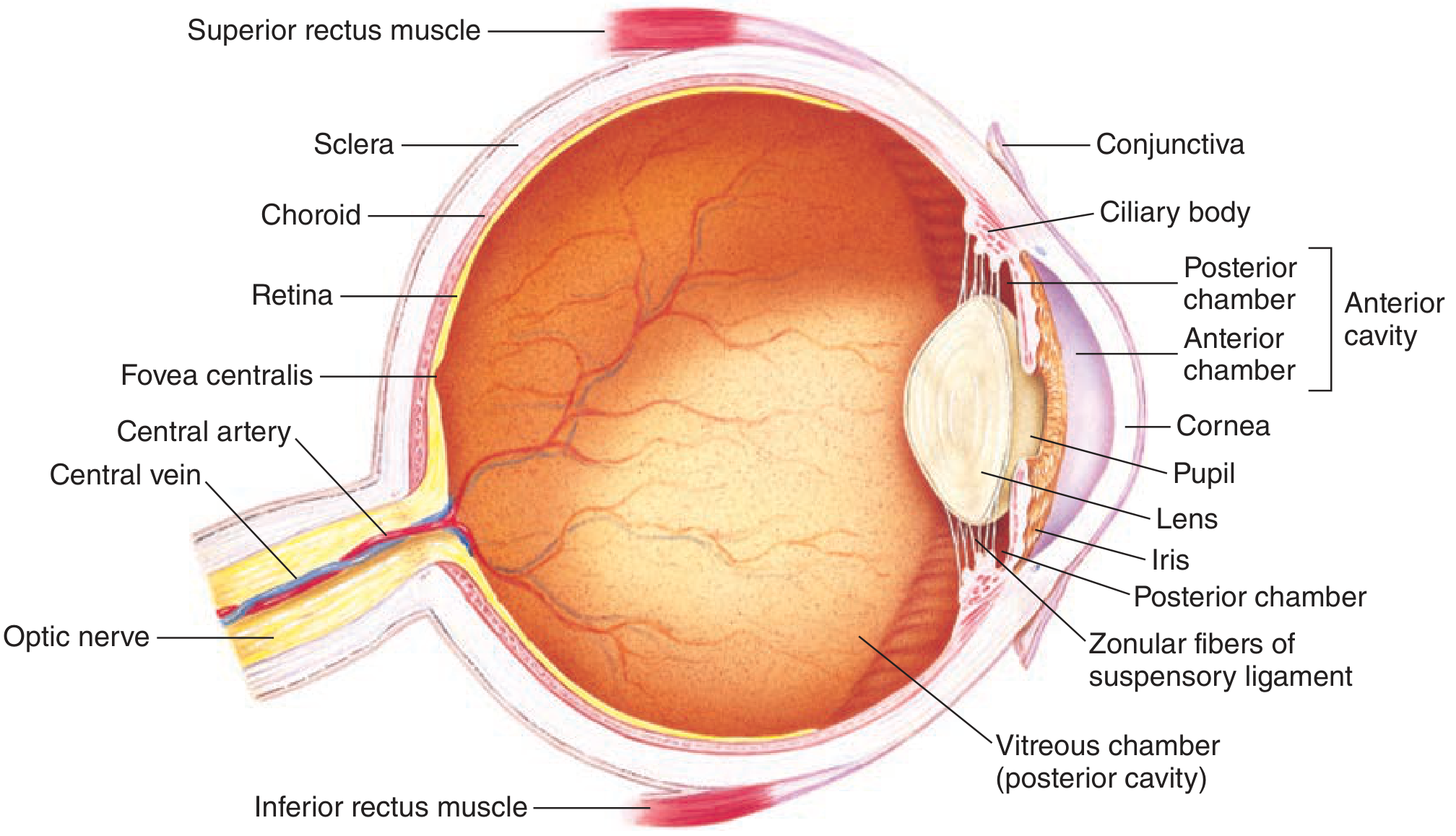
Three Structural Coats
The eyeball wall consists of three concentric layers:
1. Outer Fibrous Coat (Corneoscleral Layer)
| Structure | Description |
|---|---|
| Sclera | Opaque white outer coat of dense collagenous connective tissue; protects the globe; thinnest at the rectus muscle insertions |
| Cornea | Transparent anterior modification of the sclera; allows light entry; meets the sclera at the corneoscleral limbus (which houses corneolimbal stem cells) |
Corneal layers (anterior → posterior):
- Epithelium — nonkeratinized stratified squamous, 5–6 cells thick; prone to abrasion
- Bowman layer (anterior basement membrane)
- Stroma — thick, avascular
- Descemet membrane (posterior basement membrane)
- Endothelium
Conjunctiva — clear mucous membrane covering the sclera (bulbar) and inner eyelid surface (palpebral); stratified columnar with goblet cells.
2. Middle Vascular Coat (Uvea)
The uveal tract = choroid + ciliary body + iris. It supplies nutrition and controls light/accommodation.
| Structure | Function |
|---|---|
| Choroid | Vascular layer between sclera and retina; inner choriocapillary layer nourishes the retina; outer Bruch membrane is the basal lamina for RPE cells |
| Ciliary body | Between iris and choroid; secretes aqueous humor via ciliary processes; anchors zonular fibers (suspensory ligament of the lens); contains ciliary muscle for accommodation |
| Iris | Pigmented, opaque diaphragm in front of the lens; controls pupil size via sphincter pupillae (parasympathetic → miosis) and dilator pupillae (sympathetic → mydriasis); pupil diameter changes can produce a 16-fold change in retinal light exposure |
3. Inner Sensory Layer — Retina
The retina lines the posterior two-thirds of the globe and contains 10 layers:
| Layer | Contents |
|---|---|
| 1 — Retinal pigment epithelium (RPE) | Absorbs scattered light; maintains blood-retina barrier; phagocytoses shed rod/cone discs; restores photosensitivity |
| 2 — Photoreceptors | Rods (120 million) — detect light intensity; contain rhodopsin (opsin + 11-cis-retinal). Cones (7 million) — detect color (red, green, blue); contain iodopsin |
| 3 — Outer limiting membrane | Zonulae adherentes of Müller cells |
| 4 — Outer nuclear layer | Nuclei of rods and cones |
| 5 — Outer plexiform layer | Synapses of photoreceptors with horizontal, amacrine, and bipolar cells |
| 6 — Inner nuclear layer | Nuclei of bipolar, horizontal, amacrine, and Müller cells |
| 7 — Inner plexiform layer | Synapses of bipolar/amacrine cells with ganglion cells |
| 8 — Ganglion cell layer | Cell bodies of ganglion cells |
| 9 — Nerve fiber layer | Axons of ganglion cells → form the optic nerve |
| 10 — Inner limiting membrane | Basal lamina separating retina from vitreous body |
Fovea centralis — the area of highest visual acuity, densely packed with cones. Optic disc — where the optic nerve exits; has no photoreceptors ("blind spot").
Lens
A transparent, biconvex, avascular structure suspended by zonular fibers from the ciliary body. Consists of a lens capsule, subcapsular epithelium, and lens fiber cells. Changes shape during accommodation — ciliary muscle contraction relaxes zonular tension, making the lens more convex for near focus.
Chambers and Fluid Compartments
| Chamber | Location | Contents |
|---|---|---|
| Anterior chamber | Between cornea and iris | Aqueous humor |
| Posterior chamber | Between iris, zonule, and lens | Aqueous humor |
| Vitreous chamber | Between lens and retina | Vitreous body (clear gel) |
Aqueous humor is produced by the ciliary processes → flows through the pupil into the anterior chamber → drains via the trabecular meshwork into the canal of Schlemm (at the iridocorneal angle). Blockage raises intraocular pressure (IOP) → glaucoma risk.
Accessory Structures
| Structure | Note |
|---|---|
| Eyelids | Skin, tarsal plates, orbicularis oculi, levator palpebrae superioris, conjunctiva |
| Tarsal (Meibomian) glands | Sebaceous glands in tarsal plates; produce the lipid layer of the tear film |
| Lacrimal gland | Produces aqueous tears; flow drains via nasolacrimal duct into the nasal cavity |
| Extraocular muscles | Superior/inferior rectus, medial/lateral rectus, superior/inferior oblique — move the globe |
Embryological Origins
| Tissue | Origin |
|---|---|
| Retina | Neuroectoderm |
| Lens, corneal epithelium | Surface ectoderm |
| Sclera, corneal stroma, vascular coat | Mesoderm |
Sources: Ganong's Review of Medical Physiology, 26e; Histology: A Text and Atlas (Wojciech's), 8e; Junqueira's Basic Histology, 17e; Tintinalli's Emergency Medicine, 9e
This is a shared conversation. Sign in to Orris to start your own chat.