

58c7a27f-e70c-4800-8f96-4308d8eea063.jpeg
Write a answer according to kd tripathy mbbs pharmacology book
Quick Answer: The question is about a mid-40s man with insomnia secondary to job-related anxiety. The drugs used are sedative-hypnotics (benzodiazepines, Z-drugs) and antidepressants (for long-term anxiety). Below is a comprehensive answer based on KD Tripathi's pharmacology principles.
Searching sources...
Reading File
Now let me search the library for the relevant topics in parallel.
Finding Sources
Finding Sources
Finding Sources
Finding Sources
Reading File
Finding Sources
Reading File
Finding Sources
Reading File
Finding Sources
Reading File
Finding Sources
Reading File
Reading File
I now have enough information to write a comprehensive answer. Let me also fetch the key diagram image.
Loading Image
Here is a complete, exam-ready answer structured as per KD Tripathi's MBBS Pharmacology approach (4+3+3 = 10 marks):
Case: Young Man (Mid-40s) with Insomnia Due to Job-Related Anxiety
Clinical Analysis
This patient has anxiety-related (secondary) insomnia. As noted in the margin of the question image: since there is a history of anxiety-related insomnia, sedative-hypnotics may be given short-term, but antidepressants with anxiolytic properties should be added for long-term treatment.
(a) Drugs That Could Be Used (4 marks)
The drugs are divided into two categories:
1. For Immediate/Short-term Relief of Insomnia:
A. Benzodiazepines (BZDs)
- Short-acting (for sleep-onset insomnia): Triazolam, Midazolam
- Intermediate-acting: Temazepam, Nitrazepam, Loprazolam
- Long-acting (anxiety + insomnia): Diazepam, Clonazepam, Lorazepam, Alprazolam (especially for panic + anxiety)
B. Non-Benzodiazepine Hypnotics ("Z-Drugs")
- Zolpidem - most commonly used; short half-life (2-3 hrs)
- Zaleplon - very short half-life; ideal for sleep-onset insomnia
- Eszopiclone - longer acting among Z-drugs
2. For Long-term Treatment of Underlying Anxiety (preferred over BZDs):
C. SSRIs (First-line for anxiety)
- Escitalopram, Paroxetine, Sertraline, Fluoxetine
D. SNRIs
- Venlafaxine, Duloxetine
E. Azapirones
- Buspirone - specifically for Generalized Anxiety Disorder (GAD); no dependence
F. Barbiturates (now largely obsolete - not recommended)
(b) Mechanisms of Action (3 marks)
1. Benzodiazepines - GABA-A Receptor Positive Allosteric Modulation
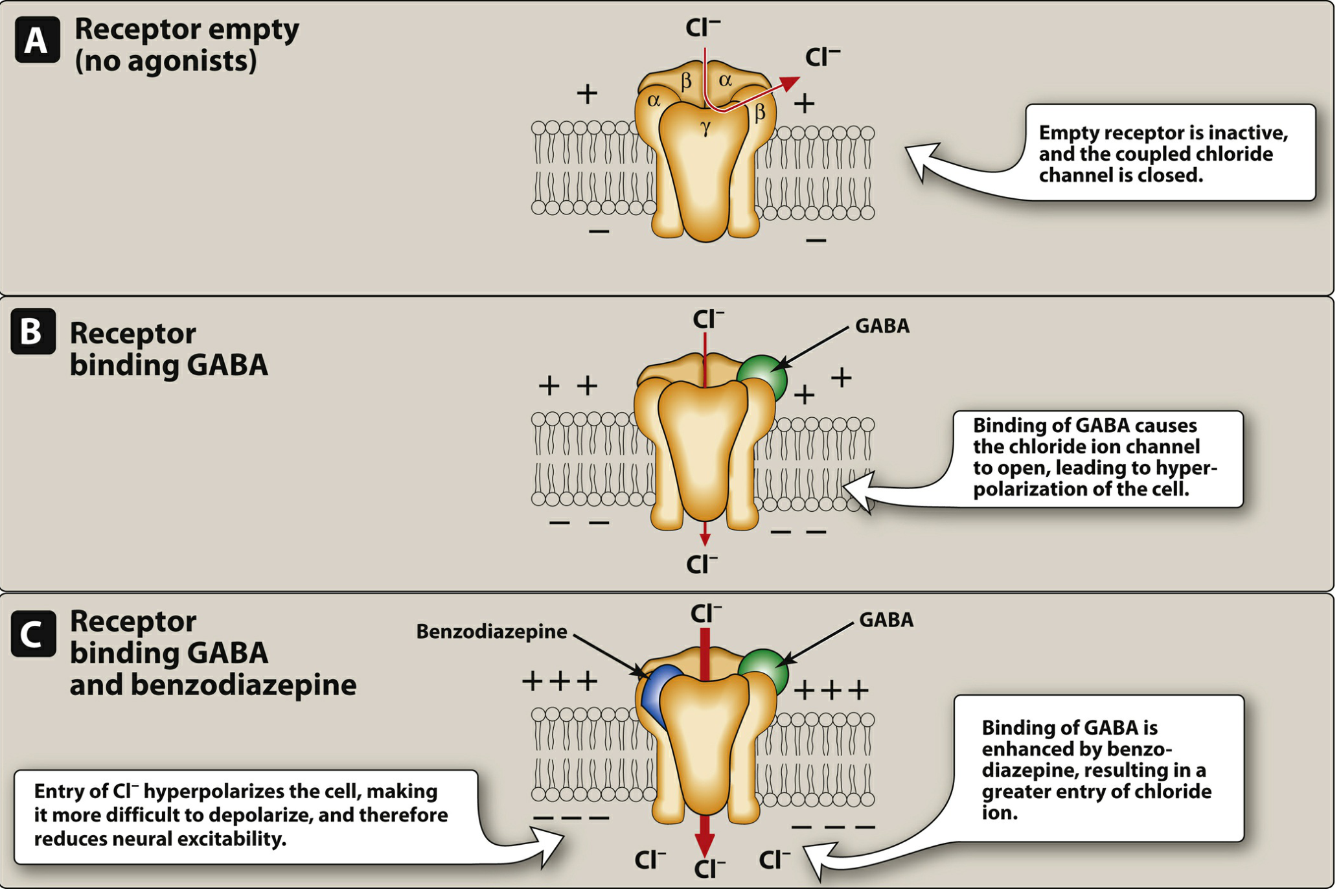
- BZDs bind to a specific high-affinity site at the interface of the α and γ subunits of the GABA-A receptor (distinct from the GABA binding site)
- This binding increases the FREQUENCY of chloride channel opening in response to GABA
- Increased Cl⁻ influx → hyperpolarization of the neuron → decreased neuronal excitability → anxiolytic + sedative-hypnotic effects
- Anxiolytic effect: mediated via α2-subunit GABA-A receptors in the limbic system
- Sedative/hypnotic effect: mediated via α1-subunit GABA-A receptors
Key distinction from barbiturates: Barbiturates increase the DURATION of Cl⁻ channel opening, while benzodiazepines increase the FREQUENCY of opening.
2. Z-Drugs (Zolpidem, Zaleplon, Eszopiclone)
- Structurally different from BZDs, but also act on GABA-A receptors, selectively at the α1-subunit benzodiazepine binding site
- Because of α1 selectivity, they primarily produce hypnotic effects with minimal anxiolytic, anticonvulsant, or muscle-relaxant effects
- Do not significantly alter normal sleep architecture (REM and slow-wave sleep largely preserved)
3. Buspirone
- Acts as a partial agonist at 5-HT1A serotonin receptors (pre- and postsynaptic)
- Also has some affinity for D2 dopamine receptors and 5-HT2A receptors
- Does NOT act on GABA receptors
- Reduces anxiety without sedation; has no dependence potential
- Slow onset (takes 1-2 weeks to take effect)
4. SSRIs / SNRIs
- SSRIs (e.g., escitalopram): Block the serotonin reuptake transporter (SERT) → increased synaptic serotonin → anxiolytic + antidepressant effect via downregulation of postsynaptic 5-HT receptors over time
- SNRIs (e.g., venlafaxine): Block both SERT and the norepinephrine reuptake transporter (NET) → anxiolytic effect
(c) Advantages and Disadvantages of Each (3 marks)
| Drug Class | Advantages | Disadvantages |
|---|---|---|
| Benzodiazepines | Rapid onset; effective for both anxiety and insomnia; muscle relaxant; anticonvulsant; wide therapeutic index | Dependence and tolerance (with >2 weeks use); rebound insomnia on withdrawal; daytime sedation/hangover; psychomotor impairment; not for long-term use; withdrawal can be dangerous |
| Z-Drugs (Zolpidem, Zaleplon) | Rapid onset; short half-life; minimal residual sedation; do not suppress REM or slow-wave sleep; less tolerance; fewer withdrawal effects than BZDs | Only for insomnia (no anxiolytic effect); complex sleep behaviors (sleep-walking, sleep-driving); amnesic effects; dependence possible with prolonged use |
| Buspirone | No dependence/addiction; no sedation; no psychomotor impairment; does not potentiate alcohol; safe in elderly; good for chronic GAD | Slow onset (1-2 weeks); not effective for acute/episodic anxiety; not useful as hypnotic; ineffective if patient was previously on BZDs |
| SSRIs/SNRIs | First-line for chronic anxiety; no dependence; can treat comorbid depression; safe long-term | Slow onset (2-4 weeks); initial anxiety worsening; sexual dysfunction; GI side effects; withdrawal syndrome if abruptly stopped; not useful for acute insomnia |
| Barbiturates | Effective CNS depressants | Very narrow therapeutic index; severe dependence; fatal in overdose; strong enzyme inducers; no longer recommended |
Summary / Recommended Approach for this Patient
Per KD Tripathi's principles:
- Short-term: Use a short-acting BZD (e.g., temazepam) or Z-drug (zolpidem 5-10 mg at bedtime) for immediate insomnia relief
- Concurrent/Long-term: Start an SSRI (escitalopram) or buspirone for the underlying job-related anxiety
- Taper the BZD as the SSRI takes effect (over 4-6 weeks)
- Non-pharmacological: Sleep hygiene, cognitive behavioral therapy (CBT-I), stress management
Sources: Lippincott Illustrated Reviews: Pharmacology, Chapter 16 (Sedative-Hypnotics); KD Tripathi principles are aligned with the GABA-A mechanism, BZD pharmacology, and buspirone/SSRI use for anxiety as described above.
This is a shared conversation. Sign in to Orris to start your own chat.