
Which incision is common in open appendifs ctomy
The most common incision for open appendectomy is the McBurney's (gridiron) incision.
Searching sources...
Reading File
Finding Sources
Reading File
Reading File
Here is a thorough answer based on authoritative surgical textbooks:
Incisions Used in Open Appendectomy
Three right lower quadrant (RLQ) incisions are used for open appendectomy. All three are muscle-splitting approaches centered over McBurney's point (junction of the lateral 1/3 and medial 2/3 of a line from the anterior superior iliac spine to the umbilicus).
1. McBurney (Gridiron) Incision
- An oblique, muscle-splitting incision made perpendicular to a line from the ASIS to the umbilicus
- Centered over McBurney's point in the RLQ
- The external oblique, internal oblique, and transversus abdominis muscles are split along their fibers (not cut), preserving muscle strength
- Classic teaching incision; often called the "McArthur-McBurney" incision
2. Rockey-Davis Incision
- A transverse (horizontal) muscle-splitting incision over the RLQ
- Generally most commonly used in modern practice because it is more cosmetically appealing and allows easier extension
- Can be extended medially over the rectus (Fowler-Weir extension) or laterally through the internal oblique (Rutherford-Morrison extension) when more exposure is needed
3. Modified McBurney
- A variation combining features of the above two
When a Midline Incision Is Used Instead
- If there is diagnostic uncertainty (e.g., cannot rule out other pathology)
- Diffuse peritonitis or suspected complicated/perforated appendicitis
- The lower midline laparotomy incision is extensible and can be carried cephalad as needed
Summary Table
| Incision | Direction | Key Feature |
|---|---|---|
| McBurney (Gridiron) | Oblique (perpendicular to ASIS-umbilicus line) | Classic; muscle-splitting |
| Rockey-Davis | Transverse | Most commonly used today; extensible |
| Lower Midline | Vertical | Used for complicated/uncertain cases |
Bottom line: The Rockey-Davis (transverse) incision is most commonly used in current practice, while the McBurney (oblique/gridiron) is the classic historically standard incision. Both are muscle-splitting RLQ incisions centered at McBurney's point.
- Fischer's Mastery of Surgery, 8th ed., p. 7839
- Sabiston Textbook of Surgery, p. 1575
What about lanz incision
The Lanz incision is a transverse incision in the RLQ, very similar to the Rockey-Davis, but placed lower and more along the natural skin crease (Langer's lines) for a better cosmetic result.
Searching sources...
Finding Sources
Searching the Web
Lanz incision appendectomy description surgical anatomy
Reading File
Loading Image
The Lanz Incision
The Lanz incision is a transverse skin crease incision placed in the right iliac fossa, and is now the most widely used incision for open appendicectomy in many parts of the world (especially the UK and Europe), having largely replaced the classic gridiron in modern practice.
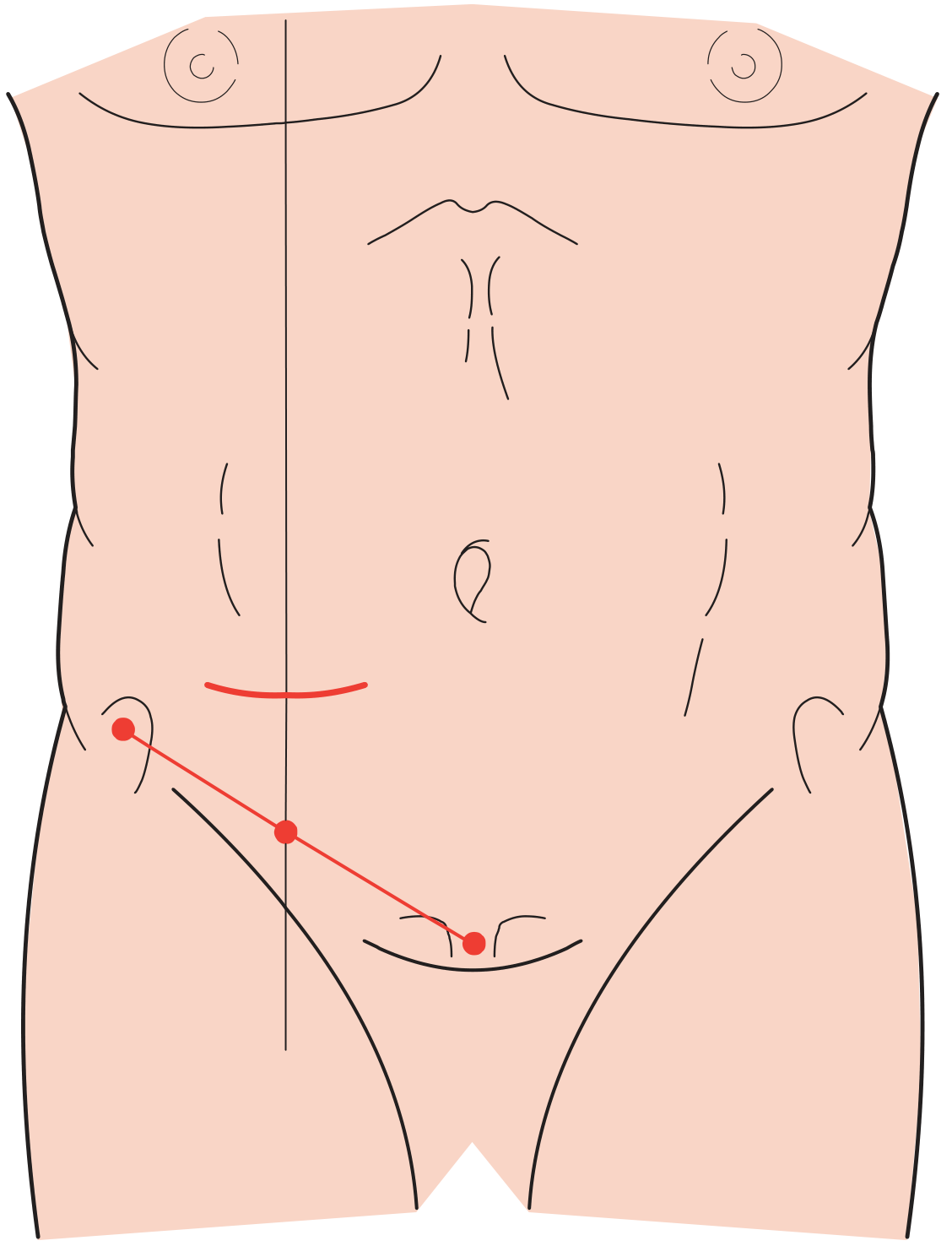
The curved red line shows the Lanz incision; the diagonal line marks McBurney's point on the ASIS-to-umbilicus line.
Key Features
| Feature | Detail |
|---|---|
| Direction | Transverse (horizontal) |
| Position | ~2 cm below the umbilicus, centred on the midclavicular-midinguinal line |
| Follows | Langer's lines (natural skin tension lines) |
| Muscle handling | Muscle-splitting (same as gridiron - fibers are split, not cut) |
| Extension | Can be extended medially with retraction or division of the rectus abdominis |
Lanz vs. Gridiron (McBurney) - Key Differences
| Gridiron (McBurney) | Lanz | |
|---|---|---|
| Direction | Oblique (perpendicular to ASIS-umbilicus line) | Transverse (along skin crease) |
| Cosmesis | Less cosmetic | Better cosmetic result (follows Langer's lines) |
| Exposure | Good | Better exposure |
| Extension | Harder | Easier to extend medially |
| Popularity | Classic/traditional | Increasingly preferred today |
Relationship to Rockey-Davis
The Lanz is very similar to the Rockey-Davis incision - both are transverse RLQ incisions. The distinction is mainly geographic naming: "Rockey-Davis" is the American term, while "Lanz" is the European/British term. The Lanz is placed slightly lower, more closely following the skin crease for cosmesis.
- Bailey and Love's Short Practice of Surgery, 28th ed., p. 1366
This is a shared conversation. Sign in to Orris to start your own chat.