
Hi, I am a final year MBBS student in dr..mgr tamilnadu medical University. Tell me about necrotising enterocolitis in neonates
Reading File
Now let me search the medical library and PubMed in parallel for NEC content.
Finding Sources
Finding Sources
Searching PubMed
"necrotizing enterocolitis"[MeSH Terms] AND neonates
Excellent - multiple sources found. Let me read the most relevant ones in parallel - Creasy & Resnik (maternal-fetal medicine), Robbins Pathology, and Sabiston Surgery for comprehensive coverage.
Reading File
Reading File
Reading File
Reading File
Let me now get the Bell staging criteria and more clinical details, plus fetch the NEC pathology image.
Finding Sources
Reading File
Loading Image
Let me get the Bell staging criteria in full from Fischer's Mastery of Surgery.
Reading File
Reading File
I now have comprehensive information. Let me also grab the X-ray image of NEC pneumatosis from Fischer's.
Loading Image
Reading File
I now have all the information needed for a comprehensive answer. Let me compile it.
Necrotising Enterocolitis (NEC) in Neonates
NEC is the most common gastrointestinal emergency in the neonatal period and a devastating complication of prematurity. Here is a complete breakdown for your MBBS finals.
Definition & Epidemiology
- NEC is characterized by intestinal inflammation that can progress to transmural necrosis and perforation.
- Affects 1-5% of all NICU admissions overall; 4-13% of very low birth weight (VLBW) infants (<1500 g).
- Incidence is inversely proportional to gestational age - the more premature the infant, the higher the risk; peak incidence at ~32 weeks corrected gestational age.
- Mortality: 10-30% overall; up to 50% in infants requiring surgery.
- 80% of cases occur in the first month of life, typically after enteral feeds are initiated.
(Creasy & Resnik's Maternal-Fetal Medicine; Sabiston Textbook of Surgery)
Pathogenesis (Multifactorial)
Three core mechanisms interact:
| Mechanism | Detail |
|---|---|
| Intestinal immaturity | Abnormal bowel motility, immature vascular supply, poor epithelial barrier function, immature mucosal immune defense |
| Gut microbiome disruption | Abnormal colonization by pathogenic bacteria; prolonged antibiotic use disturbs normal flora; infectious clusters occur in NICUs |
| Exaggerated inflammatory response | Cytokine/chemokine release; platelet-activating factor (PAF) promotes enterocyte apoptosis and compromises tight junctions, increasing mucosal permeability; TLR4 activation increases gut ischemia in response to pathogenic bacteria |
- NEC is almost exclusively seen in infants who have received enteral feeds, suggesting postnatal bacterial introduction triggers the cascade.
- In term neonates, NEC is often associated with congenital heart disease, perinatal asphyxia, and hypoxia/low-flow states (so-called "term-NEC").
(Robbins Basic Pathology; Fischer's Mastery of Surgery; Grainger & Allison Diagnostic Radiology)
Risk Factors
Antenatal:
- Prematurity and low birth weight (most significant)
- Indomethacin tocolysis (especially double-agent tocolytic therapy)
- Protective: antenatal corticosteroid administration
Postnatal:
- Formula feeding (vs. human milk)
- Rapid advancement of feeds
- Prolonged antibiotic use
- Multiple blood transfusions
- Hypoxia/ischaemia (especially in term infants with congenital cardiac disease)
- Exposure to enteric pathogens (cluster outbreaks)
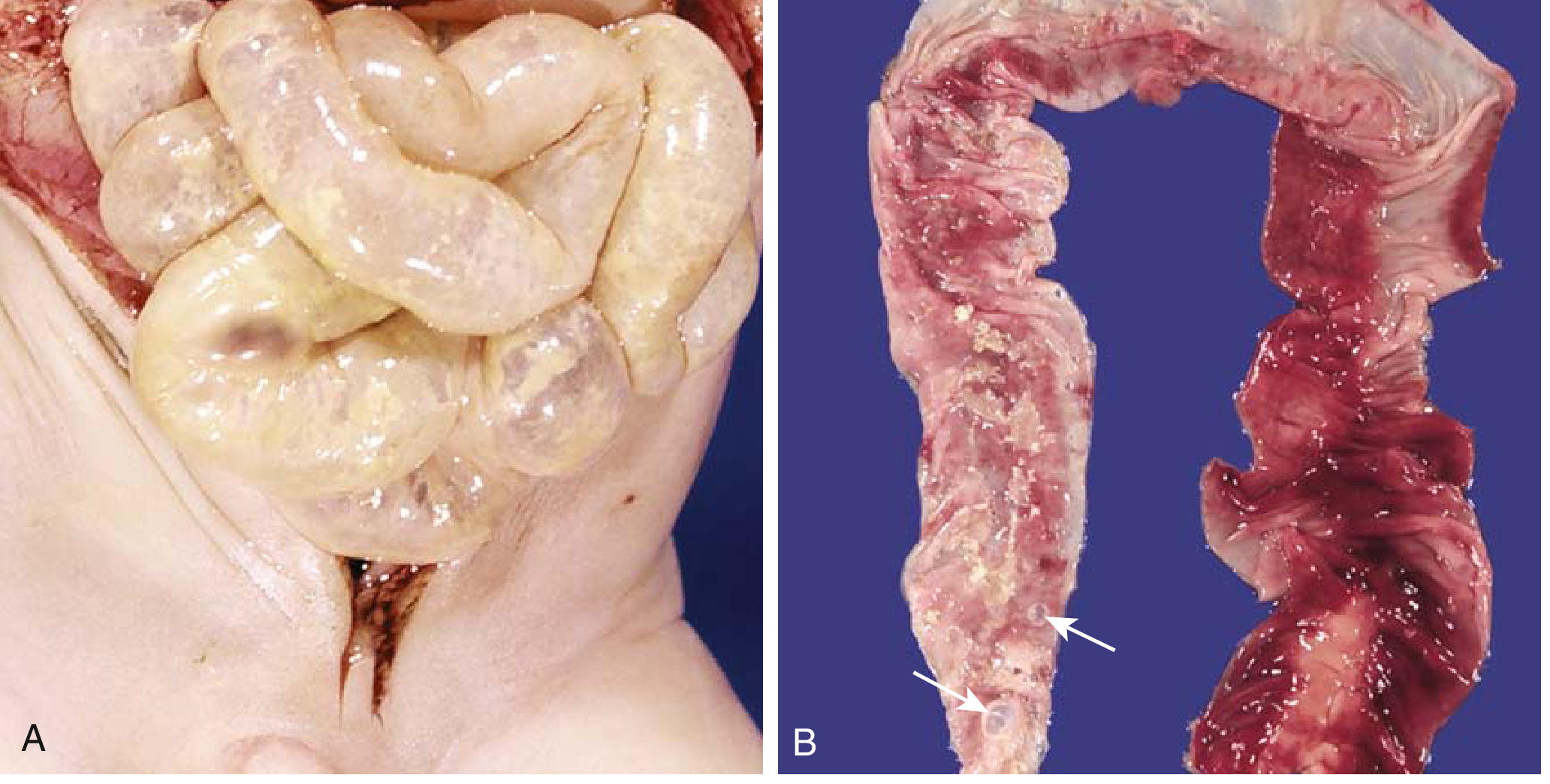
Pathology (Morphology)
Macroscopic:
- Most commonly involves: terminal ileum, cecum, and right colon (any segment can be involved)
- Bowel is distended, friable, congested, or gangrenous
- Perforation and peritonitis may be present
Microscopic:
- Mucosal or transmural coagulative necrosis
- Ulceration
- Bacterial colonization
- Submucosal gas bubbles (pneumatosis intestinalis)
- Granulation tissue and fibrosis (in healing phase)
Clinical Features
Systemic (non-specific early signs):
- Temperature instability
- Lethargy, apnea, bradycardia
- Hypoglycaemia, oxygen desaturation
GI signs (more specific):
- Feeding intolerance, increased gastric residuals
- Abdominal distension and tenderness
- Bloody stools (occult or gross)
- Vomiting, diarrhoea
Advanced signs:
- Abdominal wall erythema and oedema (cellulitis)
- Blue discolouration of the abdomen (perforation)
- Visible dilated bowel loops through thin abdominal wall
- Septic shock, DIC, cardiovascular collapse
Lab findings:
- Thrombocytopenia, leukocytosis or leukopenia
- Elevated CRP, elevated lactate
- Metabolic acidosis, respiratory acidosis
Bell Staging Criteria (Bell et al., 1978 - Ann Surg)
This is the classic clinical staging system used to guide management:
| Stage | Systemic Signs | GI Signs | Radiographic Findings |
|---|---|---|---|
| I - Suspected | Temperature instability, lethargy, apnea, bradycardia | Poor feeding, ↑ gastric residuals, emesis, mild abdominal distension, occult blood in stools | Distension with mild ileus |
| II - Definite | (as above) | Persistent occult or gross GI bleeding, marked abdominal distension | Marked intestinal distension, small bowel separation/oedema, pneumatosis intestinalis, portal venous gas |
| III - Advanced | Deterioration of vital signs, septic shock | - | Pneumoperitoneum (free air) |
(Fischer's Mastery of Surgery, 8th ed.)
Radiological Features
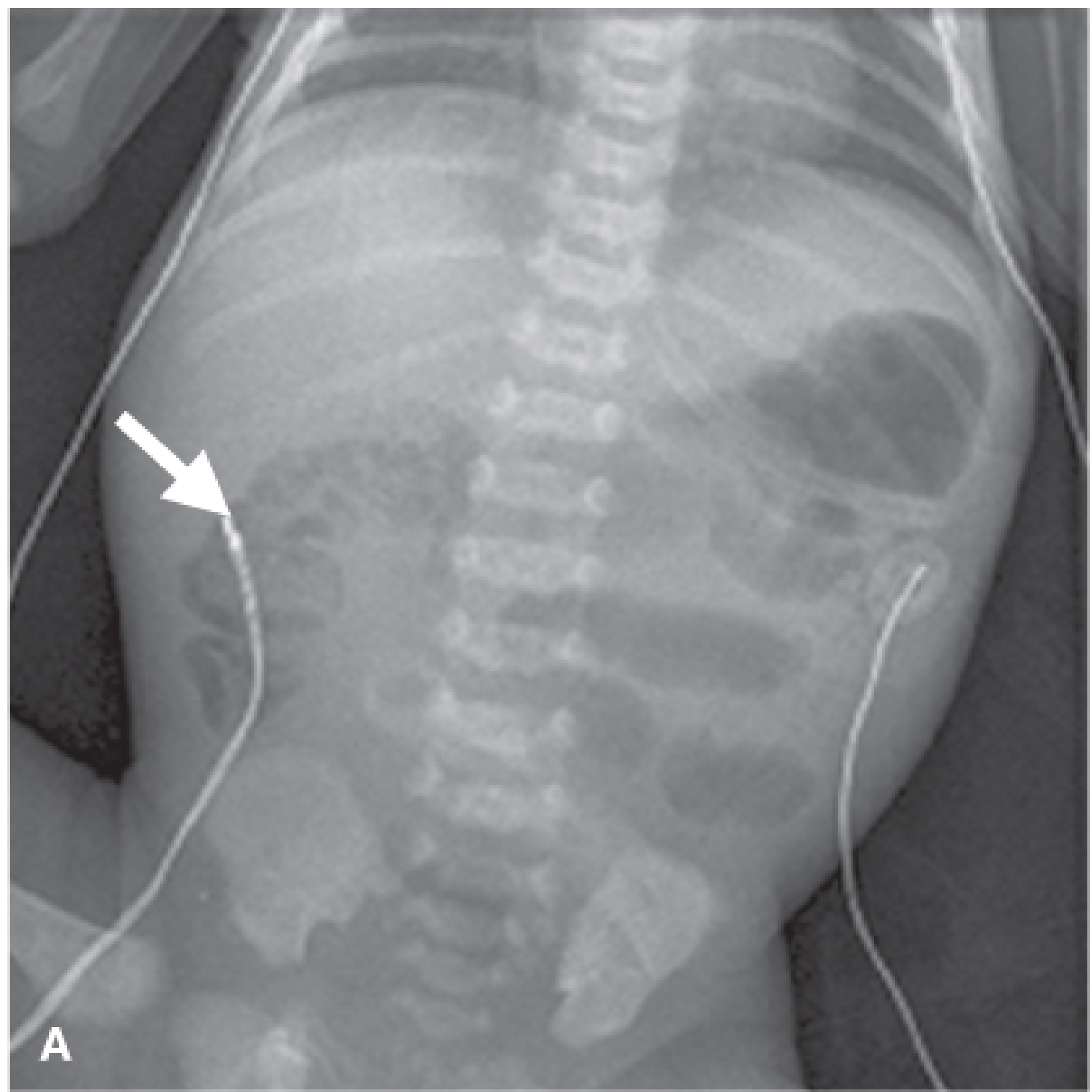
Four key X-ray signs (in order of significance):
- Non-specific global bowel dilatation - earliest, non-specific
- Persistent/fixed bowel loop - on serial X-rays, same loop doesn't change position - poor prognostic sign
- Pneumatosis intestinalis - pathognomonic; intramural gas (hydrogen from bacterial fermentation); seen as bubbly or linear lucencies in the bowel wall
- Portal venous gas - branching linear lucencies over liver radiating from porta hepatis; seen in ~30%, indicates severe disease
- Pneumoperitoneum (free air) - indicates perforation; absolute indication for surgery
Ultrasound may reveal: portal venous gas, bowel wall thickening, complex ascites (indicating perforation).
Management
Medical (>50% of cases can be managed without surgery)
- Nil per mouth (NPO) - stop all enteral feeds
- Orogastric tube decompression
- IV fluid resuscitation
- Broad-spectrum antibiotics (covering gram-negative organisms and anaerobes)
- Serial abdominal X-rays (every 6-8 hours initially)
- Close monitoring for surgical indications
Surgical Indications
| Absolute | Relative |
|---|---|
| Pneumoperitoneum (free air) | Clinical deterioration |
| Persistent metabolic acidosis | |
| Abdominal wall cellulitis | |
| Palpable abdominal mass (matted ischemic bowel) | |
| Persistent fixed bowel loop on X-ray | |
| Portal venous gas |
Surgical Options
- Exploratory laparotomy - resection of all nonviable segments; preserving maximum intestinal length
- Ostomy creation - common; allows bowel rest and later anastomosis
- Second-look laparotomy - at 24-48 hours for marginally viable bowel
- Peritoneal drainage (bedside) - for extremely low birth weight (<1500 g) infants with perforated NEC; effective as temporizing or definitive treatment; outcomes comparable to laparotomy in VLBW infants (established by multicenter RCT)
- Primary anastomosis - only in rare, very stable infants with focal, isolated perforation
Prevention
- Human breast milk - fourfold decrease in NEC risk (RR 0.25; meta-analysis of RCTs); all mothers of at-risk infants (<32 weeks) should be encouraged strongly
- Antenatal corticosteroids - protective
- Gradual, protocol-based feeding advancement
- Probiotics - evidence is low; not yet standard of care
Complications & Prognosis
- Short bowel syndrome (SBS) - after extensive bowel resection
- Post-NEC strictures - in ~10% of infants (most commonly at the splenic flexure); develop after both medical and surgical management; a contrast enema should be done before ostomy reversal
- Adhesions - may cause late intestinal obstruction
- High mortality, especially in surgical cases (up to 50%)
- NEC totalis (involvement of entire GI tract) - near-universally fatal
Key Points to Remember for Exams
- Most common GI emergency in neonates; most significant risk factor = prematurity
- Pathognomonic finding: pneumatosis intestinalis on X-ray
- Absolute surgical indication: pneumoperitoneum
- Bell staging classifies disease into I (suspected), II (definite), III (advanced)
- Human breast milk is the single most important preventive measure
- Terminal ileum and right colon are most commonly affected
- Portal venous gas is a poor prognostic indicator
- ~10% develop post-NEC strictures even after conservative management
This is a shared conversation. Sign in to Orris to start your own chat.