
Juvenile idiopathic arthritis
Reading File
Finding Sources
Searching PubMed
"juvenile idiopathic arthritis"[MeSH Terms]
Finding Sources
Searching PubMed
"juvenile idiopathic arthritis" treatment
Now let me read the most comprehensive sources in parallel:
Reading File
Reading File
Reading File
Reading File
Reading File
Searching Images
juvenile idiopathic arthritis joint swelling rash
I now have comprehensive information to provide a thorough overview. Let me also get the remaining rows from the Harriet Lane table on subtypes:
Reading File
I have enough information to write a comprehensive answer. Let me compile it now.
Juvenile Idiopathic Arthritis (JIA)
JIA is the most common rheumatologic condition in children and serves as an umbrella term replacing the older "juvenile rheumatoid arthritis." It encompasses a heterogeneous group of arthritides of unknown cause — likely autoimmune — that present before age 16 with arthritis persisting ≥6 weeks after other causes are excluded.
Classification Criteria (ILAR)
| Criterion | Requirement |
|---|---|
| Age of onset | < 16 years |
| Duration | ≥ 6 weeks |
| Definition | Joint swelling, limitation in ROM, and/or tenderness |
Subtypes (ILAR Classification)
1. Oligoarticular JIA (40–50% — most common)
- Demographics: F > M; peak onset 2–4 years
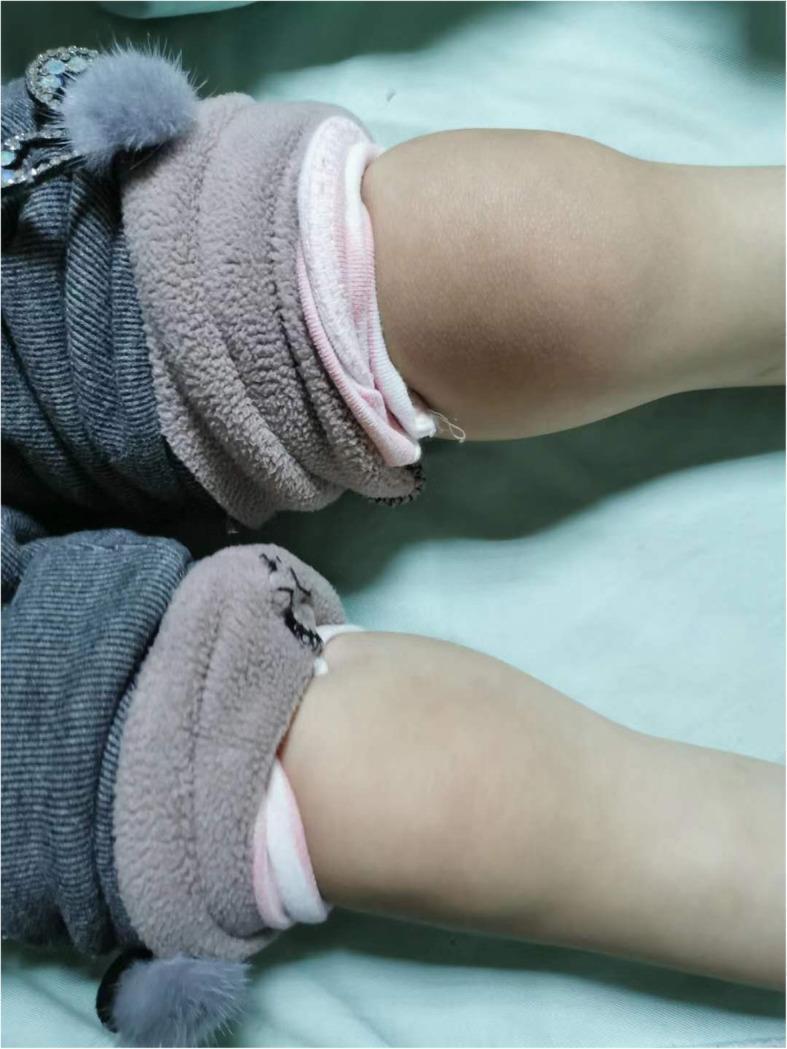
- Joints: 1–4 joints in first 6 months; lower extremity large joints (knees, ankles)
- Subtypes: Persistent (<4 joints throughout) vs. Extended (>4 joints after 6 months)
- Key features: 60–70% ANA positive; uveitis in ~30% (16% persistent, 25% extended)
2. Polyarticular RF-negative (20–35%)
- Demographics: F > M; bimodal peak 2–4 and 10–14 years
- Joints: ≥5 joints (first 6 months); small and large, symmetric or asymmetric
- Key features: 50% ANA positive; uveitis prevalence 4%
3. Polyarticular RF-positive (<10%)
- Demographics: F > M; peak onset 9–12 years
- Joints: ≥5 joints; symmetric polyarthritis
- Key features: 40% ANA positive; rheumatoid nodules; uveitis 2%
- Closest analog to adult RA
4. Systemic JIA / Still Disease (5–15%)
- Demographics: M = F; peak 1–5 years
- Definition: Arthritis + quotidian (daily spiking) fevers ≥2 weeks, plus ≥1 of:
- Evanescent salmon-pink macular rash (non-pruritic, on trunk, extremities, palms/soles)
- Generalized lymphadenopathy
- Hepatosplenomegaly
- Serositis (pleuritis, pericarditis)
- Labs: Anemia, leukocytosis, thrombocytosis, elevated ESR/CRP/ferritin; ANA 20%; HLA-B27 5–10%
- Fevers characteristically spike to ≥39°C in a "rabbit-ear" diurnal pattern
- Uveitis rare (1%)
5. Enthesitis-Related Arthritis (10–15%)
- Demographics: M > F; peak 9–16 years
- Peripheral arthritis + enthesitis; sacroiliac involvement common
- Strongly HLA-B27 associated; overlaps with spondyloarthropathy spectrum
6. Psoriatic JIA
- Arthritis + psoriasis, or arthritis + ≥2 of: dactylitis, nail pitting/onycholysis, first-degree relative with psoriasis
7. Undifferentiated (5%)
- Does not fit any subtype, or meets criteria for ≥2 subtypes
Clinical Features
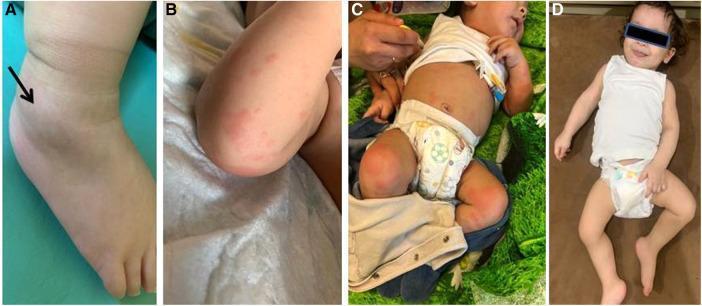
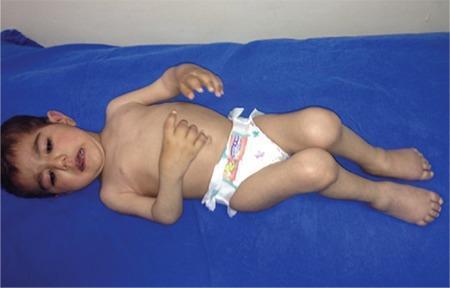
Joints: Knee most commonly affected; wrist (flexed/ulnar deviated), hands (radially deviated), cervical spine, and TMJ can all be involved.
Extra-articular:
- Uveitis — most common in oligoarticular ANA-positive girls; often asymptomatic → requires routine slit-lamp exam every 3–6 months
- Cervical spine involvement → facet ankylosis, atlantoaxial subluxation, kyphosis
- Lower extremity: flexion contractures (hip, knee), subluxation, equinovarus feet, valgus knees
Radiology: Early — soft tissue swelling and effusion; Late — bone and cartilage destruction
Macrophage Activation Syndrome (MAS)
A life-threatening complication occurring in 7–17% of systemic JIA patients (can also complicate SLE, Kawasaki disease).
| Feature | Description |
|---|---|
| Mechanism | Uncontrolled T-lymphocyte and macrophage proliferation → cytokine storm → multiorgan failure |
| Clinical | Persistent fever, altered mental status, lymphadenopathy, hepatosplenomegaly, purpura, mucosal bleeding |
| Labs | Pancytopenia, liver dysfunction, DIC, hyperferritinemia, hypertriglyceridemia, low fibrinogen, paradoxical drop in ESR (despite active inflammation) |
| Treatment | Pulse IV corticosteroids + IL-1 or IL-6 blockade; cyclosporine A or JAK inhibitors for refractory disease |
Treatment
Treatment is subtype- and severity-dependent, with a step-up approach:
| Category | Agents |
|---|---|
| NSAIDs | Naproxen, ibuprofen — first-line for mild disease |
| Corticosteroids | Intra-articular injections preferred; systemic for severe/systemic disease |
| DMARDs (non-biologic) | Methotrexate (current first-line DMARD), leflunomide, azathioprine |
| Biologic — anti-TNF | Etanercept, infliximab, adalimumab |
| Biologic — anti-IL-1 | Anakinra, canakinumab (especially for systemic JIA) |
| Biologic — anti-IL-6 | Tocilizumab (systemic and polyarticular JIA) |
| T-cell costimulation inhibitor | Abatacept |
| Anti-CD20 | Rituximab |
| JAK inhibitors | Tofacitinib, baricitinib (newer option) |
| Surgical | Synovectomy (refractory), arthrodesis, arthroplasty (severe disease) |
Methotrexate is the standard first-line DMARD; biologics are added for inadequate response. Systemic JIA is increasingly managed with early IL-1 or IL-6 blockade.
Prognosis
- ~50% achieve remission without sequelae
- ~25% have mild disability
- ~20–25% develop crippling arthritis, blindness, or both
- Oligoarticular persistent form carries the best prognosis; RF-positive polyarticular and systemic JIA have higher morbidity
Key Images
Sources: The Harriet Lane Handbook (23rd ed.); Miller's Review of Orthopaedics (9th ed.); Tintinalli's Emergency Medicine; Robbins & Kumar Basic Pathology
This is a shared conversation. Sign in to Orris to start your own chat.