
In microscopy of breast carcinoma in morphology of it is the basement membrane breached or intact
Reading File
In breast carcinoma, the key microscopic distinction is whether the basement membrane is breached or intact - this determines the difference between in situ and invasive carcinoma. Let me get the textbook details.
Searching sources...
Finding Sources
Finding Sources
Reading File
Reading File
Reading File
Loading Image
Here is a clear, textbook-sourced answer to your question:
Breast Carcinoma: Basement Membrane - Breached or Intact?
The answer depends entirely on whether the carcinoma is in situ or invasive. This distinction is the single most important morphologic feature in breast carcinoma.
Carcinoma In Situ - Basement Membrane INTACT
In ductal carcinoma in situ (DCIS) and lobular carcinoma in situ (LCIS), the malignant cells are confined within ducts and lobules - the basement membrane is intact and not breached.
- As Robbins Pathology states: "Carcinoma in situ refers to cancer cells confined within ducts and lobules by a basement membrane."
- Robbins & Kumar Basic Pathology adds: "Both [DCIS and LCIS] 'respect' the basement membrane and do not invade into stroma or lymphovascular vessels."
- Myoepithelial cells are generally preserved in involved ducts/lobules in DCIS.
- Because the basement membrane is intact, there is no metastatic potential in true in situ disease.
Histologic patterns of DCIS (all with intact basement membrane):
| Pattern | Feature |
|---|---|
| Comedo type | High-grade cells with central necrosis and calcifications |
| Cribriform | Rounded "cookie-cutter" spaces |
| Micropapillary | Bulbous protrusions without fibrovascular cores |
| Papillary | True papillae with fibrovascular cores, lacking myoepithelial cells |
Invasive (Infiltrating) Carcinoma - Basement Membrane BREACHED
In invasive ductal carcinoma (now called "No Special Type" / NST) and invasive lobular carcinoma, malignant cells have broken through the basement membrane into the surrounding stroma.
- Bailey & Love's Surgery states: "Infiltration of the surrounding tissue through a breach in the basement membrane leads to 'invasive or infiltrative' ductal or lobular carcinoma."
- Sabiston Surgery notes: "The basement membrane layer is an important boundary, differentiating noninvasive breast cancer (DCIS) from invasive breast cancer. Invasion or infiltration across this boundary confers metastatic potential."
Histology Image - In Situ Carcinoma (Intact Basement Membrane)
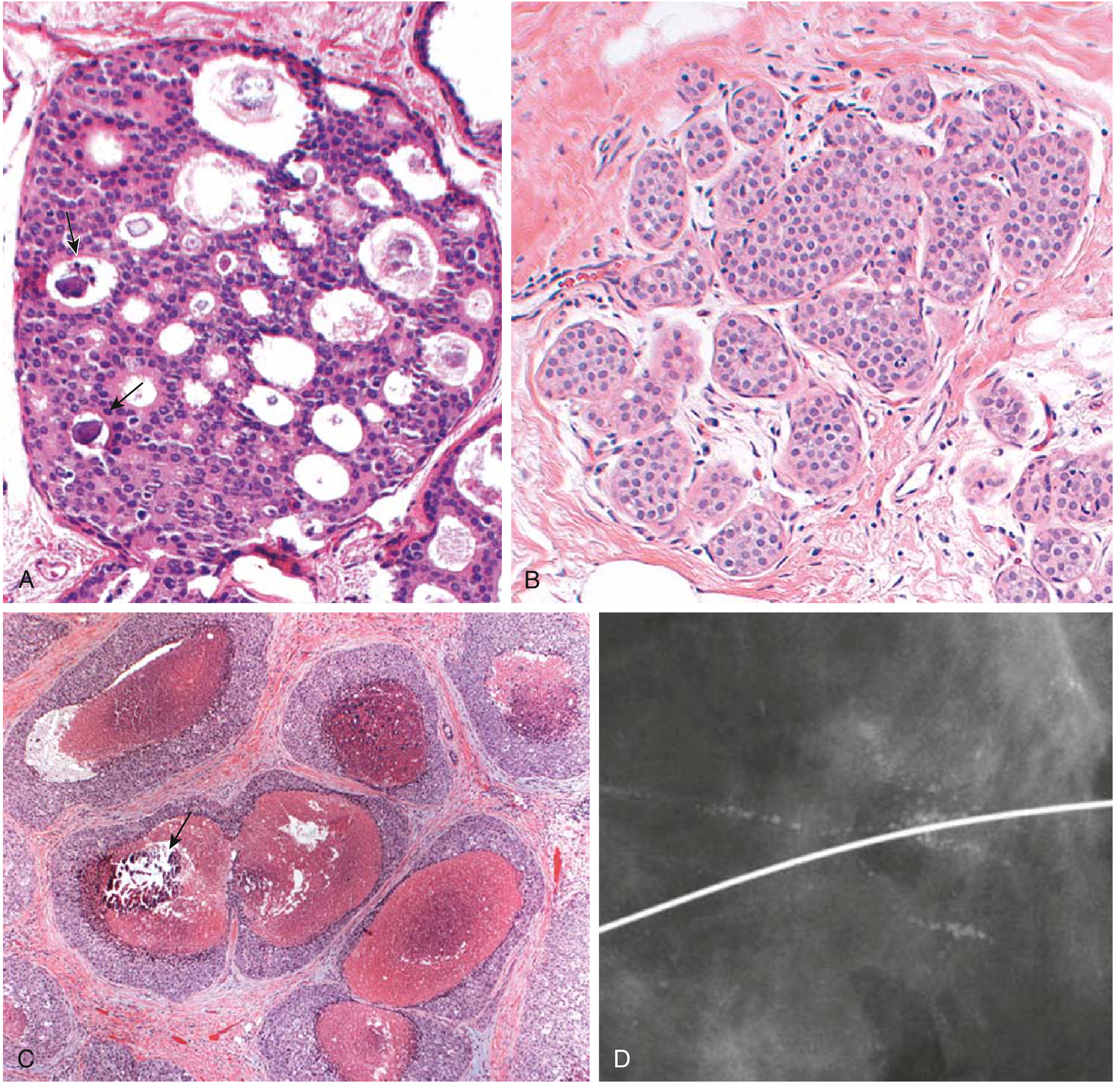
(A) DCIS - distorted lobular spaces with calcified secretory material. (B) LCIS - monomorphic cells filling the lobule. (C) Comedo DCIS - central necrosis and calcifications. (D) Mammogram showing linear ductal calcifications of DCIS.
Summary Table
| Type | Basement Membrane | Metastatic Risk |
|---|---|---|
| DCIS | Intact | None (local recurrence only) |
| LCIS | Intact | None (risk marker for future cancer) |
| Invasive carcinoma | BREACHED | Present - can spread to nodes and distant sites |
Special note - Paget disease of the nipple: DCIS cells extend up lactiferous ducts into nipple skin without crossing the basement membrane, so this remains classified as in situ disease even though it involves the skin.
Sources: Robbins, Cotran & Kumar Pathologic Basis of Disease; Robbins & Kumar Basic Pathology; Bailey & Love's Short Practice of Surgery 28th Ed; Sabiston Textbook of Surgery.
This is a shared conversation. Sign in to Orris to start your own chat.