
KCL replacement guidline
I'll look up the KCL (potassium chloride) replacement guidelines from the medical library.
Searching sources...
Reading File
Finding Sources
Searching PubMed
potassium chloride replacement hypokalemia guidelines
Good hits. Now let me read the detailed content from the most relevant sources simultaneously.
Reading File
Reading File
Reading File
Let me also pull the surgical and nephrology content for completeness.
Reading File
Reading File
I now have comprehensive data from four authoritative sources. Let me also fetch the ECG image for visual reference.
Loading Image
I now have everything needed for a complete, well-sourced answer. Here is the full KCL replacement guideline:
KCL (Potassium Chloride) Replacement Guidelines
1. Definitions & Severity Classification
| Severity | Serum K+ (mEq/L) | Notes |
|---|---|---|
| Normal | 3.5 - 5.0 | - |
| Mild hypokalemia | 3.0 - 3.5 | Often asymptomatic |
| Moderate hypokalemia | 2.5 - 3.0 | Weakness, ECG changes may appear |
| Severe hypokalemia | < 2.5 (or < 3.0 with symptoms) | Life-threatening; paralysis possible below 2.0 |
Key deficit rule: Each 0.3 mEq/L drop in serum K+ below normal corresponds to ~100 mEq total body deficit. However, the correlation between plasma K+ and total body deficit is imprecise - over- and under-replacement both carry risk, so frequent re-checking is essential.
2. ECG Monitoring
Always obtain an ECG when hypokalemia is suspected. ECG changes correlate with severity:
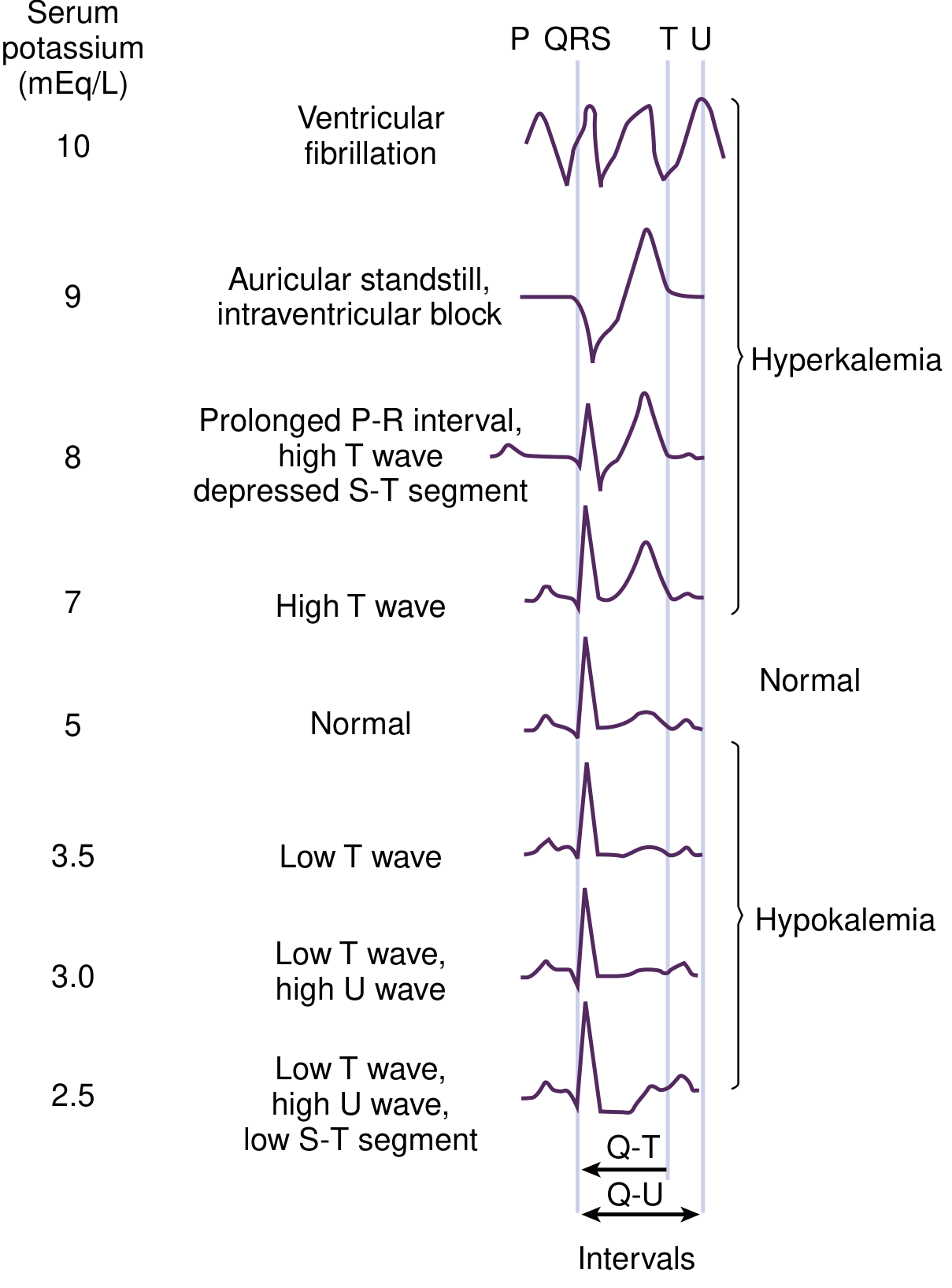
- Mild: Flattened T waves
- Moderate: Prominent U waves (small deflections after T wave)
- Severe: ST depression, prolonged QT interval (>500 ms doubles/triples torsades risk), arrhythmias
Continuous cardiac monitoring is mandatory if K+ < 2.0 mEq/L, QT > 500 ms, or IV rate > 20 mEq/hr.
3. Oral Replacement (First-Line for Mild-Moderate)
- Preferred route when patient can tolerate PO and no severe symptoms
- KCl is the most common form; also available as liquid, powder, and tablet
- Dose: 40-60 mEq orally every 2-4 hours (Rosen's EM)
- Each oral dose should not exceed 20-40 mEq per administration (NKF Primer)
- Safer than IV - less risk of overshoot hyperkalemia
- Chronic supplementation: 60-80 mEq/day for outpatient management (Morgan & Mikhail)
- Oral replacement over several days is the safest method for stable patients
4. Intravenous (IV) KCL Replacement
Indications for IV
- Moderate-severe hypokalemia with cardiac arrhythmias or significant ECG changes
- Severe muscle weakness or paralysis
- K+ < 3.0 mEq/L (symptomatic) or < 2.5 mEq/L (any)
- Patient unable to tolerate oral potassium
- DKA, perioperative settings, or NPO patients
Peripheral IV Rates
| Rate | Access | Monitoring Required |
|---|---|---|
| ≤ 8-10 mEq/hr | Peripheral IV | Standard monitoring |
| 10-20 mEq/hr | Central line required | Continuous ECG monitoring |
| > 20 mEq/hr | Central line only | Continuous ECG; reserved for K+ < 2.0 or QT > 500 ms |
- Peripheral IV max: 8 mEq/hr due to risk of phlebitis/allodynia
- Daily max: 240 mEq/day IV
- Goal of IV therapy = remove patient from immediate danger, NOT correct entire deficit
Important IV Rules
- Avoid dextrose-containing solutions (D5W etc.) - insulin release from hyperglycemia will worsen hypokalemia
- Replace in multiple small doses with frequent K+ level checks every 2-3 hours
- Monitor urine output (replacement is less effective in oliguric patients)
5. Choosing the Right Potassium Salt
| Preparation | Use When |
|---|---|
| KCl (potassium chloride) | First-line; especially when metabolic alkalosis is also present (corrects chloride deficit too) |
| K-acetate or K-citrate (potassium bicarbonate equivalent) | Metabolic acidosis |
| K-phosphate | Concurrent hypophosphatemia (e.g., DKA) |
6. Special Situations
DKA (Diabetic Ketoacidosis)
- Monitor K+ hourly once treatment starts (insulin drives K+ intracellularly)
- Start K+ replacement when K+ < 5.0-5.2 mEq/L and urine output has resumed
- Delay insulin if K+ < 3.3 mEq/L - replace potassium first
- Patients with normal/near-normal K+ on admission are at highest risk of dangerous drop during therapy
Hypomagnesemia (Co-existing)
- ~50% of hypokalemic patients also have hypomagnesemia
- Potassium cannot be corrected without correcting magnesium first
- Magnesium is needed for K+ to move intracellularly; without it, kidneys waste K+
- Give at least 0.5 g/hr magnesium sulfate concurrently; otherwise K+ replacement will fail
- Refractory hypokalemia should always prompt a check for and correction of hypomagnesemia
Heart Failure
- Maintain K+ between 4.0 and 5.0 mEq/L (tighter target than general population)
- Hypokalemia is an independent risk factor for morbidity/mortality in HF
Perioperative/Elective Surgery
- Generally safe to proceed with K+ ≥ 3.0 mEq/L for elective cases
- Decision should also account for rate of development and presence of organ dysfunction
- Chronic mild hypokalemia is better tolerated than acute drops
7. Monitoring & Disposition
- Recheck serum K+ every 2-3 hours during active IV replacement
- Correction of large deficits may take several days; simultaneous oral + IV replacement may be used
- Discharge criteria (mild hypokalemia): K+ > 3.5 mEq/L with no ECG changes, close follow-up in 1 week
- Diuretic-induced hypokalemia: consider adding potassium-sparing agent (spironolactone, amiloride) or increasing dietary K+ intake (fruits, nuts, legumes)
Sources:
- Rosen's Emergency Medicine, 9e, Ch. 114 (Hypokalemia Management)
- Morgan & Mikhail's Clinical Anesthesiology, 7e, Ch. 49 (Treatment of Hypokalemia)
- NKF Primer on Kidney Diseases, 8e, Ch. 10 (Treatment of Hypokalemia)
- Current Surgical Therapy, 14e (Hypokalemia in Surgical Patients)
- Symptom to Diagnosis, 4e (Potassium Replacement in DKA)
This is a shared conversation. Sign in to Orris to start your own chat.