
Electrical stimulation & circulation ? answer this PG level
Reading File
Now let me search the medical library for relevant content on electrical stimulation and circulation.
Finding Sources
Finding Sources
Finding Sources
Finding Sources
Finding Sources
Finding Sources
Finding Sources
Finding Sources
Reading File
Reading File
Now let me search for more relevant physiology content on electrical stimulation effects on circulation.
Finding Sources
Finding Sources
Reading File
Reading File
Reading File
Reading File
Reading File
Reading File
I now have sufficient content to compose a comprehensive PG-level answer on electrical stimulation and circulation. Let me compile it.
Electrical Stimulation & Circulation - PG Level
1. Basic Concept
Electrical stimulation refers to the application of electrical current to biological tissues to alter their function. In the cardiovascular context, this spans a spectrum from:
- Vagal / autonomic stimulation (physiological)
- Transcutaneous electrical nerve stimulation (TENS)
- Cardiac pacing (temporary and permanent)
- Cardioversion and defibrillation
- Implantable devices (ICD, CRT)
- Spinal cord stimulation for ischemic pain
2. Physiological Basis: The Electrical Heart
The heart is inherently an electrical organ. The normal sequence is:
SA node → AV node → Bundle of His → Purkinje fibers → ventricular myocardium
- The SA node fires intrinsically at 60-100 bpm
- Sympathetic input (epinephrine, norepinephrine) increases rate via adrenergic receptors
- Parasympathetic (vagal) input slows the SA node by reducing the pacemaker depolarization rate and delays AV nodal conduction
- Cardiac output (CO) = Heart Rate (HR) × Stroke Volume (SV); circulation depends critically on maintaining this
"The discharge rate of the SA node is usually modulated by a balance of input from the sympathetic and parasympathetic nerves (i.e., the autonomic nervous system)." - Roberts and Hedges' Clinical Procedures in Emergency Medicine
3. Vagal (Parasympathetic) Electrical Effects on Circulation
Vagal stimulation (e.g., carotid sinus massage, Valsalva, direct vagal stimulation) produces:
| Effect | Mechanism |
|---|---|
| Sinus bradycardia | Decreases SA node depolarization rate |
| AV nodal block | Enhances AV nodal blockade of impulses |
| SVT termination | Interrupts re-entrant circuit |
| Blood pressure drop | Reduced CO from bradycardia |
Carotid Sinus Syndrome (CSS): Defined as an asystolic pause >3 seconds or a systolic BP drop >50 mmHg in response to carotid sinus massage. It produces cerebral hypoperfusion via baroreflex-mediated bradycardia (29%), hypotension (37%), or both (34%).
"Vagal stimulation results in slowing of electrical activity, examples being termination of an SVT, slowing of the ventricular rate of AF (via the AV node), or simply producing a sinus bradycardia (via the SA node)." - Roberts and Hedges' Clinical Procedures in Emergency Medicine
4. Cardiac Pacing
A. Temporary Pacing
Purpose: Maintain circulatory stability until the underlying cause is corrected or a permanent pacemaker is placed.
Types:
- Transcutaneous (external): Quickest option; electrodes placed on chest wall; uncomfortable due to pectoral muscle stimulation; ~20% of patients fail to achieve capture
- Transvenous: Lead placed percutaneously via internal jugular or subclavian into the right ventricular apex; more reliable
Indications:
- Asystolic cardiac arrest
- Symptomatic bradycardia (hemodynamic compromise)
- Torsades de pointes suppression (rate kept 85-100 bpm until offending drug cleared)
- High-degree AV block in acute MI
- Bradycardia during interventional/surgical cardiac procedures
- Overdrive pacing to terminate sustained SVT or VT
Key principle of transcutaneous pacing: Pulse duration was increased from 2 to 20 ms, which reduced required current, minimized VF risk, reduced pain and skin burns. Larger electrode surface area further reduces current density. (Pfenninger and Fowler's Procedures for Primary Care)
Demand pacing (sensing threshold):
- Set pacemaker rate ~10 bpm below intrinsic rate
- Gradually increase sensitivity (clockwise) until oversensing - this is too sensitive
- Reduce back to halfway between oversensing point and sensing threshold
- Final setting set at 2 mA above the threshold at which capture is lost
- Risk of "pulseless electrical activity" (PEA/electromechanical dissociation) must be recognized if spikes and LBBB pattern are present but no pulse
B. Permanent Pacemaker
Indications: Symptomatic bradycardia (dizziness, syncope, fatigue, exercise intolerance/chronotropic incompetence), heart failure from bradyarrhythmia, maintaining heart rate to allow continued use of essential antiarrhythmic drugs.
System components:
- Pulse generator (battery + circuitry)
- 1-3 leads placed transvenously (axillary/subclavian/cephalic vein)
- Atrial lead: right atrial appendage
- Ventricular lead: RV apex, RV septum, or outflow tract ("active fixation" with helical screw)
"Pacemakers are implanted either to alleviate symptoms caused by bradycardia or to prevent severe symptoms in patients in whom symptomatic bradycardia is likely to develop." - Goldman-Cecil Medicine
5. Cardioversion & Defibrillation
Defibrillation
"Defibrillation is the therapeutic use of electricity in cardiac arrest to depolarize the entire myocardium to eliminate ventricular fibrillation or nonperfusing ventricular tachycardia so that coordinated contractions can resume." - Tintinalli's Emergency Medicine
- Mechanism: Non-synchronized shock depolarizes all myocardial cells simultaneously, rendering them refractory and allowing the SA node (or highest automaticity focus) to re-establish sinus rhythm
- Energy: 360 J (monophasic) or 200 J (biphasic)
- Indication: VF, pulseless VT only
- Defibrillation is NOT for asystole (it is not "jumpstarting the heart")
Cardioversion
- Mechanism: Electrical discharge synchronized to the R wave of the QRS complex (avoids the vulnerable T-wave period, which can trigger VF)
- Purpose: Convert tachyarrhythmias - AF, atrial flutter, hemodynamically unstable SVT, VT with pulse
- Key distinction from defibrillation: Synchronization to QRS prevents inducing VF
| Feature | Cardioversion | Defibrillation |
|---|---|---|
| Synchronization | Yes (R wave) | No |
| Rhythm targeted | AF, flutter, SVT, VT with pulse | VF, pulseless VT |
| Patient status | May be conscious (sedated) | Pulseless/unconscious |
| Energy (biphasic) | Lower, rhythm-specific | 200 J fixed |
Contraindications to cardioversion:
- Digitalis toxicity (absolute)
- Left atrial/appendage thrombus (unless TEE negative)
- Sick sinus syndrome (pacemaker must be in situ first)
- AF >48 hours without adequate anticoagulation (5% thromboembolic risk in first 2 weeks post-cardioversion)
- Large left atrial diameter (>4.5 cm) - low chance of maintaining sinus rhythm
Atrial Fibrillation Treatment (Guyton and Hall)
Atrial fibrillation results from multiple re-entrant circuits in atrial muscle firing at 300-600 impulses/min. The AV node acts as a gatekeeper (refractory period ~0.35 sec), creating the characteristic "irregularly irregular" ventricular response at 125-150 bpm. Electroshock synchronized to the QRS (i.e., cardioversion) can restore sinus rhythm.
6. Effect of Electrical Stimulation on Peripheral Circulation
TENS (Transcutaneous Electrical Nerve Stimulation)
- Modulates pain via dorsal horn mechanisms (gate control), but also has secondary vasomotor effects
- Evidence for direct circulatory benefit is limited
Spinal Cord Stimulation (SCS)
- Electrode placed epidurally to stimulate dorsal columns
- Improves ischemic limb blood flow in peripheral vascular disease
- Strongest evidence: complex regional pain syndrome, ischemic pain (Goldman-Cecil Medicine)
- Conventional, high-frequency, and burst stimulation all effective; mechanism includes sympathetic inhibition causing vasodilation
Hemodynamic Effects of Tachyarrhythmias (and why electrical therapy restores circulation)
When heart rate exceeds ~150 bpm, diastolic filling time drops precipitously → stroke volume falls → CO decreases. MAP = CO × TPR drops → cerebral and peripheral hypoperfusion.
"CO begins to drop, mean arterial blood pressure (MAP) will decrease and cause hypoperfusion of the brain and other peripheral tissue (MAP = CO × TPR)." - Roberts and Hedges'
Electrical cardioversion/defibrillation restores sinus rhythm → restores adequate diastolic filling → restores CO and MAP.
7. Implantable Cardioverter Defibrillator (ICD)
Provides tiered therapy:
- Antitachycardia pacing (ATP) - attempts to interrupt VT by pacing
- Low-energy cardioversion
- High-energy defibrillation
- Bradycardic backup pacing
ICD is implanted in patients at high risk for sudden cardiac death (e.g., EF <35%, post-MI VT/VF, channelopathies like Brugada syndrome, Long QT).
8. Summary Table
| Modality | Mechanism | Circulatory Effect |
|---|---|---|
| Vagal stimulation | Parasympathetic - SA/AV node slowing | Bradycardia, BP drop |
| Transcutaneous pacing | External electrical capture | Maintains HR and CO in bradycardia |
| Transvenous pacing | Direct endocardial stimulation | Stable HR and hemodynamics |
| Cardioversion | Synchronized shock - resets rhythm | Restores sinus rhythm, CO |
| Defibrillation | Unsynchronized - terminates VF | Allows return of spontaneous circulation |
| ICD | Tiered therapy | Aborts sudden cardiac death |
| Spinal cord stimulation | Dorsal column + sympathetic inhibition | Improved peripheral perfusion in ischemia |
References:
- Goldman-Cecil Medicine (International Edition), 2-Volume Set
- Roberts and Hedges' Clinical Procedures in Emergency Medicine
- Pfenninger and Fowler's Procedures for Primary Care, 3rd ed.
- Guyton and Hall Textbook of Medical Physiology
- Tintinalli's Emergency Medicine: A Comprehensive Study Guide
- Braunwald's Heart Disease, 15th ed.
I want basic MPT Level response for this topic
Finding Sources
Finding Sources
Reading File
Finding Sources
Reading File
Finding Sources
Finding Sources
Finding Sources
Finding Sources
Finding Sources
Finding Sources
Finding Sources
Reading File
I now have sufficient content. Here is a clean, basic MPT (Master of Physiotherapy) level answer - focused, clear, practically oriented for physiotherapy students.
Electrical Stimulation & Circulation
Basic MPT Level
1. What Is Electrical Stimulation?
Electrical stimulation (ES) is the application of controlled electrical current to the body through electrodes to produce a physiological response - either in nerves, muscles, or blood vessels. In physiotherapy, its effect on circulation is one of the key clinical applications.
2. How Electricity Affects Circulation - Basic Mechanisms
When an electrical current is applied to the body, it can affect circulation through three main pathways:
a) Direct Muscle Contraction (Neuromuscular Electrical Stimulation - NMES)
- The current depolarizes motor nerves → causes rhythmic muscle contractions
- Contracting muscles squeeze surrounding veins → acts like a muscle pump
- This increases venous return to the heart
- Important in immobilized or post-surgical patients to prevent DVT (deep vein thrombosis)
b) Axon Reflex / Vasodilation
- Sensory nerve stimulation triggers release of neuropeptides (substance P, CGRP)
- These cause arteriolar vasodilation and increased local blood flow
- Known as neurogenic vasodilation
c) Sympathetic Inhibition
- Certain ES modalities (e.g., TENS, SCS) inhibit sympathetic vasoconstriction
- Result: blood vessels relax → peripheral circulation improves
3. Modalities Used in Physiotherapy & Their Circulatory Effects
A. TENS (Transcutaneous Electrical Nerve Stimulation)
- Applied through skin electrodes
- Conventional TENS (high frequency, low intensity): primarily pain relief via gate control; mild local vasodilation via axon reflex
- Acupuncture-like TENS (low frequency, high intensity): stronger vasodilation via endorphin and neuropeptide release
- Clinical use: Ischemic pain, complex regional pain syndrome (CRPS), peripheral vascular disease pain
- Evidence supports short-term benefit for neuropathic pain
B. NMES / Faradic Stimulation
- Stimulates motor nerves to produce rhythmic muscle contractions
- Most important circulatory effect: augments venous return via the calf muscle pump
- Used post-surgery, in ICU patients, and in paralyzed limbs to prevent venous stasis and DVT
- Also maintains muscle bulk → preserves pumping capacity
C. Interferential Therapy (IFT)
- Two medium-frequency currents (typically 4000 Hz) cross in tissue, creating a low-frequency interference pattern (1-150 Hz) at depth
- Causes deeper muscle contractions than TENS
- Promotes increased local circulation, reduces edema, accelerates tissue healing
- Preferred when deeper penetration is needed (e.g., hip, shoulder girdle)
D. Galvanic Current (Direct Current)
- Anode (+): vasoconstriction, used to reduce acute bleeding/edema
- Cathode (-): vasodilation, increases blood flow to chronic ischemic areas
- Iontophoresis uses DC to drive anti-inflammatory drugs (e.g., dexamethasone) into tissue via local circulation enhancement
4. Electrical Stimulation & Venous Return - Key Concept for MPT
The calf muscle pump is the most important peripheral venous pump:
- Calf muscle contraction → compresses deep veins → propels blood proximally
- Calf muscle relaxation → venous valves prevent reflux → veins refill from superficial system
When a patient is immobile (post-surgery, bed rest, neurological conditions):
- Calf muscle pump fails → venous stasis → risk of DVT and pulmonary embolism
NMES of calf muscles in immobile patients:
- Mimics the muscle pump action
- Maintains venous flow velocity
- Reduces stasis
- This is the primary circulation-related use of ES in physiotherapy
5. Spinal Cord Stimulation (SCS) & Peripheral Circulation
- Epidural electrodes at posterior dorsal columns
- Indicated for: peripheral vascular disease ischemic pain, CRPS, neuropathic limb pain
- Mechanism: sympathetic inhibition → arteriolar vasodilation → improved peripheral blood flow → reduced ischemic pain and tissue damage
- Effective for ischemic lower extremity pain due to peripheral vascular disease
- Used when conservative measures fail; 5-7 day trial first before permanent implant
(Morgan & Mikhail's Clinical Anesthesiology)
6. Electrical Stimulation in Wound Healing & Microcirculation
- Promotes angiogenesis (new blood vessel formation) in chronic wounds
- Galvanic stimulation attracts macrophages, fibroblasts, and neutrophils by galvanotaxis
- Increases capillary density in wound beds
- Used in pressure ulcers, diabetic foot ulcers, and non-healing surgical wounds
7. Contraindications Related to Circulation
| Contraindication | Reason |
|---|---|
| Active DVT / thrombophlebitis | Risk of dislodging thrombus → embolism |
| Active bleeding / hemorrhage | Vasodilation worsens bleeding |
| Cardiac pacemaker (over chest/trunk) | Interference with pacemaker function |
| Malignancy in treatment area | May increase blood flow to tumor |
| Arterial aneurysm | Risk of rupture with vasodilation |
8. Quick Summary Table
| Modality | Main Circulatory Effect | Key Clinical Use |
|---|---|---|
| TENS | Local vasodilation, axon reflex | Ischemic pain, CRPS |
| NMES | Venous return via muscle pump | DVT prevention, post-surgery |
| IFT | Deep muscle contraction, reduces edema | Edema, joint conditions |
| Galvanic (+) | Vasoconstriction | Acute edema/bleeding |
| Galvanic (-) | Vasodilation | Chronic ischemia, wound healing |
| SCS | Sympathetic inhibition, vasodilation | PVD, CRPS ischemic pain |
Key Points to Remember (MPT Exam Focus)
- NMES + calf muscle = venous pump - most tested circulatory application in physiotherapy
- TENS causes vasodilation via axon reflex (sensory nerve stimulation → neuropeptides)
- Cathode causes vasodilation; anode causes vasoconstriction in DC application
- SCS improves peripheral circulation in PVD via sympathetic inhibition
- DVT is an absolute contraindication - never apply ES over a known thrombus
- IFT penetrates deeper than TENS for circulation effects in deeper structures
References: Goldman-Cecil Medicine; Morgan & Mikhail's Clinical Anesthesiology, 7e; Campbell's Operative Orthopaedics, 15e; Pfenninger and Fowler's Procedures for Primary Care, 3e
Explain the mechanism of complex regional pain syndrome (CRPS) and how ES improves circulation
Finding Sources
Finding Sources
Reading File
Reading File
Reading File
Finding Sources
Reading File
Finding Sources
Finding Sources
Finding Sources
Finding Sources
Reading File
Finding Sources
Finding Sources
Loading Image
Searching PubMed
"complex regional pain syndrome" AND "electrical stimulation" AND circulation
I now have comprehensive content from the textbooks. Here is the full MPT-level answer.
CRPS: Mechanism & How Electrical Stimulation Improves Circulation
Part 1: What Is CRPS?
Complex Regional Pain Syndrome (CRPS) is a chronic, progressive, neuropathic pain condition characterized by pain disproportionate to the inciting injury, combined with autonomic, sensory, motor, and trophic changes in a limb.
Historical names: Reflex Sympathetic Dystrophy (RSD), Causalgia, Sudeck's Atrophy, Shoulder-Hand Syndrome
Two Types (IASP Classification):
| Type | Old Name | Nerve Lesion |
|---|---|---|
| CRPS I | Reflex Sympathetic Dystrophy (RSD) | No definable nerve lesion |
| CRPS II | Causalgia | Definable peripheral nerve lesion |
Common causes: Fracture (16-46%), sprain/strain (10-29%), post-surgery (3-24%), contusion/crush injury (8-18%). Myocardial infarction accounts for ~12%.
Demographics: Mean age 36-46 years; women predominate (60-81%).
Part 2: Clinical Features & Stages
Cardinal symptom: Burning pain, severe and disproportionate to the injury, not confined to a single nerve distribution.
Four domains (Budapest Criteria):
| Domain | Features |
|---|---|
| Sensory | Allodynia, hyperalgesia, thermal allodynia |
| Vasomotor | Skin color change (red → blue/purple/pale), temperature asymmetry >1°C |
| Sudomotor / Edema | Hyperhidrosis, pitting or non-pitting edema |
| Motor / Trophic | Weakness, tremor, dystonia; shiny skin, brittle nails, hair changes, osteoporosis |
Budapest Criteria for Diagnosis: Symptoms in ≥3 categories + signs in ≥2 categories + no other diagnosis explains findings.
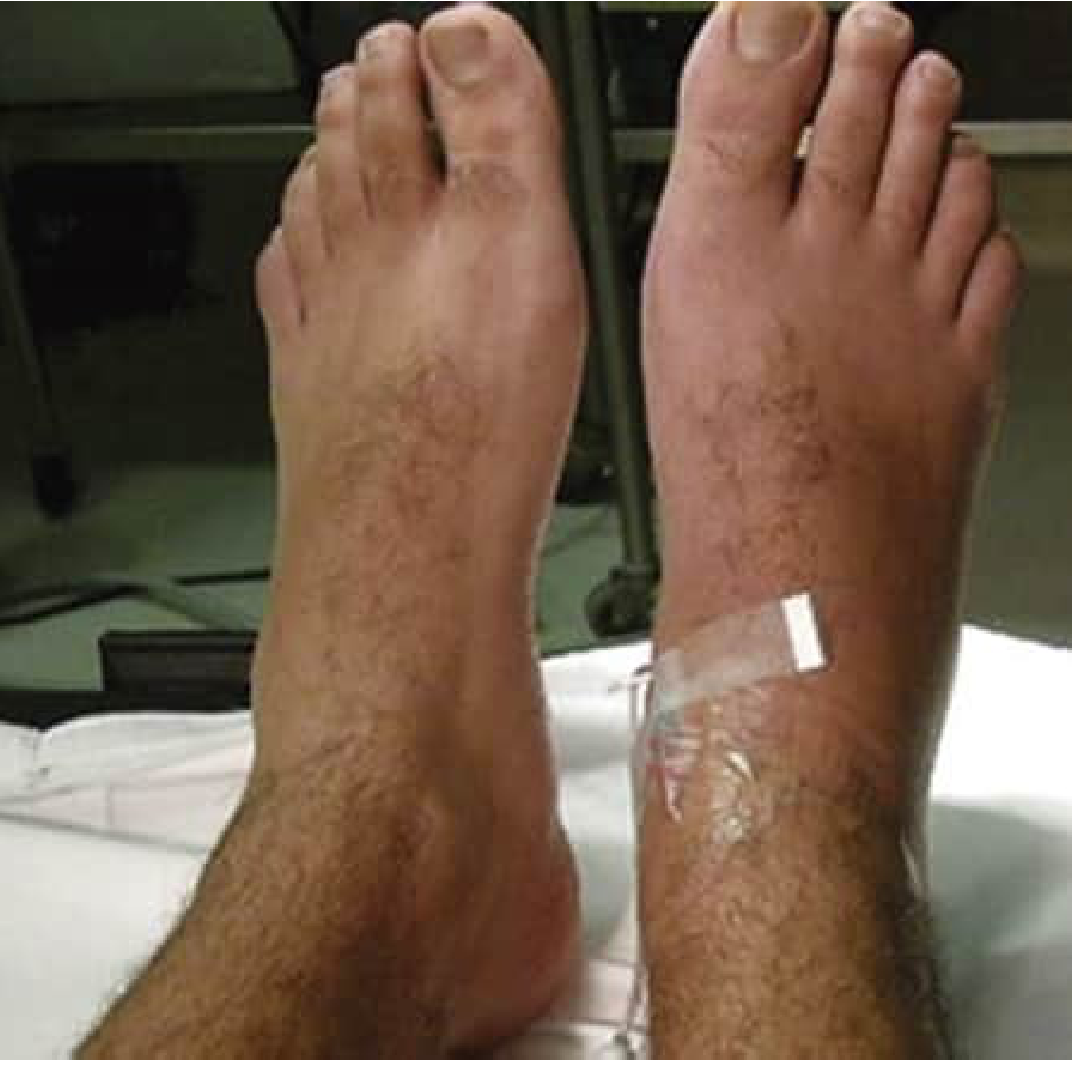
CRPS I: Right foot shows swelling and redness vs. the normal left foot (Bradley & Daroff's Neurology)
Three Stages of Progression:
Stage I (Acute, 0-3 months):
- Burning, throbbing pain localized to one limb
- Mild edema, increased skin temperature (warm, red)
- Vasomotor instability
Stage II (Dystrophic, 3-6 months):
- Edema spreads, skin thickens, muscle wasting begins
- Skin becomes cool, mottled
- Joint stiffness increases
Stage III (Atrophic, >6 months):
- Irreversible trophic changes - waxy skin, brittle nails
- Severe limb contractures, flexor deformity
- Marked osteoporosis on X-ray
- Cold, cyanotic limb, severely impaired circulation
Part 3: Pathophysiology - The Mechanism of CRPS
CRPS involves three overlapping mechanisms that together explain the pain, autonomic dysfunction, and circulatory impairment:
Mechanism 1: Peripheral Sensitization & Neurogenic Inflammation
After tissue injury, C-fibers and Aδ fibers release neuropeptides into the peripheral tissue:
- Substance P and CGRP (Calcitonin Gene-Related Peptide): Cause neurogenic inflammation - vasodilation, plasma extravasation, mast cell degranulation
- Elevated CGRP levels are found systemically in CRPS patients
- These mediators sensitize peripheral nociceptors → hyperalgesia and allodynia
- Neurogenic edema forms from increased vascular permeability
"Increased systemic calcitonin gene-related peptide (CGRP) levels may contribute to neurogenic inflammation, edema, vasodilatation, and increased sweating. Elevated neuropeptide concentrations may lead to pain and hyperalgesia." - Bradley and Daroff's Neurology
Mechanism 2: Sympathetic-Afferent Coupling (Key Circulatory Mechanism)
This is the core mechanism behind circulatory disturbance in CRPS:
Normal state: Sympathetic efferents (norepinephrine) → vasoconstriction → normal blood flow regulation
In CRPS:
- Peripheral injury → upregulation of alpha-adrenergic receptors on nociceptors and blood vessel walls
- Functional coupling develops between sympathetic efferent fibers and sensory afferent fibers
- Norepinephrine from sympathetic terminals now directly excites pain fibers (sympathetically maintained pain)
- Paradoxical circulatory changes:
- Early: decreased sympathetic outflow → vasodilation → warm, red limb
- Late: catecholamine hypersensitivity of upregulated alpha receptors → intense vasoconstriction → cold, cyanotic, ischemic limb
"There is decreased sympathetic outflow to the affected limb and autonomic manifestations previously ascribed to sympathetic overactivity are now thought to be due to catecholamine hypersensitivity." - Bradley and Daroff's Neurology
This explains why the limb in late CRPS has poor circulation - the up-regulated adrenergic receptors cause excessive vasoconstriction even at normal catecholamine levels.
Mechanism 3: Central Sensitization
- Wind-up in dorsal horn → spinal cord sensitization
- Wide dynamic range (WDR) neurons become hyperexcitable
- Cortical reorganization in the primary somatosensory cortex (S1) - the affected body part representation shrinks or reorganizes
- Disinhibition of motor cortex → tremor, dystonia
- Brainstem and thalamic involvement → widespread pain spread (limb-to-limb spread of CRPS)
- Immunological contributions: Altered HLA expression, cytokines, interleukins → maintain inflammatory and edematous state
Mechanism 4: Immune-Inflammatory Component
- Autoantibodies against adrenergic and muscarinic receptors have been found in CRPS patients
- Pro-inflammatory cytokines (TNF-α, IL-1β, IL-6) in local tissue
- These perpetuate neurogenic inflammation and microvascular changes
Part 4: Circulatory Disturbances in CRPS - Summary
| Stage | Sympathetic Activity | Vascular State | Skin Appearance |
|---|---|---|---|
| Early (warm phase) | Decreased outflow | Vasodilation | Red, warm, swollen |
| Late (cold phase) | Catecholamine hypersensitivity | Vasoconstriction | Cold, blue-purple, ischemic |
| All stages | Edema from neurogenic inflammation | Increased permeability | Pitting edema |
The net effect: impaired microcirculation, tissue ischemia, and trophic changes in the affected limb.
Part 5: How Electrical Stimulation Improves Circulation in CRPS
ES works through multiple complementary pathways to reverse the circulatory impairment:
Pathway 1: TENS - Inhibition of Sympathetic Vasoconstriction
High-frequency TENS (conventional TENS, 80-100 Hz):
- Activates large Aβ sensory fibers → dorsal horn gate control
- Reduces dorsal horn hyperexcitability → decreases central sensitization
- Diminishes sympathetic efferent output from the spinal cord → reduces vasoconstriction
- Result: improved arteriolar dilation and skin blood flow
Low-frequency TENS (acupuncture-like TENS, 2-4 Hz):
- Activates Aδ fibers → hypothalamus releases endorphins and enkephalins
- Also triggers axon reflex → antidromic release of CGRP from C-fiber terminals
- CGRP is a potent vasodilator → direct arteriolar dilation
- Result: lasting improvement in skin microcirculation
Pathway 2: Spinal Cord Stimulation (SCS) - Most Evidence-Based ES for CRPS
SCS is the strongest evidence-based neuromodulation technique for CRPS (Goldman-Cecil Medicine; Morgan & Mikhail).
How it works:
- Epidural electrode placed in posterior epidural space (usually T8-T10 for lower limb CRPS)
- Dorsal column stimulation → activates large myelinated Aβ fibers
- Antidromic activation reaches peripheral sensory terminals → releases vasodilatory neuropeptides (CGRP, VIP)
- Inhibits sympathetic preganglionic neurons in the intermediolateral column of the spinal cord → reduces norepinephrine release → reduces alpha-adrenergic vasoconstriction
- Supraspinal effects: Activates descending inhibitory pathways (serotonergic, noradrenergic) that modulate sympathetic tone
- Net effect: sustained vasodilation of the affected limb's blood vessels, increased skin perfusion, reduced ischemic pain
"Spinal cord stimulation (SCS) may be effective for neuropathic pain, including sympathetically mediated pain... ischemic lower extremity pain due to peripheral vascular disease." - Morgan & Mikhail's Clinical Anesthesiology
SCS Protocol:
- 5-7 day external trial → if >50% pain relief, proceed to permanent implant
- Paresthesia should cover the painful area
- Effective even for full-body CRPS spread
- "Unfortunately, the effectiveness of the technique decreases with time in some patients"
Pathway 3: NMES - Muscle Pump to Reduce Edema
In CRPS, venous and lymphatic stasis worsen edema and impair perfusion.
- NMES causes rhythmic calf/limb muscle contractions
- Acts as a mechanical venous pump → clears edema fluid
- Reduces venous hypertension → improves capillary filling
- Allows better arterial inflow to the tissue
This is especially useful in Stage II-III CRPS where limb disuse has made active exercises impossible.
Pathway 4: Interferential Therapy (IFT) - Deep Tissue Circulation
- Medium-frequency carrier (4000 Hz) passes through skin easily
- Beat frequency (1-150 Hz) at the crossover point causes:
- Vasodilation via local axon reflex
- Rhythmic deep muscle contractions
- Reduction of edema by improving lymphatic drainage
- Used when CRPS involves deep joints (shoulder, hip) where TENS penetration is insufficient
Pathway 5: Dorsal Root Ganglion (DRG) Stimulation
A newer technique specifically for CRPS in lower extremities:
- Electrode placed at the DRG level
- More targeted than SCS - only covers the specific dermatome affected
- Modulates afferent signaling directly at the DRG → reduces nociceptor sensitization → decreases sympathetic reflex vasoconstriction
- Shown to be an effective alternative to SCS for CRPS and improves tolerance for physical therapy
"Dorsal root ganglion (DRG) stimulation has been shown to be an effective therapy and alternative to SCS to help treat CRPS in the lower extremities." - Morgan & Mikhail's Clinical Anesthesiology
Part 6: Summary Diagram - CRPS Mechanism & ES Intervention Points
TISSUE INJURY
      ↓
C-fiber / Aδ activation
      ↓
Neuropeptide release (Substance P, CGRP)
  → Neurogenic inflammation → Edema       ← [TENS reduces via gate control]
      ↓
Peripheral sensitization → Allodynia / Hyperalgesia
      ↓
Spinal cord sensitization (central sensitization)
  → WDR hyperexcitability                 ← [SCS interrupts dorsal horn]
      ↓
Sympathetic-afferent coupling
  → Upregulated α-adrenergic receptors    ← [SCS inhibits sympathetic outflow]
      ↓
Catecholamine hypersensitivity
  → Vasoconstriction → Ischemia → Cold limb ← [TENS/SCS: vasodilation]
      ↓
Disuse atrophy + venous stasis
  → Edema, trophic changes                ← [NMES: muscle pump, reduces edema]
Part 7: Quick Revision Table for MPT
| ES Modality | Mechanism in CRPS | Circulatory Benefit |
|---|---|---|
| High-freq TENS | Gate control → reduces sympathetic drive | Arteriolar vasodilation |
| Low-freq TENS | Endorphin release + axon reflex CGRP | Lasting microcirculation improvement |
| SCS | Dorsal column Aβ activation → sympathetic inhibition + antidromic neuropeptide release | Best evidence; sustained limb vasodilation |
| DRG stimulation | Targeted DRG modulation → reduces afferent sensitization | Focused segmental vasodilation; improves PT tolerance |
| NMES | Muscle pump → clears venous/lymphatic stasis | Reduces edema, improves capillary filling |
| IFT | Deep tissue axon reflex + muscle contractions | Reduces deep edema, promotes lymphatic drainage |
Key Exam Points:
- CRPS mechanism = peripheral sensitization + central sensitization + sympathetic-afferent coupling + immune inflammation
- The cold phase of CRPS (late stage) is due to catecholamine hypersensitivity of upregulated alpha receptors, NOT increased sympathetic outflow
- SCS has the strongest evidence for CRPS among all ES modalities
- ES improves CRPS circulation primarily via sympathetic inhibition → vasodilation
- CGRP is the key vasodilatory neuropeptide involved in both the CRPS pathology and the ES therapeutic response
- Budapest Criteria require symptoms in ≥3 domains + signs in ≥2 domains
References: Bradley and Daroff's Neurology in Clinical Practice; Andrews' Diseases of the Skin; Morgan & Mikhail's Clinical Anesthesiology, 7e; Goldman-Cecil Medicine; Campbell's Operative Orthopaedics, 15e
This is a shared conversation. Sign in to Orris to start your own chat.