
Pheochromocytoma
I'll read the medical library skill first, then search for comprehensive pheochromocytoma content.
Reading File
Now I'll run parallel searches across the library database and PubMed simultaneously.
Finding Sources
Searching PubMed
pheochromocytoma diagnosis management
Good results. Now let me read the most comprehensive sections - Brenner & Rector (kidney/endocrine) and Campbell-Walsh (urology) in parallel:
Reading File
Reading File
Excellent content from Brenner & Rector. Let me continue reading that section and also get the biochemical/diagnostic content from Campbell-Walsh:
Reading File
Finding Sources
Good. Now let me read the key diagnostic, clinical, and management content from Campbell-Walsh and Goldman-Cecil in parallel:
Reading File
Reading File
Excellent. I now have comprehensive content. Let me also fetch the catecholamine flowchart image and read more of the Goldman-Cecil diagnosis/treatment section:
Loading Image
Reading File
I now have enough comprehensive content to write a detailed, well-organized answer. Let me compile everything.
Pheochromocytoma
Overview and Epidemiology
Pheochromocytoma is a catecholamine-secreting tumor arising from the chromaffin cells of the adrenal medulla. Incidence is estimated at 1-2 per 100,000 individuals per year, and it accounts for roughly 0.5% of cases of hypertension. Among incidentally discovered adrenal masses, approximately 5% turn out to be pheochromocytomas, and incidentalomas represent 10-25% of all diagnoses.
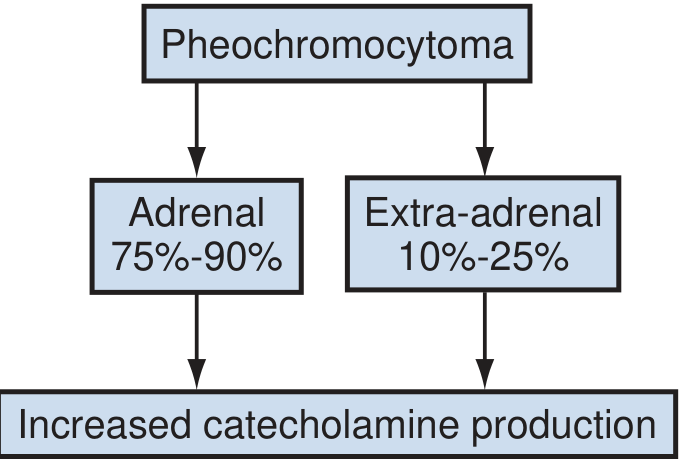
Extra-adrenal pheochromocytomas (paragangliomas) account for 10-25% of cases. They arise from the sympathetic paraganglia (chromaffin tissue paralleling sympathetic and parasympathetic ganglia). Common sites include the organ of Zuckerkandl (at the aortic bifurcation), the bladder, thorax, head, and neck.
Pathophysiology
Adrenal medullary cells - unlike sympathetic ganglion cells - possess PNMT (phenylethanolamine N-methyltransferase), which converts norepinephrine to epinephrine. Pheochromocytomas vary in their enzymatic composition, producing variable ratios of norepinephrine, epinephrine, and dopamine. This explains the heterogeneity in clinical presentation:
- Tumors secreting predominantly epinephrine (usually adrenal): tachycardia, anxiety, diaphoresis, marked systolic hypertension
- Tumors secreting predominantly norepinephrine (often extra-adrenal): sustained hypertension, pallor, reflex bradycardia
- Metanephrines (normetanephrine and metanephrine) are produced continuously inside tumor cells by COMT, independent of catecholamine release, making them more reliable biomarkers
The Rule of 10s (Classic Teaching)
| Feature | Proportion |
|---|---|
| Extra-adrenal (paraganglioma) | ~10-25% |
| Bilateral | ~10% |
| Malignant | ~10% (higher for paragangliomas) |
| Familial | >10% (likely much higher - up to 40%) |
| Pediatric | ~10% |
| Incidentaloma | ~10-25% |
Hereditary Syndromes
Over 15 susceptibility genes are now identified. Key syndromes:
| Syndrome | Gene | Features |
|---|---|---|
| MEN2A | RET | Pheochromocytoma (~50%, usually bilateral), medullary thyroid carcinoma, parathyroid adenoma, cutaneous lichen amyloidosis |
| MEN2B | RET | Bilateral pheo, medullary thyroid carcinoma, mucosal neuromas, marfanoid habitus, Hirschsprung disease |
| Von Hippel-Lindau type 2 | VHL (chr 3p25-26) | ~20% develop pheo/paraganglioma; also hemangioblastomas, clear cell RCC, pancreatic NETs |
| Neurofibromatosis type 1 | NF1 (chr 17q11.2) | ~2% develop pheo; café au lait spots, neurofibromas, Lisch nodules |
| SDH mutations | SDHB/C/D/AF2 | Paraganglioma syndromes; SDHB carries highest malignancy risk |
Physical signs that should raise suspicion: café au lait spots, neurofibromas, retinal hemangiomas, port wine stains, subungual fibromas, ash leaf patches, adenoma sebaceum, marfanoid habitus.
Clinical Presentation
Classic triad (present in up to 95% in some series): headache, diaphoresis, and palpitations - all episodic (paroxysmal).
| Typical Symptoms | Atypical / Not Typical |
|---|---|
| Hypertension (sustained or paroxysmal) | Flushing (more typical of carcinoid) |
| Headache, sweating attacks | |
| Palpitations, tremor | |
| Pallor (not flushing) | |
| Weight loss, fatigue | |
| Hyperglycemia (alpha-adrenergic inhibition of insulin) | |
| Orthostatic hypotension | |
| Cold hands and feet, Raynaud phenomenon | |
| Cardiomyopathy (dilated or hypertrophic - reversible with resection) | |
| Hematuria (bladder paraganglioma - triggered by micturition) |
Ectopic hormone co-secretion can cause Cushing syndrome (CRH/ACTH), hypercalcemia (PTHrP), watery diarrhea (VIP), or acromegaly (GHRH).
Diagnosis
Who to Screen
Suspect pheochromocytoma in patients with:
- Hyperadrenergic spells (non-exertional palpitations, diaphoresis, headache, tremor, pallor)
- Resistant hypertension
- Known familial syndrome (MEN2, NF1, VHL)
- Family history of pheochromocytoma
- Pressor response during anesthesia, surgery, or angiography
- Hypertension onset before age 20
- Idiopathic dilated cardiomyopathy
- Incidental adrenal mass on imaging
Biochemical Testing
First-line test: Plasma free fractionated metanephrines (normetanephrine + metanephrine)
- Sensitivity ~99%, Specificity ~85%
- Preferred because metanephrines are produced continuously (not episodically), making them detectable even between paroxysms
Alternative: 24-hour urinary fractionated metanephrines and catecholamines
- Some experts consider this the gold standard first-line test
- Less affected by acute sympathoadrenal activation
Important caveats: False positives can be caused by sympathomimetics (cocaine, amphetamines, pseudoephedrine), SSRIs/SNRIs, MAOIs, tricyclic antidepressants, and physiologic stressors. Plasma catecholamines alone are less reliable for distinguishing pheochromocytoma from essential hypertension.
Imaging
CT (preferred for initial localization):
- Pre-contrast attenuation >10 Hounsfield units (HU) raises concern; HU ≤10 makes pheochromocytoma very unlikely
- Marked contrast enhancement with slow washout (<50% at 10 min) is suspicious
- Do NOT give contrast before alpha-blockade
MRI:
- T1: low signal intensity
- T2: characteristically bright (high signal) - "light bulb" appearance
- Preferred in children, pregnancy, or if avoiding radiation
Functional imaging:
- MIBG scintigraphy (metaiodobenzylguanidine): excellent specificity for chromaffin tissue
- Gallium-68 DOTATATE PET/CT: now considered superior to MIBG for metastatic and hereditary disease
- Useful for identifying metastatic/multifocal disease
Genetic Testing
Recommended for all patients with pheochromocytoma or paraganglioma. Risk of familial disease is highest when: paraganglioma is present, bilateral adrenal tumors, family history, onset before age 45, or syndromic features are present. More than 15 susceptibility genes have been identified (NF1, RET, VHL, SDHB/C/D, SDHA, SDHAF2, MAX, HIF2A, FH, TMEM127, etc.).
Management
Preoperative Medical Preparation (mandatory before any surgery)
Step 1: Alpha-blockade (7-14 days preoperatively)
- Phenoxybenzamine (preferred): irreversible, nonselective alpha-blocker. Start 10 mg once or twice daily, titrate by 10-20 mg every 2-3 days; final dose typically 20-100 mg/day
- Doxazosin (selective alpha-1 blocker): increasingly used as an alternative; similar surgical safety
- Target BP: <120/80 mmHg seated; systolic >90 mmHg standing
Step 2: High-sodium diet (≥5000 mg/day) from day 2-3 of alpha-blockade to reverse catecholamine-induced volume contraction
Step 3: Beta-blockade - only AFTER adequate alpha-blockade is established (to prevent unopposed alpha stimulation). Indicated if resting HR >80 bpm. Never give beta-blockers first.
Step 4: Volume expansion - IV fluids perioperatively
Intraoperative Management
- Anticipate hypertensive episodes during tumor manipulation
- IV agents with rapid onset/short half-life: nitroprusside, phentolamine, nitroglycerin, nicardipine
- Short-acting beta-blockers: labetalol, esmolol for tachycardia/arrhythmia
- Aggressive fluid resuscitation after tumor removal (sudden loss of tonic vasoconstriction causes hypotension)
Postoperative Management
- Monitor for hypotension (treat with vasopressors: phenylephrine; guided by invasive monitoring)
- Correct hypoglycemia (rebound - alpha-adrenergic inhibition of insulin release is removed)
- Correct electrolyte abnormalities
- Persistent hypertension postoperatively is common and may need antihypertensives
- Monitor for glucocorticoid insufficiency if bilateral adrenalectomy was performed
Surgical Treatment
Laparoscopic adrenalectomy is the standard of care for most adrenal pheochromocytomas. Open adrenalectomy is reserved for large tumors (>6 cm), locally invasive tumors, or paragangliomas. Partial adrenalectomy may be considered for hereditary bilateral disease to preserve adrenocortical function (recent meta-analysis PMID [40214691] supports good surgical outcomes).
Malignant Pheochromocytoma
- Defined by the presence of metastases (lymph nodes, liver, lung, bone) - not histology alone
-
10% are metastatic at diagnosis; SDHB mutation is the strongest predictor of malignancy
- Treatment: surgery (debulking), MIBG therapy (high-dose I-131 MIBG), chemotherapy (CVD: cyclophosphamide, vincristine, dacarbazine), tyrosine kinase inhibitors, SSA (if DOTATATE-positive)
Key Takeaways
- Pheochromocytoma is rare but lethal if missed - a high index of suspicion is essential
- The classic triad is headache, sweating, and hypertension (paroxysmal or sustained)
- Plasma free metanephrines are the best first-line biochemical test (sensitivity ~99%)
- CT with HU >10 or MRI with T2 brightness is typical; confirm biochemically first
- Alpha-blockade before beta-blockade is the cardinal perioperative rule
- Up to 40% are familial - genetic testing is recommended for all cases
- Cardiomyopathy from pheochromocytoma is often reversible after tumor removal
Sources: Goldman-Cecil Medicine, 26th Ed., p. 2464-2466 | Campbell-Walsh-Wein Urology, 12th Ed., p. 3146-3191 | Brenner & Rector's The Kidney, 10th Ed. | Mulholland & Greenfield's Surgery, 7th Ed.
This is a shared conversation. Sign in to Orris to start your own chat.