
bacterial classification
Bacterial Classification
1. Taxonomic Hierarchy (Linnaean System)
| Rank | Example |
|---|---|
| Kingdom | Prokaryotae |
| Division | Gracilicutes |
| Class | Scotobacteria |
| Order | Eubacteriales |
| Family | Enterobacteriaceae |
| Genus | Escherichia |
| Species | coli |
| Subtype | E. coli O157:H7 |
2. Prokaryotes vs. Eukaryotes
| Characteristic | Eukaryote | Prokaryote (Bacteria) |
|---|---|---|
| Size | >5 µm | 0.5-3.0 µm |
| Nucleus | Membrane-bound | No nuclear membrane |
| Chromosomes | Diploid, multiple | Single, circular, haploid |
| Ribosomes | 80S (60S+40S) | 70S (50S+30S) - antibiotic target |
| Mitochondria | Present | Absent |
| Cytoplasmic membrane | Contains sterols | No sterols (except Mycoplasma) |
| Cell wall | Absent (except fungi) | Peptidoglycan-based |
| Reproduction | Sexual and asexual | Asexual (binary fission only) |
- Medical Microbiology 9e, p. 139 (Table 12.1)
3. Classification by Morphology (Macroscopic & Microscopic)
Shape (Morphology)
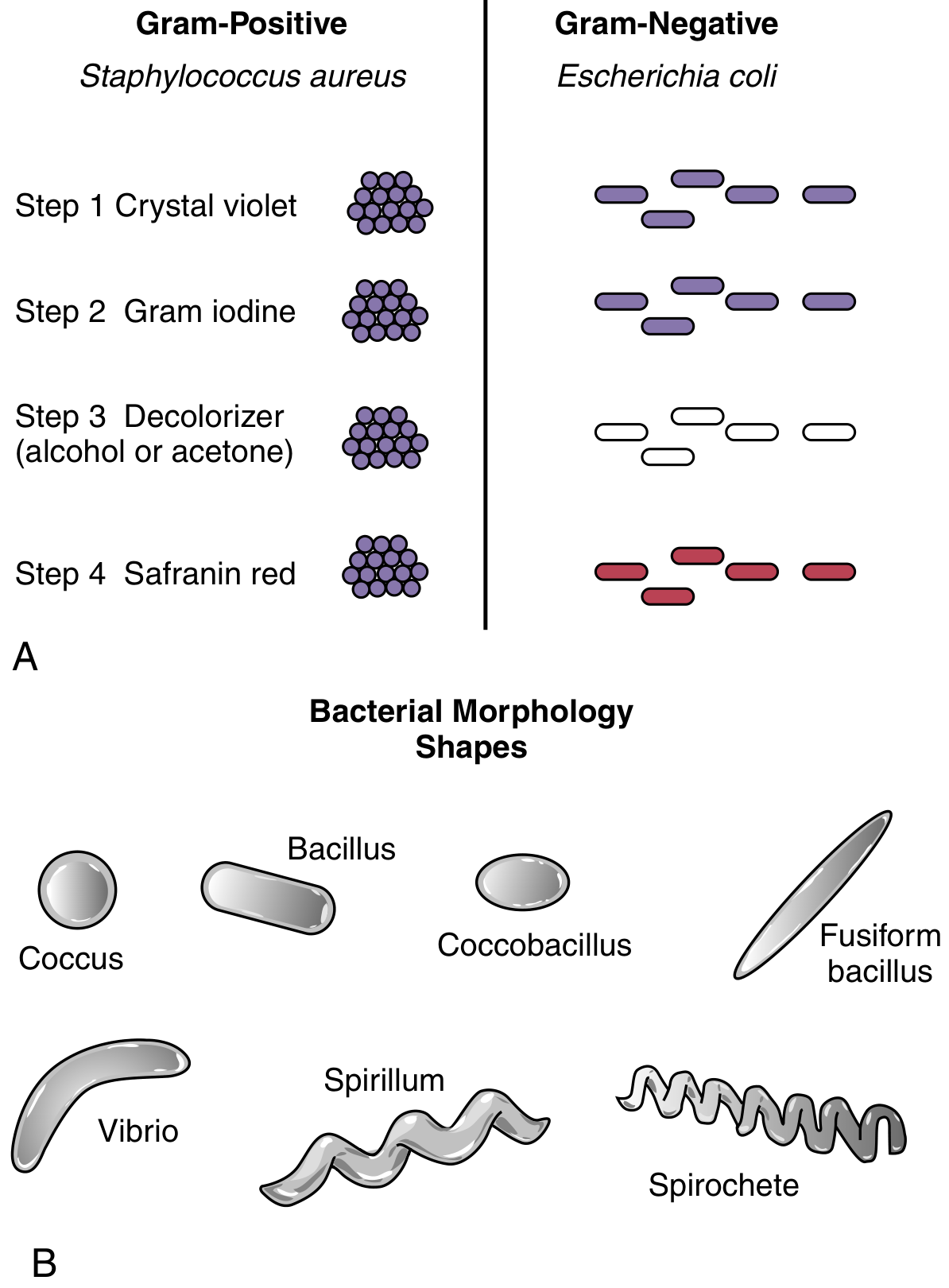
| Shape | Description | Example |
|---|---|---|
| Coccus | Spherical | Staphylococcus, Streptococcus |
| Bacillus | Rod-shaped | E. coli, Bacillus spp. |
| Coccobacillus | Short rod | Haemophilus influenzae |
| Vibrio | Comma-shaped curve | Vibrio cholerae |
| Spirillum | Rigid spiral | Campylobacter |
| Spirochete | Flexible coiled | Treponema, Borrelia |
| Fusiform bacillus | Spindle-shaped | Fusobacterium |
| Filamentous | Branching hyphae-like | Nocardia, Actinomyces |
Aggregation Patterns
- Clusters (grapelike): Staphylococcus aureus
- Chains: Streptococcus pyogenes
- Diplococci (pairs): S. pneumoniae, Neisseria spp.
Colony Morphology
4. Classification by Gram Stain
| Feature | Gram-Positive | Gram-Negative |
|---|---|---|
| Color result | Purple (crystal violet retained) | Red/Pink (safranin counterstain) |
| Peptidoglycan layer | Thick | Thin |
| Outer membrane | Absent | Present |
| Lipopolysaccharide (LPS/Endotoxin) | Absent | Present |
| Teichoic acid | Often present | Absent |
| Sporulation | Some bacteria (e.g., Clostridium, Bacillus) | None |
| Penicillin susceptibility | More susceptible | More resistant |
| Lysozyme sensitivity | Sensitive | Resistant |
Gram-Stain Procedure (4 Steps)
- Apply crystal violet (primary stain)
- Add Gram's iodine (mordant - precipitates stain)
- Wash with acetone/alcohol decolorizer
- Apply safranin (red counterstain)
5. Classification by Metabolic/Oxygen Requirements
| Category | Description | Examples |
|---|---|---|
| Obligate aerobe | Require O2 as terminal electron acceptor | Mycobacterium tuberculosis, Bacillus spp. |
| Obligate anaerobe | Cannot survive in O2 | Clostridium, Bacteroides |
| Facultative anaerobe | Grow with or without O2 | E. coli, most Enterobacteriaceae |
| Microaerophile | Require low O2 | Campylobacter, Helicobacter |
| Aerotolerant anaerobe | Tolerate O2 but do not use it | Lactobacillus |
- Jawetz, Melnick & Adelberg's Medical Microbiology 28e (Glossary)
6. Classification by Biochemical Tests
| Test | What it Detects | Example Use |
|---|---|---|
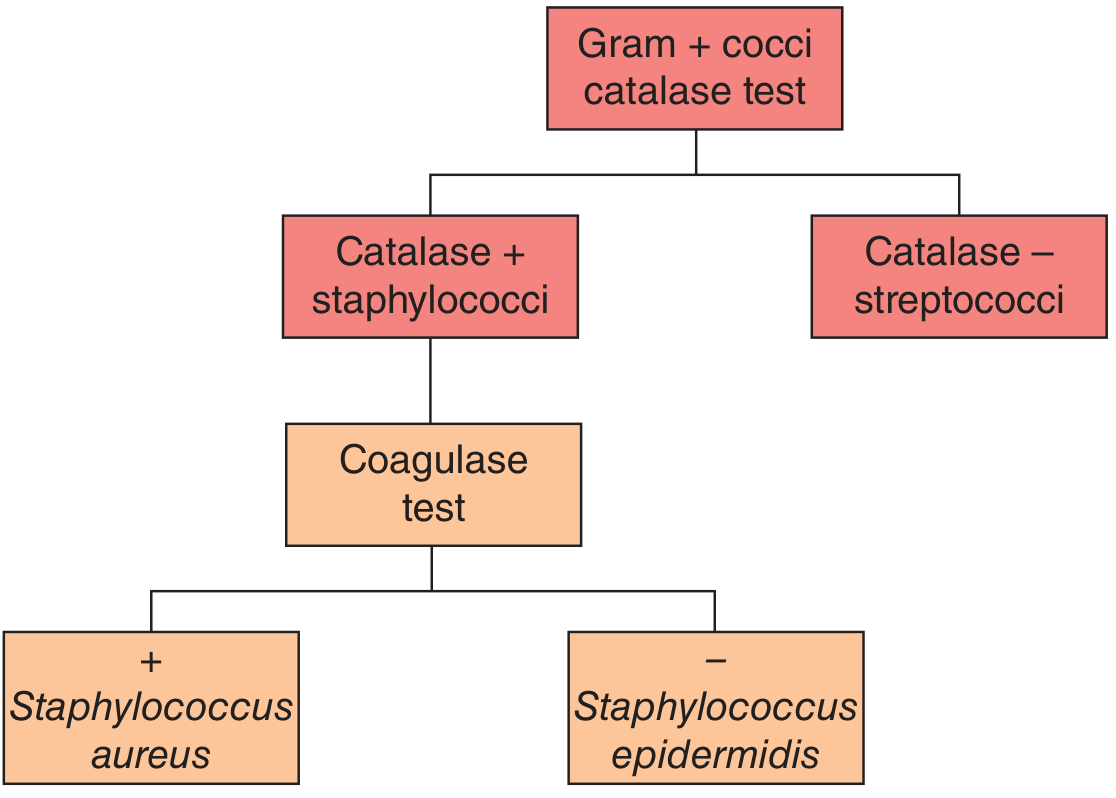
| Catalase | H2O2-splitting enzyme | Staphylococci (+) vs Streptococci (-) |
| Coagulase | Fibrin-clotting enzyme | S. aureus (+) vs S. epidermidis (-) |
| Oxidase | Cytochrome C oxidase | Pseudomonas (+) vs E. coli (-) |
| Urease | Urea hydrolysis → NH3 | Proteus (strongly +) |
| Nitrate reduction | NO3- → NO2- + N2 | Used in urinalysis for Gram-neg rods |
| Lactose fermentation | Acid production from lactose | E. coli (pink) vs Salmonella (white) on MacConkey |
| Voges-Proskauer | Acetoin production | Differentiates enteric rods |
7. Classification by Culture Media
| Media Type | Purpose | Example |
|---|---|---|
| Non-selective (complex) | Supports most bacteria | Blood agar, Chocolate agar |
| Selective | Inhibits unwanted organisms | MacConkey (Gram-neg rods), CNA agar (Gram-pos cocci) |
| Differential | Distinguishes by metabolic reaction | MacConkey (lactose fermentation) |
- Sodium azide - selects Gram-positives over Gram-negatives
- Bile salts - selects Gram-negative enteric bacteria
- Colistin + nalidixic acid - selects Gram-positive cocci
8. Classification by Immunologic Properties (Serotyping)
- Serotypes / Serovars / Serogroups: identify specific strains within a species (e.g., E. coli O157:H7)
- Especially useful in outbreak epidemiology to trace clonal spread
9. Classification by Genotype (Modern Molecular Methods)
| Method | Principle | Use |
|---|---|---|
| 16S rRNA sequencing | Conserved ribosomal RNA gene sequence | Gold standard for species identification |
| Whole genome sequencing | Full genomic comparison | Strain-level identification, outbreak tracing |
| DNA-DNA hybridization | % genetic similarity | Species definition (>70% = same species) |
| MLST (multi-locus sequence typing) | 7 housekeeping gene alleles | Epidemiologic typing |
10. Special Staining Categories
| Category | Stain | Example Organisms |
|---|---|---|
| Acid-fast | Ziehl-Neelsen / Auramine | Mycobacterium tuberculosis, M. leprae |
| No cell wall | No Gram stain possible | Mycoplasma spp. |
| Intracellular obligates | Giemsa, immunofluorescence | Chlamydia, Rickettsia |
| Endospore-formers | Schaeffer-Fulton | Bacillus, Clostridium |
Summary: Classification Criteria at a Glance
Bacteria
├── By Gram stain:   Gram-positive | Gram-negative | Acid-fast | No wall
├── By shape:        Cocci | Bacilli | Spirochetes | Filamentous
├── By O2 need:      Aerobe | Anaerobe | Facultative | Microaerophile
├── By metabolism:   Fermentative | Oxidative | Photosynthetic
├── By structure:    Capsule / Flagella / Pili / Spores
├── By serology:     O, H, K antigens (serotypes)
└── By genetics:     16S rRNA / Whole genome / DNA hybridization
Flowchart with example of bacteria species with explaination
What format would you like the flowchart in?
A detailed educational flowchart for bacterial classification with example species. The flowchart starts at the top with "BACTERIA" and branches step by step: Step 1 - Gram Stain splits into two branches: - LEFT branch: "GRAM-POSITIVE (Purple)" with label "Thick peptidoglycan, no outer membrane" - RIGHT branch: "GRAM-NEGATIVE (Red/Pink)" with label "Thin peptidoglycan, has outer membrane & LPS" Step 2 - Each branch splits by Shape: GRAM-POSITIVE left side: - "Cocci (spherical)" → further splits by Catalase: - Catalase POSITIVE → "Staphylococcus" → splits by Coagulase: - Coagulase + → "S. aureus" (causes skin infections, pneumonia, toxic shock) - Coagulase − → "S. epidermidis" (causes catheter infections) - Catalase NEGATIVE → "Streptococcus" → splits by Hemolysis: - Beta-hemolysis → "S. pyogenes" (strep throat, rheumatic fever) - Alpha-hemolysis → "S. pneumoniae" (pneumonia, meningitis) - Gamma (no hemolysis) → "Enterococcus faecalis" (UTI, endocarditis) - "Bacilli (rods)" → splits by Spores: - Spore-forming → "Bacillus anthracis" (anthrax), "Clostridium tetani" (tetanus) - Non-spore-forming → "Listeria monocytogenes" (listeriosis), "Corynebacterium diphtheriae" (diphtheria) GRAM-NEGATIVE right side: - "Cocci (spherical)" → "Neisseria meningitidis" (meningitis), "N. gonorrhoeae" (gonorrhea) - "Bacilli (rods)" → splits by Oxygen requirement: - Aerobic/Facultative → "Enterobacteriaceae": "E. coli" (UTI, diarrhea), "Salmonella typhi" (typhoid), "Klebsiella pneumoniae" (pneumonia) - Anaerobic → "Bacteroides fragilis" (intra-abdominal infections) - "Spirochetes (spiral)" → "Treponema pallidum" (syphilis), "Borrelia burgdorferi" (Lyme disease) At the bottom, a separate box: "GRAM-STAIN EXCEPTIONS: Acid-fast stain → Mycobacterium tuberculosis (TB), M. leprae (leprosy). No cell wall → Mycoplasma pneumoniae (atypical pneumonia). Obligate intracellular → Chlamydia trachomatis, Rickettsia rickettsii" Use a clean white background, blue and red color coding for gram positive/negative branches, green for organism names, small italic text for disease examples. Use clear arrows and boxes. Professional medical education style, highly readable, organized layout.
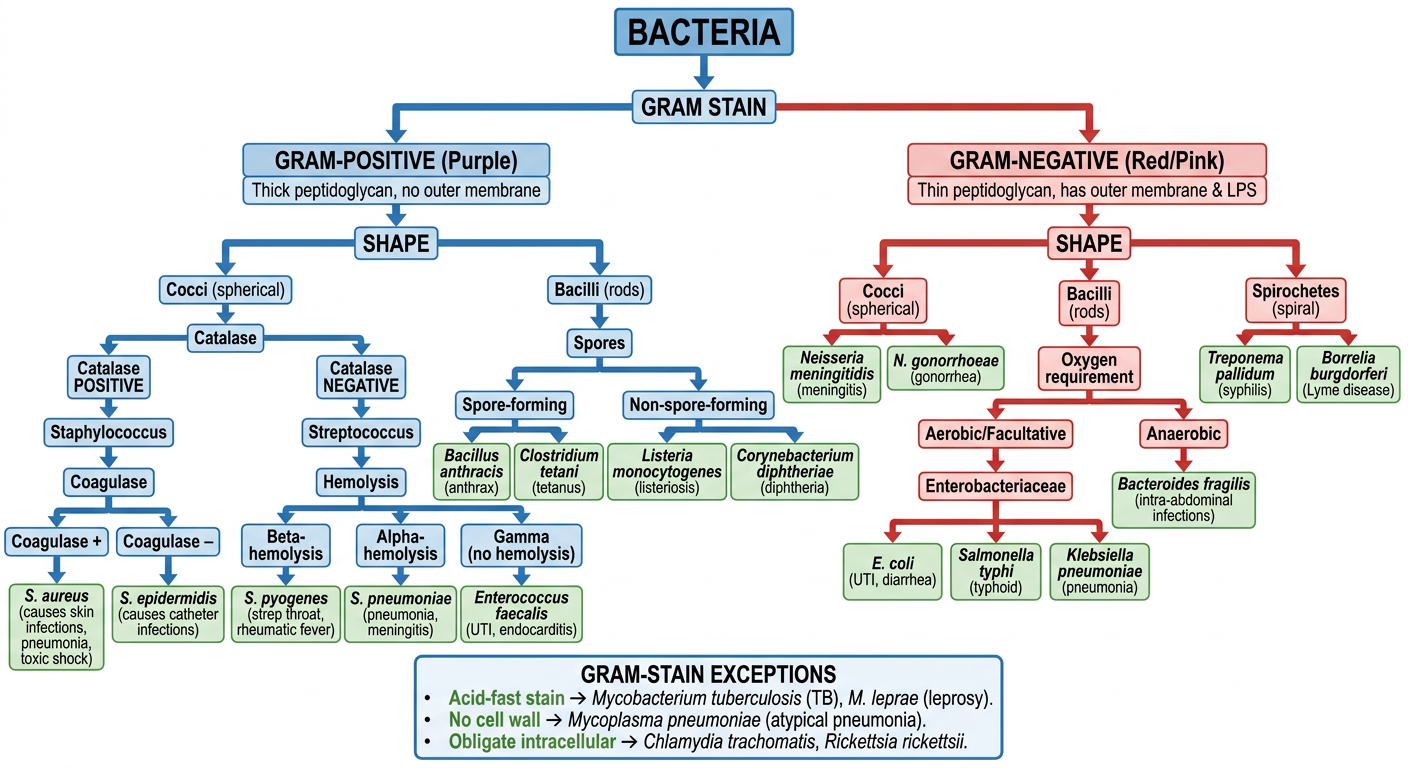
How to Read the Flowchart
Step 1 - Gram Stain (First Branch Point)
GRAM-POSITIVE Bacteria (Purple)
Gram-Positive Cocci
| Test | Result | Organism | Diseases |
|---|---|---|---|
| Catalase | + | Staphylococcus | - |
| Coagulase (from Staph) | + | S. aureus | Skin abscesses, pneumonia, toxic shock syndrome, food poisoning |
| Coagulase (from Staph) | - | S. epidermidis | Catheter/prosthetic device infections |
| Catalase | - | Streptococcus | - |
| Beta-hemolysis (from Strep) | S. pyogenes (Group A) | Strep throat, scarlet fever, rheumatic fever | |
| Alpha-hemolysis (from Strep) | S. pneumoniae | Pneumonia, meningitis, otitis media | |
| No hemolysis | Enterococcus faecalis | UTI, endocarditis |
Gram-Positive Bacilli (Rods)
| Feature | Organism | Diseases |
|---|---|---|
| Spore-forming, aerobic | Bacillus anthracis | Anthrax |
| Spore-forming, anaerobic | Clostridium tetani | Tetanus |
| Spore-forming, anaerobic | C. difficile | Pseudomembranous colitis (antibiotic-associated diarrhea) |
| Non-spore-forming | Listeria monocytogenes | Listeriosis (dangerous in pregnancy) |
| Non-spore-forming | Corynebacterium diphtheriae | Diphtheria |
| Acid-fast positive (special) | Mycobacterium tuberculosis | Tuberculosis |
GRAM-NEGATIVE Bacteria (Red/Pink)
Gram-Negative Cocci
| Organism | Diseases |
|---|---|
| Neisseria meningitidis | Bacterial meningitis, septicemia |
| N. gonorrhoeae | Gonorrhea, neonatal conjunctivitis |
Gram-Negative Rods (Bacilli)
| Organism | Key Feature | Diseases |
|---|---|---|
| E. coli | Oxidase-neg, lactose fermenter | UTI, neonatal meningitis, diarrhea |
| Salmonella typhi | Non-lactose fermenter | Typhoid fever |
| Klebsiella pneumoniae | Mucoid capsule | Pneumonia (especially alcoholics), UTI |
| Shigella dysenteriae | Non-motile | Bloody dysentery |
| Organism | Key Feature | Diseases |
|---|---|---|
| Pseudomonas aeruginosa | Oxidase-positive, blue-green pigment | Burn/wound infections, CF pneumonia |
| Helicobacter pylori | Microaerophile, urease+ | Peptic ulcer, gastric cancer |
| Organism | Diseases |
|---|---|
| Bacteroides fragilis | Intra-abdominal infections, abscesses |
Gram-Negative Spirochetes (Spiral)
| Organism | Diseases |
|---|---|
| Treponema pallidum | Syphilis |
| Borrelia burgdorferi | Lyme disease |
| Leptospira interrogans | Leptospirosis |
Gram-Stain Exceptions (Special Groups)
| Category | Reason | Organism | Disease |
|---|---|---|---|
| Acid-fast | Waxy mycolic acid wall | M. tuberculosis, M. leprae | TB, Leprosy |
| No cell wall | Cannot retain any stain | Mycoplasma pneumoniae | Atypical ("walking") pneumonia |
| Obligate intracellular | Too small, no independent metabolism | Chlamydia trachomatis | STI, trachoma |
| Obligate intracellular | Rickettsia rickettsii | Rocky Mountain Spotted Fever |
gpc, gnb , Kingdom Division Class Order Family Genus Species c Subtype
A detailed professional educational taxonomy table/diagram showing full Linnaean classification for Gram-Positive Cocci (GPC) and Gram-Negative Bacilli (GNB) bacteria. Layout: Two large side-by-side columns, left column is blue-themed for GPC, right column is red-themed for GNB. Each column shows a vertical taxonomy ladder with 8 rows for the ranks: Kingdom, Division, Class, Order, Family, Genus, Species, Subtype. LEFT COLUMN - GRAM-POSITIVE COCCI (GPC) - Blue theme: Title: "GPC - Gram-Positive Cocci" Show TWO example organisms side by side within the column: Example 1: Staphylococcus aureus Kingdom: Bacteria Division: Firmicutes Class: Bacilli Order: Bacillales Family: Staphylococcaceae Genus: Staphylococcus Species: S. aureus Subtype: MRSA (Methicillin-Resistant S. aureus) Disease note: Skin infections, pneumonia, toxic shock Example 2: Streptococcus pyogenes Kingdom: Bacteria Division: Firmicutes Class: Bacilli Order: Lactobacillales Family: Streptococcaceae Genus: Streptococcus Species: S. pyogenes Subtype: Group A Streptococcus (GAS) Disease note: Strep throat, rheumatic fever RIGHT COLUMN - GRAM-NEGATIVE BACILLI (GNB) - Red/orange theme: Title: "GNB - Gram-Negative Bacilli" Show TWO example organisms side by side within the column: Example 1: Escherichia coli Kingdom: Bacteria Division: Proteobacteria Class: Gammaproteobacteria Order: Enterobacterales Family: Enterobacteriaceae Genus: Escherichia Species: E. coli Subtype: E. coli O157:H7 Disease note: UTI, diarrhea, neonatal meningitis Example 2: Klebsiella pneumoniae Kingdom: Bacteria Division: Proteobacteria Class: Gammaproteobacteria Order: Enterobacterales Family: Enterobacteriaceae Genus: Klebsiella Species: K. pneumoniae Subtype: CRKP (Carbapenem-Resistant K. pneumoniae) Disease note: Hospital pneumonia, UTI At the very top center, a title box: "Full Linnaean Taxonomy: GPC vs GNB" At the bottom, a legend box: "GPC = Gram-Positive Cocci (purple on Gram stain, thick peptidoglycan, NO outer membrane) | GNB = Gram-Negative Bacilli (pink/red on Gram stain, thin peptidoglycan, HAS outer membrane + LPS endotoxin)" Use clean white background, clear bold rank labels on left side, connecting arrows between ranks, color-coded boxes per organism, professional medical textbook style, large readable font.
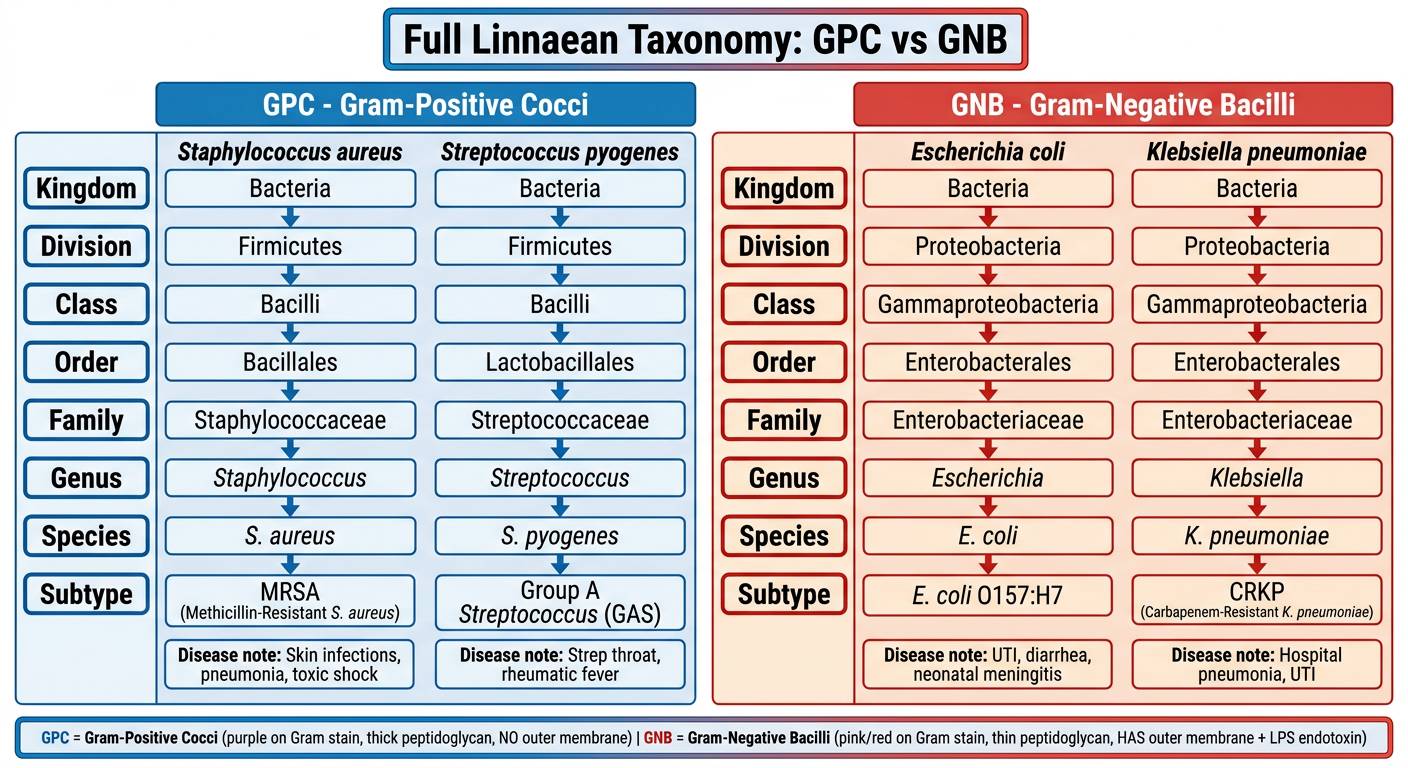
GRAM-POSITIVE COCCI (GPC)
Example 1 - Staphylococcus aureus
| Rank | Classification | Notes |
|---|---|---|
| Kingdom | Bacteria | Prokaryote, no nucleus |
| Division (Phylum) | Firmicutes | Low G+C content, thick peptidoglycan |
| Class | Bacilli | Despite name, includes cocci too |
| Order | Bacillales | |
| Family | Staphylococcaceae | Catalase-positive cocci |
| Genus | Staphylococcus | 40+ species |
| Species | S. aureus | Coagulase-positive |
| Subtype | MRSA | Methicillin-Resistant S. aureus - major hospital pathogen |
Example 2 - Streptococcus pyogenes
| Rank | Classification | Notes |
|---|---|---|
| Kingdom | Bacteria | |
| Division (Phylum) | Firmicutes | |
| Class | Bacilli | |
| Order | Lactobacillales | |
| Family | Streptococcaceae | Catalase-negative cocci |
| Genus | Streptococcus | |
| Species | S. pyogenes | Beta-hemolytic |
| Subtype | Group A Streptococcus (GAS) | Lancefield group A antigen |
Example 3 - Streptococcus pneumoniae
| Rank | Classification | Notes |
|---|---|---|
| Kingdom | Bacteria | |
| Division (Phylum) | Firmicutes | |
| Class | Bacilli | |
| Order | Lactobacillales | |
| Family | Streptococcaceae | |
| Genus | Streptococcus | |
| Species | S. pneumoniae | Alpha-hemolytic, bile-soluble |
| Subtype | >90 serotypes | Classified by polysaccharide capsule type |
GRAM-NEGATIVE BACILLI (GNB)
Example 1 - Escherichia coli
| Rank | Classification | Notes |
|---|---|---|
| Kingdom | Bacteria | |
| Division (Phylum) | Proteobacteria | Largest phylum of Gram-negatives |
| Class | Gammaproteobacteria | |
| Order | Enterobacterales | |
| Family | Enterobacteriaceae | "Enterics" - gut flora |
| Genus | Escherichia | |
| Species | E. coli | Oxidase-negative, lactose fermenter |
| Subtype | E. coli O157:H7 | O = somatic antigen, H = flagellar antigen |
Example 2 - Klebsiella pneumoniae
| Rank | Classification | Notes |
|---|---|---|
| Kingdom | Bacteria | |
| Division (Phylum) | Proteobacteria | |
| Class | Gammaproteobacteria | |
| Order | Enterobacterales | |
| Family | Enterobacteriaceae | |
| Genus | Klebsiella | |
| Species | K. pneumoniae | Large mucoid capsule, non-motile |
| Subtype | CRKP | Carbapenem-Resistant K. pneumoniae - WHO priority pathogen |
Example 3 - Pseudomonas aeruginosa
| Rank | Classification | Notes |
|---|---|---|
| Kingdom | Bacteria | |
| Division (Phylum) | Proteobacteria | |
| Class | Gammaproteobacteria | |
| Order | Pseudomonadales | |
| Family | Pseudomonadaceae | |
| Genus | Pseudomonas | |
| Species | P. aeruginosa | Oxidase-positive, blue-green pyocyanin pigment |
| Subtype | Mucoid strains | Found in cystic fibrosis patients |
Quick Comparison Summary
| Feature | GPC | GNB |
|---|---|---|
| Gram stain | Purple | Pink/Red |
| Phylum | Firmicutes | Proteobacteria |
| Peptidoglycan | Thick | Thin |
| Outer membrane | Absent | Present |
| LPS (Endotoxin) | No | Yes - causes septic shock |
| Typical antibiotics | Penicillin, Vancomycin | Cephalosporins, Fluoroquinolones, Carbapenems |
| Key virulence | Exotoxins, Coagulase, Protein A | Endotoxin, Pili, Type III secretion |
add all gpc species and gnb
Complete Taxonomy: ALL Clinically Relevant GPC & GNB Species
GRAM-POSITIVE COCCI (GPC) - Complete
GENUS 1: Staphylococcus (Phylum: Firmicutes)
| Rank | All Species |
|---|---|
| Kingdom | Bacteria |
| Division/Phylum | Firmicutes |
| Class | Bacilli |
| Order | Bacillales |
| Family | Staphylococcaceae |
| Genus | Staphylococcus |
Species - Coagulase Positive:
| Species | Subtype | Key Disease | Notes |
|---|---|---|---|
| S. aureus | MRSA (methicillin-resistant) | Skin/soft tissue infections, bacteremia, pneumonia, endocarditis, toxic shock syndrome, food poisoning | Most virulent; coagulase+, catalase+ |
| MSSA (methicillin-sensitive) | Same as above | Antibiotic-sensitive strain | |
| VRSA (vancomycin-resistant) | Last-resort treatment failures | Rare but critical |
Species - Coagulase Negative (CoNS):
| Species | Subtype/Resistance | Key Disease | Distinguishing Feature |
|---|---|---|---|
| S. epidermidis | Slime-producing strains | Catheter/prosthetic device infections, neonatal sepsis, endocarditis | Most common CoNS; biofilm producer |
| S. saprophyticus | - | UTI in young sexually active women | Novobiocin-resistant |
| S. haemolyticus | Vancomycin-reduced susceptibility | UTI in hospitalized patients, wound infections | 2nd most common CoNS clinically |
| S. lugdunensis | - | Aggressive endocarditis, skin infections | Behaves like S. aureus in virulence |
| S. schleiferi | - | Wound infections, otitis | Less common |
| S. warneri | - | Bacteremia in immunocompromised | Rare pathogen |
| S. capitis | - | Neonatal sepsis, endocarditis | Found on scalp/face |
| S. hominis | - | Bacteremia, catheter infections | Normal skin flora |
- Red Book 2021, p. 2421: "There are more than 40 named coagulase-negative Staphylococcus species; S. epidermidis, S. haemolyticus, S. saprophyticus, S. schleiferi, and S. lugdunensis most often associated with human infections."
GENUS 2: Streptococcus (Phylum: Firmicutes)
| Rank | Classification |
|---|---|
| Kingdom | Bacteria |
| Division/Phylum | Firmicutes |
| Class | Bacilli |
| Order | Lactobacillales |
| Family | Streptococcaceae |
| Genus | Streptococcus |
| Species | Lancefield Group | Hemolysis | Subtype | Key Disease |
|---|---|---|---|---|
| S. pyogenes | Group A (GAS) | Beta | M-protein types (1, 3, 5, 12, 28...) | Strep throat, scarlet fever, rheumatic fever, necrotizing fasciitis, glomerulonephritis |
| S. agalactiae | Group B (GBS) | Beta | Serotypes Ia, Ib, II-IX | Neonatal meningitis & bacteremia, maternal peripartum infections |
| S. dysgalactiae | Group C/G | Beta | - | Pharyngitis, cellulitis, bacteremia |
| S. pneumoniae | No Lancefield group | Alpha | >90 capsular serotypes | Pneumonia, bacterial meningitis, otitis media, sinusitis |
| S. viridans group | No Lancefield group | Alpha | - | Subacute bacterial endocarditis, dental caries |
| - S. mutans | - | Alpha/None | - | Dental caries |
| - S. mitis | - | Alpha | - | Endocarditis |
| - S. sanguinis | - | Alpha | - | Endocarditis |
| - S. salivarius | - | Alpha | - | Opportunistic infections |
| - S. milleri group (S. anginosus, S. constellatus, S. intermedius) | - | Variable | - | Brain/liver/lung abscesses |
| S. bovis / S. gallolyticus | Group D | None (gamma) | - | Endocarditis, bacteremia - associated with colon cancer |
GENUS 3: Enterococcus (Phylum: Firmicutes)
| Rank | Classification |
|---|---|
| Kingdom | Bacteria |
| Division/Phylum | Firmicutes |
| Class | Bacilli |
| Order | Lactobacillales |
| Family | Enterococcaceae |
| Genus | Enterococcus |
| Species | Subtype/Resistance | Key Disease | Notes |
|---|---|---|---|
| E. faecalis | VSE (vancomycin-sensitive) | UTI, endocarditis, bacteremia | 80-90% of enterococcal infections |
| E. faecium | VRE (vancomycin-resistant) | Nosocomial UTI, bacteremia | More resistant than E. faecalis; hospital pathogen |
| E. gallinarum | Intrinsic low-level vancomycin resistance | Rare infections | |
| E. casseliflavus | Intrinsic low-level vancomycin resistance | Rare infections |
- Henry's Clinical Diagnosis: "E. faecalis and E. faecium are the most common causes of nosocomial UTI and bacteremia."
GRAM-NEGATIVE BACILLI (GNB) - Complete
FAMILY 1: Enterobacteriaceae / Enterobacterales (Phylum: Proteobacteria)
| Rank | Classification |
|---|---|
| Kingdom | Bacteria |
| Division/Phylum | Proteobacteria |
| Class | Gammaproteobacteria |
| Order | Enterobacterales |
| Family | Enterobacteriaceae |
| Genus | Species | Subtype | Key Disease | Key Feature |
|---|---|---|---|---|
| Escherichia | E. coli | O157:H7 (EHEC) | UTI, neonatal meningitis, HUS, traveler's diarrhea | Most common GNB; lactose fermenter, oxidase- |
| ETEC | Traveler's diarrhea | Heat-labile & heat-stable toxins | ||
| EPEC | Infant diarrhea | |||
| UPEC | UTI | Uropathogenic | ||
| Klebsiella | K. pneumoniae | CRKP, ESBL+ | Hospital pneumonia, UTI, liver abscess | Mucoid capsule; "currant jelly" sputum |
| K. oxytoca | ESBL+ | UTI, bacteremia | ||
| Proteus | P. mirabilis | - | UTI, kidney stones, wound infections | Urease+, swarming motility, staghorn calculi |
| P. vulgaris | - | UTI, wound infections | ||
| Salmonella | S. typhi | - | Typhoid fever | Non-lactose fermenter; H2S+ |
| S. paratyphi | A, B, C | Paratyphoid fever | ||
| S. enteritidis / typhimurium | Many serovars | Food poisoning, gastroenteritis | ||
| Shigella | S. dysenteriae | Serotype 1 | Bloody dysentery (most severe) | Shiga toxin; non-motile |
| S. flexneri | 15 serotypes | Bacillary dysentery | Most common in developing countries | |
| S. sonnei | - | Mild diarrhea | Most common in developed countries | |
| S. boydii | - | Diarrhea | ||
| Enterobacter | E. cloacae | AmpC beta-lactamase | Nosocomial pneumonia, UTI, bacteremia | Inducible AmpC resistance |
| E. aerogenes (now Klebsiella aerogenes) | Hospital infections | |||
| Serratia | S. marcescens | - | Hospital pneumonia, UTI, bacteremia | Red pigment (prodigiosin); IV drug users |
| Citrobacter | C. freundii | - | UTI, neonatal meningitis, brain abscess | |
| C. koseri | - | Neonatal brain abscess | ||
| Providencia | P. stuartii | - | UTI in catheterized patients | |
| Morganella | M. morganii | - | UTI, wound infections | |
| Yersinia | Y. pestis | Biovar Orientalis, Antiqua, Medievalis | Plague (bubonic, pneumonic, septicemic) | Bioterrorism agent |
| Y. enterocolitica | - | Enterocolitis, mesenteric adenitis | Mimics appendicitis | |
| Y. pseudotuberculosis | - | Mesenteric adenitis |
FAMILY 2: Non-Fermentative GNB (Phylum: Proteobacteria)
| Genus | Species | Order/Family | Subtype | Key Disease | Key Feature |
|---|---|---|---|---|---|
| Pseudomonas | P. aeruginosa | Pseudomonadales / Pseudomonadaceae | Mucoid strains (CF) | Burn infections, VAP, cystic fibrosis, hot tub folliculitis | Oxidase+, blue-green pyocyanin pigment, grape odor |
| Acinetobacter | A. baumannii | Pseudomonadales / Moraxellaceae | CRAB (carbapenem-resistant) | VAP, wound infections, bacteremia in ICU | "ESKAPE" pathogen; survives on surfaces |
| Stenotrophomonas | S. maltophilia | Xanthomonadales | - | Pneumonia in immunocompromised, CF | Intrinsically resistant to carbapenems |
| Burkholderia | B. cepacia complex | Burkholderiales | Multiple genomovars | Lung infections in CF patients | |
| B. pseudomallei | - | Melioidosis | Endemic in SE Asia |
FAMILY 3: Fastidious GNB (special growth requirements)
| Genus | Species | Phylum/Class | Key Disease | Special Feature |
|---|---|---|---|---|
| Haemophilus | H. influenzae | Proteobacteria / Pasteurellales | Meningitis (type b), pneumonia, otitis | Requires X and V factors; type b has polysaccharide capsule |
| H. ducreyi | Chancroid (painful genital ulcer) | |||
| Legionella | L. pneumophila | Legionellales | Legionnaire's disease (severe pneumonia), Pontiac fever | Intracellular; grows in air conditioning/water systems |
| Bordetella | B. pertussis | Burkholderiales | Whooping cough (pertussis) | Pertussis toxin; "whoop" inspiratory sound |
| B. parapertussis | Milder pertussis | |||
| Brucella | B. melitensis | Rhizobiales | Brucellosis (undulant fever) | Zoonosis (goats) |
| B. abortus | Brucellosis | Zoonosis (cattle) | ||
| Francisella | F. tularensis | Thiotrichales | Tularemia ("rabbit fever") | Bioterrorism agent; extremely infectious |
| Pasteurella | P. multocida | Pasteurellales | Wound infections after animal bites | Cat/dog bites |
| Bartonella | B. henselae | Rhizobiales | Cat scratch disease, bacillary angiomatosis |
FAMILY 4: Curved / Microaerophilic GNB
| Genus | Species | Order/Family | Key Disease | Special Feature |
|---|---|---|---|---|
| Campylobacter | C. jejuni | Campylobacterales | Most common bacterial diarrhea worldwide; Guillain-Barré syndrome | Microaerophile; comma/S-shaped rods |
| C. fetus | Bacteremia in immunocompromised | |||
| Helicobacter | H. pylori | Campylobacterales | Peptic ulcer disease, gastric cancer, MALT lymphoma | Urease+; spiral rods; lives in gastric mucosa |
| Vibrio | V. cholerae | Vibrionales | Cholera ("rice water" diarrhea) | O1 and O139 serovars cause epidemics |
| V. parahaemolyticus | Seafood-associated gastroenteritis | Halophile | ||
| V. vulnificus | Wound infections, septicemia | Raw oysters; fatal in liver disease patients |
FAMILY 5: Gram-Negative Cocci & Coccobacilli (related group)
| Genus | Species | Key Disease |
|---|---|---|
| Neisseria | N. meningitidis | Bacterial meningitis, Waterhouse-Friderichsen syndrome |
| N. gonorrhoeae | Gonorrhea, PID, neonatal ophthalmia | |
| Moraxella | M. catarrhalis | Otitis media, sinusitis, COPD exacerbations |
Master Summary Table
| Group | Phylum | Class | Order | Family | Example |
|---|---|---|---|---|---|
| GPC - Staphylococci | Firmicutes | Bacilli | Bacillales | Staphylococcaceae | S. aureus, S. epidermidis |
| GPC - Streptococci | Firmicutes | Bacilli | Lactobacillales | Streptococcaceae | S. pyogenes, S. pneumoniae |
| GPC - Enterococci | Firmicutes | Bacilli | Lactobacillales | Enterococcaceae | E. faecalis, E. faecium |
| GNB - Enterobacterales | Proteobacteria | Gammaproteobacteria | Enterobacterales | Enterobacteriaceae | E. coli, Klebsiella, Salmonella |
| GNB - Non-fermenters | Proteobacteria | Gammaproteobacteria | Pseudomonadales | Pseudomonadaceae / Moraxellaceae | P. aeruginosa, A. baumannii |
| GNB - Fastidious | Proteobacteria | Various | Various | Various | H. influenzae, Legionella |
| GNB - Curved | Proteobacteria | Epsilonproteobacteria | Campylobacterales | Campylobacteraceae | Campylobacter, H. pylori |
Create a comparative PDF chart of GPC vs GNB antibiotic susceptibility
mkdir -p /home/daytona/workspace/gpc-gnb-chart && ls /home/daytona/workspace/gpc-gnb-chart
~/gpc-gnb-chart/generate_chart.py
from reportlab.lib.pagesizes import A3, landscape
from reportlab.lib import colors
from reportlab.lib.styles import getSampleStyleSheet, ParagraphStyle
from reportlab.lib.units import cm, mm
from reportlab.platypus import (
    SimpleDocTemplate, Table, TableStyle, Paragraph,
    Spacer, HRFlowable, KeepTogether
)
from reportlab.lib.enums import TA_CENTER, TA_LEFT
from reportlab.platypus import PageBreak

OUTPUT = "/home/daytona/workspace/gpc-gnb-chart/GPC_vs_GNB_Antibiotic_Susceptibility.pdf"

# ── Colours ──────────────────────────────────────────────────────────────────
DARK_BLUE   = colors.HexColor("#1a3a5c")
MID_BLUE    = colors.HexColor("#2e6da4")
LIGHT_BLUE  = colors.HexColor("#d0e4f7")
PALE_BLUE   = colors.HexColor("#eaf3fb")

DARK_RED    = colors.HexColor("#8b1a1a")
MID_RED     = colors.HexColor("#c0392b")
LIGHT_RED   = colors.HexColor("#fdd5d0")
PALE_RED    = colors.HexColor("#fff0ee")

DARK_GREEN  = colors.HexColor("#1a5c2e")
LIGHT_GREEN = colors.HexColor("#d4edda")

DARK_ORANGE = colors.HexColor("#7d4e00")
LIGHT_ORANGE= colors.HexColor("#fff3cd")

GREY_HEADER = colors.HexColor("#2c3e50")
LIGHT_GREY  = colors.HexColor("#f2f4f6")
WHITE       = colors.white
BLACK       = colors.black

# Susceptibility cell colours
S_COLOR  = colors.HexColor("#27ae60")   # Susceptible  - green
R_COLOR  = colors.HexColor("#e74c3c")   # Resistant    - red
V_COLOR  = colors.HexColor("#f39c12")   # Variable     - amber
I_COLOR  = colors.HexColor("#8e44ad")   # Intermediate - purple
NA_COLOR = colors.HexColor("#95a5a6")   # N/A          - grey

doc = SimpleDocTemplate(
    OUTPUT,
    pagesize=landscape(A3),
    leftMargin=1.2*cm, rightMargin=1.2*cm,
    topMargin=1.5*cm,  bottomMargin=1.5*cm,
    title="GPC vs GNB Antibiotic Susceptibility Chart",
    author="Orris Medical Reference"
)

styles = getSampleStyleSheet()

def style(name, **kw):
    s = ParagraphStyle(name, parent=styles["Normal"], **kw)
    return s

title_style = style("Title2", fontSize=20, fontName="Helvetica-Bold",
                    textColor=WHITE, alignment=TA_CENTER, spaceAfter=4)
subtitle_style = style("Sub", fontSize=11, fontName="Helvetica",
                       textColor=colors.HexColor("#ccddee"), alignment=TA_CENTER)
section_style = style("Sec", fontSize=13, fontName="Helvetica-Bold",
                      textColor=WHITE, alignment=TA_CENTER)
cell_hdr = style("CH", fontSize=8.5, fontName="Helvetica-Bold",
                 textColor=WHITE, alignment=TA_CENTER, leading=10)
cell_body = style("CB", fontSize=7.5, fontName="Helvetica",
                  textColor=BLACK, alignment=TA_LEFT, leading=9)
cell_center = style("CC", fontSize=7.5, fontName="Helvetica",
                    textColor=BLACK, alignment=TA_CENTER, leading=9)
legend_style = style("Leg", fontSize=8, fontName="Helvetica",
                     textColor=BLACK, alignment=TA_LEFT)
note_style = style("Note", fontSize=7.5, fontName="Helvetica-Oblique",
                   textColor=colors.HexColor("#555555"), alignment=TA_CENTER)

# ── Helper: coloured susceptibility cell ─────────────────────────────────────
def sc(text, bg=None):
    """Return a (Paragraph, bg_color) tuple for susceptibility cells."""
    mapping = {
        "S":  (S_COLOR,  WHITE, "S"),
        "R":  (R_COLOR,  WHITE, "R"),
        "V":  (V_COLOR,  WHITE, "V"),
        "I":  (I_COLOR,  WHITE, "I"),
        "S*": (colors.HexColor("#1e8449"), WHITE, "S*"),
        "R*": (colors.HexColor("#b03a2e"), WHITE, "R*"),
        "V*": (colors.HexColor("#d68910"), WHITE, "V*"),
        "-":  (NA_COLOR, WHITE, "-"),
    }
    if text in mapping:
        bg_col, fg_col, label = mapping[text]
        p = Paragraph(f"<b>{label}</b>",
                      style("SC", fontSize=8, fontName="Helvetica-Bold",
                            textColor=fg_col, alignment=TA_CENTER, leading=10))
        return p, bg_col
    p = Paragraph(text, cell_center)
    return p, (bg if bg else WHITE)

# ── Data definition ──────────────────────────────────────────────────────────
# Columns: Antibiotic | Class | S.aureus(MSSA) | S.aureus(MRSA) | S.pyogenes |
#          S.pneumoniae | E.faecalis | E.faecium(VRE) ||
#          E.coli | Klebsiella | Pseudomonas | Acinetobacter | Salmonella | H.influenzae

# Key: S=Susceptible, R=Resistant, V=Variable, I=Intermediate, -=Not applicable / not used
# S* / V* / R* = with caveats (footnote)

ABX_DATA = [
    # [Antibiotic, Drug Class,
    #   MSSA, MRSA, S.pyo, S.pneu, E.fae, E.fae(VRE),
    #   E.coli, Klebsiella, Pseudomonas, Acinetobacter, Salmonella, H.influenzae]
    # ── Beta-lactams ──────────────────────────────────────────────
    ["Penicillin G", "Natural Penicillin",
     "S","R","S","V*","S","-",
     "R","R","R","R","R","R"],
    ["Amoxicillin", "Aminopenicillin",
     "S","R","S","S","S","-",
     "V","R","R","R","V","V"],
    ["Amoxicillin-Clavulanate", "Beta-lactam + Inhibitor",
     "S","R","S","S","S","-",
     "S","S","R","V","V","S"],
    ["Nafcillin / Oxacillin", "Antistaphylococcal PCN",
     "S","R","S","S","R","R",
     "R","R","R","R","R","R"],
    ["Piperacillin-Tazobactam", "Extended PCN + Inhibitor",
     "S","R","S","S","S","-",
     "S","S","V","V","S","S"],
    ["Cefazolin (1st gen)", "1st-Gen Cephalosporin",
     "S","R","S","S","R","R",
     "S","S","R","R","V","V"],
    ["Ceftriaxone (3rd gen)", "3rd-Gen Cephalosporin",
     "S","R","S","S","R","R",
     "S","S","R","R","S","S"],
    ["Ceftazidime (3rd gen)", "3rd-Gen Cephalosporin (anti-Pseudo)",
     "R","R","R","R","R","R",
     "S","S","S","V","S","S"],
    ["Cefepime (4th gen)", "4th-Gen Cephalosporin",
     "S","R","S","S","R","R",
     "S","S","S","V","S","S"],
    ["Ceftaroline (5th gen)", "5th-Gen Cephalosporin (anti-MRSA)",
     "S","S","S","S","R","R",
     "S","S","R","R","S","S"],
    ["Imipenem/Meropenem", "Carbapenem",
     "S","R","S","S","S","R",
     "S","S","V","V","S","S"],
    ["Ertapenem", "Carbapenem (no Pseudo)",
     "S","R","S","S","S","R",
     "S","S","R","V","S","S"],
    ["Aztreonam", "Monobactam",
     "R","R","R","R","R","R",
     "S","S","S","V","S","S"],
    # ── Glycopeptides ──────────────────────────────────────────────
    ["Vancomycin", "Glycopeptide",
     "S","S","S","S","S","R",
     "R","R","R","R","R","R"],
    ["Teicoplanin", "Glycopeptide",
     "S","S","S","S","S","R",
     "R","R","R","R","R","R"],
    # ── Lipopeptide ────────────────────────────────────────────────
    ["Daptomycin", "Lipopeptide",
     "S","S","S","S","S","V",
     "R","R","R","R","R","R"],
    # ── Oxazolidinones ─────────────────────────────────────────────
    ["Linezolid", "Oxazolidinone",
     "S","S","S","S","S","S",
     "R","R","R","R","R","R"],
    ["Tedizolid", "Oxazolidinone (2nd gen)",
     "S","S","S","S","S","S",
     "R","R","R","R","R","R"],
    # ── Aminoglycosides ────────────────────────────────────────────
    ["Gentamicin", "Aminoglycoside",
     "S","V","V","R","V*","V*",
     "S","S","S","V","V","V"],
    ["Amikacin", "Aminoglycoside",
     "S","V","V","R","V*","V*",
     "S","S","S","V","V","S"],
    # ── Fluoroquinolones ───────────────────────────────────────────
    ["Ciprofloxacin", "Fluoroquinolone",
     "S","R","V","R","V","V",
     "S","S","S","V","V","S"],
    ["Levofloxacin", "Respiratory FQ",
     "S","R","S","S","S","V",
     "S","S","S","V","S","S"],
    ["Moxifloxacin", "Respiratory FQ",
     "S","R","S","S","S","V",
     "S","S","R","V","S","S"],
    # ── Macrolides ─────────────────────────────────────────────────
    ["Azithromycin", "Macrolide",
     "V","R","S","V","R","R",
     "R","R","R","R","V","S"],
    ["Erythromycin", "Macrolide",
     "V","R","S","V","R","R",
     "R","R","R","R","R","R"],
    # ── Tetracyclines ──────────────────────────────────────────────
    ["Doxycycline", "Tetracycline",
     "S","V","S","S","V","V",
     "V","V","R","V","V","R"],
    ["Tigecycline", "Glycylcycline",
     "S","S","S","S","S","S",
     "S","S","R","S","S","S"],
    # ── Folate Inhibitors ──────────────────────────────────────────
    ["TMP-SMX", "Sulfonamide Combo",
     "S","V","V","V","R","R",
     "V","V","R","V","V","V"],
    # ── Other ──────────────────────────────────────────────────────
    ["Clindamycin", "Lincosamide",
     "S","V","S","S","R","R",
     "R","R","R","R","R","R"],
    ["Metronidazole", "Nitroimidazole",
     "R","R","R","R","R","R",
     "R","R","R","R","R","R"],
    ["Rifampicin", "Rifamycin",
     "S","S","S","S","V","V",
     "R","R","R","R","R","R"],
    ["Colistin / Polymyxin B", "Polymyxin",
     "R","R","R","R","R","R",
     "S","S","S","S","S","R"],
    ["Nitrofurantoin", "Nitrofuran",
     "S","S","S","V","S","R",
     "S","V","R","R","R","R"],
    ["Fosfomycin", "Phosphonic acid",
     "S","S","V","V","S","V",
     "S","V","V","R","V","V"],
]

# Column widths (landscape A3 = 420 x 297mm, usable ~397mm)
# Antibiotic(90), Class(80), then 12 organism cols each 19mm => 228mm => total 398mm
COL_W = [90, 80] + [19]*12
page_w = sum(COL_W)

# ── Build table rows ─────────────────────────────────────────────────────────
def hdr(txt, bg, fg=WHITE, size=8):
    return Paragraph(f"<b>{txt}</b>",
                     style("H", fontSize=size, fontName="Helvetica-Bold",
                           textColor=fg, alignment=TA_CENTER, leading=9))

# Row 0: mega header
R0 = [
    hdr("ANTIBIOTIC", GREY_HEADER, size=9),
    hdr("DRUG CLASS", GREY_HEADER, size=9),
    hdr("GRAM-POSITIVE COCCI (GPC)", MID_BLUE, size=10),
    Paragraph(""), Paragraph(""), Paragraph(""), Paragraph(""), Paragraph(""),
    hdr("GRAM-NEGATIVE BACILLI (GNB)", MID_RED, size=10),
    Paragraph(""), Paragraph(""), Paragraph(""), Paragraph(""), Paragraph(""),
]

# Row 1: organism names
org_names_gpc = ["S. aureus\n(MSSA)", "S. aureus\n(MRSA)", "S. pyogenes\n(GAS)",
                 "S. pneumoniae", "E. faecalis", "E. faecium\n(VRE)"]
org_names_gnb = ["E. coli", "Klebsiella\npneumoniae", "Pseudomonas\naeruginosa",
                 "Acinetobacter\nbaumannii", "Salmonella\nspp.", "H. influenzae"]

R1 = [hdr("ANTIBIOTIC", DARK_BLUE, size=8),
      hdr("CLASS", DARK_BLUE, size=8)]
for n in org_names_gpc:
    R1.append(hdr(n, MID_BLUE, size=7.5))
for n in org_names_gnb:
    R1.append(hdr(n, MID_RED, size=7.5))

# Data rows
data_rows = []
style_commands = []
row_idx = 2  # rows 0,1 are headers

for i, row in enumerate(ABX_DATA):
    abx, cls = row[0], row[1]
    sus_vals = row[2:]  # 12 values

    tr = [
        Paragraph(f"<b>{abx}</b>",
                  style("A", fontSize=8, fontName="Helvetica-Bold",
                        textColor=DARK_BLUE, alignment=TA_LEFT, leading=10)),
        Paragraph(cls,
                  style("C", fontSize=7.5, fontName="Helvetica-Oblique",
                        textColor=colors.HexColor("#333333"), alignment=TA_LEFT, leading=9)),
    ]
    for j, val in enumerate(sus_vals):
        p, bg = sc(val)
        tr.append(p)
        col = 2 + j
        bg_key = f"bg_{row_idx}_{col}"
        style_commands.append(("BACKGROUND", (col, row_idx), (col, row_idx), bg))

    row_bg = PALE_BLUE if i % 2 == 0 else WHITE
    style_commands.append(("BACKGROUND", (0, row_idx), (1, row_idx), row_bg))
    data_rows.append(tr)
    row_idx += 1

all_rows = [R0, R1] + data_rows

# ── Table style ──────────────────────────────────────────────────────────────
base_style = [
    # Spanning
    ("SPAN", (2, 0), (7, 0)),    # GPC header spans cols 2-7
    ("SPAN", (8, 0), (13, 0)),   # GNB header spans cols 8-13
    ("SPAN", (0, 0), (0, 1)),    # Antibiotic header spans rows 0-1
    ("SPAN", (1, 0), (1, 1)),    # Class header spans rows 0-1

    # Fonts / alignment
    ("VALIGN", (0, 0), (-1, -1), "MIDDLE"),
    ("ALIGN",  (0, 0), (-1, -1), "CENTER"),
    ("ALIGN",  (0, 2), (1, -1),  "LEFT"),

    # Grid
    ("GRID",      (0, 0), (-1, -1), 0.4, colors.HexColor("#aaaaaa")),
    ("LINEBELOW", (0, 1), (-1, 1),  1.2, DARK_BLUE),

    # Row 0 backgrounds
    ("BACKGROUND", (0, 0), (1, 1),   GREY_HEADER),
    ("BACKGROUND", (2, 0), (7, 0),   MID_BLUE),
    ("BACKGROUND", (2, 1), (7, 1),   DARK_BLUE),
    ("BACKGROUND", (8, 0), (13, 0),  MID_RED),
    ("BACKGROUND", (8, 1), (13, 1),  DARK_RED),

    # Vertical separator between GPC and GNB
    ("LINEAFTER", (7, 0), (7, -1), 2, GREY_HEADER),

    # Row heights
    ("ROWBACKGROUNDS", (0, 2), (-1, -1), [PALE_BLUE, WHITE]),

    # Padding
    ("TOPPADDING",    (0, 0), (-1, -1), 4),
    ("BOTTOMPADDING", (0, 0), (-1, -1), 4),
    ("LEFTPADDING",   (0, 0), (-1, -1), 3),
    ("RIGHTPADDING",  (0, 0), (-1, -1), 3),
]

ts = TableStyle(base_style + style_commands)

t = Table(all_rows, colWidths=COL_W, repeatRows=2)
t.setStyle(ts)

# ── Legend ────────────────────────────────────────────────────────────────────
legend_items = [
    (S_COLOR,  "S  = Susceptible (typically effective)"),
    (R_COLOR,  "R  = Resistant (not effective)"),
    (V_COLOR,  "V  = Variable (depends on strain/resistance pattern)"),
    (I_COLOR,  "I   = Intermediate / reduced susceptibility"),
    (NA_COLOR, "-   = Not applicable / not used clinically"),
]

def legend_row(col, label):
    box = Table([[""]], colWidths=[12], rowHeights=[12])
    box.setStyle(TableStyle([("BACKGROUND",(0,0),(0,0),col),
                              ("GRID",(0,0),(0,0),0.5,colors.grey)]))
    return [box, Paragraph(f"  {label}", legend_style)]

leg_data = [legend_row(c, l) for c, l in legend_items]
# Build as a single-row horizontal legend
leg_cells = []
for c, l in legend_items:
    box = Table([[""]], colWidths=[10], rowHeights=[10])
    box.setStyle(TableStyle([("BACKGROUND",(0,0),(0,0),c),
                              ("GRID",(0,0),(0,0),0.5,colors.grey)]))
    leg_cells.append(box)
    leg_cells.append(Paragraph(f" {l}   ", legend_style))

leg_table = Table([leg_cells], colWidths=([12,120]*5))
leg_table.setStyle(TableStyle([
    ("VALIGN",(0,0),(-1,-1),"MIDDLE"),
    ("ALIGN", (0,0),(-1,-1),"LEFT"),
    ("TOPPADDING",(0,0),(-1,-1),3),
    ("BOTTOMPADDING",(0,0),(-1,-1),3),
]))

notes = [
    "* V for penicillin against S. pneumoniae: susceptibility varies by site (meningitis requires higher MIC breakpoints).",
    "* Gentamicin/Amikacin used synergistically with beta-lactams for enterococcal endocarditis (not monotherapy).",
    "* MRSA = Methicillin-Resistant S. aureus; VRE = Vancomycin-Resistant Enterococcus; ESBL/CRKP strains may show further resistance.",
    "* Pseudomonas aeruginosa is intrinsically resistant to many antibiotics; always verify local antibiogram.",
    "* This chart reflects general/typical susceptibility patterns. Always consult local antibiogram and culture/sensitivity results.",
]

# ── Assemble document ─────────────────────────────────────────────────────────
elements = []

# Page title banner
title_table = Table(
    [[Paragraph("GPC vs GNB", title_style)],
     [Paragraph("Comparative Antibiotic Susceptibility Reference Chart", subtitle_style)],
     [Paragraph("Gram-Positive Cocci (GPC)  |  Gram-Negative Bacilli (GNB)  •  Orris Medical Reference 2026", subtitle_style)]],
    colWidths=[page_w]
)
title_table.setStyle(TableStyle([
    ("BACKGROUND", (0,0),(0,2), DARK_BLUE),
    ("TOPPADDING", (0,0),(0,2), 6),
    ("BOTTOMPADDING",(0,0),(0,2), 6),
    ("LEFTPADDING", (0,0),(0,2), 8),
    ("RIGHTPADDING",(0,0),(0,2), 8),
]))

elements.append(title_table)
elements.append(Spacer(1, 6))
elements.append(t)
elements.append(Spacer(1, 6))

# Legend box
leg_outer = Table(
    [[Paragraph("<b>LEGEND:</b>", style("LT", fontSize=8.5, fontName="Helvetica-Bold",
                                        textColor=GREY_HEADER, alignment=TA_LEFT)),
      leg_table]],
    colWidths=[55, page_w - 55]
)
leg_outer.setStyle(TableStyle([
    ("BACKGROUND",(0,0),(-1,-1), LIGHT_GREY),
    ("BOX",(0,0),(-1,-1), 0.8, colors.HexColor("#aaaaaa")),
    ("VALIGN",(0,0),(-1,-1),"MIDDLE"),
    ("TOPPADDING",(0,0),(-1,-1),5),
    ("BOTTOMPADDING",(0,0),(-1,-1),5),
    ("LEFTPADDING",(0,0),(-1,-1),6),
]))
elements.append(leg_outer)
elements.append(Spacer(1, 5))

for note in notes:
    elements.append(Paragraph(f"<i>{note}</i>", note_style))
    elements.append(Spacer(1, 2))

doc.build(elements)
print(f"PDF created: {OUTPUT}")
cd /home/daytona/workspace/gpc-gnb-chart && python generate_chart.py 2>&1
ls -lh /home/daytona/workspace/gpc-gnb-chart/
GPC vs GNB Antibiotic Susceptibility
PDF Document · PDF
What's Inside the Chart
| GPC (6) | GNB (6) |
|---|---|
| S. aureus MSSA | E. coli |
| S. aureus MRSA | Klebsiella pneumoniae |
| S. pyogenes (GAS) | Pseudomonas aeruginosa |
| S. pneumoniae | Acinetobacter baumannii |
| E. faecalis | Salmonella spp. |
| E. faecium (VRE) | H. influenzae |
- Beta-lactams (Penicillins, Cephalosporins 1st-5th gen, Carbapenems, Monobactam)
- Glycopeptides (Vancomycin, Teicoplanin)
- Lipopeptides (Daptomycin)
- Oxazolidinones (Linezolid, Tedizolid)
- Aminoglycosides
- Fluoroquinolones
- Macrolides
- Tetracyclines / Glycylcyclines
- Folate inhibitors (TMP-SMX)
- Lincosamides, Rifamycins, Polymyxins, Nitrofurans, Fosfomycin
- 🟢 S = Susceptible
- 🔴 R = Resistant
- 🟡 V = Variable
- 🟣 I = Intermediate
- ⚫ - = Not applicable
gnb Genus Species Phylum/Class Special Feature Key Disease
A detailed professional medical reference table for Gram-Negative Bacilli (GNB). The table should show 40+ clinically relevant species organized by category. Table with 5 columns: - Column 1: GENUS (bold, left-aligned) - Column 2: SPECIES (italicized, left-aligned) - Column 3: PHYLUM/CLASS (smaller text, center) - Column 4: SPECIAL FEATURE (concise, left-aligned) - Column 5: KEY DISEASE (left-aligned) Organize into sections with color-coded category headers: SECTION 1 - ENTEROBACTERIACEAE (FAMILY ENTEROBACTERALES, PHYLUM PROTEOBACTERIA, CLASS GAMMAPROTEOBACTERIA) - Blue header - Escherichia | E. coli | Gamma | Oxidase-, lactose ferment | UTI, neonatal meningitis, diarrhea, HUS - Escherichia | E. coli O157:H7 | Gamma | Shiga toxin producer | Hemolytic uremic syndrome - Klebsiella | K. pneumoniae | Gamma | Mucoid capsule, non-motile | Hospital pneumonia, UTI, liver abscess - Klebsiella | K. oxytoca | Gamma | ESBL producer | UTI, bacteremia - Proteus | P. mirabilis | Gamma | Urease+, swarming | Staghorn calculi, UTI - Proteus | P. vulgaris | Gamma | Urease+, indole+ | UTI, wound infections - Morganella | M. morganii | Gamma | Urease+, indole+ | UTI, wound infection - Salmonella | S. typhi | Gamma | Non-lactose ferment, H2S+ | Typhoid fever (systemic) - Salmonella | S. paratyphi | Gamma | Non-lactose ferment | Paratyphoid fever - Salmonella | S. enteritidis | Gamma | Food pathogen | Foodborne gastroenteritis - Salmonella | S. typhimurium | Gamma | Multiple serovars | Foodborne gastroenteritis - Shigella | S. dysenteriae | Gamma | Non-motile, Shiga toxin | Severe bloody dysentery - Shigella | S. flexneri | Gamma | 15 serotypes | Bacillary dysentery - Shigella | S. sonnei | Gamma | Non-motile | Mild diarrhea - Shigella | S. boydii | Gamma | Non-motile | Diarrhea - Yersinia | Y. pestis | Gamma | Biofilm | PLAGUE (bubonic/pneumonic/septicemic) - Yersinia | Y. enterocolitica | Gamma | Psychrophilic | Enterocolitis, mesenteric adenitis - Yersinia | Y. pseudotuberculosis | Gamma | Cold-loving | Mesenteric adenitis, mimics appendicitis - Enterobacter | E. cloacae | Gamma | AmpC beta-lactamase | Nosocomial infections - Enterobacter | E. aerogenes | Gamma | AmpC producer | Hospital-acquired infections - Serratia | S. marcescens | Gamma | Red pigment | Hospital infections, IV drug users - Citrobacter | C. freundii | Gamma | ESBL producer | UTI, neonatal meningitis - Citrobacter | C. koseri | Gamma | Meningitis risk | Neonatal brain abscess - Providencia | P. stuartii | Gamma | Urease+ | UTI in catheterized patients - Hafnia | H. alvei | Gamma | Lactose delayed | Rarely pathogenic SECTION 2 - NON-FERMENTATIVE GRAM-NEGATIVE BACILLI - Red header - Pseudomonas | P. aeruginosa | Gamma | Oxidase+, blue-green pigment, mucoid | Burn/wound infections, VAP, CF lung disease - Pseudomonas | P. fluorescens | Gamma | Oxidase+, fluorescence | Environmental contaminant - Pseudomonas | P. putida | Gamma | Oxidase+ | Environmental - Acinetobacter | A. baumannii | Gamma | Oxidase-, CRAB strains | Hospital VAP, wound infections - Acinetobacter | A. lwoffii | Gamma | Oxidase- | Opportunistic - Stenotrophomonas | S. maltophilia | Xanthomonas (class) | Oxidase-, carbapenem-resistant | CF pneumonia, VAP in ICU - Burkholderia | B. cepacia | Burkholderiales | Multiple genomovars | CF lung colonization - Burkholderia | B. pseudomallei | Burkholderiales | Bipolar staining | Melioidosis (endemic SE Asia) SECTION 3 - FASTIDIOUS GRAM-NEGATIVE BACILLI - Orange header - Haemophilus | H. influenzae | Pasteurellales | Requires X & V factors, type b has capsule | Meningitis, pneumonia, epiglottitis - Haemophilus | H. ducreyi | Pasteurellales | Gram-negative bacillus | Chancroid (STI) - Legionella | L. pneumophila | Legionellales | Intracellular, water systems | Legionnaire's disease, Pontiac fever - Bordetella | B. pertussis | Burkholderiales | Pertussis toxin producer | Whooping cough (pertussis) - Bordetella | B. parapertussis | Burkholderiales | Mild toxin | Parapertussis (milder) - Brucella | B. melitensis | Rhizobiales | Zoonosis (goats) | Brucellosis (undulant fever) - Brucella | B. abortus | Rhizobiales | Zoonosis (cattle) | Brucellosis - Francisella | F. tularensis | Thiotrichales | Bioterror agent, highly infectious | Tularemia (rabbit fever) - Pasteurella | P. multocida | Pasteurellales | Animal bite wound pathogen | Cat/dog bite infections - Bartonella | B. henselae | Rhizobiales | Cat flea vector | Cat scratch disease, bacillary angiomatosis SECTION 4 - CURVED/SPIRAL GRAM-NEGATIVE BACILLI - Purple header - Campylobacter | C. jejuni | Epsilonproteobacteria | Microaerophile, comma-shaped | Most common bacterial diarrhea - Campylobacter | C. fetus | Epsilonproteobacteria | Microaerophile, S-shaped | Bacteremia in elderly/immunocompromised - Helicobacter | H. pylori | Epsilonproteobacteria | Urease+, spiral, lives in stomach | Peptic ulcer, gastric cancer, MALT lymphoma - Vibrio | V. cholerae | Vibrionales | O1 & O139 epidemic strains | Cholera (rice-water diarrhea) - Vibrio | V. parahaemolyticus | Vibrionales | Halophile (salt-loving) | Seafood-associated gastroenteritis - Vibrio | V. vulnificus | Vibrionales | Highly virulent | Raw oyster infections, septicemia SECTION 5 - GRAM-NEGATIVE COCCI / COCCOBACILLI - Green header - Neisseria | N. meningitidis | Gammaproteobacteria | Gram-negative diplococcus | Bacterial meningitis, septicemia - Neisseria | N. gonorrhoeae | Gammaproteobacteria | Gram-negative diplococcus | Gonorrhea, PID, neonatal ophthalmia - Moraxella | M. catarrhalis | Gammaproteobacteria | Gram-negative diplococcus | Otitis media, sinusitis, COPD exacerbation Use white background. Section headers bold, full-width color bands. Alternate row shading (very light grey/white) for readability. Professional, high-contrast layout. Include a footer: "Data source: Henry's Clinical Diagnosis & Laboratory Methods, Red Book 2021, Medical Microbiology 9e. *Phylum = Proteobacteria unless noted; Class = Gammaproteobacteria unless noted."
400, message: Got more than 4194304 bytes when reading: b'data: {"candidates": [{"content": {"role": "model","parts": [{"inlineData": {"mimeType": "image/png"...'.
We encountered an error while processing your request. Please try again or reach out to us for help.
gnb Group Phylum Class Order Family species Key Disease
~/gpc-gnb-chart/gnb_taxonomy.py
from reportlab.lib.pagesizes import A3, landscape
from reportlab.lib import colors
from reportlab.lib.styles import getSampleStyleSheet, ParagraphStyle
from reportlab.lib.units import cm, mm
from reportlab.platypus import (
    SimpleDocTemplate, Table, TableStyle, Paragraph, Spacer
)
from reportlab.lib.enums import TA_CENTER, TA_LEFT

OUTPUT = "/home/daytona/workspace/gpc-gnb-chart/GNB_Full_Taxonomy_Table.pdf"

# ── Palette ──────────────────────────────────────────────────────────────────
NAVY       = colors.HexColor("#0d2b45")
BLUE_H     = colors.HexColor("#1a5276")
BLUE_L     = colors.HexColor("#d6eaf8")
BLUE_P     = colors.HexColor("#eaf4fb")

RED_H      = colors.HexColor("#922b21")
RED_L      = colors.HexColor("#fadbd8")
RED_P      = colors.HexColor("#fef9f9")

GREEN_H    = colors.HexColor("#1e8449")
GREEN_L    = colors.HexColor("#d5f5e3")
GREEN_P    = colors.HexColor("#f0faf4")

ORANGE_H   = colors.HexColor("#784212")
ORANGE_L   = colors.HexColor("#fdebd0")
ORANGE_P   = colors.HexColor("#fef9f4")

PURPLE_H   = colors.HexColor("#4a235a")
PURPLE_L   = colors.HexColor("#e8daef")
PURPLE_P   = colors.HexColor("#faf5fc")

TEAL_H     = colors.HexColor("#0e6655")
TEAL_L     = colors.HexColor("#d1f2eb")
TEAL_P     = colors.HexColor("#f0faf8")

GREY_H     = colors.HexColor("#2c3e50")
GREY_L     = colors.HexColor("#f2f3f4")
WHITE      = colors.white
BLACK      = colors.black

def st(name, **kw):
    base = getSampleStyleSheet()["Normal"]
    return ParagraphStyle(name, parent=base, **kw)

# Paragraph styles
TH = st("TH", fontSize=8, fontName="Helvetica-Bold",
        textColor=WHITE, alignment=TA_CENTER, leading=10)
TD_L = st("TDL", fontSize=7.5, fontName="Helvetica",
          textColor=BLACK, alignment=TA_LEFT, leading=9)
TD_I = st("TDI", fontSize=7.5, fontName="Helvetica-Oblique",
          textColor=colors.HexColor("#1a3a5c"), alignment=TA_LEFT, leading=9)
TD_C = st("TDC", fontSize=7.5, fontName="Helvetica",
          textColor=BLACK, alignment=TA_CENTER, leading=9)
SEC_H = st("SEC", fontSize=9.5, fontName="Helvetica-Bold",
           textColor=WHITE, alignment=TA_CENTER, leading=12)
NOTE = st("NOTE", fontSize=7, fontName="Helvetica-Oblique",
          textColor=colors.HexColor("#555555"), alignment=TA_LEFT, leading=9)

def p(text, style): return Paragraph(text, style)
def ph(text): return p(text, TH)
def pl(text): return p(text, TD_L)
def pi(text): return p(text, TD_I)
def pc(text): return p(text, TD_C)
def pb(text): return p(f"<b>{text}</b>", TD_L)

# ── Column widths (landscape A3 usable ~397mm) ───────────────────────────────
# Group | Phylum | Class | Order | Family | Species | Key Disease
CW = [38, 45, 60, 52, 58, 65, 110]   # mm
# total = 428 → slightly over; reduce
CW = [35, 42, 58, 50, 55, 62, 108]   # ≈ 410mm

# ── Header row ────────────────────────────────────────────────────────────────
HDR = [ph("GROUP"), ph("PHYLUM"), ph("CLASS"),
       ph("ORDER"), ph("FAMILY"), ph("SPECIES"), ph("KEY DISEASE")]

# ── Section header helper ─────────────────────────────────────────────────────
def sec(label, bg, n_cols=7):
    row = [p(f"<b>{label}</b>", SEC_H)] + [p("", SEC_H)] * (n_cols - 1)
    return row, bg

# ── Data ──────────────────────────────────────────────────────────────────────
# Each tuple: (group, phylum, class_, order, family, species_italic, disease)
# ─── 1. Enterobacteriaceae ────────────────────────────────────────────────────
ENTERO = [
    ("Enteric\nFermenters", "Pseudomonadota\n(Proteobacteria)", "Gamma-\nproteobacteria",
     "Enterobacterales", "Enterobacteriaceae",
     "Escherichia coli", "UTI, neonatal meningitis, diarrhea (ETEC/EHEC), HUS (O157:H7)"),
    ("", "", "", "", "",
     "Klebsiella pneumoniae", "Hospital-acquired pneumonia, UTI, liver abscess; ESBL/CRKP strains"),
    ("", "", "", "", "",
     "Klebsiella oxytoca", "UTI, bacteremia; ESBL-producing strains"),
    ("", "", "", "", "",
     "Proteus mirabilis", "UTI, staghorn kidney calculi; swarming, urease+"),
    ("", "", "", "", "",
     "Proteus vulgaris", "UTI, wound infections; indole+"),
    ("", "", "", "", "",
     "Morganella morganii", "UTI, wound infections; nosocomial"),
    ("", "", "", "", "",
     "Providencia stuartii", "UTI in catheterised patients; aminoglycoside-resistant"),
    ("", "", "", "", "",
     "Enterobacter cloacae", "Nosocomial pneumonia, UTI, bacteremia; AmpC β-lactamase"),
    ("", "", "", "", "",
     "Enterobacter aerogenes\n(Klebsiella aerogenes)", "Hospital infections; AmpC producer"),
    ("", "", "", "", "",
     "Serratia marcescens", "Hospital pneumonia, UTI; red pigment (prodigiosin); IV drug users"),
    ("", "", "", "", "",
     "Citrobacter freundii", "UTI, neonatal meningitis; ESBL producer"),
    ("", "", "", "", "",
     "Citrobacter koseri", "Neonatal brain abscess; meningitis risk"),
    ("", "", "", "", "",
     "Hafnia alvei", "Rare opportunist; gastroenteritis"),
]

SALMONELLA = [
    ("Salmonella /\nShigella\n(Enteric)", "Pseudomonadota", "Gamma-\nproteobacteria",
     "Enterobacterales", "Enterobacteriaceae",
     "Salmonella typhi", "Typhoid fever (enteric fever); rose spots, hepatosplenomegaly"),
    ("", "", "", "", "",
     "Salmonella paratyphi A/B/C", "Paratyphoid fever"),
    ("", "", "", "", "",
     "Salmonella enteritidis", "Foodborne gastroenteritis (poultry/eggs)"),
    ("", "", "", "", "",
     "Salmonella typhimurium", "Foodborne gastroenteritis; bacteremia in sickle cell"),
    ("", "", "", "", "",
     "Shigella dysenteriae", "Severe bloody dysentery; Shiga toxin; HUS risk"),
    ("", "", "", "", "",
     "Shigella flexneri", "Bacillary dysentery; most common in developing countries"),
    ("", "", "", "", "",
     "Shigella sonnei", "Mild diarrhea; most common in developed countries"),
    ("", "", "", "", "",
     "Shigella boydii", "Diarrhea; endemic in Indian subcontinent"),
]

YERSINIA = [
    ("Yersinia", "Pseudomonadota", "Gamma-\nproteobacteria",
     "Enterobacterales", "Yersiniaceae",
     "Yersinia pestis", "PLAGUE: bubonic / pneumonic / septicemic; bioterrorism agent"),
    ("", "", "", "", "",
     "Yersinia enterocolitica", "Enterocolitis, mesenteric adenitis (mimics appendicitis)"),
    ("", "", "", "", "",
     "Yersinia pseudotuberculosis", "Mesenteric adenitis; Kawasaki-like syndrome in children"),
]

# ─── 2. Non-fermenters ────────────────────────────────────────────────────────
NONFERMENT = [
    ("Non-\nFermentative\nGNB", "Pseudomonadota", "Gamma-\nproteobacteria",
     "Pseudomonadales", "Pseudomonadaceae",
     "Pseudomonas aeruginosa", "Burn/wound infections, VAP, CF lung disease, hot-tub folliculitis; oxidase+, pyocyanin"),
    ("", "", "", "", "Pseudomonadaceae",
     "Pseudomonas fluorescens", "Rare opportunist; blood product contamination"),
    ("", "", "Gamma-\nproteobacteria",
     "Pseudomonadales", "Moraxellaceae",
     "Acinetobacter baumannii", "VAP, wound infections; CRAB strains; survives on dry surfaces"),
    ("", "", "", "", "Moraxellaceae",
     "Acinetobacter lwoffii", "Meningitis, bacteremia; rarely pathogenic"),
    ("", "", "Xanthomonadetes",
     "Xanthomonadales", "Xanthomonadaceae",
     "Stenotrophomonas maltophilia", "VAP in ICU, CF; intrinsically carbapenem-resistant; TMP-SMX"),
    ("", "", "Beta-\nproteobacteria",
     "Burkholderiales", "Burkholderiaceae",
     "Burkholderia cepacia complex", "CF lung colonisation; multiple genomovars; hard to treat"),
    ("", "", "", "Burkholderiales", "Burkholderiaceae",
     "Burkholderia pseudomallei", "Melioidosis; SE Asia/N. Australia; mimics TB"),
]

# ─── 3. Fastidious GNB ───────────────────────────────────────────────────────
FASTIDIOUS = [
    ("Fastidious\nGNB", "Pseudomonadota", "Gamma-\nproteobacteria",
     "Pasteurellales", "Pasteurellaceae",
     "Haemophilus influenzae", "Meningitis (type b), epiglottitis, otitis media; requires X & V factors"),
    ("", "", "", "Pasteurellales", "Pasteurellaceae",
     "Haemophilus ducreyi", "Chancroid (painful genital ulcer); STI"),
    ("", "", "", "Pasteurellales", "Pasteurellaceae",
     "Pasteurella multocida", "Animal bite wound infections (cat/dog); cellulitis"),
    ("", "", "", "Legionellales", "Legionellaceae",
     "Legionella pneumophila", "Legionnaire's disease (severe pneumonia); Pontiac fever; water systems"),
    ("", "", "Beta-\nproteobacteria",
     "Burkholderiales", "Alcaligenaceae",
     "Bordetella pertussis", "Whooping cough; pertussis toxin → lymphocytosis"),
    ("", "", "", "Burkholderiales", "Alcaligenaceae",
     "Bordetella parapertussis", "Milder pertussis-like illness"),
    ("", "", "Alpha-\nproteobacteria",
     "Rhizobiales", "Brucellaceae",
     "Brucella melitensis", "Brucellosis (undulant fever); goats; undulating fever"),
    ("", "", "", "Rhizobiales", "Brucellaceae",
     "Brucella abortus", "Brucellosis; cattle; occupational disease"),
    ("", "", "Gamma-\nproteobacteria",
     "Thiotrichales", "Francisellaceae",
     "Francisella tularensis", "Tularemia (rabbit fever); extremely infectious; bioterrorism agent"),
    ("", "", "Alpha-\nproteobacteria",
     "Rhizobiales", "Bartonellaceae",
     "Bartonella henselae", "Cat scratch disease, bacillary angiomatosis (HIV patients)"),
    ("", "", "", "Rhizobiales", "Bartonellaceae",
     "Bartonella quintana", "Trench fever; bacillary angiomatosis in homeless"),
]

# ─── 4. Curved/Microaerophilic ────────────────────────────────────────────────
CURVED = [
    ("Curved /\nMicroaero-\nphilic GNB", "Pseudomonadota", "Epsilon-\nproteobacteria",
     "Campylobacterales", "Campylobacteraceae",
     "Campylobacter jejuni", "Most common bacterial diarrhea worldwide; Guillain-Barré post-infection"),
    ("", "", "", "Campylobacterales", "Campylobacteraceae",
     "Campylobacter fetus", "Bacteremia; meningitis in immunocompromised & elderly"),
    ("", "", "", "Campylobacterales", "Helicobacteraceae",
     "Helicobacter pylori", "Peptic ulcer disease, gastric cancer, MALT lymphoma; urease+"),
    ("", "", "Gamma-\nproteobacteria",
     "Vibrionales", "Vibrionaceae",
     "Vibrio cholerae (O1/O139)", "Cholera (rice-water diarrhea); massive fluid loss"),
    ("", "", "", "Vibrionales", "Vibrionaceae",
     "Vibrio parahaemolyticus", "Seafood-associated gastroenteritis; halophile"),
    ("", "", "", "Vibrionales", "Vibrionaceae",
     "Vibrio vulnificus", "Septicemia from raw oysters; fatal in liver disease"),
]

# ─── 5. GN Cocci/Coccobacilli ────────────────────────────────────────────────
GNCOC = [
    ("GN Cocci /\nCoccobacilli", "Pseudomonadota", "Beta-\nproteobacteria",
     "Neisseriales", "Neisseriaceae",
     "Neisseria meningitidis", "Bacterial meningitis, Waterhouse-Friderichsen syndrome; capsule serogroups A,B,C,W,Y"),
    ("", "", "", "Neisseriales", "Neisseriaceae",
     "Neisseria gonorrhoeae", "Gonorrhea, PID, neonatal ophthalmia, disseminated GC infection"),
    ("", "", "Gamma-\nproteobacteria",
     "Pseudomonadales", "Moraxellaceae",
     "Moraxella catarrhalis", "Otitis media, sinusitis, COPD exacerbation; β-lactamase+"),
]

# ─── 6. Anaerobic GNB ────────────────────────────────────────────────────────
ANAEROB = [
    ("Anaerobic\nGNB", "Bacteroidota\n(Bacteroidetes)", "Bacteroidia",
     "Bacteroidales", "Bacteroidaceae",
     "Bacteroides fragilis", "Intra-abdominal infections, abscesses; most common anaerobe in clinical specimens"),
    ("", "", "", "Bacteroidales", "Prevotellaceae",
     "Prevotella melaninogenica", "Oral infections, aspiration pneumonia, brain abscess"),
    ("", "", "", "Bacteroidales", "Porphyromonadaceae",
     "Porphyromonas gingivalis", "Periodontal disease; implicated in cardiovascular disease"),
    ("", "Fusobacteriota\n(Fusobacteria)", "Fusobacteriia",
     "Fusobacteriales", "Fusobacteriaceae",
     "Fusobacterium nucleatum", "Oral infections, Lemierre syndrome, colorectal cancer association"),
]

# ── Build PDF ─────────────────────────────────────────────────────────────────
doc = SimpleDocTemplate(
    OUTPUT,
    pagesize=landscape(A3),
    leftMargin=1.0*cm, rightMargin=1.0*cm,
    topMargin=1.3*cm, bottomMargin=1.3*cm,
    title="GNB Full Taxonomy Table",
    author="Orris Medical Reference"
)

def build_section(label, bg_h, bg_l, bg_p, data_rows):
    """Returns list of table row lists for one section."""
    rows = []
    # Section header spanning all 7 cols
    sec_row = [p(f"<b>  {label}</b>",
                 st("SH", fontSize=9, fontName="Helvetica-Bold",
                    textColor=WHITE, alignment=TA_LEFT, leading=11))]
    sec_row += [p("", TH)] * 6
    rows.append(("SEC", sec_row, bg_h))

    for i, (grp, phyl, cls, ord_, fam, spp, dis) in enumerate(data_rows):
        row = [
            pb(grp) if grp else p("", TD_L),
            pc(phyl) if phyl else p("", TD_C),
            pc(cls) if cls else p("", TD_C),
            pc(ord_) if ord_ else p("", TD_C),
            pc(fam) if fam else p("", TD_C),
            pi(spp),
            pl(dis),
        ]
        bg = bg_l if i % 2 == 0 else bg_p
        rows.append(("DATA", row, bg))
    return rows

sections = [
    ("GROUP 1 · ENTEROBACTERIACEAE  (Enteric Fermenters + Salmonella/Shigella + Yersinia)",
     BLUE_H, BLUE_L, BLUE_P,
     ENTERO + SALMONELLA + YERSINIA),
    ("GROUP 2 · NON-FERMENTATIVE GNB  (Environmental / Opportunistic)",
     RED_H, RED_L, RED_P,
     NONFERMENT),
    ("GROUP 3 · FASTIDIOUS GNB  (Special Growth Requirements)",
     ORANGE_H, ORANGE_L, ORANGE_P,
     FASTIDIOUS),
    ("GROUP 4 · CURVED / MICROAEROPHILIC GNB",
     PURPLE_H, PURPLE_L, PURPLE_P,
     CURVED),
    ("GROUP 5 · GN COCCI & COCCOBACILLI",
     GREEN_H, GREEN_L, GREEN_P,
     GNCOC),
    ("GROUP 6 · ANAEROBIC GNB",
     TEAL_H, TEAL_L, TEAL_P,
     ANAEROB),
]

# Collect all rows with metadata
all_rows_meta = []  # list of (type, row_data, bg_color)
all_rows_meta.append(("HDR", HDR, GREY_H))

for label, bg_h, bg_l, bg_p, data in sections:
    all_rows_meta.extend(build_section(label, bg_h, bg_l, bg_p, data))

all_rows = [r for _, r, _ in all_rows_meta]

# Build table style
ts_cmds = [
    # Grid
    ("GRID",      (0,0),(-1,-1), 0.35, colors.HexColor("#bbbbbb")),
    ("VALIGN",    (0,0),(-1,-1), "MIDDLE"),
    ("ALIGN",     (0,0),(-1,-1), "CENTER"),
    ("ALIGN",     (0,0),(0,-1),  "LEFT"),
    ("ALIGN",     (5,0),(6,-1),  "LEFT"),
    # Padding
    ("TOPPADDING",    (0,0),(-1,-1), 3),
    ("BOTTOMPADDING", (0,0),(-1,-1), 3),
    ("LEFTPADDING",   (0,0),(-1,-1), 4),
    ("RIGHTPADDING",  (0,0),(-1,-1), 3),
    # Header row
    ("BACKGROUND",    (0,0),(-1,0), GREY_H),
    ("LINEBELOW",     (0,0),(-1,0), 1.2, WHITE),
]

for i, (rtype, row, bg) in enumerate(all_rows_meta):
    if rtype == "SEC":
        ts_cmds.append(("SPAN",       (0,i),(-1,i)))
        ts_cmds.append(("BACKGROUND", (0,i),(-1,i), bg))
        ts_cmds.append(("LINEABOVE",  (0,i),(-1,i), 1.0, colors.HexColor("#888888")))
        ts_cmds.append(("LINEBELOW",  (0,i),(-1,i), 0.8, colors.HexColor("#888888")))
    elif rtype == "DATA":
        ts_cmds.append(("BACKGROUND", (0,i),(-1,i), bg))

# Bold species column
ts_cmds.append(("FONTNAME", (5,1),(5,-1), "Helvetica-Oblique"))

ts = TableStyle(ts_cmds)
tbl = Table(all_rows, colWidths=CW, repeatRows=1)
tbl.setStyle(ts)

# ── Title banner ──────────────────────────────────────────────────────────────
total_w = sum(CW)
title_tbl = Table([
    [p("<b>GRAM-NEGATIVE BACILLI (GNB)</b>",
       st("T1", fontSize=18, fontName="Helvetica-Bold", textColor=WHITE,
          alignment=TA_CENTER))],
    [p("Complete Taxonomic Classification  ·  Group | Phylum | Class | Order | Family | Species | Key Disease",
       st("T2", fontSize=9.5, fontName="Helvetica", textColor=colors.HexColor("#aaccee"),
          alignment=TA_CENTER))],
    [p("6 Groups  ·  40+ Clinically Relevant Species  ·  Orris Medical Reference 2026",
       st("T3", fontSize=8, fontName="Helvetica-Oblique", textColor=colors.HexColor("#88aacc"),
          alignment=TA_CENTER))],
], colWidths=[total_w])
title_tbl.setStyle(TableStyle([
    ("BACKGROUND",    (0,0),(0,2), NAVY),
    ("TOPPADDING",    (0,0),(0,2), 5),
    ("BOTTOMPADDING", (0,0),(0,2), 5),
    ("LEFTPADDING",   (0,0),(0,2), 8),
]))

notes = [
    "Phylum 'Pseudomonadota' is the modern name for Proteobacteria (same organisms). "
    "Class abbreviations: Gamma = Gammaproteobacteria; Beta = Betaproteobacteria; "
    "Alpha = Alphaproteobacteria; Epsilon = Epsilonproteobacteria.",
    "GNB = Gram-Negative Bacilli. All stain pink/red on Gram stain due to thin peptidoglycan + outer membrane with LPS (endotoxin). "
    "Species in italics per standard microbiological nomenclature.",
    "Sources: Henry's Clinical Diagnosis & Laboratory Methods; Red Book 2021; Medical Microbiology 9e (Murray); Jawetz, Melnick & Adelberg's Medical Microbiology 28e.",
]

elements = [title_tbl, Spacer(1, 5), tbl, Spacer(1, 5)]
for n in notes:
    elements.append(Paragraph(n, NOTE))
    elements.append(Spacer(1, 2))

doc.build(elements)
print(f"PDF saved: {OUTPUT}")
cd /home/daytona/workspace/gpc-gnb-chart && python gnb_taxonomy.py 2>&1
ls -lh /home/daytona/workspace/gpc-gnb-chart/GNB_Full_Taxonomy_Table.pdf
GNB Full Taxonomy Table
PDF Document · PDF
GNB - Complete Taxonomy: Group → Phylum → Class → Order → Family → Species → Key Disease
GROUP 1 - ENTEROBACTERIACEAE (Enteric Fermenters)
| Group | Phylum | Class | Order | Family | Species | Key Disease |
|---|---|---|---|---|---|---|
| Enteric Fermenters | Proteobacteria | Gammaproteobacteria | Enterobacterales | Enterobacteriaceae | Escherichia coli | UTI, neonatal meningitis, diarrhea (ETEC/EHEC), HUS (O157:H7) |
| Klebsiella pneumoniae | Hospital-acquired pneumonia, UTI, liver abscess; ESBL/CRKP strains | |||||
| Klebsiella oxytoca | UTI, bacteremia; ESBL-producing strains | |||||
| Proteus mirabilis | UTI, staghorn kidney calculi; swarming, urease+ | |||||
| Proteus vulgaris | UTI, wound infections; indole+ | |||||
| Morganella morganii | UTI, wound infections; nosocomial | |||||
| Providencia stuartii | UTI in catheterised patients; aminoglycoside-resistant | |||||
| Enterobacter cloacae | Nosocomial pneumonia, UTI, bacteremia; AmpC β-lactamase | |||||
| Enterobacter aerogenes | Hospital infections; AmpC producer | |||||
| Serratia marcescens | Hospital pneumonia, UTI; red pigment; IV drug users | |||||
| Citrobacter freundii | UTI, neonatal meningitis; ESBL producer | |||||
| Citrobacter koseri | Neonatal brain abscess | |||||
| Salmonella / Shigella | Salmonella typhi | Typhoid fever; rose spots, hepatosplenomegaly | ||||
| Salmonella paratyphi A/B/C | Paratyphoid fever | |||||
| Salmonella enteritidis | Foodborne gastroenteritis (poultry/eggs) | |||||
| Salmonella typhimurium | Foodborne gastroenteritis; bacteremia in sickle cell | |||||
| Shigella dysenteriae | Severe bloody dysentery; Shiga toxin; HUS risk | |||||
| Shigella flexneri | Bacillary dysentery; most common in developing countries | |||||
| Shigella sonnei | Mild diarrhea; most common in developed countries | |||||
| Shigella boydii | Diarrhea; endemic in Indian subcontinent | |||||
| Yersinia | Yersiniaceae | Yersinia pestis | PLAGUE (bubonic/pneumonic/septicemic); bioterrorism agent | |||
| Yersinia enterocolitica | Enterocolitis, mesenteric adenitis (mimics appendicitis) | |||||
| Yersinia pseudotuberculosis | Mesenteric adenitis; Kawasaki-like in children |
GROUP 2 - NON-FERMENTATIVE GNB
| Group | Phylum | Class | Order | Family | Species | Key Disease |
|---|---|---|---|---|---|---|
| Non-Fermenters | Proteobacteria | Gammaproteobacteria | Pseudomonadales | Pseudomonadaceae | Pseudomonas aeruginosa | Burn/wound infections, VAP, cystic fibrosis, hot-tub folliculitis; oxidase+, pyocyanin pigment |
| Pseudomonas fluorescens | Rare; blood product contamination | |||||
| Pseudomonadales | Moraxellaceae | Acinetobacter baumannii | VAP, wound infections; CRAB strains; survives on dry surfaces | |||
| Xanthomonadetes | Xanthomonadales | Xanthomonadaceae | Stenotrophomonas maltophilia | VAP in ICU, CF; intrinsically carbapenem-resistant; TMP-SMX | ||
| Betaproteobacteria | Burkholderiales | Burkholderiaceae | Burkholderia cepacia complex | CF lung colonisation; multiple genomovars | ||
| Burkholderia pseudomallei | Melioidosis; SE Asia/N. Australia; mimics TB |
GROUP 3 - FASTIDIOUS GNB (special growth requirements)
| Group | Phylum | Class | Order | Family | Species | Key Disease |
|---|---|---|---|---|---|---|
| Fastidious | Proteobacteria | Gammaproteobacteria | Pasteurellales | Pasteurellaceae | Haemophilus influenzae | Meningitis (type b), epiglottitis, otitis media; requires X & V factors |
| Haemophilus ducreyi | Chancroid (painful genital ulcer - STI) | |||||
| Pasteurella multocida | Cat/dog bite wound infections; cellulitis | |||||
| Legionellales | Legionellaceae | Legionella pneumophila | Legionnaire's disease; Pontiac fever; water/AC systems | |||
| Betaproteobacteria | Burkholderiales | Alcaligenaceae | Bordetella pertussis | Whooping cough (pertussis); lymphocytosis | ||
| Bordetella parapertussis | Milder pertussis-like illness | |||||
| Alphaproteobacteria | Rhizobiales | Brucellaceae | Brucella melitensis | Brucellosis (undulant fever); goats | ||
| Brucella abortus | Brucellosis; cattle; occupational disease | |||||
| Gammaproteobacteria | Thiotrichales | Francisellaceae | Francisella tularensis | Tularemia (rabbit fever); bioterrorism agent | ||
| Alphaproteobacteria | Rhizobiales | Bartonellaceae | Bartonella henselae | Cat scratch disease; bacillary angiomatosis (HIV) | ||
| Bartonella quintana | Trench fever; bacillary angiomatosis in homeless |
GROUP 4 - CURVED / MICROAEROPHILIC GNB
| Group | Phylum | Class | Order | Family | Species | Key Disease |
|---|---|---|---|---|---|---|
| Curved | Proteobacteria | Epsilonproteobacteria | Campylobacterales | Campylobacteraceae | Campylobacter jejuni | Most common bacterial diarrhea worldwide; Guillain-Barré post-infection |
| Campylobacter fetus | Bacteremia; meningitis in immunocompromised | |||||
| Campylobacterales | Helicobacteraceae | Helicobacter pylori | Peptic ulcer, gastric cancer, MALT lymphoma; urease+ | |||
| Gammaproteobacteria | Vibrionales | Vibrionaceae | Vibrio cholerae O1/O139 | Cholera (rice-water diarrhea); massive fluid loss | ||
| Vibrio parahaemolyticus | Seafood-associated gastroenteritis; halophile | |||||
| Vibrio vulnificus | Septicemia from raw oysters; fatal in liver disease |
GROUP 5 - GN COCCI & COCCOBACILLI
| Group | Phylum | Class | Order | Family | Species | Key Disease |
|---|---|---|---|---|---|---|
| GN Cocci | Proteobacteria | Betaproteobacteria | Neisseriales | Neisseriaceae | Neisseria meningitidis | Bacterial meningitis; Waterhouse-Friderichsen syndrome; serogroups A,B,C,W,Y |
| Neisseria gonorrhoeae | Gonorrhea, PID, neonatal ophthalmia | |||||
| Gammaproteobacteria | Pseudomonadales | Moraxellaceae | Moraxella catarrhalis | Otitis media, sinusitis, COPD exacerbation; β-lactamase+ |
GROUP 6 - ANAEROBIC GNB
| Group | Phylum | Class | Order | Family | Species | Key Disease |
|---|---|---|---|---|---|---|
| Anaerobic | Bacteroidetes | Bacteroidia | Bacteroidales | Bacteroidaceae | Bacteroides fragilis | Intra-abdominal infections, abscesses; most common anaerobe in clinical specimens |
| Prevotellaceae | Prevotella melaninogenica | Oral infections, aspiration pneumonia, brain abscess | ||||
| Porphyromonadaceae | Porphyromonas gingivalis | Periodontal disease; linked to cardiovascular disease | ||||
| Fusobacteria | Fusobacteriia | Fusobacteriales | Fusobacteriaceae | Fusobacterium nucleatum | Oral infections, Lemierre syndrome; colorectal cancer association |
Generate antibiotic resistance patterns for common GNB (ESBL, MRSA, VRE)
~/gpc-gnb-chart/resistance_patterns.py
from reportlab.lib.pagesizes import A3, landscape
from reportlab.lib import colors
from reportlab.lib.styles import getSampleStyleSheet, ParagraphStyle
from reportlab.lib.units import cm
from reportlab.platypus import (
    SimpleDocTemplate, Table, TableStyle, Paragraph, Spacer, HRFlowable
)
from reportlab.lib.enums import TA_CENTER, TA_LEFT, TA_RIGHT

OUTPUT = "/home/daytona/workspace/gpc-gnb-chart/Antibiotic_Resistance_Patterns.pdf"

# ── Palette ───────────────────────────────────────────────────────────────────
NAVY       = colors.HexColor("#0d2b45")
DARK_BLUE  = colors.HexColor("#1a3a5c")
MID_BLUE   = colors.HexColor("#2471a3")
PALE_BLUE  = colors.HexColor("#d6eaf8")
VLIGHT_BLUE= colors.HexColor("#eaf4fb")

DARK_RED   = colors.HexColor("#7b241c")
MID_RED    = colors.HexColor("#c0392b")
PALE_RED   = colors.HexColor("#fadbd8")
VLIGHT_RED = colors.HexColor("#fff5f4")

DARK_GREEN = colors.HexColor("#1d6a3a")
MID_GREEN  = colors.HexColor("#27ae60")
PALE_GREEN = colors.HexColor("#d5f5e3")
VLIGHT_GRN = colors.HexColor("#f0faf4")

DARK_ORNG  = colors.HexColor("#784212")
MID_ORNG   = colors.HexColor("#d35400")
PALE_ORNG  = colors.HexColor("#fdebd0")
VLIGHT_ORG = colors.HexColor("#fef9f4")

DARK_PURP  = colors.HexColor("#4a235a")
MID_PURP   = colors.HexColor("#7d3c98")
PALE_PURP  = colors.HexColor("#e8daef")
VLIGHT_PRP = colors.HexColor("#faf5fc")

DARK_TEAL  = colors.HexColor("#0e6655")
PALE_TEAL  = colors.HexColor("#d1f2eb")
VLIGHT_TEL = colors.HexColor("#f0faf8")

GREY       = colors.HexColor("#2c3e50")
LGREY      = colors.HexColor("#f2f3f4")
WHITE      = colors.white
BLACK      = colors.black

# Cell colours for susceptibility
S_CLR  = colors.HexColor("#27ae60")   # Susceptible
R_CLR  = colors.HexColor("#e74c3c")   # Resistant
V_CLR  = colors.HexColor("#f39c12")   # Variable
I_CLR  = colors.HexColor("#8e44ad")   # Intermediate
N_CLR  = colors.HexColor("#95a5a6")   # N/A

def sty(name, **kw):
    base = getSampleStyleSheet()["Normal"]
    return ParagraphStyle(name, parent=base, **kw)

TH   = sty("TH",   fontSize=8,   fontName="Helvetica-Bold",   textColor=WHITE, alignment=TA_CENTER, leading=10)
THL  = sty("THL",  fontSize=8,   fontName="Helvetica-Bold",   textColor=WHITE, alignment=TA_LEFT,   leading=10)
TD   = sty("TD",   fontSize=7.5, fontName="Helvetica",         textColor=BLACK, alignment=TA_LEFT,   leading=9)
TDC  = sty("TDC",  fontSize=7.5, fontName="Helvetica",         textColor=BLACK, alignment=TA_CENTER, leading=9)
TDB  = sty("TDB",  fontSize=7.5, fontName="Helvetica-Bold",    textColor=BLACK, alignment=TA_LEFT,   leading=9)
TDBR = sty("TDBR", fontSize=7.5, fontName="Helvetica-Bold",    textColor=BLACK, alignment=TA_CENTER, leading=9)
SEC  = sty("SEC",  fontSize=10,  fontName="Helvetica-Bold",    textColor=WHITE, alignment=TA_LEFT,   leading=12)
NOTE = sty("NOTE", fontSize=7,   fontName="Helvetica-Oblique", textColor=colors.HexColor("#555555"), alignment=TA_LEFT, leading=9)
MECH = sty("MECH", fontSize=7.5, fontName="Helvetica",         textColor=colors.HexColor("#1a3a5c"), alignment=TA_LEFT, leading=9)
BOX  = sty("BOX",  fontSize=8,   fontName="Helvetica",         textColor=BLACK, alignment=TA_LEFT,   leading=10)

def ph(t): return Paragraph(t, TH)
def phl(t): return Paragraph(t, THL)
def p(t):  return Paragraph(t, TD)
def pc(t): return Paragraph(t, TDC)
def pb(t): return Paragraph(f"<b>{t}</b>", TDB)
def pbc(t):return Paragraph(f"<b>{t}</b>", TDBR)

def sc_cell(code):
    """Coloured susceptibility cell."""
    MAP = {
        "S":  (S_CLR,  "S"),
        "R":  (R_CLR,  "R"),
        "V":  (V_CLR,  "V"),
        "I":  (I_CLR,  "I"),
        "-":  (N_CLR,  "-"),
        "S*": (colors.HexColor("#1e8449"), "S*"),
        "R*": (colors.HexColor("#b03a2e"), "R*"),
    }
    col, label = MAP.get(code, (N_CLR, code))
    return Paragraph(f"<b>{label}</b>",
                     sty("SC", fontSize=8, fontName="Helvetica-Bold",
                         textColor=WHITE, alignment=TA_CENTER, leading=10)), col

doc = SimpleDocTemplate(
    OUTPUT,
    pagesize=landscape(A3),
    leftMargin=1.0*cm, rightMargin=1.0*cm,
    topMargin=1.2*cm,  bottomMargin=1.2*cm,
    title="Antibiotic Resistance Patterns – ESBL · CRE · MRSA · VRE · MDR-GNB",
    author="Orris Medical Reference"
)

# ═══════════════════════════════════════════════════════════════════════════════
# PAGE 1 — RESISTANCE MECHANISM OVERVIEW TABLE
# ═══════════════════════════════════════════════════════════════════════════════
# Columns: Resistance Type | Organism(s) | Mechanism | Genes/Enzymes |
#          Drugs RESISTANT | Drugs ACTIVE | Detection | Clinical Notes
OV_CW = [40, 70, 75, 62, 75, 75, 45, 68]  # total ~510 → trim
OV_CW = [38, 65, 72, 60, 70, 72, 42, 62]  # ~481mm — fits landscape A3

OV_HDR = [ph("RESISTANCE\nTYPE"), ph("AFFECTED\nORGANISMS"),
          ph("MECHANISM"), ph("GENES /\nENZYMES"),
          ph("RESISTANT TO\n(avoid)"), ph("ACTIVE DRUGS\n(treatment)"),
          ph("DETECTION"), ph("KEY CLINICAL NOTES")]

OV_DATA = [
    # ── ESBL ──
    ["ESBL\n(Extended-Spectrum\nBeta-Lactamase)",
     "E. coli, K. pneumoniae,\nK. oxytoca, P. mirabilis,\nEnterobacter spp.",
     "Plasmid-encoded β-lactamases\nhydroly se extended-spectrum\ncephalosporins; overcome\ninhibitors variably",
     "blaTEM, blaSHV,\nblaCTX-M\n(CTX-M most common\nworldwide)",
     "Penicillins, ALL\ncephalosporins (1st–4th gen),\nAztreonam;\nPiperacillin-tazobactam\n(unreliable)",
     "Carbapenems (DOC):\nErtapenem, Meropenem;\nFosfomycin (UTI);\nNitrofurantoin (UTI);\nFluoroquinolones (if susceptible);\nTMP-SMX (if susceptible)",
     "Double-disk synergy\ntest (DDST);\nCombination disk;\nMIC testing;\nMolecular PCR",
     "Carbapenem superior to\npiperacillin-tazobactam (RCT);\nHigh-risk: hospital, elderly,\nprior antibiotics, travel;\nPlasmid-mediated = rapid spread"],
    # ── CRE ──
    ["CRE\n(Carbapenem-Resistant\nEnterobacterales)",
     "K. pneumoniae (KPC),\nE. coli, Enterobacter,\nSerratia, Proteus",
     "Carbapenemase production\n(KPC, MBL, OXA);\nOR porin loss +\nAmpC/ESBL coproduction",
     "blaKPC (Class A)\nblaNDM, blaVIM,\nblaIMP (Class B MBL)\nblaOXA-48 (Class D)",
     "ALL beta-lactams\nincl. carbapenems;\nOften also: FQ,\naminoglycosides,\nTMP-SMX",
     "Ceftazidime-avibactam (KPC,\nsome OXA);\nMeropenem-vaborbactam (KPC);\nImipenem-cilastatin-relebactam;\nCefiderocol (MBL, OXA-48);\nAztreonam-avibactam (MBL);\nColistin (last resort, nephrotoxic)",
     "Modified Hodge test;\nCarbaNP test;\nMicrobroth dilution;\nMolecular: PCR/\nWGS for gene type",
     "50% of CRE produce\ncarbapenemase;\nKPC dominant in USA;\nNDM dominant in\nS. Asia/Africa;\nMortality 40-50%\nin bloodstream infection"],
    # ── AmpC ──
    ["AmpC β-Lactamase\n(Inducible/\nChromosomal)",
     "SPACE organisms:\nSerratia, Pseudomonas,\nAcinetobacter,\nCitrobacter, Enterobacter\n(+ Morganella, Hafnia)",
     "Inducible chromosomal\nor plasmid AmpC;\ninduced by 3rd-gen\ncephalosporins →\nhydrolyses them",
     "ampC gene\n(chromosomal);\nplasmid AmpC:\nblaCMY, blaDHA,\nblaFOX, blaACT",
     "All penicillins;\nAll cephalosporins\n1st–3rd gen;\nClavulanate combinations;\n(avoid even if in vitro\nsusceptible to 3GC)",
     "Cefepime (4th gen) if\nMIC ≤2 μg/mL;\nCarbapenem if\nMIC ≥4 μg/mL;\nFluoroquinolones;\nPiperacillin-tazobactam\n(limited evidence)",
     "No reliable phenotypic\ntest for inducible AmpC;\nWatch for MIC creep;\nMolecular PCR",
     "3rd-gen cephalosporin\nmay test 'susceptible'\nbut fail clinically;\nCo-production of ESBL\ncommon; use 4th-gen or\ncarbapenem empirically"],
    # ── MDR Pseudomonas ──
    ["MDR Pseudomonas\naeruginosa\n(Non-fermentative)",
     "Pseudomonas aeruginosa\n(especially ICU,\nCF patients)",
     "Multiple: porin loss (OprD),\nefflux pumps (MexAB-OprM),\nbeta-lactamases (IMP/VIM/NDM),\nAmpC upregulation,\nmodified PBPs",
     "blaIMP, blaVIM,\nblaOXA-48;\nOprD mutation;\nMexAB-OprM, MexCD,\nMexXY efflux pumps",
     "Ampicillin (intrinsic R);\nTMP-SMX (intrinsic R);\nAll early gen cephalosporins;\nErtapenem;\n1st/2nd gen FQ",
     "Piperacillin-tazobactam;\nCeftazidime;\nCefepime;\nImipenem/Meropenem;\nCiprofloxacin;\nAmikacin;\nColistin (XDR strains);\nCeftolozane-tazobactam\n(MDR Pseudomonas)",
     "Susceptibility testing\nmandatory;\nCombination therapy\nfor serious infections;\nPDD extended infusion",
     "Intrinsic resistance to\nmany drug classes;\nAlways obtain cultures;\nConsult ID for MDR\nstrains; de-escalate\nbased on C&S"],
    # ── CRAB ──
    ["CRAB\n(Carbapenem-Resistant\nAcinetobacter baumannii)",
     "Acinetobacter baumannii\n(ICU, war wounds,\nhospital environment)",
     "OXA-type carbapenemases\n(OXA-23, OXA-40, OXA-58);\nMBL (NDM, IMP, VIM);\nPorin loss;\nMultiple efflux pumps",
     "blaOXA-23 (dominant);\nblaOXA-40,\nblaOXA-58;\nblaNDM (emerging)",
     "ALL beta-lactams;\nFluoroquinolones;\nAminoglycosides;\nTMP-SMX;\n(pan-resistant strains\nexist)",
     "Colistin/Polymyxin B\n(last resort);\nSulbactam (intrinsic\nactivity vs. Acinetobacter);\nTigecycline;\nMinocycline;\nCefiderocol (emerging);\nRifampicin (combination)",
     "MIC testing essential;\nOXA carbapenemase PCR;\nSurface sampling\nfor outbreak tracing",
     "Survives on dry\nsurfaces for weeks;\nHospital outbreak\npotential is high;\npan-drug resistance\n(PDR) reported;\nBundled infection\ncontrol critical"],
    # ── MRSA ──
    ["MRSA\n(Methicillin-Resistant\nS. aureus)\n[GPC, not GNB]",
     "Staphylococcus aureus\n(HA-MRSA: hospital;\nCA-MRSA: community;\nLA-MRSA: livestock)",
     "mecA gene → altered PBP2a\n(PBP2') with low affinity for\nall beta-lactams;\nCA-MRSA also carries\nPVL (Panton-Valentine\nleukocidin) toxin",
     "mecA, mecC\n(PBP2a);\nPVL (CA-MRSA);\nnuc gene (ID);\nSCCmec types\nI–XI",
     "ALL beta-lactams\n(penicillins, cephalosporins,\ncarbapenems, monobactam);\nErythromycin;\nOften Clindamycin (V/R)",
     "Vancomycin (DOC for\nbacteremia, endocarditis,\nmeningitis);\nLinezolid (skin, pneumonia);\nDaptomycin (bacteremia);\nTedizolid;\nTMP-SMX (skin, SSTI);\nDoxycycline (skin);\nCeftaroline (5th gen β-lac)",
     "Oxacillin/cefoxitin\ndisk screen;\nPBP2a latex\nagglutination;\nMRSA PCR;\nMolecular typing\n(spa, MLST, WGS)",
     "Vancomycin penetrates\npoorly into lung & bone;\nuse linezolid/daptomycin\nfor MRSA pneumonia;\nNasal screening detects\ncarriage (MRSA bundle);\nVRSA/VISA strains rare"],
    # ── VRE ──
    ["VRE\n(Vancomycin-Resistant\nEnterococcus)\n[GPC, not GNB]",
     "Enterococcus faecium\n(VanA/VanB);\nE. faecalis (VanB,\nless common;\nintrinsic low-level\nVanC: E. gallinarum)",
     "Acquired van gene clusters\nmodify D-Ala-D-Ala terminus\nof peptidoglycan precursor\nto D-Ala-D-Lac (VanA,B)\nor D-Ala-D-Ser (VanC) →\nvancomycin cannot bind",
     "vanA (high-level;\nR to vancomycin\n+ teicoplanin);\nvanB (variable;\nR to vancomycin,\nS to teicoplanin);\nvanC (intrinsic,\nlow-level)",
     "Vancomycin;\nTeicoplanin (VanA);\nAmpicillin (E. faecium\nusually resistant);\nAll cephalosporins;\nAll carbapenems (MRSE)",
     "Linezolid (DOC);\nDaptomycin;\nTedizolid;\nQ-D (Quinupristin-\ndalfopristin) – E. faecium\nonly;\nHigh-dose ampicillin\n(if MIC allows, E. faecalis)",
     "Vancomycin MIC;\nVan gene PCR\n(vanA, vanB);\nVRE rectal swab\nscreening in ICU;\nEpidemic strain\ntyping (WGS)",
     "Risk factors: prolonged\nhospitalisation, prior\nvancomycin, GI surgery;\nStrict contact\nprecautions;\nLinezolid resistance\ncan emerge on therapy;\nDaptomycin non-\nsusceptible strains exist"],
    # ── Stenotrophomonas ──
    ["Intrinsic MDR:\nStenotrophomonas\nmaltophilia",
     "Stenotrophomonas\nmaltophilia\n(ICU, CF, immunocomp.)",
     "Intrinsic resistance to\ncarbapenems via\nL1 (MBL) + L2 (cephalosporinase);\nMultiple efflux pumps;\nOuter membrane impermeability",
     "L1 MBL (blaL1);\nL2 cephalosporinase\n(blaL2);\nSmeABC, SmeDEF\nefflux pumps",
     "ALL carbapenems\n(intrinsically resistant);\nAll penicillins;\nMost cephalosporins;\nAminoglycosides;\nMany FQ",
     "TMP-SMX (DOC);\nLevofloxacin;\nMinocycline/Doxycycline;\nTigecycline;\nChloramphenicol;\nCeftazidime-avibactam\n(variable)",
     "Disk diffusion or\nMIC (TMP-SMX);\nMolecular:\nblaL1, blaL2",
     "Carbapenem therapy\ncan select for\nStenotrophomonas;\nConsider in patients\non prolonged carbapenem;\nCF patients: chronic\ncolonisation common"],
]

def build_overview_table(data):
    all_rows = [OV_HDR]
    cmd = [
        ("GRID",      (0,0),(-1,-1), 0.3, colors.HexColor("#aaaaaa")),
        ("BACKGROUND",(0,0),(-1,0),  GREY),
        ("VALIGN",    (0,0),(-1,-1), "TOP"),
        ("ALIGN",     (0,0),(-1,-1), "LEFT"),
        ("ALIGN",     (0,0),(-1,0),  "CENTER"),
        ("TOPPADDING",    (0,0),(-1,-1), 3),
        ("BOTTOMPADDING", (0,0),(-1,-1), 3),
        ("LEFTPADDING",   (0,0),(-1,-1), 4),
        ("RIGHTPADDING",  (0,0),(-1,-1), 3),
        ("LINEBELOW", (0,0),(-1,0), 1.0, WHITE),
    ]
    row_bgs = [
        (PALE_BLUE,  VLIGHT_BLUE),   # ESBL
        (PALE_RED,   VLIGHT_RED),    # CRE
        (PALE_ORNG,  VLIGHT_ORG),    # AmpC
        (PALE_PURP,  VLIGHT_PRP),    # Pseudomonas
        (PALE_RED,   VLIGHT_RED),    # CRAB
        (PALE_BLUE,  VLIGHT_BLUE),   # MRSA
        (PALE_GREEN, VLIGHT_GRN),    # VRE
        (PALE_TEAL,  VLIGHT_TEL),    # Steno
    ]
    for i, row_data in enumerate(data):
        styled_row = []
        for j, cell in enumerate(row_data):
            if j == 0:
                styled_row.append(Paragraph(f"<b>{cell}</b>",
                    sty("R0", fontSize=8, fontName="Helvetica-Bold",
                        textColor=WHITE, alignment=TA_CENTER, leading=10)))
            elif j in (4, 5):  # resistant / active
                styled_row.append(Paragraph(cell, MECH))
            else:
                styled_row.append(Paragraph(cell, TD))

        ri = i + 1
        bg0, bg1 = row_bgs[i % len(row_bgs)]
        # col 0 gets distinctive dark bg
        dark_cols = [
            MID_BLUE, MID_RED, MID_ORNG, MID_PURP,
            MID_RED, MID_BLUE, MID_GREEN, DARK_TEAL
        ]
        cmd.append(("BACKGROUND", (0,ri),(0,ri), dark_cols[i % len(dark_cols)]))
        cmd.append(("TEXTCOLOR",  (0,ri),(0,ri), WHITE))
        # Resistant column = pale red
        cmd.append(("BACKGROUND", (4,ri),(4,ri), PALE_RED))
        # Active drugs column = pale green
        cmd.append(("BACKGROUND", (5,ri),(5,ri), PALE_GREEN))
        # rest alternating
        for c in [1,2,3,6,7]:
            cmd.append(("BACKGROUND", (c,ri),(c,ri), bg0 if i%2==0 else bg1))

        all_rows.append(styled_row)

    cmd.append(("FONTSIZE", (0,1),(0,-1), 8))
    ts = TableStyle(cmd)
    t = Table(all_rows, colWidths=OV_CW, repeatRows=1)
    t.setStyle(ts)
    return t

# ═══════════════════════════════════════════════════════════════════════════════
# PAGE 2 — DRUG-BY-DRUG COMPARISON MATRIX
# Rows = antibiotics, Cols = resistance phenotype
# ═══════════════════════════════════════════════════════════════════════════════
# Cols: Antibiotic | Class | ESBL-E.coli | CRE-Kpn | MDR-Psa | CRAB | MRSA | VRE | AmpC
MAT_CW = [75, 65, 28, 28, 28, 28, 28, 28, 28]   # ~336mm

MAT_ORG_HDR = [
    ph("ANTIBIOTIC"), ph("CLASS"),
    ph("ESBL\nE. coli"), ph("CRE\nK. pneu."),
    ph("MDR\nP. aeru."), ph("CRAB\nA. bau."),
    ph("MRSA\nS. aur."), ph("VRE\nE. fae."),
    ph("AmpC\nEnterob."),
]

# (drug, class, ESBL-Ec, CRE-Kp, MDR-Pa, CRAB, MRSA, VRE, AmpC)
MAT_DATA = [
    # ── Penicillins ────────────────────────────────────────────────────────────
    ("Amoxicillin-Clavulanate",  "Aminopenicillin+BLI",   "R","R","R","R","R","R","R"),
    ("Piperacillin-Tazobactam",  "Ureidopenicillin+BLI",  "V*","R","V","R","R","R","V*"),
    ("Ampicillin-Sulbactam",     "Aminopenicillin+BLI",   "R","R","R","V*","R","R","R"),
    # ── Cephalosporins ────────────────────────────────────────────────────────
    ("Cefazolin (1G)",           "1st Gen Cephalosporin", "R","R","R","R","R","R","R"),
    ("Cefuroxime (2G)",          "2nd Gen Cephalosporin", "R","R","R","R","R","R","R"),
    ("Ceftriaxone (3G)",         "3rd Gen Cephalosporin", "R","R","R","R","R","R","R"),
    ("Ceftazidime (3G anti-Psa)","3rd Gen Cephalosporin", "R","R","V","R","R","R","R"),
    ("Cefepime (4G)",            "4th Gen Cephalosporin", "V*","R","V","R","R","R","V*"),
    ("Ceftaroline (5G)",         "5th Gen Cephalosporin\n(anti-MRSA)", "V","R","R","R","S","R","V"),
    ("Ceftazidime-Avibactam",    "3GC + BLI (non-MBL)",  "S","S*","S","V","R","R","S"),
    ("Ceftolozane-Tazobactam",   "3GC + BLI (Pseudo)",   "S","R","S","R","R","R","S"),
    ("Cefiderocol",              "Siderophore Cephalosporin","S","S","S","S","R","R","S"),
    # ── Carbapenems ──────────────────────────────────────────────────────────
    ("Ertapenem",                "Carbapenem (no Psa)",   "S","R","R","R","R","R","S"),
    ("Meropenem",                "Carbapenem",            "S","V*","V","R","R","R","S"),
    ("Imipenem-Cilastatin",      "Carbapenem",            "S","V*","V","R","R","R","S"),
    ("Meropenem-Vaborbactam",    "Carbapenem+BLI (KPC)",  "S","S*","V","R","R","R","S"),
    ("Imip-Cilastatin-Relebact.","Carbapenem+BLI (KPC)",  "S","S*","S","R","R","R","S"),
    ("Aztreonam-Avibactam",      "Monobactam+BLI (MBL)",  "S","S*","V","R","R","R","S"),
    # ── Glycopeptides ─────────────────────────────────────────────────────────
    ("Vancomycin",               "Glycopeptide",          "R","R","R","R","S","R","R"),
    ("Teicoplanin",              "Glycopeptide",          "R","R","R","R","S","V*","R"),
    # ── Lipopeptide / Oxazolidinone ──────────────────────────────────────────
    ("Daptomycin",               "Lipopeptide",           "R","R","R","R","S","S","R"),
    ("Linezolid",                "Oxazolidinone",         "R","R","R","R","S","S","R"),
    ("Tedizolid",                "Oxazolidinone (2G)",    "R","R","R","R","S","S","R"),
    # ── Aminoglycosides ───────────────────────────────────────────────────────
    ("Gentamicin",               "Aminoglycoside",        "V","V","V","V","R","V*","V"),
    ("Amikacin",                 "Aminoglycoside",        "V","V","S","V","R","V*","V"),
    # ── Fluoroquinolones ──────────────────────────────────────────────────────
    ("Ciprofloxacin",            "Fluoroquinolone",       "V","V","V","V","R","V","V"),
    ("Levofloxacin",             "Respiratory FQ",        "V","V","V","V","R","V","V"),
    # ── Tetracyclines ─────────────────────────────────────────────────────────
    ("Doxycycline",              "Tetracycline",          "V","V","R","V","S*","V","V"),
    ("Tigecycline",              "Glycylcycline",         "S","S","R","S","S","S","S"),
    ("Minocycline",              "Tetracycline",          "V","V","R","S","S","V","V"),
    # ── Folate inhibitors ─────────────────────────────────────────────────────
    ("TMP-SMX",                  "Sulfonamide Combo",     "V","V","R","R","V*","R","V"),
    # ── Polymyxins ────────────────────────────────────────────────────────────
    ("Colistin / Polymyxin B",   "Polymyxin",             "S","S*","S","S","R","R","S"),
    # ── Misc ──────────────────────────────────────────────────────────────────
    ("Nitrofurantoin",           "Nitrofuran (UTI only)", "S","V","R","R","V","V","S"),
    ("Fosfomycin",               "Phosphonic acid",       "S","V","V","R","S","V","S"),
    ("Rifampicin",               "Rifamycin (adjunct)",   "R","R","R","R","S","V","R"),
    ("Chloramphenicol",          "Amphenicol",            "V","V","R","V","V","V","V"),
]

def build_matrix(data):
    # Determine row count (cols for A3 landscape = up to ~520mm usable with narrow cols)
    # We'll split into two halves for readability
    all_rows = [MAT_ORG_HDR]
    cmd = [
        ("GRID",      (0,0),(-1,-1), 0.3, colors.HexColor("#aaaaaa")),
        ("BACKGROUND",(0,0),(-1,0),  GREY),
        ("VALIGN",    (0,0),(-1,-1), "MIDDLE"),
        ("ALIGN",     (0,0),(-1,-1), "CENTER"),
        ("ALIGN",     (0,1),(1,-1),  "LEFT"),
        ("TOPPADDING",    (0,0),(-1,-1), 3),
        ("BOTTOMPADDING", (0,0),(-1,-1), 3),
        ("LEFTPADDING",   (0,0),(-1,-1), 4),
        ("RIGHTPADDING",  (0,0),(-1,-1), 3),
        ("LINEBELOW", (0,0),(-1,0), 1.0, WHITE),
        ("FONTNAME",  (0,1),(1,-1), "Helvetica"),
        ("FONTSIZE",  (0,1),(1,-1), 7.5),
    ]
    # Group separators (by drug class)
    sep_indices_after = [2, 11, 17, 22, 25, 27, 30, 31, 34]  # row indices (0-based data)

    for i, (drug, cls, *sus_vals) in enumerate(data):
        ri = i + 1
        row = [p(drug), p(cls)]
        for j, val in enumerate(sus_vals):
            cell_p, cell_bg = sc_cell(val)
            row.append(cell_p)
            cmd.append(("BACKGROUND", (j+2, ri), (j+2, ri), cell_bg))

        row_bg = LGREY if i % 2 == 0 else WHITE
        cmd.append(("BACKGROUND", (0,ri),(1,ri), row_bg))
        all_rows.append(row)

        if i in sep_indices_after:
            cmd.append(("LINEBELOW", (0,ri),(-1,ri), 1.0, colors.HexColor("#888888")))

    ts = TableStyle(cmd)
    t = Table(all_rows, colWidths=MAT_CW, repeatRows=1)
    t.setStyle(ts)
    return t

# ═══════════════════════════════════════════════════════════════════════════════
# LEGEND + FOOTNOTES
# ═══════════════════════════════════════════════════════════════════════════════
LEGEND_DATA = [
    (S_CLR,  "S  = Susceptible – drug is effective"),
    (R_CLR,  "R  = Resistant – drug not effective"),
    (V_CLR,  "V  = Variable – depends on local resistance/MIC testing"),
    (I_CLR,  "I   = Intermediate susceptibility"),
    (N_CLR,  "-   = Not applicable"),
]

def legend_box(items):
    cells = []
    for col, label in items:
        box = Table([[""]], colWidths=[10], rowHeights=[10])
        box.setStyle(TableStyle([("BACKGROUND",(0,0),(0,0),col),
                                  ("GRID",(0,0),(0,0),0.5,colors.grey)]))
        cells.extend([box, Paragraph(f" {label}   ", BOX)])
    lt = Table([cells], colWidths=([12,115]*5))
    lt.setStyle(TableStyle([("VALIGN",(0,0),(-1,-1),"MIDDLE"),
                             ("TOPPADDING",(0,0),(-1,-1),3),
                             ("BOTTOMPADDING",(0,0),(-1,-1),3)]))
    return lt

NOTES = [
    "S* = Susceptible with caveats (e.g., ESBL + pip-tazo: inferior to carbapenem per RCT; CRE + meropenem: only if MIC ≤1 and no carbapenemase gene; MRSA + doxycycline/TMP-SMX: skin infections only).",
    "V* = Variable with important caveats (e.g., Gentamicin/Amikacin used synergistically for enterococcal endocarditis only; Piperacillin-tazobactam for ESBL: unreliable, use carbapenem for serious infections).",
    "CRE treatment: drug of choice depends on carbapenemase type — KPC→Ceftazidime-avibactam or Meropenem-vaborbactam; MBL (NDM/VIM/IMP)→Aztreonam-avibactam or Cefiderocol; OXA-48→Ceftazidime-avibactam.",
    "CRAB (Carbapenem-resistant A. baumannii): Sulbactam has intrinsic activity against Acinetobacter spp.; consider sulbactam-based combinations or Cefiderocol for severe infections.",
    "BLI = Beta-Lactamase Inhibitor. GPC = Gram-Positive Cocci (MRSA, VRE included for completeness). GNB = Gram-Negative Bacilli.",
    "Sources: The Harriet Lane Handbook 23e; Red Book 2021; Goldman-Cecil Medicine; Harrison's Principles of Internal Medicine 22e; Medical Microbiology 9e.",
]

# ═══════════════════════════════════════════════════════════════════════════════
# ASSEMBLE DOCUMENT
# ═══════════════════════════════════════════════════════════════════════════════
total_w = sum(OV_CW)

def make_title(text, sub, col=NAVY):
    tt = Table([
        [Paragraph(f"<b>{text}</b>",
                   sty("T1", fontSize=17, fontName="Helvetica-Bold",
                       textColor=WHITE, alignment=TA_CENTER))],
        [Paragraph(sub,
                   sty("T2", fontSize=9, fontName="Helvetica",
                       textColor=colors.HexColor("#aaccee"),
                       alignment=TA_CENTER))],
    ], colWidths=[total_w])
    tt.setStyle(TableStyle([
        ("BACKGROUND", (0,0),(0,1), col),
        ("TOPPADDING",    (0,0),(0,1), 5),
        ("BOTTOMPADDING", (0,0),(0,1), 5),
        ("LEFTPADDING",   (0,0),(0,1), 8),
    ]))
    return tt

def sec_banner(text, bg):
    tt = Table([[Paragraph(f"  <b>{text}</b>",
                           sty("SB", fontSize=9.5, fontName="Helvetica-Bold",
                               textColor=WHITE, alignment=TA_LEFT, leading=12))]],
               colWidths=[total_w])
    tt.setStyle(TableStyle([
        ("BACKGROUND", (0,0),(0,0), bg),
        ("TOPPADDING",    (0,0),(0,0), 4),
        ("BOTTOMPADDING", (0,0),(0,0), 4),
        ("LEFTPADDING",   (0,0),(0,0), 8),
    ]))
    return tt

elements = []

# ── PAGE 1: Mechanism table ───────────────────────────────────────────────────
elements.append(make_title(
    "ANTIBIOTIC RESISTANCE PATTERNS IN COMMON PATHOGENS",
    "ESBL · CRE · AmpC · MDR-Pseudomonas · CRAB · MRSA · VRE  —  Mechanisms, Genes, Treatment & Clinical Notes",
    NAVY))
elements.append(Spacer(1, 5))
elements.append(sec_banner(
    "SECTION 1 — RESISTANCE MECHANISMS: Organisms | Mechanism | Genes | Resistant-to | Active Drugs | Detection | Notes",
    DARK_BLUE))
elements.append(Spacer(1, 4))
elements.append(build_overview_table(OV_DATA))
elements.append(Spacer(1, 6))
elements.append(legend_box(LEGEND_DATA))
elements.append(Spacer(1, 4))
for n in NOTES[:3]:
    elements.append(Paragraph(n, NOTE))
    elements.append(Spacer(1,2))

# ── PAGE 2: Matrix ────────────────────────────────────────────────────────────
from reportlab.platypus import PageBreak
elements.append(PageBreak())

mat_total_w = sum(MAT_CW)
mat_title = Table([
    [Paragraph("<b>SECTION 2 — DRUG × PATHOGEN SUSCEPTIBILITY MATRIX</b>",
               sty("MT", fontSize=14, fontName="Helvetica-Bold",
                   textColor=WHITE, alignment=TA_CENTER))],
    [Paragraph("36 Antibiotics × 7 Resistance Phenotypes  ·  Colour-coded Susceptibility",
               sty("MS", fontSize=9, fontName="Helvetica",
                   textColor=colors.HexColor("#aaccee"), alignment=TA_CENTER))],
], colWidths=[mat_total_w])
mat_title.setStyle(TableStyle([
    ("BACKGROUND",(0,0),(0,1), NAVY),
    ("TOPPADDING",(0,0),(0,1),5),("BOTTOMPADDING",(0,0),(0,1),5),
    ("LEFTPADDING",(0,0),(0,1),8),
]))
elements.append(mat_title)
elements.append(Spacer(1,5))
elements.append(build_matrix(MAT_DATA))
elements.append(Spacer(1,6))
elements.append(legend_box(LEGEND_DATA))
elements.append(Spacer(1,4))
for n in NOTES[3:]:
    elements.append(Paragraph(n, NOTE))
    elements.append(Spacer(1,2))

doc.build(elements)
print(f"PDF saved: {OUTPUT}")
cd /home/daytona/workspace/gpc-gnb-chart && python resistance_patterns.py 2>&1
ls -lh /home/daytona/workspace/gpc-gnb-chart/Antibiotic_Resistance_Patterns.pdf
Antibiotic Resistance Patterns
PDF Document · PDF
What's Inside (2 Pages, Landscape A3)
Page 1 - Resistance Mechanism Table
| Phenotype | Key Organisms | Mechanism | Genes |
|---|---|---|---|
| ESBL | E. coli, K. pneumoniae, P. mirabilis | Plasmid β-lactamases hydrolyse cephalosporins | blaTEM, blaSHV, blaCTX-M |
| CRE | K. pneumoniae (KPC), E. coli, Enterobacter | Carbapenemase production OR porin loss + AmpC | blaKPC, blaNDM, blaVIM, blaOXA-48 |
| AmpC | SPACE organisms (Serratia, Pseudomonas, Acinetobacter, Citrobacter, Enterobacter) | Inducible chromosomal AmpC; 3rd-gen cephalosporins induce it | ampC, blaCMY, blaDHA |
| MDR-Pseudomonas | P. aeruginosa (ICU/CF) | Porin loss + efflux pumps + beta-lactamases | OprD, MexAB-OprM, blaVIM/IMP |
| CRAB | A. baumannii | OXA carbapenemases + efflux + impermeability | blaOXA-23, blaNDM |
| MRSA | S. aureus (HA/CA/LA) | mecA → altered PBP2a (low β-lactam affinity) | mecA, PVL toxin (CA-MRSA) |
| VRE | E. faecium (VanA/B) | van genes modify peptidoglycan terminus | vanA (high-level), vanB (variable) |
| Stenotrophomonas | S. maltophilia | Intrinsic MBL (L1) + cephalosporinase (L2) + efflux | blaL1, blaL2 |
Page 2 - Drug × Pathogen Susceptibility Matrix
- 🟢 S = Susceptible
- 🔴 R = Resistant
- 🟡 V = Variable
- 🟣 I = Intermediate
- S* / V* = With important clinical caveats (explained in footnotes)
- ESBL → Carbapenems are DOC; piperacillin-tazobactam is unreliable even if in-vitro susceptible
- CRE-KPC → Ceftazidime-avibactam or Meropenem-vaborbactam
- CRE-MBL (NDM) → Aztreonam-avibactam or Cefiderocol
- MRSA pneumonia → Linezolid/Daptomycin (vancomycin penetrates lung poorly)
- VRE → Linezolid (DOC) or Daptomycin; resistance can emerge on therapy
- AmpC → Never rely on 3rd-gen cephalosporins even if susceptible in vitro; use Cefepime or Carbapenem
gnb lf and nlf seperate data
~/gpc-gnb-chart/gnb_lf_nlf.py
from reportlab.lib.pagesizes import A3, landscape
from reportlab.lib import colors
from reportlab.lib.styles import getSampleStyleSheet, ParagraphStyle
from reportlab.lib.units import cm
from reportlab.platypus import (
    SimpleDocTemplate, Table, TableStyle, Paragraph, Spacer, PageBreak
)
from reportlab.lib.enums import TA_CENTER, TA_LEFT

OUTPUT = "/home/daytona/workspace/gpc-gnb-chart/GNB_LF_vs_NLF.pdf"

# ── Palette ───────────────────────────────────────────────────────────────────
NAVY        = colors.HexColor("#0d2b45")
# LF = pink/red theme (pink colonies on MacConkey)
LF_DARK     = colors.HexColor("#7b1d38")
LF_MID      = colors.HexColor("#c0392b")
LF_LIGHT    = colors.HexColor("#fadbd8")
LF_PALE     = colors.HexColor("#fef5f4")
LF_ALT      = colors.HexColor("#fdecea")
# NLF = colourless/white on MacConkey → use teal/grey-blue
NLF_DARK    = colors.HexColor("#0e4d5c")
NLF_MID     = colors.HexColor("#117a8b")
NLF_LIGHT   = colors.HexColor("#d1ecf1")
NLF_PALE    = colors.HexColor("#f0fafc")
NLF_ALT     = colors.HexColor("#e4f4f8")
# Sub-group headers
SUB_PINK    = colors.HexColor("#922b21")
SUB_TEAL    = colors.HexColor("#0e6655")
SUB_PURPLE  = colors.HexColor("#4a235a")
SUB_OLIVE   = colors.HexColor("#4d4011")
SUB_NAVY2   = colors.HexColor("#1a3a5c")

GREY        = colors.HexColor("#2c3e50")
LGREY       = colors.HexColor("#f2f3f4")
WHITE       = colors.white
BLACK       = colors.black

def sty(name, **kw):
    return ParagraphStyle(name, parent=getSampleStyleSheet()["Normal"], **kw)

TH   = sty("TH",  fontSize=8,   fontName="Helvetica-Bold", textColor=WHITE, alignment=TA_CENTER, leading=10)
THL  = sty("THL", fontSize=8,   fontName="Helvetica-Bold", textColor=WHITE, alignment=TA_LEFT,   leading=10)
TD   = sty("TD",  fontSize=7.5, fontName="Helvetica",       textColor=BLACK, alignment=TA_LEFT,   leading=9)
TDI  = sty("TDI", fontSize=7.5, fontName="Helvetica-Oblique",textColor=colors.HexColor("#1a3a5c"), alignment=TA_LEFT, leading=9)
TDC  = sty("TDC", fontSize=7.5, fontName="Helvetica",       textColor=BLACK, alignment=TA_CENTER, leading=9)
TDB  = sty("TDB", fontSize=7.5, fontName="Helvetica-Bold",  textColor=BLACK, alignment=TA_LEFT,   leading=9)
NOTE = sty("NOTE",fontSize=7,   fontName="Helvetica-Oblique",textColor=colors.HexColor("#555"),    alignment=TA_LEFT, leading=9)

def ph(t): return Paragraph(t, TH)
def p(t):  return Paragraph(t, TD)
def pi(t): return Paragraph(f"<i>{t}</i>", TDI)
def pb(t): return Paragraph(f"<b>{t}</b>", TDB)
def pc(t): return Paragraph(t, TDC)

doc = SimpleDocTemplate(
    OUTPUT,
    pagesize=landscape(A3),
    leftMargin=1.0*cm, rightMargin=1.0*cm,
    topMargin=1.2*cm,  bottomMargin=1.2*cm,
    title="GNB: Lactose Fermenters vs Non-Lactose Fermenters",
    author="Orris Medical Reference"
)

# ─────────────────────────────────────────────────────────────────────────────
# COLUMN DEFINITIONS
# Cols: No. | Genus | Species | MacConkey | O2 Req | Oxidase | Other Tests |
#       Key Disease | Treatment hints
# ─────────────────────────────────────────────────────────────────────────────
CW = [10, 38, 60, 38, 32, 28, 62, 88, 80]   # total ~436mm
HDR_ROW = [ph("#"), ph("GENUS"), ph("SPECIES"),
           ph("MacConkey\nColony"), ph("O₂\nReq."),
           ph("Oxidase"), ph("KEY TESTS /\nDISTINGUISHING FEATURES"),
           ph("KEY DISEASE"), ph("TREATMENT HINTS")]

# ─────────────────────────────────────────────────────────────────────────────
# DATA: (genus, species, macconkey, o2, oxidase, tests, disease, rx)
# ─────────────────────────────────────────────────────────────────────────────

# ══ LACTOSE FERMENTERS ═══════════════════════════════════════════════════════
# MacConkey: PINK to PINK-PURPLE colonies (acid production from lactose)

LF_SUBGROUPS = [
    # (subgroup_label, subgroup_bg, rows_list)
    (
        "▶  FAST LACTOSE FERMENTERS  (Pink/Pink-Purple colonies on MacConkey within 24h)",
        LF_DARK,
        [
            ("Escherichia", "E. coli",
             "Pink-Red\n(flat, dry)", "Fac. Anaerobe",
             "Negative",
             "Oxidase−; Indole+;\nIMViC: ++-−;\nTSI: A/A, gas+;\nH₂S−",
             "UTI (most common cause);\nNeonatal meningitis;\nTraverler's diarrhea (ETEC);\nBloody diarrhea + HUS (O157:H7);\nBacteremia/Sepsis",
             "UTI: TMP-SMX, FQ, nitrofurantoin;\nSerious/ESBL: Carbapenem;\nO157:H7: supportive only\n(antibiotics worsen HUS)"),

            ("Klebsiella", "K. pneumoniae",
             "Pink, mucoid\n(large, viscous)", "Fac. Anaerobe",
             "Negative",
             "Oxidase−; Urease+;\nIMViC: −−++;\nMucoid capsule;\nVoges-Proskauer+;\nTSI: A/A, gas+, H₂S−",
             "Hospital pneumonia\n('currant jelly' sputum);\nUTI, liver abscess;\nNeonatal meningitis;\nSepsis (ESBL/CRKP)",
             "Non-MDR: Cephalosporins, FQ;\nESBL: Carbapenem;\nCRKP: Ceftazidime-avibactam;\nMeropenem-vaborbactam"),

            ("Klebsiella", "K. oxytoca",
             "Pink, mucoid", "Fac. Anaerobe",
             "Negative",
             "Oxidase−; Indole+;\nUrease+; ONPG+;\nVP+",
             "UTI; antibiotic-associated\nhemorrhagic colitis;\nbacteremia",
             "Similar to K. pneumoniae;\nESBL strains: Carbapenem"),

            ("Enterobacter", "E. cloacae",
             "Pink-Purple\n(mucoid)", "Fac. Anaerobe",
             "Negative",
             "Oxidase−; Motile;\nVP+; Citrate+;\nAmpC β-lactamase;\nTSI: A/A, gas+",
             "Nosocomial pneumonia;\nUTI; wound infections;\nbacteremia;\nMeningitis (neonates)",
             "Cefepime (if MIC ≤2);\nCarbapenem;\nFluoroquinolones;\nAvoid 3GC (AmpC)"),

            ("Enterobacter", "E. aerogenes\n(K. aerogenes)",
             "Pink, mucoid", "Fac. Anaerobe",
             "Negative",
             "Oxidase−; VP+;\nMotile; Urease V;\nAmpC β-lactamase",
             "Nosocomial infections;\nUTI; pneumonia;\nbacteremia",
             "Same as E. cloacae;\nAvoid 3GC"),

            ("Serratia", "S. marcescens",
             "Pink/Red\n(red pigment)", "Fac. Anaerobe",
             "Negative",
             "Oxidase−; Gelatinase+;\nDNase+; Lipase+;\nRed pigment (prodigiosin)\non some strains;\nSlate white if non-pigmented",
             "Hospital pneumonia;\nUTI; wound infections;\nEndocarditis (IV drug\nusers); keratitis;\nbacteremia",
             "TMP-SMX, FQ;\nCarbapenem for MDR;\nAvoid aminoglycosides\n(intrinsic resistance)"),

            ("Citrobacter", "C. freundii",
             "Pink\n(late fermenter)", "Fac. Anaerobe",
             "Negative",
             "Oxidase−; H₂S+;\nCitrate+; Indole−;\nAmpC + ESBL producer;\nTSI: A/A or K/A, H₂S+",
             "UTI; wound infections;\nneonatal meningitis;\nbrain abscess (neonates);\nbacteremia",
             "Carbapenem preferred;\nAvoid 3GC (AmpC);\nFQ if susceptible"),

            ("Citrobacter", "C. koseri",
             "Pink", "Fac. Anaerobe",
             "Negative",
             "Oxidase−; Indole+;\nH₂S−; Citrate+;\nURBAN: neonatal\nbrain abscess marker",
             "Neonatal brain abscess;\nmeningitis; UTI",
             "Carbapenem;\nExtended infusion\nfor serious infections"),
        ]
    ),
    (
        "▶  DELAYED / SLOW LACTOSE FERMENTERS  (Pale pink after 24h; or positive ONPG test)",
        colors.HexColor("#5d1a00"),
        [
            ("Hafnia", "H. alvei",
             "Pale pink\n(delayed)", "Fac. Anaerobe",
             "Negative",
             "Oxidase−; VP+ at 22°C;\nONPG+; Indole−;\nCitrate−",
             "Rare opportunist;\ngastroenteritis;\nbacteremia in\nimmunocompromised",
             "FQ; TMP-SMX;\nCarbapenem for serious"),

            ("Cronobacter", "C. sakazakii\n(Enterobacter s.)",
             "Yellow-pink\n(mucoid)", "Fac. Anaerobe",
             "Negative",
             "Yellow pigment;\nONPG+; VP+;\nMotile",
             "Neonatal meningitis\nand sepsis (powdered\nformula contamination);\nBrain abscess",
             "Carbapenem;\nCiprofloxacin;\nHigh mortality in neonates"),
        ]
    ),
]

# ══ NON-LACTOSE FERMENTERS ═══════════════════════════════════════════════════
# MacConkey: COLOURLESS / PALE colonies (no acid from lactose)

NLF_SUBGROUPS = [
    (
        "▶  NLF — ENTEROBACTERALES  (Pale/Colourless on MacConkey; Oxidase−; Fermentative)",
        NLF_DARK,
        [
            ("Salmonella", "S. typhi",
             "Colourless\n(pale, H₂S+)", "Fac. Anaerobe",
             "Negative",
             "Oxidase−; H₂S+ on TSI;\nLactose−; Motile;\nTSI: K/A, H₂S+;\nIMViC: −−−+;\nWidal test (serology)",
             "Typhoid fever:\nfever >38.5°C ≥3 days,\nrose spots, relative\nbradycardia, splenomegaly,\nconstipation > diarrhea",
             "Ceftriaxone (DOC);\nAzithromycin (oral);\nFluoroquinolone (check\nresistance);\nNEVER aminoglycosides"),

            ("Salmonella", "S. enteritidis /\ntyphimurium\n(non-typhoidal)",
             "Colourless\n(H₂S+)", "Fac. Anaerobe",
             "Negative",
             "Oxidase−; H₂S+;\nMotile; Lactose−;\nTSI: K/A, H₂S+",
             "Foodborne gastroenteritis\n(self-limiting);\nbacteremia in sickle\ncell, HIV patients",
             "Gastro: supportive\n(antibiotics may\nprolong carrier state);\nBacteremia: Ceftriaxone"),

            ("Shigella", "S. dysenteriae\n(most severe)",
             "Colourless", "Fac. Anaerobe",
             "Negative",
             "Oxidase−; H₂S−;\nNon-motile;\nLactose−; Indole V;\nTSI: K/A, no gas;\nShiga toxin (type 1)",
             "Bloody dysentery;\nShiga toxin → HUS;\nhigh mortality without Rx;\nfecal-oral spread",
             "Azithromycin;\nCeftriaxone;\nFluoroquinolone (check\nresistance);\nAmpicillin (if sensitive)"),

            ("Shigella", "S. flexneri / sonnei /\nboydii",
             "Colourless", "Fac. Anaerobe",
             "Negative",
             "Oxidase−; Non-motile;\nH₂S−; Gas−;\nNo toxin (flexneri/sonnei)",
             "Bacillary dysentery\n(flexneri, boydii);\nMild watery→bloody\ndiarrhea (sonnei)",
             "Azithromycin;\nCiprofloxacin;\nCeftriaxone"),

            ("Proteus", "P. mirabilis",
             "Colourless\n(swarming haze)", "Fac. Anaerobe",
             "Negative",
             "Oxidase−; Urease+++;\nSwarming motility;\nIndole−; H₂S+;\nTSI: K/A, H₂S+;\nPhenylpyruvic acid+",
             "UTI (2nd most common);\nstaghorn calculi\n(urease → struvite);\nwound infections",
             "Ampicillin-sulbactam;\nCephalosporins;\nTMP-SMX; FQ;\nCarbapenem if MDR"),

            ("Proteus", "P. vulgaris",
             "Colourless\n(swarming)", "Fac. Anaerobe",
             "Negative",
             "Oxidase−; Urease+;\nIndole+; H₂S+;\nSwarming less\nprominent",
             "UTI; wound infections;\nbacteremia",
             "Avoid ampicillin\n(intrinsic resistant);\nCephalosporins; FQ;\nCarbapenem for MDR"),

            ("Yersinia", "Y. pestis",
             "Colourless\n(small, grey)", "Fac. Anaerobe",
             "Negative",
             "Oxidase−; Urease−;\nBipolar 'safety-pin'\nstaining (Wayson);\nGrows at 28°C;\nNon-motile at 37°C;\nFragilin antigen F1",
             "PLAGUE:\nBubonic (bubo);\nPneumonic (droplet);\nSepticemic;\nBioterrorism category A",
             "Streptomycin (DOC);\nGentamicin;\nDoxycycline;\nCiprofloxacin"),

            ("Yersinia", "Y. enterocolitica",
             "Pale pink\n(delayed)", "Fac. Anaerobe",
             "Negative",
             "Oxidase−; Urease+;\nMotile at 22°C;\nVP+ at 22°C;\nCold enrichment\n(4°C) for isolation;\nTSI: K/A or A/A",
             "Enterocolitis;\nmesenteric adenitis\n(mimics appendicitis);\nreactive arthritis;\nbacteria in cold meats/\npork products",
             "Mild: self-limiting;\nSevere: TMP-SMX,\nciprofloxacin,\ndoxycycline;\nSepsis: ceftriaxone"),

            ("Morganella", "M. morganii",
             "Colourless", "Fac. Anaerobe",
             "Negative",
             "Oxidase−; Urease+;\nIndole+; H₂S−;\nPhenylalanine\ndeaminase+;\nMotile",
             "UTI; wound infections;\nneonatal meningitis;\nnecrotizing fasciitis;\nbacteremia",
             "TMP-SMX; FQ;\nIntrinsic resistant to\npenicillin + colistin;\nCarbapenem for MDR"),

            ("Providencia", "P. stuartii /\nP. rettgeri",
             "Colourless", "Fac. Anaerobe",
             "Negative",
             "Oxidase−; Urease+;\nMotile; Indole+;\nPhenylalanine\ndeaminase+",
             "UTI in long-term\ncatheterised patients;\nwound infections;\nbacteremia;\nburn wound infections",
             "FQ; Carbapenem;\nIntrinsically resistant\nto many agents;\nAmikacin may work"),
        ]
    ),
    (
        "▶  NLF — NON-FERMENTATIVE GNB  (Pale/Colourless on MacConkey; variable Oxidase; Oxidative or non-reactive)",
        NLF_MID,
        [
            ("Pseudomonas", "P. aeruginosa",
             "Colourless/Green\n(blue-green pigment,\ngrape-like odour)", "Strict Aerobe",
             "POSITIVE",
             "Oxidase+; Pyocyanin\n(blue-green pigment);\nPyoverdin (fluorescent);\nNon-fermenter;\nGlucose: oxidative;\nTSI: K/K (no rxn);\nOdour: grape-like",
             "Burn/wound infections;\nVAP (ICU, ventilator);\nCF chronic lung disease;\nHot-tub folliculitis;\nExternal otitis\n('swimmer's ear');\nEcthyma gangrenosum\n(black skin lesions)",
             "Anti-pseudomonal\nβ-lactam (pip-tazo,\nceftazidime, cefepime,\nceftolozane-tazo);\n+ aminoglycoside for\nserious infections;\nColistin for XDR"),

            ("Pseudomonas", "P. fluorescens /\nP. putida",
             "Colourless\n(fluorescent)", "Strict Aerobe",
             "POSITIVE",
             "Oxidase+; Pyoverdin\n(fluorescent);\nNon-fermenter;\nGrows at 4°C",
             "Rare; blood/IV product\ncontamination;\nbacteremia in\nimmunocompromised",
             "Pip-tazo; FQ;\nCarbapenem"),

            ("Acinetobacter", "A. baumannii",
             "Colourless /\nPale grey\n(mucoid)", "Strict Aerobe",
             "NEGATIVE",
             "Oxidase−; Coccobacillus\n(short rods → cocci\nafter 48h);\nNon-motile;\nNon-fermenter;\nGlucose: oxidative\nor non-reactive;\nGrows on MacConkey",
             "VAP (ICU);\nWound infections\n(war wounds);\nbacteremia; UTI;\nSurvives on dry\nsurfaces 3+ weeks;\nHospital outbreaks",
             "Sulbactam-based\n(Amp-sulbactam);\nColistin/Polymyxin B;\nTigecycline;\nCefiderocol;\nMinocycline"),

            ("Stenotrophomonas", "S. maltophilia",
             "Pale yellow\n(lavender odour)", "Strict Aerobe",
             "POSITIVE",
             "Oxidase+/weak;\nDNase+; Lipase+;\nOxidative (not\nfermentative);\nLavender-green odour;\nResistant to\ncarbapenems",
             "VAP in ICU;\nPneumonia in CF;\nbacteremia in\nimmunocompromised;\nBronchiectasis",
             "TMP-SMX (DOC);\nLevofloxacin;\nMinocycline;\nTigecycline;\nCarbapenem: RESISTANT"),

            ("Burkholderia", "B. cepacia complex\n(Bcc)",
             "Pale pink /\nColourless", "Strict Aerobe",
             "POSITIVE",
             "Oxidase+; Motile;\nOxidative; Lysine+;\nONPG+; Oxidase+;\nResistant to\npolymyxins",
             "CF lung colonisation\n(poor prognosis);\nHospital infections;\nbacteremia;\nPneumonia",
             "TMP-SMX;\nMeropenem;\nCeftazidime;\nChloramphenicol;\nIntrinsic polymyxin R"),

            ("Burkholderia", "B. pseudomallei",
             "Colourless\n(wrinkled colony)", "Strict Aerobe",
             "POSITIVE",
             "Oxidase+; Bipolar\nstaining ('safety pin');\nOxidative; Motile;\nArginine+; Grows\n41–42°C;\nBiohazard L3",
             "MELIOIDOSIS:\npneumonia, sepsis,\nliver/spleen abscesses;\nendemic SE Asia,\nN. Australia;\nmimics TB",
             "IV: Ceftazidime or\nMeropenem ×14 days;\nEradication: TMP-SMX\n×3–6 months"),
        ]
    ),
    (
        "▶  NLF — FASTIDIOUS & CURVED GNB  (Require special media; slow/special growth)",
        SUB_PURPLE,
        [
            ("Haemophilus", "H. influenzae",
             "Does not grow on\nMacConkey\n(requires X+V)", "Fac. Anaerobe",
             "POSITIVE",
             "Requires hemin (X factor)\n+ NAD (V factor);\nSatellitism around\nS. aureus on blood agar;\nCapsule type b = PRP;\nOxidase+",
             "Type b: meningitis,\nepiglottitis, sepsis;\nnon-typeable:\notitis media, sinusitis,\nCOPD exacerbation;\npneumonia",
             "Type b meningitis:\nCeftriaxone;\nMild: Amoxicillin-\nclavulanate;\nβ-lactamase strains:\ncephalosporins"),

            ("Legionella", "L. pneumophila",
             "Does not grow on\nMacConkey\n(BCYE agar)", "Strict Aerobe",
             "POSITIVE\n(weak)",
             "Requires L-cysteine;\nBCYE agar only;\nUrinary antigen test\n(serogroup 1);\nSilver stain in tissue;\nDIF smear",
             "Legionnaire's disease\n(severe pneumonia);\nPontiac fever\n(self-limiting)\n(flu-like, no pneumonia);\nSource: water tanks,\nAC systems",
             "Azithromycin (DOC);\nLevofloxacin;\nDoxycycline;\nDuration: 7–10 days\n(21 days if immuno-)"),

            ("Bordetella", "B. pertussis",
             "Does not grow on\nMacConkey\n(Bordet-Gengou)", "Strict Aerobe",
             "POSITIVE",
             "Bordet-Gengou agar;\nRegan-Lowe medium;\nDFA or PCR\n(gold standard);\nLymphocytosis++\n(pertussis toxin);\nFilamentous\nhemagglutinin (FHA)",
             "Whooping cough:\nCatarrhal → Paroxysmal\n(whoop + apnoea) →\nConvalescent;\nMost severe in infants;\nVaccine-preventable",
             "Azithromycin (DOC);\nClarithromycin;\nTMP-SMX (alternative);\nTreat close contacts;\nVaccine: DTaP/Tdap"),

            ("Campylobacter", "C. jejuni",
             "Does not grow on\nstandard MacConkey\n(CCDA/Skirrow)", "Microaerophile\n(5% O₂)",
             "POSITIVE",
             "Skirrow or CCDA\nmedium; 42°C;\nComma/S-shaped rods;\nDarting motility;\nOxidase+; Hippurate+\n(distinguishes from\nC. coli)",
             "Most common bacterial\ndiarrhoea worldwide;\nbloody diarrhoea;\npost-infectious GBS\n(Guillain-Barré);\nReactive arthritis;\nZoonosis (poultry)",
             "Mild: self-limiting;\nSevere: Azithromycin;\nAlternative: FQ\n(but resistance rising);\nNEVER\ncephalosporins"),

            ("Helicobacter", "H. pylori",
             "Does not grow on\nMacConkey\n(Skirrow/CA)", "Microaerophile\n(5% O₂)",
             "POSITIVE",
             "Urease+++ (CLO test);\nOxidase+; Catalase+;\nSpiral rods;\nGrows at 37°C;\nUrea breath test;\nStool antigen test;\nHistology (Giemsa)",
             "Peptic ulcer disease\n(gastric + duodenal);\nGastric adenocarcinoma;\nMALT lymphoma;\nFunctional dyspepsia;\nPresent in ~50% world\npopulation",
             "Triple therapy:\nPPI + Clarithromycin +\nAmoxicillin ×7–14d;\nQuadruple (bismuth):\nPPI+Bismuth+Metronidazole\n+Tetracycline;\nLevo-based for resistant"),

            ("Vibrio", "V. cholerae\n(O1 / O139)",
             "Pale/colourless on\nMacConkey;\nGrows on TCBS\n(yellow colonies)", "Fac. Anaerobe",
             "POSITIVE",
             "Oxidase+; Curved rod;\nRapid darting motility;\nTCBS agar (yellow\ncolonies = cholera);\nO1 antigen: El Tor\n(El Tor biotype\nnow dominant);\nCholeragen toxin",
             "CHOLERA:\nRice-water diarrhoea;\nmassive fluid loss\n(up to 20 L/day);\nHypovolaemic shock;\nmortality without Rx",
             "ORS/IV fluids (main Rx);\nDoxycycline;\nAzithromycin;\nSingle dose cipro"),

            ("Neisseria", "N. meningitidis",
             "Does not grow\non MacConkey\n(chocolate agar)",  "Strict Aerobe",
             "POSITIVE",
             "Oxidase+; Gram-neg\ndiplococcus; Ferments\nglucose AND maltose\n(vs. N. gonorrhoeae);\nPolysaccharide capsule\nserogroups A,B,C,W,Y;\nCSF India ink−",
             "Bacterial meningitis;\nWaterhouse-Friderichsen\nsyndrome (adrenal\nhaemorrhage, DIC);\nMeningococcaemia;\nPetechial/purpuric rash;\nHigh mortality without Rx",
             "Ceftriaxone (DOC);\nPenicillin G (if sens.);\nChemoprophylaxis:\nRifampicin or\nciprofloxacin for\nclose contacts;\nVaccines: MenACWY,\nMenB"),

            ("Neisseria", "N. gonorrhoeae",
             "Does not grow\non MacConkey\n(Thayer-Martin)", "Strict Aerobe",
             "POSITIVE",
             "Oxidase+; Gram-neg\ndiplococcus; Ferments\nglucose ONLY;\nRequires CO₂;\nThayer-Martin medium;\nIntracellular in PMNs\non Gram smear;\nNuclease+",
             "Gonorrhoea (urethritis,\ncervicitis);\nPID; Fitz-Hugh-\nCurtis syndrome;\nSeptic arthritis\n(DGI); Neonatal\nophthalmia neonatorum",
             "Ceftriaxone 500mg IM\n(dual Rx: +\nazithromycin if\nchlamydia not excluded);\nNo fluoroquinolones\n(widespread resistance)"),
        ]
    ),
]

# ── Build tables ──────────────────────────────────────────────────────────────
def make_title():
    total_w = sum(CW)
    tt = Table([
        [Paragraph("<b>GRAM-NEGATIVE BACILLI (GNB)</b>",
                   sty("T1", fontSize=19, fontName="Helvetica-Bold",
                       textColor=WHITE, alignment=TA_CENTER))],
        [Paragraph("LACTOSE FERMENTERS (LF)  ⟵  MacConkey Agar  ⟶  NON-LACTOSE FERMENTERS (NLF)",
                   sty("T2", fontSize=10, fontName="Helvetica",
                       textColor=colors.HexColor("#aaccee"), alignment=TA_CENTER))],
        [Paragraph("Complete Species Reference  ·  Taxonomy · Colony Appearance · Key Tests · Disease · Treatment  ·  Orris Medical Reference 2026",
                   sty("T3", fontSize=8, fontName="Helvetica-Oblique",
                       textColor=colors.HexColor("#88aacc"), alignment=TA_CENTER))],
    ], colWidths=[total_w])
    tt.setStyle(TableStyle([
        ("BACKGROUND",(0,0),(0,2), NAVY),
        ("TOPPADDING",   (0,0),(0,2), 5),
        ("BOTTOMPADDING",(0,0),(0,2), 5),
    ]))
    return tt

def make_macckey_banner(lf=True):
    total_w = sum(CW)
    if lf:
        text  = "🔴  LACTOSE FERMENTERS (LF)  —  PINK to PINK-PURPLE colonies on MacConkey Agar  (acid + bile precipitate = colour change)"
        bg    = LF_DARK
    else:
        text  = "⬜  NON-LACTOSE FERMENTERS (NLF)  —  COLOURLESS / PALE colonies on MacConkey Agar  (no acid from lactose)"
        bg    = NLF_DARK
    tt = Table([[Paragraph(f"  <b>{text}</b>",
                           sty("BN", fontSize=10, fontName="Helvetica-Bold",
                               textColor=WHITE, alignment=TA_LEFT, leading=12))]],
               colWidths=[total_w])
    tt.setStyle(TableStyle([
        ("BACKGROUND",(0,0),(0,0), bg),
        ("TOPPADDING",(0,0),(0,0),5),("BOTTOMPADDING",(0,0),(0,0),5),
        ("LEFTPADDING",(0,0),(0,0),10),
    ]))
    return tt

def make_subgroup_banner(label, bg):
    total_w = sum(CW)
    tt = Table([[Paragraph(f"  <b>{label}</b>",
                           sty("SG", fontSize=8.5, fontName="Helvetica-Bold",
                               textColor=WHITE, alignment=TA_LEFT, leading=11))]],
               colWidths=[total_w])
    tt.setStyle(TableStyle([
        ("BACKGROUND",(0,0),(0,0), bg),
        ("TOPPADDING",(0,0),(0,0),3),("BOTTOMPADDING",(0,0),(0,0),3),
        ("LEFTPADDING",(0,0),(0,0),10),
    ]))
    return tt

def build_data_table(groups, row_offset=0):
    """Build one Table object for a list of subgroups."""
    all_rows  = [HDR_ROW]
    cmd = [
        ("GRID",      (0,0),(-1,-1), 0.3, colors.HexColor("#bbbbbb")),
        ("BACKGROUND",(0,0),(-1,0), GREY),
        ("VALIGN",    (0,0),(-1,-1), "TOP"),
        ("ALIGN",     (0,0),(-1,-1), "LEFT"),
        ("ALIGN",     (0,0),(-1,0), "CENTER"),
        ("TOPPADDING",    (0,0),(-1,-1), 3),
        ("BOTTOMPADDING", (0,0),(-1,-1), 3),
        ("LEFTPADDING",   (0,0),(-1,-1), 4),
        ("RIGHTPADDING",  (0,0),(-1,-1), 3),
        ("LINEBELOW",(0,0),(-1,0), 1.0, WHITE),
    ]

    row_num = 0  # data counter (for numbering)
    table_row_idx = 1  # 0 = header

    for grp_label, grp_bg, rows in groups:
        # Sub-group separator row
        sep_row = [Paragraph(f"<b>  {grp_label}</b>",
                             sty("SR", fontSize=8.5, fontName="Helvetica-Bold",
                                 textColor=WHITE, alignment=TA_LEFT, leading=11))]
        sep_row += [p("")] * (len(CW) - 1)
        all_rows.append(sep_row)
        cmd.append(("SPAN",       (0,table_row_idx),(-1,table_row_idx)))
        cmd.append(("BACKGROUND", (0,table_row_idx),(-1,table_row_idx), grp_bg))
        cmd.append(("LINEABOVE",  (0,table_row_idx),(-1,table_row_idx), 1.0, colors.HexColor("#666")))
        table_row_idx += 1

        for row in rows:
            genus, spp, macconkey, o2, oxidase, tests, disease, rx = row
            tr = [
                pc(str(row_offset + row_num + 1)),
                pb(genus),
                pi(spp),
                p(macconkey),
                pc(o2),
                Paragraph(f"<b>{oxidase}</b>",
                          sty("OX", fontSize=7.5, fontName="Helvetica-Bold",
                              textColor=(colors.HexColor("#1e8449") if "POSITIVE" in oxidase.upper()
                                         else colors.HexColor("#c0392b")),
                              alignment=TA_CENTER, leading=9)),
                p(tests),
                p(disease),
                p(rx),
            ]
            bg = LF_LIGHT if row_num % 2 == 0 else LF_PALE
            all_rows.append(tr)
            cmd.append(("BACKGROUND", (0,table_row_idx),(-1,table_row_idx),
                        bg if "LF" in grp_label else
                        (NLF_LIGHT if row_num % 2 == 0 else NLF_PALE)))
            table_row_idx += 1
            row_num += 1

    ts = TableStyle(cmd)
    t  = Table(all_rows, colWidths=CW, repeatRows=1)
    t.setStyle(ts)
    return t, row_num

# ── Legend ────────────────────────────────────────────────────────────────────
total_w = sum(CW)
def make_legend():
    legend_data = [
        [pb("MacConkey Agar Key:"),
         p("Pink/Pink-Purple = Lactose Fermenters (acid from lactose → colour change with neutral red indicator)"),
         pb("   Colourless/Pale = Non-Lactose Fermenters (no acid production)"),
         p("Yellow on TCBS = Vibrio cholerae")],
    ]
    lt = Table(legend_data, colWidths=[60, 160, 130, 90])
    lt.setStyle(TableStyle([
        ("BACKGROUND",(0,0),(-1,-1), LGREY),
        ("BOX",(0,0),(-1,-1),0.8, colors.grey),
        ("VALIGN",(0,0),(-1,-1),"MIDDLE"),
        ("TOPPADDING",(0,0),(-1,-1),4),("BOTTOMPADDING",(0,0),(-1,-1),4),
        ("LEFTPADDING",(0,0),(-1,-1),5),
    ]))
    return lt

NOTES = [
    "O₂ Req: Fac. Anaerobe = Facultative Anaerobe (grows with or without O₂). Strict Aerobe = requires O₂. Microaerophile = requires 5% O₂.",
    "TSI = Triple Sugar Iron agar: K/A = alkaline slant/acid butt; A/A = acid/acid. H₂S+ = black precipitate. IMViC = Indole, Methyl Red, Voges-Proskauer, Citrate.",
    "Oxidase+/− refers to cytochrome C oxidase test. All Enterobacteriaceae are Oxidase−. Pseudomonas, Campylobacter, Helicobacter, Neisseria, Vibrio are Oxidase+.",
    "ESBL-producing species (E. coli, Klebsiella, Proteus, Enterobacter, Citrobacter): always confirm susceptibility; carbapenem for serious infections.",
    "Sources: Medical Microbiology 9e (Murray et al.), pp. 296-298; Henry's Clinical Diagnosis & Laboratory Methods; Harriet Lane Handbook 23e.",
]

# ── Assemble ──────────────────────────────────────────────────────────────────
elements = []
elements.append(make_title())
elements.append(Spacer(1, 5))

# LF section
elements.append(make_macckey_banner(lf=True))
elements.append(Spacer(1, 4))
lf_table, lf_count = build_data_table(LF_SUBGROUPS, row_offset=0)
elements.append(lf_table)
elements.append(Spacer(1, 8))

# NLF section
elements.append(make_macckey_banner(lf=False))
elements.append(Spacer(1, 4))
nlf_table, nlf_count = build_data_table(NLF_SUBGROUPS, row_offset=lf_count)
elements.append(nlf_table)
elements.append(Spacer(1, 6))

# Legend + notes
elements.append(make_legend())
elements.append(Spacer(1, 5))
for n in NOTES:
    elements.append(Paragraph(n, NOTE))
    elements.append(Spacer(1, 2))

doc.build(elements)
print(f"PDF saved: {OUTPUT}")
cd /home/daytona/workspace/gpc-gnb-chart && python gnb_lf_nlf.py 2>&1
ls -lh /home/daytona/workspace/gpc-gnb-chart/GNB_LF_vs_NLF.pdf
GNB LF vs NLF
PDF Document · PDF
Full Reference Summary
🔴 LACTOSE FERMENTERS (LF)
| # | Genus | Species | O₂ | Oxidase | Key Tests | Key Disease |
|---|---|---|---|---|---|---|
| 1 | Escherichia | E. coli | Fac. | − | Indole+; IMViC ++−−; TSI A/A | UTI, neonatal meningitis, HUS (O157:H7) |
| 2 | Klebsiella | K. pneumoniae | Fac. | − | Urease+; mucoid capsule; VP+; TSI A/A | Hospital pneumonia ("currant jelly"), UTI, liver abscess |
| 3 | Klebsiella | K. oxytoca | Fac. | − | Indole+; Urease+; ONPG+ | UTI, hemorrhagic colitis, bacteremia |
| 4 | Enterobacter | E. cloacae | Fac. | − | VP+; Citrate+; AmpC β-lactamase | Nosocomial pneumonia, UTI, bacteremia |
| 5 | Enterobacter | E. aerogenes | Fac. | − | VP+; motile; AmpC | Hospital-acquired infections |
| 6 | Serratia | S. marcescens | Fac. | − | DNase+; red pigment; Gelatinase+ | Hospital pneumonia, UTI, endocarditis (IVDU) |
| 7 | Citrobacter | C. freundii | Fac. | − | H₂S+; Citrate+; Indole−; AmpC | UTI, neonatal meningitis, brain abscess |
| 8 | Citrobacter | C. koseri | Fac. | − | Indole+; H₂S−; Citrate+ | Neonatal brain abscess |
| 9 | Hafnia | H. alvei | Fac. | − | VP+ at 22°C; ONPG+ | Rare opportunist, gastroenteritis |
| 10 | Cronobacter | C. sakazakii | Fac. | − | Yellow pigment; VP+; ONPG+ | Neonatal meningitis (powdered formula) |
⬜ NON-LACTOSE FERMENTERS (NLF)
| # | Genus | Species | Oxidase | Key Tests | Key Disease |
|---|---|---|---|---|---|
| 11 | Salmonella | S. typhi | − | H₂S+; TSI K/A; non-motile at 37°C; Widal test | Typhoid fever (rose spots, relative bradycardia) |
| 12 | Salmonella | S. enteritidis/typhimurium | − | H₂S+; motile; TSI K/A | Foodborne gastroenteritis |
| 13 | Shigella | S. dysenteriae | − | Non-motile; H₂S−; gas−; Shiga toxin | Severe bloody dysentery, HUS |
| 14 | Shigella | S. flexneri/sonnei/boydii | − | Non-motile; no toxin | Bacillary dysentery (flexneri), mild diarrhea (sonnei) |
| 15 | Proteus | P. mirabilis | − | Swarming; Urease+++; H₂S+; Indole− | UTI, staghorn calculi |
| 16 | Proteus | P. vulgaris | − | Swarming; Urease+; Indole+ | UTI, wound infections |
| 17 | Yersinia | Y. pestis | − | Safety-pin staining (Wayson); non-motile at 37°C | PLAGUE (bubonic/pneumonic/septicemic) |
| 18 | Yersinia | Y. enterocolitica | − | Urease+; motile at 22°C; cold enrichment | Enterocolitis, mesenteric adenitis |
| 19 | Morganella | M. morganii | − | Urease+; Indole+; Phenylalanine deaminase+ | UTI, wound infections, necrotizing fasciitis |
| 20 | Providencia | P. stuartii | − | Urease+; Phenylalanine deaminase+; Indole+ | UTI in catheterised patients, burn wounds |
| # | Genus | Species | Oxidase | Key Tests | Key Disease |
|---|---|---|---|---|---|
| 21 | Pseudomonas | P. aeruginosa | + | Pyocyanin (blue-green); grape odour; TSI K/K | Burn infections, VAP, CF lung, ecthyma gangrenosum |
| 22 | Acinetobacter | A. baumannii | − | Coccobacillus; non-motile; oxidative/non-reactive | VAP, ICU outbreaks, war wounds; CRAB |
| 23 | Stenotrophomonas | S. maltophilia | + | DNase+; lavender odour; carbapenem resistant | VAP, CF pneumonia; TMP-SMX |
| 24 | Burkholderia | B. cepacia complex | + | Oxidase+; Lysine+; polymyxin R | CF colonisation, bacteremia |
| 25 | Burkholderia | B. pseudomallei | + | Safety-pin staining; wrinkled colony; grows 42°C | Melioidosis (SE Asia) |
| # | Genus | Species | Oxidase | Key Growth | Key Disease |
|---|---|---|---|---|---|
| 26 | Haemophilus | H. influenzae | + | Requires X + V factors; satellitism | Meningitis (type b), epiglottitis, otitis media |
| 27 | Legionella | L. pneumophila | + | BCYE agar only; urinary antigen test | Legionnaire's disease, Pontiac fever |
| 28 | Bordetella | B. pertussis | + | Bordet-Gengou agar; lymphocytosis | Whooping cough |
| 29 | Campylobacter | C. jejuni | + | Skirrow agar; 42°C; microaerophile | Most common bacterial diarrhea; Guillain-Barré |
| 30 | Helicobacter | H. pylori | + | Urease+++; CLO test; Urea breath test | Peptic ulcer, gastric cancer, MALT lymphoma |
| 31 | Vibrio | V. cholerae | + | TCBS (yellow colonies); choleragen toxin | Cholera (rice-water diarrhea) |
| 32 | Neisseria | N. meningitidis | + | Chocolate agar; ferments glucose + maltose | Bacterial meningitis; Waterhouse-Friderichsen |
| 33 | Neisseria | N. gonorrhoeae | + | Thayer-Martin; ferments glucose only | Gonorrhea, PID, neonatal ophthalmia |