
trimethoprim-sulfamethoxazole uses
I'll look up the medical library skill first, then search for comprehensive information on TMP-SMX uses.
Reading File
Now I'll search the medical library and PubMed in parallel for TMP-SMX uses.
Finding Sources
Searching PubMed
trimethoprim-sulfamethoxazole clinical uses indications
The table results are noisy. Let me search with better terms and also look for dedicated sections in the textbooks.
Finding Sources
Finding Sources
Excellent! Found dedicated sections in multiple authoritative textbooks. Let me read the most comprehensive ones - Goodman & Gilman's, Katzung's, Harrison's, and Lippincott's.
Reading File
Reading File
Reading File
Reading File
Good data from Harrison's. Now let me read the Katzung Clinical Uses section (which had a lot of content) and the Lippincott TMP-SMX figure.
Reading File
Reading File
I now have comprehensive data from multiple authoritative textbooks. Let me fetch the Lippincott therapeutic applications diagram and also read more Katzung content on adverse effects.
Loading Image
Reading File
I now have everything needed for a thorough answer. Let me compile the comprehensive response.
Trimethoprim-Sulfamethoxazole (TMP-SMX / Cotrimoxazole)
Mechanism of Action
TMP-SMX blocks two sequential steps in bacterial folate synthesis, creating a synergistic (often bactericidal) effect:
- Sulfamethoxazole inhibits dihydropterate synthetase, blocking incorporation of PABA into dihydrofolic acid
- Trimethoprim inhibits dihydrofolate reductase, blocking conversion of dihydrofolate to tetrahydrofolate
The combination is formulated in a 1:5 ratio (TMP:SMX), which gives a plasma concentration ratio of 1:20 - optimal for in vitro synergy. Neither drug alone is reliably bactericidal; together, they usually are.
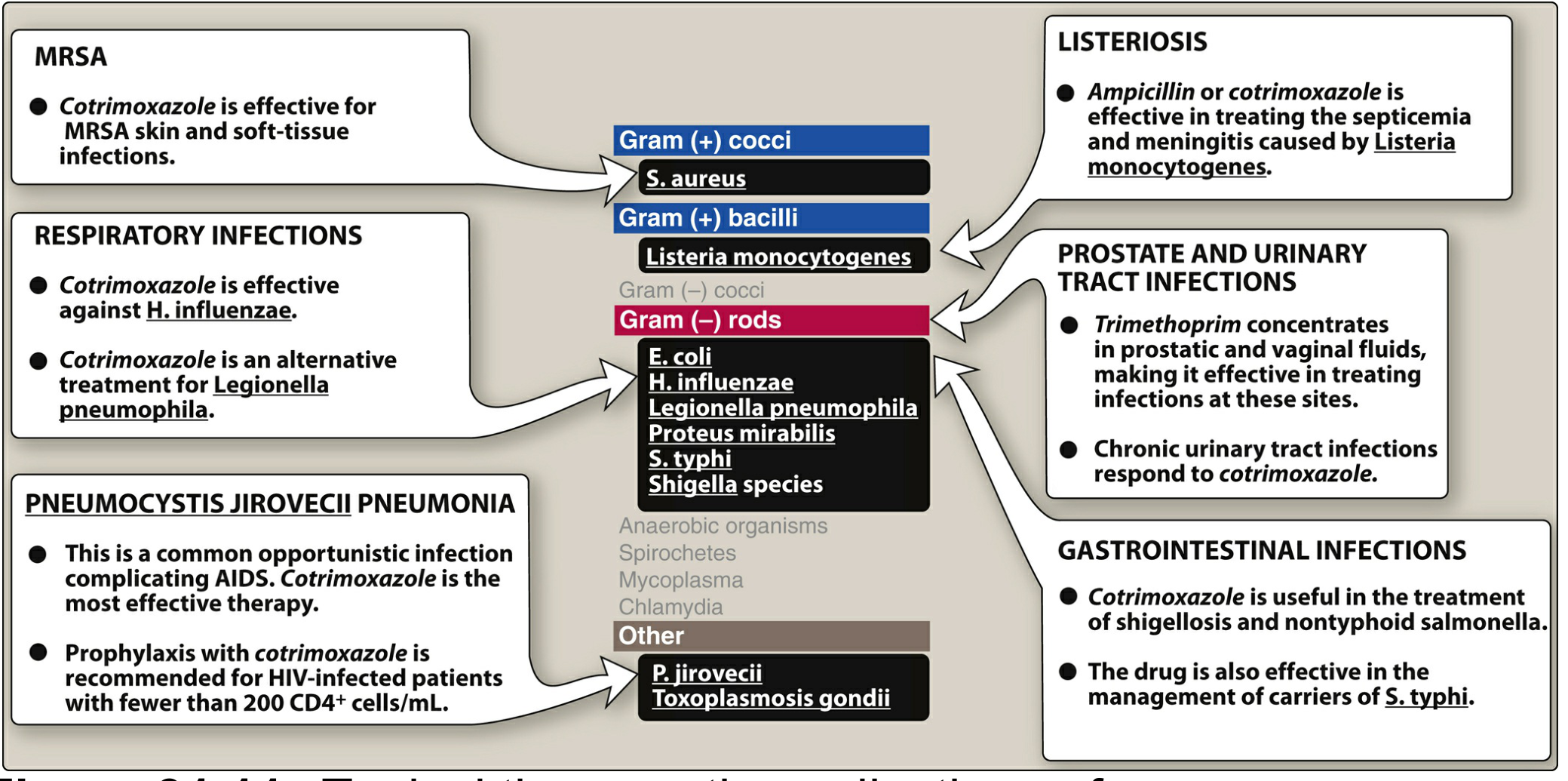
Antibacterial Spectrum
| Category | Organisms Covered |
|---|---|
| Gram-positive cocci | S. aureus (MSSA and CA-MRSA) |
| Gram-positive bacilli | Listeria monocytogenes |
| Gram-negative cocci | Neisseria gonorrhoeae (resistance now common) |
| Gram-negative rods | E. coli, H. influenzae, Proteus mirabilis, Shigella, Salmonella/S. typhi, Legionella pneumophila |
| Other gram-negatives | Stenotrophomonas maltophilia, Nocardia spp. |
| Fungi/opportunists | Pneumocystis jirovecii, Toxoplasma gondii |
Not active against: anaerobes, Pseudomonas aeruginosa, Mycoplasma, Chlamydia, spirochetes.
Clinical Uses
1. Urinary Tract Infections (UTIs)
- Most common use - treats uncomplicated and complicated UTIs caused by susceptible E. coli, Klebsiella, Proteus
- Standard dose: 1 DS tablet (160/800 mg) every 12 hours
- Prophylaxis for recurrent UTIs in women: 1 SS tablet (80/400 mg) three times weekly
- Trimethoprim concentrates in prostatic and vaginal fluids (being more lipid-soluble) - effective for bacterial prostatitis
2. Pneumocystis jirovecii Pneumonia (PCP)
- Drug of choice for both treatment and prophylaxis
- Treatment: High-dose IV or oral TMP 15-20 mg/kg/d (dosed on trimethoprim component)
- IV formulation used for moderate-to-severe PCP
- Prophylaxis: 1 DS tablet daily or three times weekly; indicated in HIV patients with CD4 < 200 cells/mL
3. Skin and Soft Tissue Infections (SSTIs)
- Effective for community-acquired MRSA SSTIs (furunculosis, cellulitis, abscesses)
- Standard DS dosing every 12 hours
- Bone and joint MRSA infections: 8-10 mg/kg/d of the TMP component
4. Respiratory Tract Infections
- Haemophilus influenzae, Moraxella catarrhalis, susceptible K. pneumoniae
- Alternative treatment for Legionella pneumophila
- Not active against Mycoplasma pneumoniae or Streptococcus pyogenes (unreliable)
5. Gastrointestinal Infections
- Shigellosis (bacillary dysentery) - treatment of choice if susceptible
- Typhoid fever / Salmonella carriers - alternative agent
- Nontyphoid Salmonella infections
- Cyclospora cayetanensis and Cystoisospora belli (Isospora) infections - TMP-SMX is the drug of choice for both treatment and long-term suppression in immunocompromised patients
6. Nocardiosis
- Drug of choice for Nocardia spp. infections (pulmonary, disseminated, CNS)
- High-dose, prolonged treatment required
7. Stenotrophomonas maltophilia
- One of the few reliable agents against this intrinsically multidrug-resistant organism
8. Listeriosis
- Alternative to ampicillin for Listeria monocytogenes septicemia and meningitis, especially in penicillin-allergic patients
9. Other Uses
- Traveler's diarrhea (where susceptibility is maintained)
- Toxoplasmosis prophylaxis in HIV/immunocompromised patients (TMP-SMX covers this at PCP prophylaxis doses)
- Whipple's disease (alternative)
- Chronic granulomatous disease - long-term prophylaxis against bacterial infections
- Wegener's granulomatosis (GPA) - used for relapse prevention
Formulations and Doses
| Formulation | Composition | Common Use |
|---|---|---|
| Single-strength (SS) tablet | TMP 80 mg + SMX 400 mg | UTI prophylaxis |
| Double-strength (DS) tablet | TMP 160 mg + SMX 800 mg | Most adult infections |
| IV solution | TMP 80 mg + SMX 400 mg per 5 mL | Severe PCP, bacteremia |
| Pediatric tablet | TMP 20 mg + SMX 100 mg | Pediatric dosing |
Pediatric dose: TMP 8 mg/kg/day + SMX 40 mg/kg/day divided every 12 hours (for shigellosis, UTI, otitis media).
Dose adjustment: Reduce by half when creatinine clearance is 15-30 mL/min. Avoid if CrCl < 15 mL/min (if alternatives exist).
Adverse Effects
| Category | Effects |
|---|---|
| GI | Nausea, vomiting, diarrhea (most common) |
| Hypersensitivity | Rash, urticaria, Stevens-Johnson syndrome (sulfonamide component) |
| Hematologic | Leukopenia, thrombocytopenia, granulocytopenia, megaloblastic anemia (with prolonged use or folate deficiency) |
| Renal/Electrolytes | Nephrotoxicity, hyperkalemia, hyponatremia (more common at high doses; TMP blocks potassium secretion in collecting duct) |
| Hepatic | Elevated transaminases (uncommon) |
Key Drug Interactions
- Warfarin - TMP-SMX inhibits CYP2C9, potentiating anticoagulant effect
- Phenytoin - increased phenytoin levels (reduced metabolism)
- Methotrexate - additive folate antagonism, increased toxicity
- ACE inhibitors/potassium-sparing diuretics - additive hyperkalemia risk (TMP blocks renal K+ secretion)
- Cyclosporine - may increase nephrotoxicity
Resistance
- TMP resistance: due to reduced cell permeability, overproduction of dihydrofolate reductase, or plasmid-encoded resistant enzymes spread via transposons
- Combined resistance is less common than resistance to either drug alone (requires simultaneous resistance to both)
- E. coli resistance now ~25-30% in many regions - limits empiric use for upper UTIs and pneumonia
- Resistance in pneumococci is also significant
Sources: Harrison's Principles of Internal Medicine 22E, p. 1221 | Katzung's Basic and Clinical Pharmacology, 16th Ed., pp. 1301-1302 | Lippincott Illustrated Reviews: Pharmacology, pp. 1037-1039 | Goodman & Gilman's Pharmacological Basis of Therapeutics
This is a shared conversation. Sign in to Orris to start your own chat.