
Can pphn is seen in infants
PPHN (Persistent Pulmonary Hypertension of the Newborn) is indeed seen in newborn infants - specifically neonates, typically in the first few days of life. It occurs when the normal transition from fetal to newborn circulation fails, causing blood to continue bypassing the lungs through fetal shunts (ductus arteriosus and foramen ovale). It is a serious, life-threatening condition predominantly affecting term or near-term newborns.
Searching sources...
Reading File
Finding Sources
Searching PubMed
persistent pulmonary hypertension newborn PPHN
Reading File
Finding Sources
Reading File
Loading Image
Yes, PPHN is specifically a condition of newborn infants (neonates). Here is a comprehensive overview based on authoritative textbook content:
Persistent Pulmonary Hypertension of the Newborn (PPHN)
What Is It?
PPHN is a condition exclusive to the neonatal period where the normal transition from fetal circulation to postnatal circulation fails. In fetal life, pulmonary vascular resistance (PVR) is intentionally high (blood bypasses the lungs since the placenta handles gas exchange). At birth, PVR should rapidly drop - when it doesn't, blood continues to shunt right-to-left through the ductus arteriosus and foramen ovale, bypassing the lungs.
Pathophysiology (Vicious Cycle)
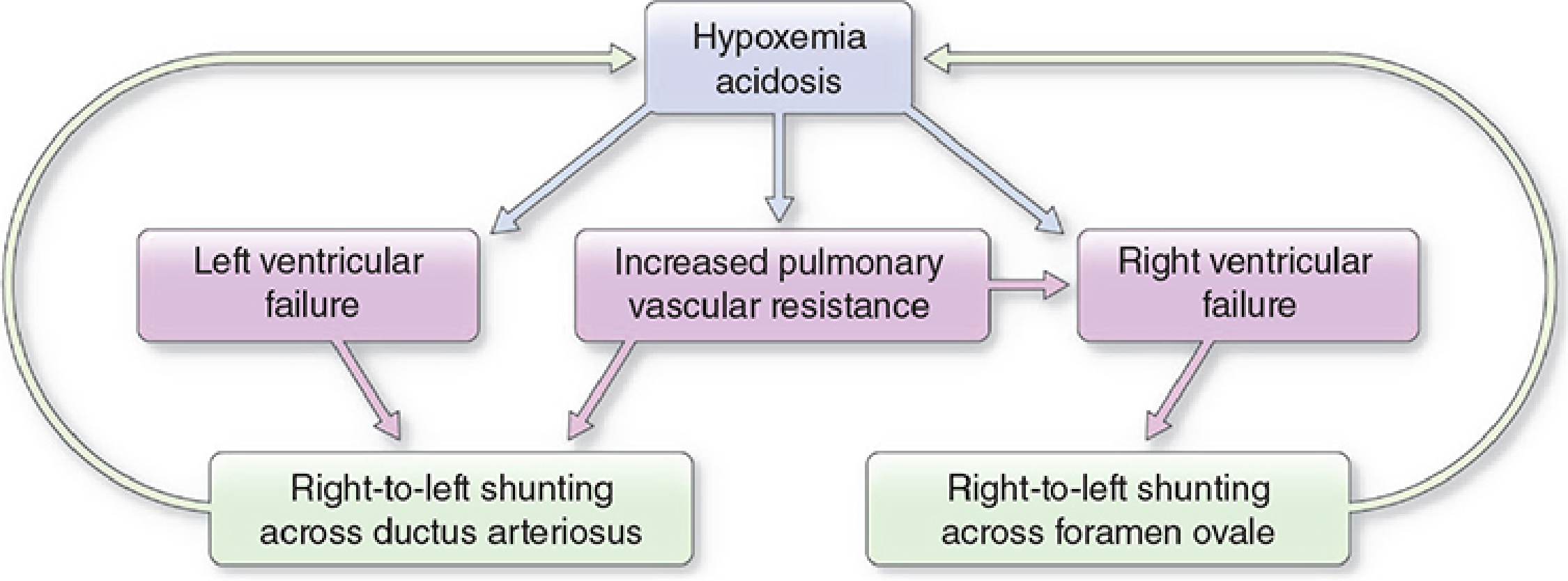
As shown above, hypoxemia and acidosis drive increased PVR → right ventricular failure → right-to-left shunting → worsening hypoxemia - a self-perpetuating cycle.
Who Gets It? (Risk Factors)
PPHN is most commonly seen in term or post-term newborns, including:
- Born by cesarean section
- History of fetal distress with low APGAR scores
- Hypoxemia and acidosis (causing vasoconstriction)
- Meconium aspiration syndrome or pneumonia (interstitial pulmonary disease)
- Polycythemia (hyperviscosity)
- Pulmonary hypoplasia - primary, or secondary to congenital diaphragmatic hernia or renal agenesis
- Maternal SSRI use in late pregnancy (also a recognized risk factor)
Etiology
- Idiopathic (primary), OR
- Secondary to conditions that increase pulmonary vascular resistance and cause vasoconstriction
Diagnostic Features
PPHN typically presents within 12-24 hours of birth:
- Severe hypoxemia - PaO2 <35-45 mmHg even in 100% O2, disproportionate to radiologic findings
- Structurally normal heart with right-to-left shunting at the foramen ovale and/or ductus arteriosus
- Pre/postductal oxygenation gradient ≥7-15 mmHg (significant finding)
- Must be distinguished from cyanotic congenital heart disease - use hyperoxia test and echocardiogram
Management Principles
(The Harriet Lane Handbook, 23rd ed.)
| Approach | Details |
|---|---|
| Improve oxygenation | Supplemental O2; blood transfusion if needed |
| Minimize pulmonary vasoconstriction | Minimal handling; sedation/paralysis if intubated; avoid severe hyperventilation |
| Maintain systemic BP | Volume expanders and/or inotropes to reverse right-to-left shunting |
| Inhaled Nitric Oxide (iNO) | Starting dose: 20 ppm (10 ppm in premature infants); reduces PVR; watch for methemoglobinemia (>4%) and NO2 toxicity |
| Prostacyclin analogs (e.g., epoprostenol) | Pulmonary vasodilator |
| Sildenafil | PDE5 inhibitor; promotes pulmonary vasodilation |
| ECMO | Reserved for severe cases: OI >40 for >3 hours or A-aO2 ≥610 for 8 hours; infant must be >2000 g and >34 weeks gestation |
Key Points to Remember
- PPHN is not seen in older children or adults in the same way - the name itself ("of the Newborn") specifies the population
- It is a neonatal emergency requiring intensive care
- A recent systematic review (PMID 39182148) confirms ECMO remains an important rescue therapy for severe PPHN when other treatments fail
- Another systematic review on IV magnesium sulfate (PMID 39194197) explored its role as an adjunct pulmonary vasodilator in PPHN
Source: The Harriet Lane Handbook - The Johns Hopkins Hospital, 23rd ed., p. 651-652
This is a shared conversation. Sign in to Orris to start your own chat.