
Bones of lower limb
Reading File
Finding Sources
Searching Images
bones of lower limb anatomy diagram
Finding Sources
Finding Sources
Reading File
Finding Sources
Finding Sources
Reading File
Finding Sources
Reading File
Reading File
Reading File
Reading File
I now have rich textbook content. Let me fetch key anatomical diagram images and compile the full answer.
Loading Image
Searching Images
femur anatomy greater lesser trochanter neck head
Searching Images
tibia fibula patella anatomy bones leg
Searching Images
foot bones tarsals metatarsals phalanges anatomy
I now have comprehensive content from the textbook. Here is a complete, well-organized overview of the bones of the lower limb.
Bones of the Lower Limb
The lower extremity appendicular skeleton is divided into four regions: the pelvic girdle, thigh, leg, and foot. All lower limb bones develop via endochondral ossification from lateral plate mesoderm.
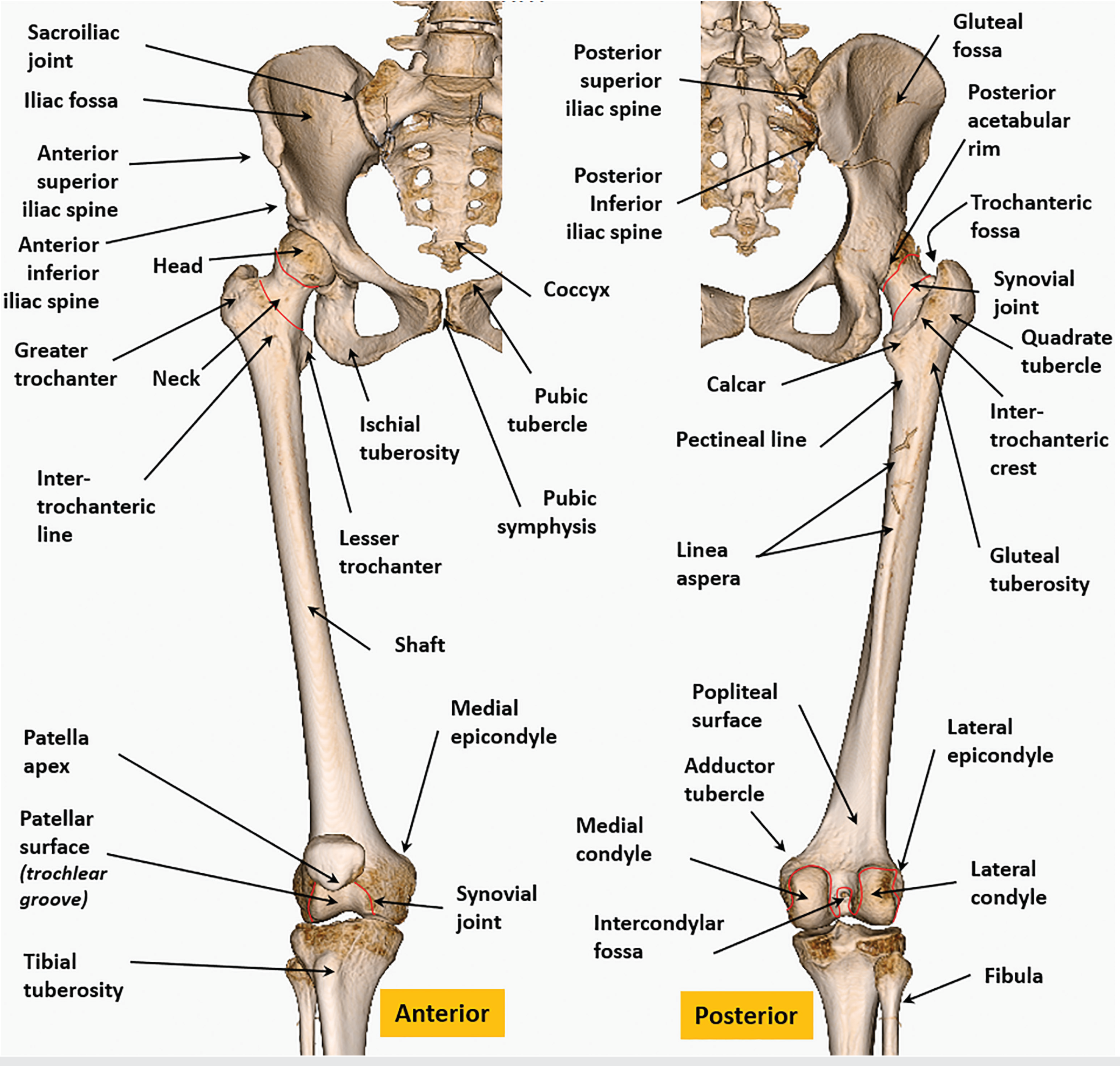
1. Pelvic Girdle (Hip Bone)
The hip bone (os coxae) is formed by three bones that fuse at the triradiate cartilage around puberty: the ilium, ischium, and pubis. Together, the two hip bones form the pelvis.
Ilium
- Most superior portion of the hip bone
- Consists of the iliac wing (flat) and the iliac body (supra-acetabular)
- Key landmarks:
- Iliac crest — superior border with anterior/posterior superior iliac spines (ASIS/PSIS)
- Anterior inferior iliac spine (AIIS) — origin of rectus femoris
- Iliac fossa — medial concave surface; iliacus muscle attaches here
- Gluteal fossa — lateral surface; origin of gluteus minimus, medius, and maximus
- Sacroiliac joint — articulates with the sacrum posteriorly
Ischium
- Forms the posteroinferior portion of the hip bone
- Ischial tuberosity — weight-bearing prominence; origin of hamstrings
- Ischial spine — attachment of sacrospinous ligament; landmark for pudendal nerve block
Pubis
- Anterior inferior portion of the hip bone
- Pubic tubercle — medial end of inguinal ligament
- Pubic symphysis — fibrocartilaginous joint between the two pubic bones
- Superior pubic ramus — forms part of the acetabular floor
Acetabulum
- Cup-shaped socket formed by all three bones (ilium superiorly, ischium inferiorly, pubis anteromedially)
- Lined by hyaline cartilage to articulate with the femoral head
- Rim deepened by the acetabular labrum (fibrocartilage)
- Triradiate cartilage — growth plate at the acetabular center (fuses ~16 years)
2. Femur (Thigh Bone)
The femur is the longest, strongest bone in the body. It has the following parts:
Proximal Femur
| Structure | Detail |
|---|---|
| Head | Two-thirds of a sphere; articulates with acetabulum; bears the fovea capitis (attachment of ligamentum teres) |
| Neck | Connects head to shaft; angle of inclination ~126° (coxa vara <120°; coxa valga >135°) |
| Greater trochanter | Large lateral projection; gluteus medius and minimus insert here; site of trochanteric bursae |
| Lesser trochanter | Posteromedial; iliopsoas inserts here |
| Intertrochanteric line | Anterior; iliofemoral ligament attaches; capsule attachment |
| Intertrochanteric crest | Posterior ridge between trochanters; bears the quadrate tubercle |
Shaft (Diaphysis)
- Linea aspera — posterior longitudinal ridge; attachment of adductors and vastus muscles
- Gluteal tuberosity — posterolateral; gluteus maximus insertion
- Pectineal line — posteromedial; pectineus insertion
- Calcar — dense trabeculae on posteromedial neck
Distal Femur
| Structure | Detail |
|---|---|
| Medial & lateral condyles | Articulate with the tibia at the knee joint |
| Medial & lateral epicondyles | Collateral ligament attachments |
| Intercondylar fossa | Posterior; cruciate ligament attachment |
| Patellar surface (trochlear groove) | Anterior; articulates with the patella |
| Adductor tubercle | On medial epicondyle; adductor magnus inserts here |
| Popliteal surface | Posterior triangular area; popliteal vessels |
3. Patella (Kneecap)
- Largest sesamoid bone in the body
- Embedded in the quadriceps tendon
- Base — superior (quadriceps attaches here)
- Apex — inferior (gives origin to patellar ligament)
- Articular surface — posterior; divided into medial and lateral facets by a vertical ridge, articulating with the trochlear groove of the femur
- Clinical significance: patellar fractures (transverse most common), chondromalacia patellae, patellar instability
4. Tibia (Shin Bone)
The medial and larger bone of the leg; bears most of body weight.
| Region | Landmarks |
|---|---|
| Proximal | Medial & lateral condyles (tibial plateau), intercondylar eminence (cruciate ligament attachment), tibial tuberosity (patellar ligament), Gerdy's tubercle (IT band) |
| Shaft | Anterior border (shin), medial surface (subcutaneous), interosseous border (interosseous membrane) |
| Distal | Medial malleolus — forms medial aspect of ankle mortise; tibial plafond (weight-bearing surface); tibial incisura (articulates with fibula) |
- Ossification: Tibial tuberosity ossification center grows from the proximal epiphysis — matures 8–12 years (female), 9–14 years (male); Osgood-Schlatter disease occurs at this site
5. Fibula
A slender, non-weight-bearing lateral bone of the leg.
| Region | Landmarks |
|---|---|
| Head | Articulates with lateral tibial condyle (proximal tibiofibular joint); common peroneal nerve winds around here |
| Shaft | Bound to tibia by interosseous membrane; origin of peroneal and extensor muscles |
| Lateral malleolus | Distal; forms lateral wall of ankle mortise; descends ~1 cm lower than medial malleolus |
- Proximal and distal tibiofibular joints are synovial (proximal) and fibrous/syndesmotic (distal)
- Fibula ossification center appears months after tibia; both fuse ~17–18 years
6. Foot Bones (26 bones total)
The foot skeleton is divided into three groups:
Tarsus (7 bones)
| Bone | Notes |
|---|---|
| Calcaneus | Largest tarsal bone; posterior (tuber calcanei = heel); sustentaculum tali supports talus; peroneal trochlea |
| Talus | Sits atop calcaneus; head articulates with navicular; body forms dome of ankle joint (talar dome) — no muscle attachments |
| Navicular | Medial side; articulates with talus proximally, three cuneiforms distally; tuberosity = tibialis posterior insertion |
| Cuboid | Lateral side; articulates with calcaneus and 4th/5th metatarsals; peroneal groove on plantar surface |
| Medial cuneiform | Largest; articulates with navicular, 1st metatarsal |
| Intermediate cuneiform | Smallest; articulates with navicular, 2nd metatarsal |
| Lateral cuneiform | Articulates with navicular, 3rd metatarsal |
Metatarsus (5 bones)
- Numbered 1–5 from medial to lateral
- Each has a base (proximal), shaft, and head (distal)
- 5th metatarsal tuberosity — prominent process at the base; peroneus brevis inserts here; common avulsion fracture site
- Jones fracture — transverse fracture at the metaphyseal-diaphyseal junction of the 5th metatarsal
Phalanges (14 bones)
- Big toe (hallux): 2 phalanges (proximal + distal)
- Toes 2–5: 3 phalanges each (proximal, middle, distal)
- Sesamoid bones are consistently found beneath the 1st metatarsal head
Summary Table
| Region | Bones |
|---|---|
| Pelvic girdle | Hip bone (ilium + ischium + pubis) ×2 |
| Thigh | Femur |
| Knee (sesamoid) | Patella |
| Leg | Tibia, Fibula |
| Foot | Calcaneus, Talus, Navicular, Cuboid, 3 Cuneiforms (tarsus) + 5 Metatarsals + 14 Phalanges |
| Total | ~62 bones in both lower limbs |
Key Clinical Correlates
- Neck of femur fracture — common in elderly (osteoporosis); blood supply to head via medial femoral circumflex artery is vulnerable → avascular necrosis
- Osgood-Schlatter disease — traction apophysitis at the tibial tuberosity in adolescents
- Pott's fracture — fibula fracture near the lateral malleolus with/without deltoid ligament injury
- Calcaneal fracture — most common tarsal fracture (fall from height); Böhler's angle reduced
- 5th metatarsal Jones fracture — poor blood supply → healing difficulties
- March fracture — stress fracture of 2nd or 3rd metatarsal shaft
Source: Imaging Anatomy Text and Atlas, Vol. 3 — Bones, Joints, Vessels and Nerves (ISBN 9781626239845)
This is a shared conversation. Sign in to Orris to start your own chat.