

99ba63ce-ceb3-48a3-8701-88d7e9901c0a.jpeg
Explain this table
This is the Davenport Diagram - a graphical tool used to analyze acid-base disorders by plotting three key variables simultaneously.
Searching sources...
Reading File
Finding Sources
Reading File
Reading File
Reading File
Now I have enough from the textbook. Let me also fetch the Davenport diagram image from the textbook to supplement my explanation.
Loading Image
Finding Sources
Loading Image
I now have everything needed for a thorough explanation. Here is the full breakdown:
The Davenport Diagram - Full Explanation
The image shows a Davenport diagram (also called a Davenport nomogram), which is the standard graphical tool used to diagnose and characterize acid-base disturbances in blood. Here is a textbook version for reference:
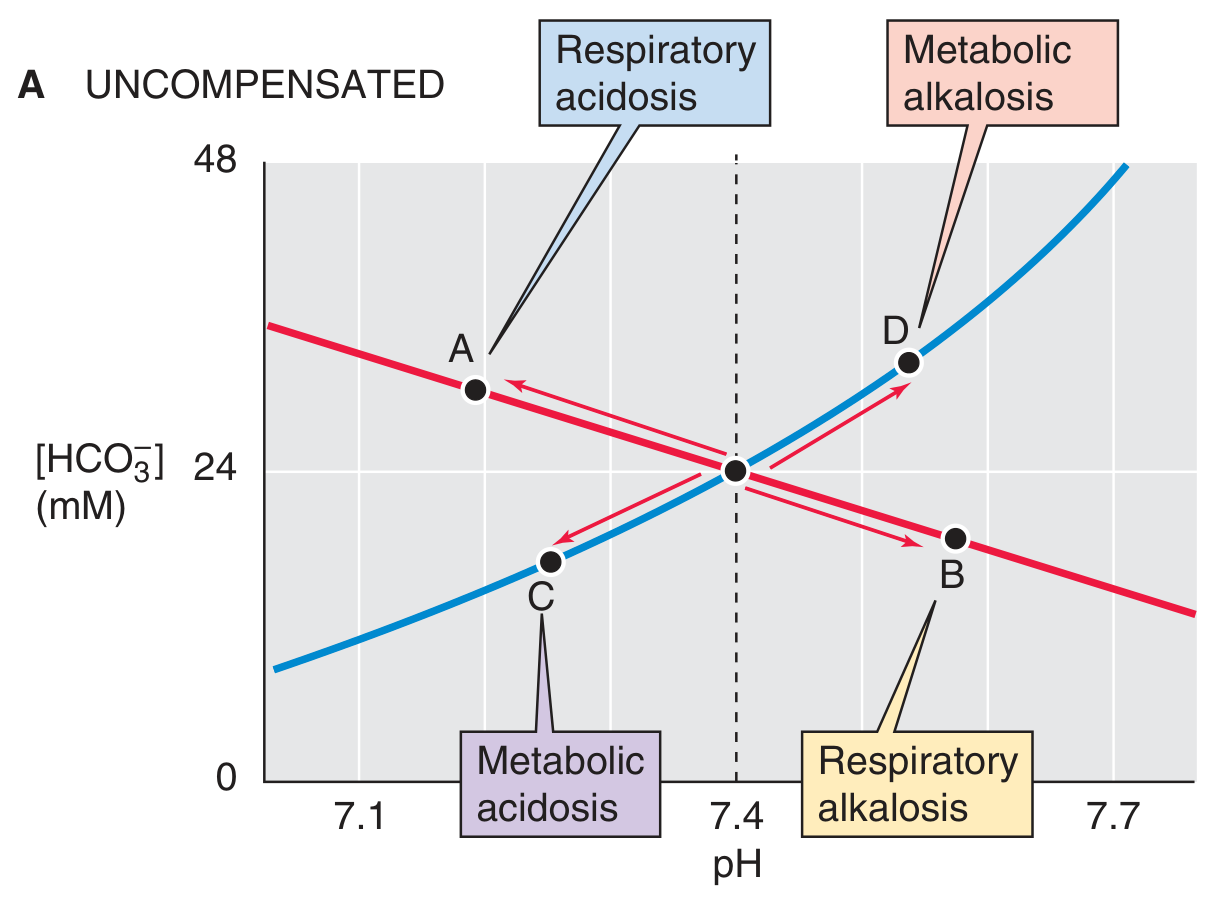
The Three Axes
The diagram simultaneously plots three variables that define acid-base status:
| Axis | What it represents |
|---|---|
| X-axis (bottom) | Arterial blood pH (7.0 - 7.8) |
| Y-axis (left) | Arterial blood [HCO3-] in mmol/L |
| Top axis | Arterial blood [H+] in nmol/L (a mirror of pH) |
| Diagonal lines (PCO2 isopleths) | Lines of constant PCO2 (in mm Hg) - each diagonal line represents a fixed PCO2 level |
The Normal Point
The center of the diagram is the Normal point (labeled in your image), which represents:
- pH = 7.40
- [HCO3-] = 24 mmol/L
- PCO2 = 40 mm Hg
All acid-base disturbances are deviations away from this central point.
The Two Key Lines
1. Non-HCO3- buffer (titration) line - the line running through Normal. When PCO2 changes (respiratory disturbance), the point moves ALONG this line, because all the non-bicarbonate buffers in blood (hemoglobin, proteins, phosphates) absorb the excess H+.
2. PCO2 isopleths (curved lines) - each curved line represents a fixed PCO2. Moving along a 40 mm Hg isopleth means PCO2 has NOT changed - this is a metabolic disturbance.
The Six Labeled Points (A through F in your image)
Using the Davenport diagram, each labeled point represents a specific acid-base state:
| Point | Location on diagram | Acid-base disorder |
|---|---|---|
| A | Low pH, slightly elevated HCO3-, high PCO2 | Acute respiratory acidosis (uncompensated) |
| B | Normal-ish pH, elevated HCO3-, elevated PCO2 | Chronic respiratory acidosis (with metabolic compensation) |
| C | High pH, elevated HCO3-, normal/low PCO2 | Metabolic alkalosis |
| Normal | pH 7.4, HCO3- 24, PCO2 40 | Normal |
| D | Low pH, low HCO3-, low PCO2 | Metabolic acidosis (partially compensated) |
| E | Low pH, low HCO3-, low PCO2 | Metabolic acidosis (more severe) |
| F | Very low pH, very low HCO3-, low PCO2 | Severe metabolic acidosis |
How to Read Any Point on the Diagram
For any plotted point, you check:
- Which PCO2 isopleth does it lie on? - tells you the PCO2
- What is the HCO3- value? - read off the Y-axis
- What is the pH? - read off the X-axis
- Is the point above or below the normal buffer line? - above means metabolic alkalosis component; below means metabolic acidosis component
Answer to Case-8 in the image
The question asks: which disturbances do points A and D represent?
- Point A is in the area of high PCO2 + low pH (left side, above normal line) = acute respiratory acidosis
- Point D is in the area of normal PCO2 + low HCO3- + slightly elevated pH - but on the diagram it sits in the region of acute respiratory alkalosis (low PCO2, shifted right/down from normal)
The answer given is (c): Acute respiratory acidosis + acute respiratory alkalosis - these are the two disturbances that point A and point D represent together.
Why is this diagram useful?
The Davenport diagram is mainly used by paramedical and clinical professionals because it lets you:
- Diagnose the primary acid-base disorder at a glance
- Identify whether compensation has occurred
- Spot mixed (compound) disorders when the point falls far outside expected compensation zones
- Avoid doing separate calculations for each variable
It is based on the Henderson-Hasselbalch equation: [HCO3-] = s × PCO2 × 10^(pH - pKCO2), which links all three variables simultaneously.
- Medical Physiology (Boron & Boulpaep), p. 943
This is a shared conversation. Sign in to Orris to start your own chat.