
Fick principle 5 mark answer in anesthesia exam
Reading File
Searching sources...
Finding Sources
Finding Sources
Now let me read the key sections from Morgan & Mikhail (anesthesia-specific) and Guyton & Hall:
Reading File
Reading File
Reading File
I have all the content needed. Let me also fetch the Fick diagram from Guyton:
Loading Image
Here is a complete, exam-ready 5-mark answer on the Fick Principle for an anesthesia exam:
Fick Principle
Definition
The Fick Principle states that the amount of a substance taken up or released by an organ per unit time equals the blood flow to that organ multiplied by the arteriovenous difference in concentration of that substance. In the context of cardiac output (CO) measurement, it is based on conservation of mass applied to oxygen uptake by the lungs.
Principle and Derivation
In steady state, the total body O2 consumption (VO2) must equal the difference between the rate of O2 leaving the lungs in pulmonary venous blood and the rate of O2 returning to the lungs in pulmonary arterial blood.
O2 consumption = CO × [O2]pulmonary vein - CO × [O2]pulmonary artery
Rearranging:
$$\text{CO} = \frac{\dot{V}{O_2}}{C{aO_2} - C_{\bar{v}O_2}}$$
Where:
- CO = cardiac output (mL/min or L/min)
- VO2 = total body oxygen consumption (mL O2/min)
- CaO2 = arterial oxygen content (mL O2/mL blood)
- CvO2 = mixed venous oxygen content (mL O2/mL blood)
(Morgan & Mikhail's Clinical Anesthesiology 7e, p. 200; Guyton & Hall Medical Physiology, p. 262)
Illustrative Example
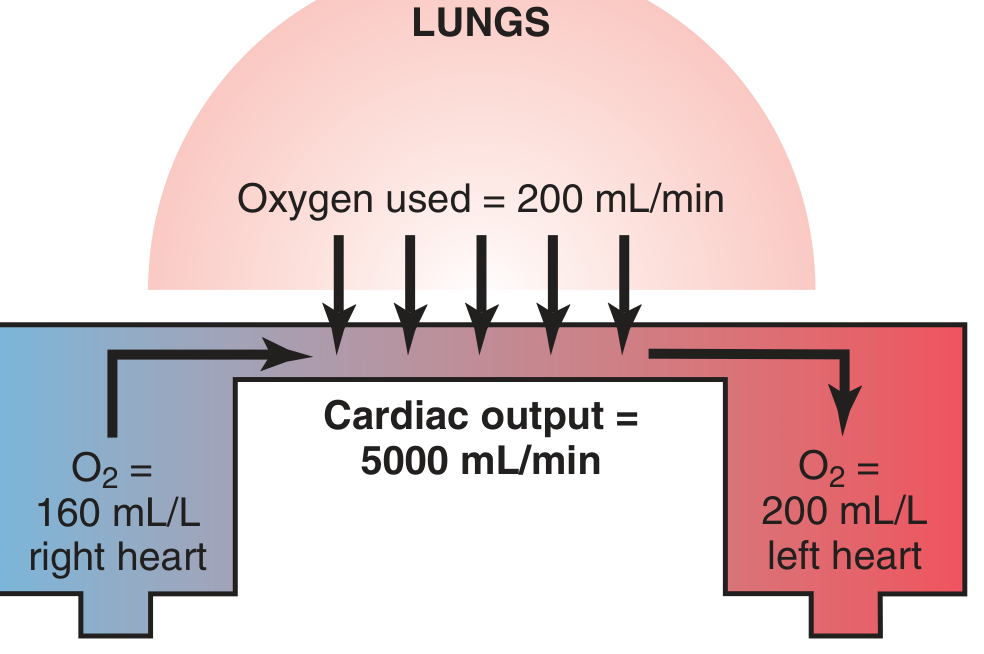
Figure: Fick principle for determining cardiac output. O2 absorbed from lungs = 200 mL/min; venous O2 = 160 mL/L; arterial O2 = 200 mL/L; a-v difference = 40 mL/L. Therefore CO = 200/40 = 5000 mL/min. (Guyton & Hall)
Worked example (Costanzo):
- VO2 = 250 mL O2/min
- Arterial O2 content = 0.20 mL O2/mL blood
- Pulmonary arterial (mixed venous) O2 content = 0.15 mL O2/mL blood
- CO = 250 / (0.20 - 0.15) = 5000 mL/min (5 L/min) - normal resting value
How It Is Applied Clinically (Anesthesia)
| Parameter | How Obtained |
|---|---|
| VO2 (O2 consumption) | Measured from inspired vs. expired gas analysis (metabolic monitor/spirometry) |
| CaO2 (arterial O2 content) | Arterial blood gas + Hb (via arterial line) |
| CvO2 (mixed venous O2 content) | Sample from pulmonary artery catheter (PA catheter distal port) |
Mixed venous blood must come from the pulmonary artery to ensure true mixing of venous return from all beds (coronary, renal, splanchnic, skeletal muscle). A central venous sample is less accurate. (Morgan & Mikhail's Clinical Anesthesiology 7e, p. 200)
Advantages
- Gold standard / reference method for CO measurement
- No exogenous indicator required
- Can simultaneously assess oxygen delivery and consumption
Limitations
- Invasive - requires PA catheter
- Assumes steady-state conditions (not valid during rapidly changing hemodynamics - e.g., post-induction, during arrhythmias)
- Error-prone if VO2 measurement is inaccurate (shivering, high FiO2)
- Time-consuming compared to thermodilution
Extensions of the Fick Principle
-
Thermodilution (modified Fick) - cold saline is used as the "indicator"; the temperature-time curve at the PA catheter estimates CO. All indicator-dilution methods of determining CO are variations of the Fick principle. (Morgan & Mikhail's, p. 200)
-
Organ-specific blood flow - The principle can be applied to any organ (e.g., renal blood flow = renal O2 consumption / renal arteriovenous O2 difference).
-
CO2 Fick - Uses CO2 production and arteriovenous CO2 content difference; useful when O2 measurement is unreliable.
Summary
The Fick Principle is the physiological basis for measuring cardiac output and oxygen delivery. In anesthesia practice, it underpins PA catheter-based CO measurement, indicator-dilution techniques, and hemodynamic monitoring. The formula CO = VO2 / (CaO2 - CvO2) is fundamental and must be applied under steady-state conditions with true mixed venous sampling.
This is a shared conversation. Sign in to Orris to start your own chat.