
Buccinator muscle easy origin insertion and action
Buccinator muscle - quick overview:
- Origin: Alveolar processes of maxilla and mandible (opposite molar teeth), and the pterygomandibular raphe
- Insertion: Blends into the orbicularis oris at the angle of the mouth
- Action: Compresses the cheeks against the teeth; keeps food in contact with teeth during chewing; used in whistling and blowing
Searching sources...
Reading File
Finding Sources
Reading File
Reading File
Reading File
Loading Image
Here is a clean, easy-to-remember breakdown of the Buccinator muscle, sourced from Gray's Anatomy for Students and Scott-Brown's Otorhinolaryngology:
Buccinator Muscle
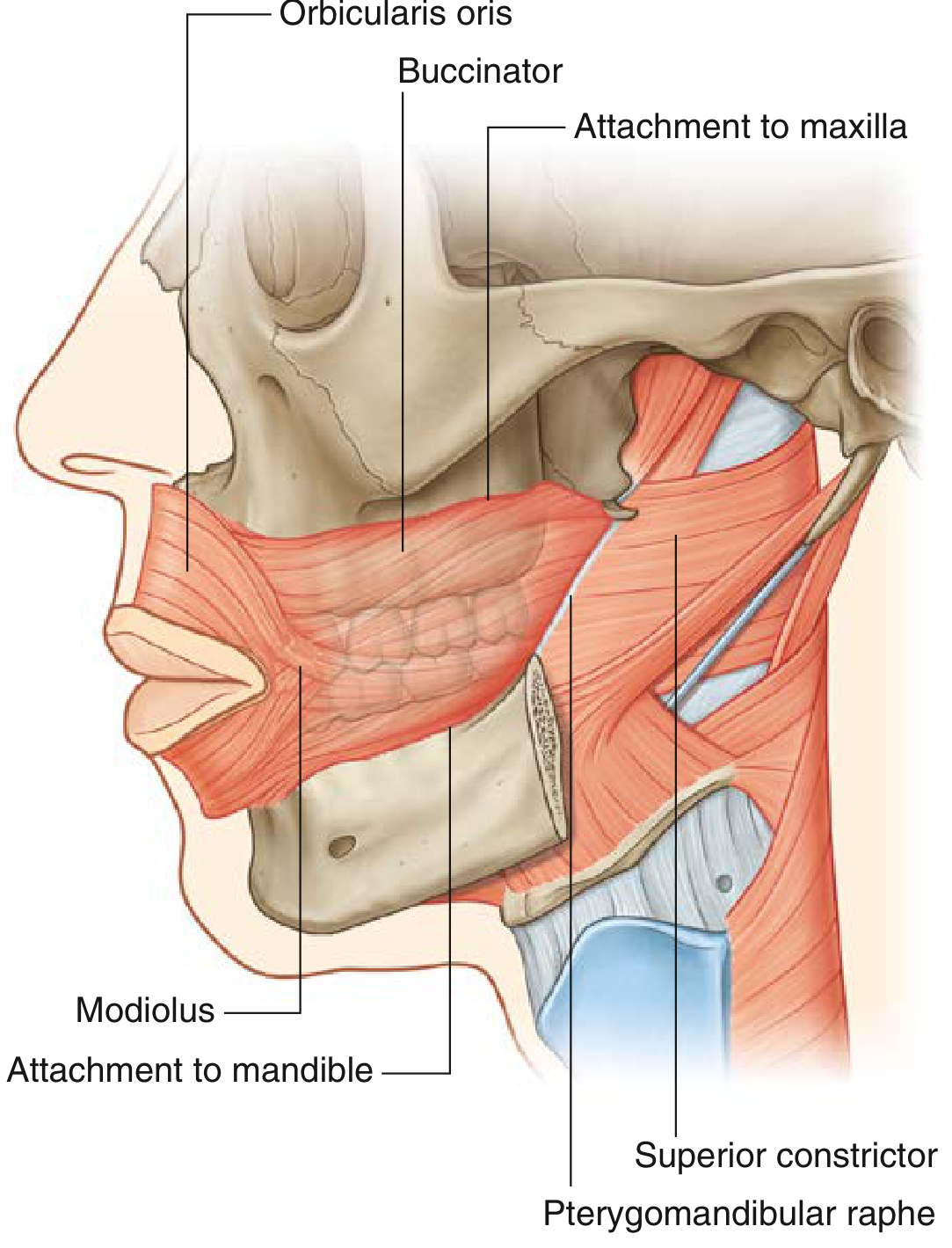
Origin (3 sites - remember "2 bones + 1 raphe")
| Site | Detail |
|---|---|
| Maxilla | Outer surface of alveolar process, opposite the molar teeth |
| Mandible | Outer surface of alveolar process, opposite the molar teeth |
| Pterygomandibular raphe | A tendinous band running from the pterygoid hamulus (above) to the mandible (behind last molar, below) |
Tip to remember: "Buccinator grabs both jaws at the molars, plus the raphe behind."
Insertion
- Fibers run forward to blend with the orbicularis oris and insert into the modiolus (a small button-like fibromuscular knot at the corner of the mouth)
- Key feature - fiber decussation: Central fibers cross at the angle of the mouth - fibers from below go into the upper lip, fibers from above go into the lower lip. The highest and lowest fibers do NOT cross and enter their respective lips directly.
Actions
| Action | How to remember |
|---|---|
| Compresses cheeks against teeth | Keeps food between molars during chewing |
| Aids mastication | Prevents food from pocketing in the cheek (assists the tongue) |
| Expels air from puffed cheeks | Used in whistling, blowing, playing wind instruments |
Memory trick: "The trumpeter's muscle" - think of a trumpet player puffing and blowing air. Buccinator = Latin for "trumpeter."
Nerve Supply
- Motor: Buccal branch of the facial nerve (CN VII)
- Sensory (skin/mucosa of cheek): Buccal branch of the mandibular nerve (CN V3)
Blood Supply
- Facial artery and buccal branch of maxillary artery
Bonus Clinical Note
The parotid duct (Stensen's duct) pierces the buccinator opposite the upper 2nd molar tooth to open into the oral cavity. This is a common exam point!
- Gray's Anatomy for Students, Buccinator section
- Scott-Brown's Otorhinolaryngology, Buccinator muscle section
This is a shared conversation. Sign in to Orris to start your own chat.