
Why ICD placed over 5th INTERCOSTAL SPACE
A chest drain (ICD - Intercostal Chest Drain) is placed in the 5th intercostal space (mid-axillary line) based on several anatomical and safety principles. Let me pull up the detailed reasoning from medical textbooks.
Searching sources...
Reading File
Finding Sources
Finding Sources
Finding Sources
Finding Sources
Reading File
Reading File
Reading File
Loading Image
Finding Sources
Here is a thorough, textbook-grounded explanation:
Why Is an ICD (Intercostal Chest Drain) Placed at the 5th Intercostal Space?
The 5th intercostal space (ICS) in the mid-axillary line (MAL) is the standard site because it sits within the "Triangle of Safety" - a zone chosen to maximize efficacy while minimizing the risk of injury to surrounding structures. There are multiple anatomical, physiological, and safety reasons behind this choice.
1. The "Triangle of Safety"
The chest drain is always inserted within the Triangle of Safety, whose boundaries are:
| Boundary | Structure |
|---|---|
| Anterior | Lateral border of pectoralis major |
| Posterior | Anterior border of latissimus dorsi |
| Inferior | A horizontal line at the level of the 5th ICS (nipple level in males) |
| Apex | The axilla |
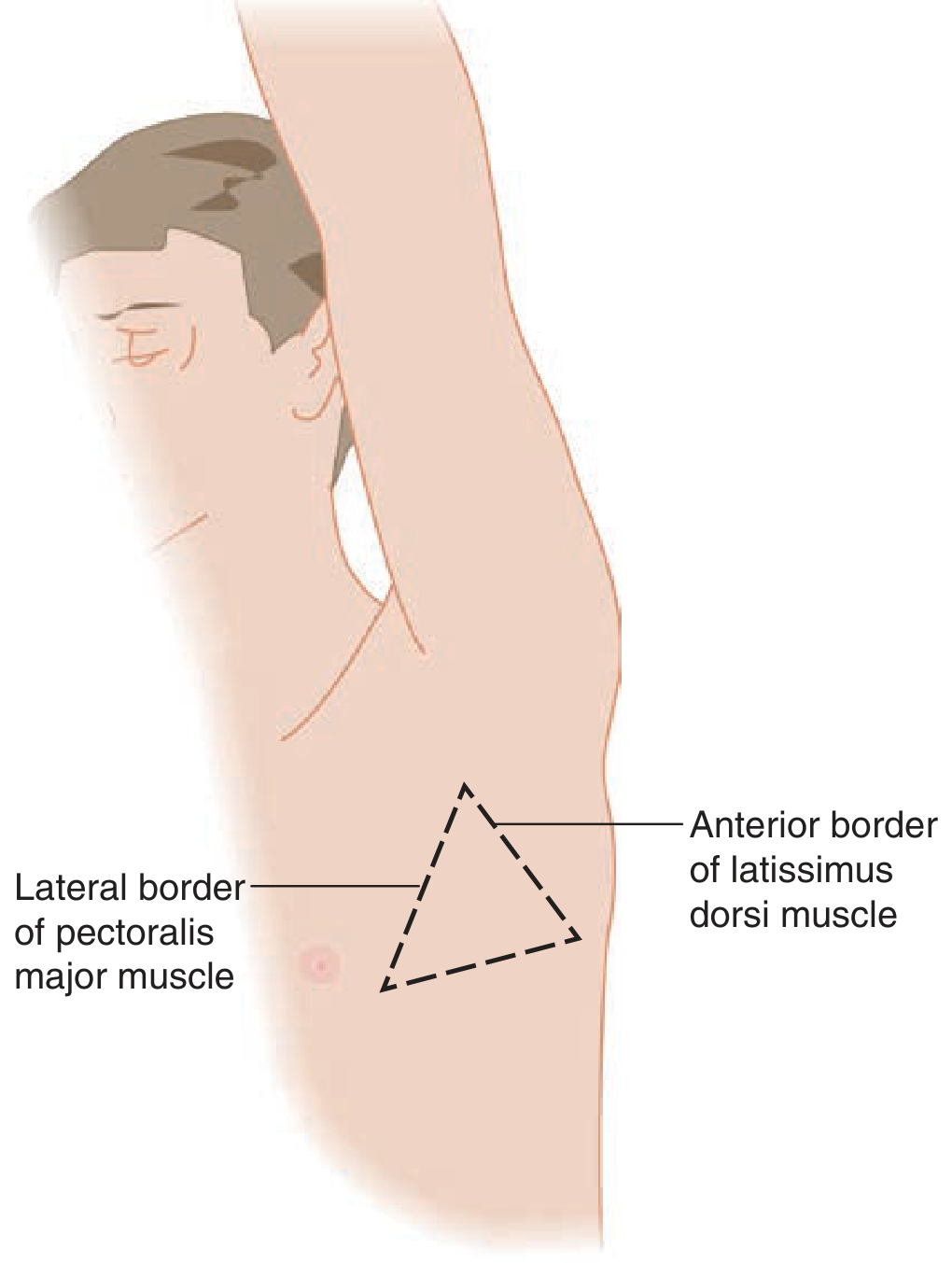
Triangle of Safety - Tintinalli's Emergency Medicine
The 5th ICS sits at the base of this triangle, making it the lowest safe point of insertion. Going lower risks entering the abdominal cavity through the diaphragm.
- Tintinalli's Emergency Medicine, section "Triangle of Safety"
- Bailey & Love's Short Practice of Surgery, 28th Ed.
2. Avoiding Injury to the Neurovascular Bundle
Each rib has a neurovascular bundle (intercostal nerve, artery, vein) running in the costal groove along the inferior surface of the rib. The drain is always inserted just above the upper border of the lower rib (i.e., the 6th rib when entering the 5th ICS) to avoid:
- Intercostal artery hemorrhage
- Intercostal nerve damage causing chronic pain
- Intercostal vein injury
"Because of this inferior placement [of the neurovascular bundle], most chest wall procedures such as thoracostomy tube placement or thoracentesis should be aimed at the superior aspect of the rib to avoid injury to this bundle."
- Mulholland & Greenfield's Surgery, 7th Ed.
3. Avoiding the Diaphragm and Abdominal Organs
The diaphragm rises significantly during expiration. Spaces below the 5th ICS in the MAL risk penetrating the diaphragm and injuring abdominal viscera:
- Right side - liver
- Left side - spleen and stomach
The 5th ICS in the MAL is high enough to remain safely within the pleural cavity throughout the full respiratory cycle.
4. Position Relative to the Lung Fissure and Fluid/Air Drainage
-
The 5th ICS in the MAL corresponds roughly to the level of the horizontal fissure laterally, placing the tube in a good anatomical position to drain both:
- Pneumothorax (air rises to apex, but drain directed superiorly)
- Hemothorax/pleural effusion (fluid settles dependently, and this posterior-lateral position sits near the base)
-
The lateral (axillary) position avoids the bulk of the serratus anterior and pectoralis major muscles anteriorly, and avoids the thick latissimus dorsi posteriorly - both of which would make insertion harder and more painful.
5. Avoiding the Breast Tissue
Placing the drain in the mid-axillary line at the 5th ICS avoids breast tissue in female patients (compared to more anterior approaches), reducing infection risk and cosmetic complications.
6. Avoiding the Heart and Great Vessels
The 5th ICS in the MAL (rather than a medial position) keeps the insertion point well lateral to the pericardium and mediastinal structures, preventing cardiac or great vessel injury.
Summary Table
| Reason | Structure Protected |
|---|---|
| Triangle of Safety | Overall safe zone |
| Superior to 6th rib | Intercostal neurovascular bundle |
| Above the diaphragm | Liver (R), Spleen/Stomach (L) |
| Mid-axillary line | Breast tissue, pectoralis major, latissimus dorsi |
| Lateral approach | Heart, great vessels, mediastinum |
| Full respiratory cycle clearance | Diaphragm at peak expiration |
The combination of these anatomical factors makes the 5th ICS, mid-axillary line the site that offers the best access to the pleural space with the least risk to surrounding structures - which is why it has become the universally recommended landmark for ICD insertion.
This is a shared conversation. Sign in to Orris to start your own chat.