
hypothalamus physiology and anatomy
I'll read the medical library skill first, then query for hypothalamus content.
Reading File
Searching sources...
Now I'll search the library in parallel - headings for anatomy/physiology sections and paragraphs for key content.
Finding Sources
Finding Sources
Excellent results. Now I'll read the most relevant sources in parallel - Neuroanatomy through Clinical Cases (detailed nuclei/anatomy), Guyton Hall physiology, and Ganong's review.
Reading File
Reading File
Reading File
Good content found. Now let me read the detailed hypothalamic nuclei section from Neuroanatomy and also read Guyton Hall on hypothalamic functions and also Histology for structural details.
Reading File
Finding Sources
Excellent content. Let me now read more of the Neuroanatomy book for the nuclei details, and fetch key images to include in the answer.
Reading File
Reading File
Now let me get the nuclei details and the Kandel book's anatomical organization, plus fetch the key anatomy diagram.
Reading File
Reading File
Loading Image
I now have comprehensive content from multiple authoritative textbooks. Let me also fetch the key nuclei diagram and the hypothalamic anatomy diagram.
Loading Image
Loading Image
I now have comprehensive, well-illustrated content from multiple leading textbooks. Let me compile the full response.
Hypothalamus: Anatomy and Physiology
The hypothalamus is one of the most functionally dense structures in the brain - weighing only about 4 grams but governing survival functions including temperature regulation, fluid balance, hunger, reproduction, sleep, and autonomic control. It is informally called the "homeostatic head ganglion."
1. Gross Anatomy and Location
The hypothalamus is part of the diencephalon and is named for its position underneath the thalamus. It:
- Forms the walls and floor of the inferior portion of the third ventricle
- Is separated from the thalamus by the hypothalamic sulcus on the wall of the third ventricle
- Is bounded anteriorly by the diagonal band of Broca; dorsally by the anterior commissure, bed nuclei of the stria terminalis, and thalamus; posteriorly by the ventral tegmental area and interpeduncular nucleus
On the ventral surface of the brain, visible structures include:
- The optic chiasm (anterior border)
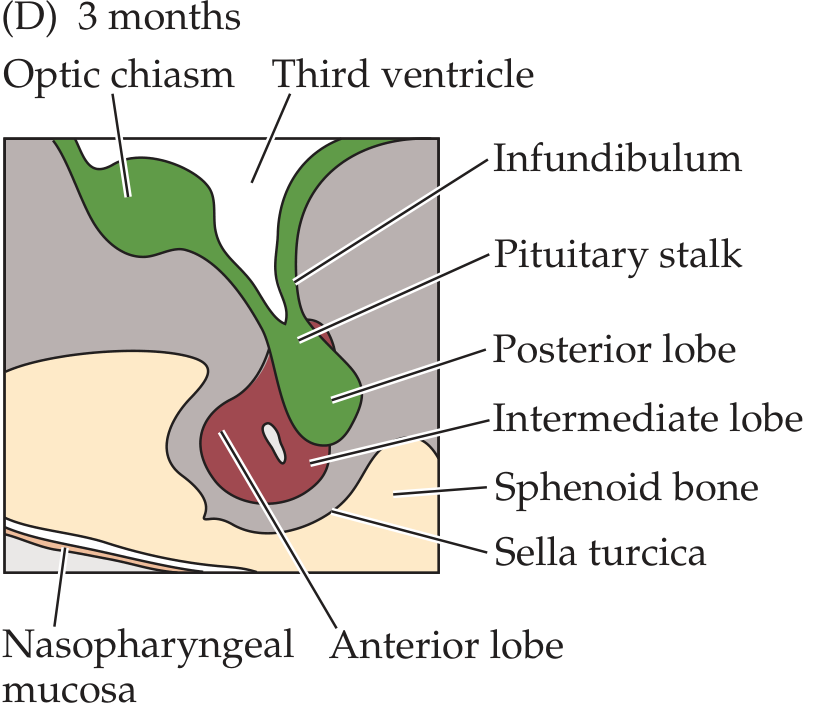
- The tuber cinereum ("gray protuberance") - a bulge between the optic chiasm and the mammillary bodies, which narrows into the infundibulum (pituitary stalk)
- The mammillary bodies - paired structures posteriorly important for memory circuits
2. Structural Organization
2a. Mediolateral Zones
The fornix (running toward the mammillary body) divides the hypothalamus into two mediolateral areas:
| Zone | Contents |
|---|---|
| Periventricular zone | Thin layer of cells immediately adjacent to the third ventricle; important for neuroendocrine regulation |
| Medial hypothalamic area | Contains most of the discrete nuclei listed below |
| Lateral hypothalamic area | Contains the lateral hypothalamic nucleus; traversed by the medial forebrain bundle (MFB) - a bidirectional fiber highway connecting hypothalamus to other regions |
2b. Rostrocaudal Regions
The hypothalamus is divided into four regions anterior to posterior:
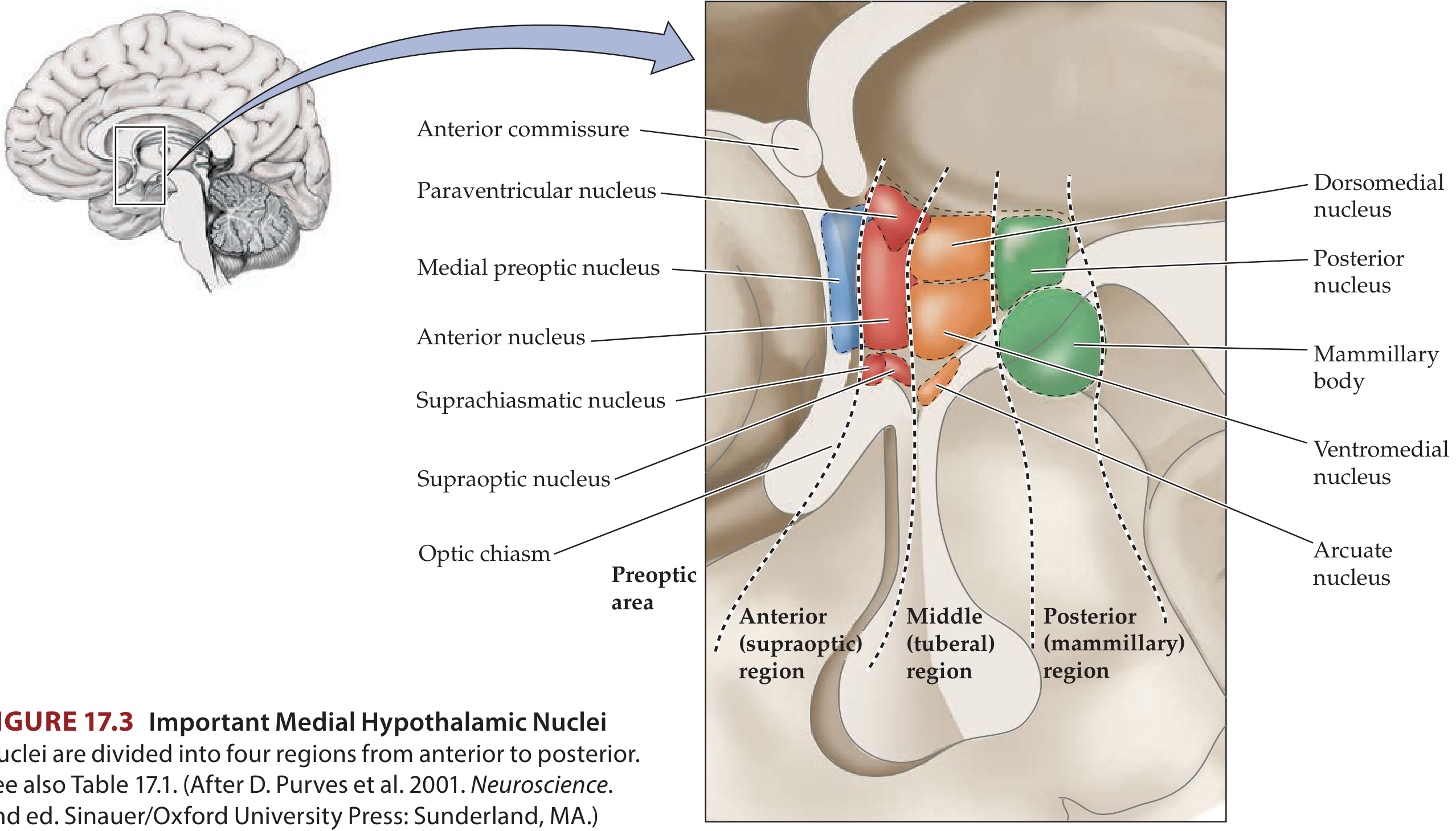
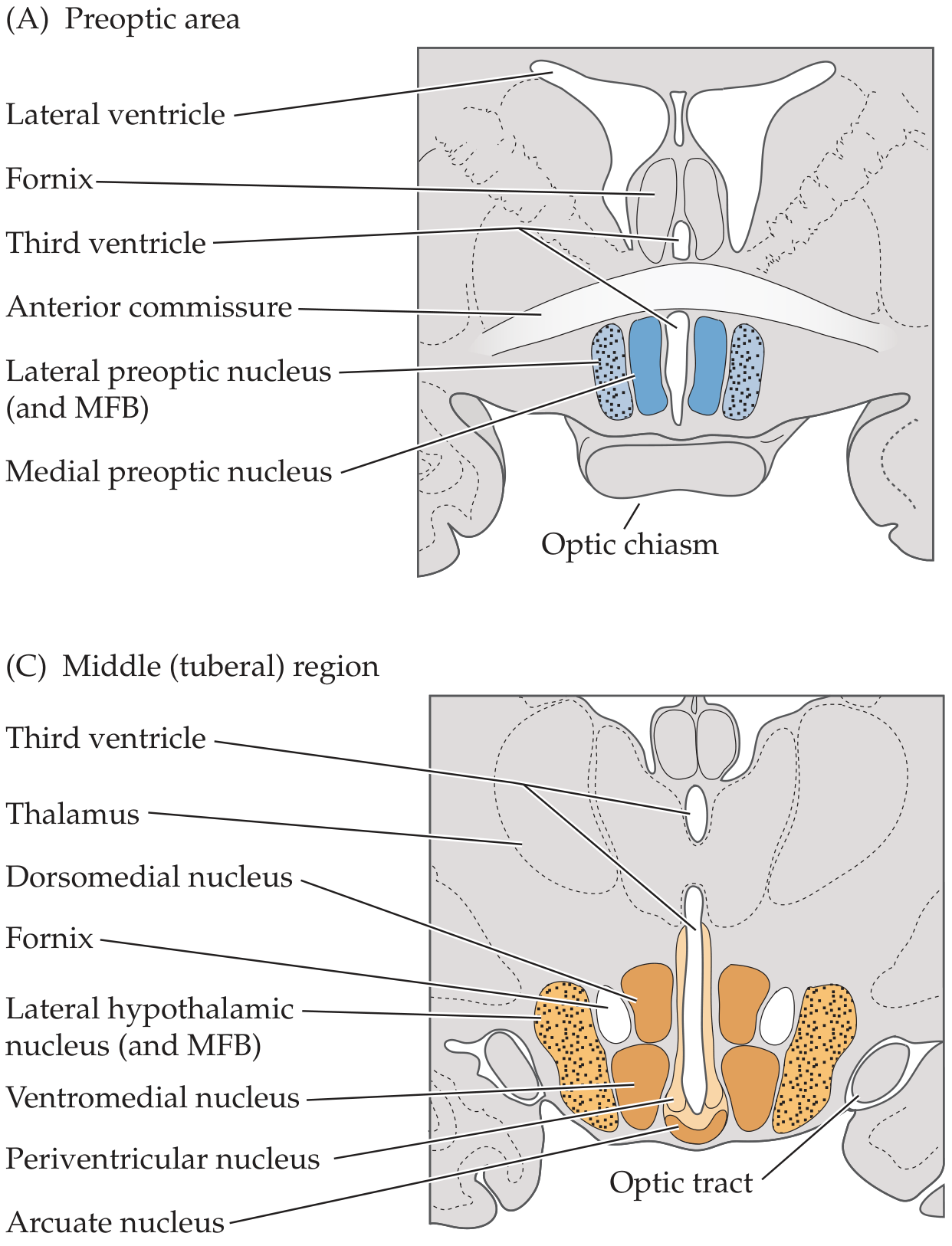
1. Preoptic Area (embryologically telencephalic, but functionally hypothalamic)
- Medial preoptic nucleus, lateral preoptic nucleus
- Functions: temperature control, sleep, sexual behavior, circadian rhythms
2. Anterior (Supraoptic) Region
- Anterior hypothalamic nucleus
- Supraoptic nucleus (SON) - neurons containing oxytocin/vasopressin, project to posterior pituitary
- Paraventricular nucleus (PVN) - neurons containing oxytocin/vasopressin; also releases CRH, TRH; projects to posterior pituitary and brainstem
- Suprachiasmatic nucleus (SCN) - the "master clock" for circadian rhythms; receives direct retinal input
3. Middle (Tuberal) Region
- Arcuate nucleus (infundibular nucleus) - projects to median eminence; releases GnRH, dopamine (inhibits prolactin), growth hormone-releasing hormone; key in feeding regulation (NPY/AgRP vs. POMC neurons)
- Ventromedial nucleus - satiety center; reproductive behavior
- Dorsomedial nucleus - feeding behavior, aggression, autonomic function
4. Posterior (Mammillary) Region
- Medial, intermediate, and lateral mammillary nuclei - receive hippocampal input via fornix; relay to anterior thalamic nucleus (Papez circuit, memory)
- Posterior hypothalamic nucleus - heat conservation; arousal
- Tuberomammillary nucleus - histaminergic neurons that promote wakefulness
3. Hypothalamic-Pituitary Connections
The hypothalamus links to both lobes of the pituitary through distinct mechanisms:
Posterior Pituitary (Neurohypophysis)
The posterior pituitary contains no glandular cells. It is composed of the axon terminals of neurons whose cell bodies sit in the supraoptic and paraventricular nuclei. These neurons synthesize:
- Vasopressin (ADH) - water retention by the kidney; osmotic regulation
- Oxytocin - uterine contractions during labor; milk letdown; pair bonding
These hormones travel down axons and are released directly into fenestrated capillaries of the posterior pituitary (magnocellular neurosecretion).
Anterior Pituitary (Adenohypophysis)
The anterior pituitary contains glandular cells and develops from Rathke's pouch (pharyngeal ectoderm). Hypothalamic control occurs via hypophysiotropic hormones released into the hypophyseal portal system - blood drains from hypothalamic capillaries through portal veins to sinusoids of the anterior pituitary (parvocellular neurosecretion). Key releasing/inhibiting hormones:
| Hypothalamic Hormone | Anterior Pituitary Effect | End Result |
|---|---|---|
| CRH (from PVN) | ACTH release | Cortisol from adrenal cortex |
| TRH | TSH release | T3/T4 from thyroid |
| GnRH (from arcuate/medial preoptic) | FSH/LH release | Gonadal steroids, gametogenesis |
| GHRH (from arcuate) | GH release | IGF-1, somatic growth |
| Somatostatin (from periventricular) | GH inhibition | - |
| Dopamine (from arcuate) | Prolactin inhibition | - |
Feedback loops are critical: for example, high circulating cortisol inhibits both CRH (in the hypothalamus) and ACTH (at the pituitary), forming a classic negative feedback loop.
4. Key Physiological Functions
The hypothalamus regulates six vital physiological functions (Kandel, Principles of Neural Science):
4a. Thermoregulation
- The anterior hypothalamic-preoptic area contains heat-sensitive and cold-sensitive neurons acting as temperature sensors
- Heating the preoptic area triggers sweating and cutaneous vasodilation (heat loss)
- The posterior hypothalamus coordinates heat conservation mechanisms (shivering, vasoconstriction)
- Temperature control follows a "distributed settling point" model - multiple feedback loops rather than a single thermostat
4b. Fluid Balance and Blood Pressure
- Osmoreceptors in the supraoptic nucleus detect plasma osmolality; increased osmolality triggers ADH secretion from the posterior pituitary
- The hypothalamus also regulates thirst behavior (drinking)
- The PVN controls vasomotor tone via autonomic pathways
- Mnemonic: Supraoptic = Salt & water (ADH + osmoreception)
4c. Energy Metabolism and Feeding
- Lateral hypothalamus = hunger/feeding center (lesion causes anorexia)
- Ventromedial nucleus = satiety center (lesion causes hyperphagia and obesity)
- The arcuate nucleus contains two opposing populations:
- NPY/AgRP neurons - orexigenic (stimulate feeding); activated by ghrelin (from stomach)
- POMC/CART neurons - anorexigenic (suppress feeding); activated by leptin (from fat)
- Regulates GH and thyroid hormones (metabolic rate)
4d. Reproductive Behavior and Gonadal Axis
- The medial preoptic nucleus contains the sexually dimorphic nucleus (SDN), larger in males
- Pulsatile GnRH release from the arcuate nucleus drives the HPG axis
- The ventromedial nucleus and ventral premammillary nucleus regulate sexual behavior
4e. Autonomic Control
- The hypothalamus exerts descending control over sympathetic and parasympathetic outflows
- Anterior/medial hypothalamus: parasympathetic tone (rest-and-digest)
- Posterior/lateral hypothalamus: sympathetic tone (fight-or-flight)
- Pathways descend through the lateral tegmentum to the brainstem and spinal cord preganglionic neurons
4f. Sleep-Wake Cycle and Circadian Rhythms
- The suprachiasmatic nucleus (SCN) receives direct retinal input via the retinohypothalamic tract; acts as the master circadian pacemaker
- The tuberomammillary nucleus releases histamine to promote wakefulness (target of antihistamines that cause drowsiness)
- The lateral hypothalamic area contains orexin/hypocretin neurons that stabilize the wake state (loss causes narcolepsy)
4g. Stress and Defensive Behavior
- The PVN is the key stress-response nucleus, coordinating CRH release and activating the HPA axis and sympathetic nervous system simultaneously
- The hypothalamus connects to the amygdala (emotional input) and prefrontal cortex (cognitive modulation) via the stria terminalis and medial forebrain bundle
5. Major Fiber Connections
| Pathway | Direction | Function |
|---|---|---|
| Medial forebrain bundle (MFB) | Bidirectional, runs through lateral hypothalamus | Connects hypothalamus with limbic forebrain and brainstem |
| Fornix | Hippocampus → mammillary bodies | Memory; limbic input to hypothalamus |
| Mammillothalamic tract | Mammillary bodies → anterior thalamus | Papez circuit (memory/emotion) |
| Retinohypothalamic tract | Retina → SCN | Circadian entrainment |
| Stria terminalis | Amygdala → hypothalamus/BNST | Emotional regulation; reproductive behavior |
| Dorsal longitudinal fasciculus | Hypothalamus → brainstem/spinal cord | Descending autonomic control |
Summary Mnemonic: HEAL
The hypothalamus participates in:
- Homeostasis (hunger, thirst, temperature, sleep)
- Endocrine control (via pituitary portal system)
- Autonomic control (sympathetic/parasympathetic)
- Limbic mechanisms (emotion, behavior)
Sources:
- Neuroanatomy through Clinical Cases, 3rd Edition (Blumenfeld), Ch. 17
- Eric Kandel, Principles of Neural Science, 6th Edition, Ch. 41
- Guyton and Hall Textbook of Medical Physiology, Ch. 74
- Ganong's Review of Medical Physiology, 26th Edition, Ch. 17-18
This is a shared conversation. Sign in to Orris to start your own chat.