
Sevoflurane for anesthesia resident for 5 marks
sevoflurane chemical structure inhaled anesthetic
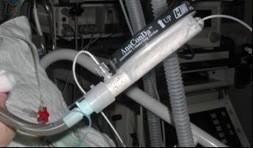
A clinical photograph of the AnaConDa® (Anaesthetic Conserving Device) integrated into a patient's respiratory circuit. This medical device functions as a miniature vaporizer and a gas-recirculation system for delivering inhaled anesthetics, such as sevoflurane, in intensive care settings. The image shows a cylindrical, partially transparent plastic device positioned between the patient's endotracheal tube and the ventilator tubing. Key visible features include the device's labeling with directional 'UP' arrows, a specialized gas line for anesthetic delivery, and internal components representing the heat and moisture exchange (HME) and activated carbon filter. The setup illustrates the clinical application of an anesthesia gas-recirculation system that replaces conventional filters while allowing for volatile sedation. The background contains standard intensive care monitoring equipment and ventilator hoses, demonstrating the device's role in critical care airway management.
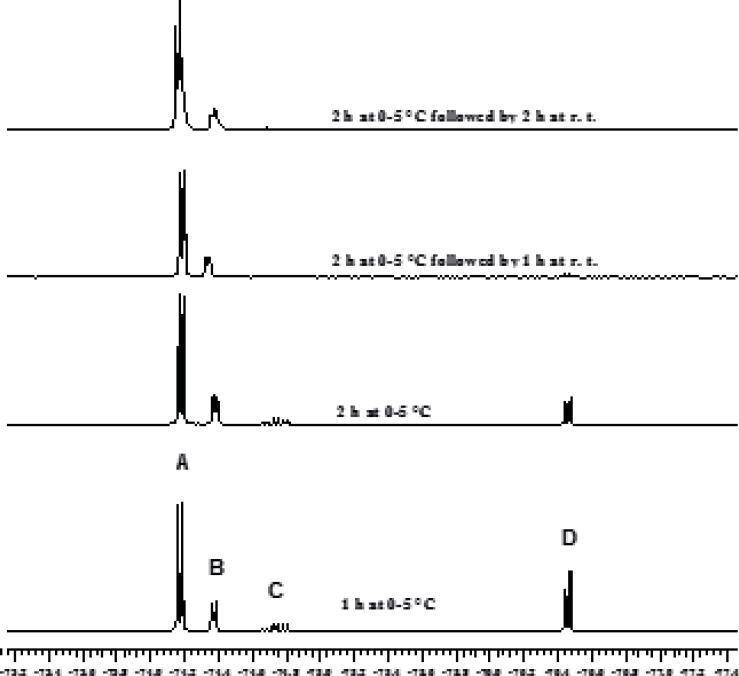
This diagnostic image displays a series of four 19F NMR (Nuclear Magnetic Resonance) spectra illustrating the kinetics of the chloromethylation of 1,1,1,3,3,3-hexafluoro-2-propanol (HFIP), a critical step in the synthesis of the inhalation anesthetic Sevoflurane. The spectra are arranged vertically to show reaction progression under varying temperatures and time intervals. Four distinct peaks are labeled A, B, C, and D. In the bottom spectrum (1 h at 0-5°C), all four peaks are prominent. As the reaction time increases to 2 h at 0-5°C, peak D—representing a transient intermediate or reagent—begins to diminish. In the top two spectra, where the reaction transitions to room temperature (r.t.) for 1 and 2 hours respectively, peak D completely disappears, indicating the consumption of the intermediate or full conversion to the product. Peaks A, B, and C remain stable, representing more permanent species in the chemical pathway. This visualization is essential for monitoring pharmaceutical synthesis efficiency and purity of anesthetic agents in a medicinal chemistry or pharmacology context.
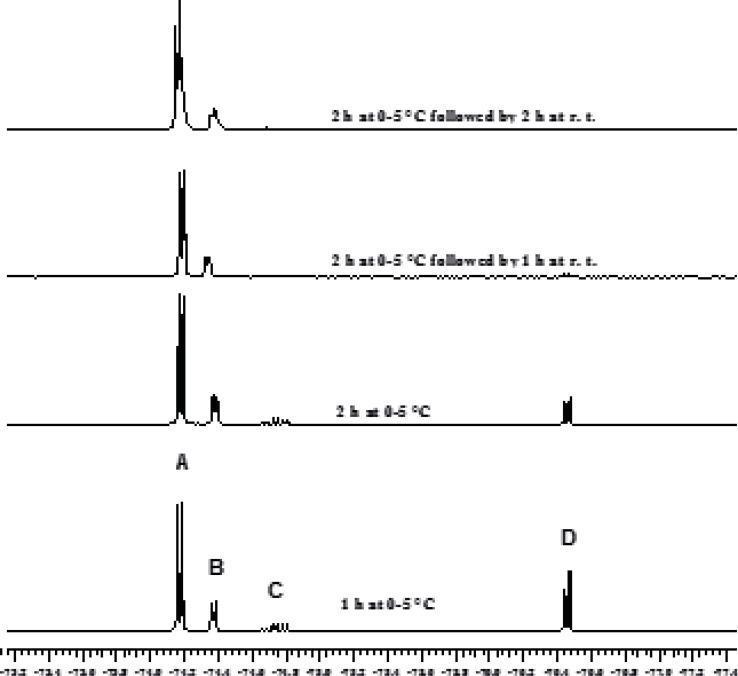
This Comparison Chart displays four stacked 19F Nuclear Magnetic Resonance (NMR) spectra used to monitor the chloromethylation reaction of 1,1,1,3,3,3-hexafluoro-2-propanol (HFIP), an intermediate in the synthesis of the general anesthetic sevoflurane. Each spectrum represents different reaction parameters: bottom (1 hour at 0-5°C), middle-lower (2 hours at 0-5°C), middle-upper (2 hours at 0-5°C followed by 1 hour at room temperature), and top (2 hours at 0-5°C followed by 2 hours at room temperature). Key peaks are labeled A, B, C, and D. Peak A, corresponding to the primary fluorinated species, shows a gradual decrease in intensity as reaction time and temperature increase. In contrast, peaks B and C (representing reaction intermediates or by-products) are most prominent in the early stages and diminish or disappear as the reaction progresses toward completion at room temperature. Peak D similarly shows consumption over time. This diagnostic visual illustrates the chemical kinetics and process optimization necessary for pharmaceutical manufacturing of volatile anesthetics in medicinal chemistry.
Sevoflurane
1. Introduction & Physical Properties
| Property | Value |
|---|---|
| MAC (adults) | ~2% (1.8-2.0%) |
| Blood:gas partition coefficient (λ b/g) | 0.65 (low - 2nd lowest after desflurane) |
| Oil:gas partition coefficient | 47-54 |
| Vapor pressure | ~157 mmHg (conventional variable-bypass vaporizer usable) |
| Boiling point | 58.5°C |
| Metabolism | ~5% by hepatic CYP2E1 |
| Molecular weight | 200 |
- Morgan & Mikhail's Clinical Anesthesiology, 7e, p. 312
2. Mechanism of Action
3. Pharmacokinetics
-
Rapid induction and emergence due to low blood solubility (λ b/g = 0.65)
-
Inhalation induction achievable within 1 minute using 4-8% in 50% N₂O/O₂
-
Approximately 5% metabolized by hepatic CYP2E1, producing:
- Hexafluoroisopropanol (HFIP) - major metabolite
- Inorganic fluoride (F⁻) - serum levels may exceed 50 µmol/L in ~7% patients, but no clinically significant nephrotoxicity has been demonstrated
-
10-25 times greater metabolism than isoflurane or desflurane
-
NOT metabolized to trifluoroacetate (unlike halothane/isoflurane) - so no immune-mediated hepatitis
-
Goodman & Gilman's Pharmacological Basis of Therapeutics, p. 498; Morgan & Mikhail, p. 313
4. Effects on Organ Systems
Cardiovascular
- Mild, concentration-dependent decrease in arterial blood pressure (via systemic vasodilation and mild myocardial depression)
- Does NOT cause tachycardia - cardiac output maintained less well than isoflurane; preferable in patients prone to myocardial ischemia
- Less hypotension compared to isoflurane or desflurane
- May prolong QT interval (clinical significance unclear; can persist 60 min post-emergence in infants)
- Does NOT sensitize myocardium to catecholamine-induced arrhythmias
Respiratory
- Concentration-dependent respiratory depression: decreased tidal volume, increased RR; net reduction in minute ventilation → ↑PaCO₂
- Non-pungent, non-irritating to airway - ideal for mask/inhalation induction
- Potent bronchodilator - most effective bronchodilator among inhalational agents; preferred in asthmatics/bronchospasm
Central Nervous System
- Slightly increases cerebral blood flow (CBF) and ICP at normocarbia (similar to isoflurane/desflurane)
- Decreases CMRO₂
- At >1.5 MAC, may impair CBF autoregulation
- ICP rise can be prevented by hyperventilation
- Emergence delirium in children - short-lived, no long-term sequelae; mitigated by fentanyl 1 µg/kg, propofol, ketamine, or alpha-2 agonists
Neuromuscular
- Produces skeletal muscle relaxation; potentiates neuromuscular blocking agents (NMBAs)
- Can produce adequate relaxation for intubation at inhalation induction doses
Renal
- Slightly decreases renal blood flow
- Fluoride ions produced by metabolism - historically a concern, but no association with clinical renal toxicity in humans
- Compound A concerns (see below)
Hepatic
-
Decreases portal vein blood flow but increases hepatic artery flow - total hepatic blood flow maintained
-
Not associated with immune-mediated hepatotoxicity (no trifluoroacetyl hapten formation)
-
Morgan & Mikhail, pp. 312-313; Goodman & Gilman, pp. 498-499
5. Compound A - Key Toxicity Issue
-
Sevoflurane reacts with CO₂ absorbents (soda lime/Baralyme containing strong bases like NaOH/KOH) to produce Compound A (fluoromethyl-2,2-difluoro-1-[trifluoromethyl]vinyl ether), a vinyl halide
-
Compound A is a dose-dependent nephrotoxin in rats (proximal tubular necrosis >150 ppm-hours)
-
Not nephrotoxic in humans - human kidneys have far lower β-lyase activity than rat kidneys, which is the enzyme responsible for bioactivation
-
Compound A accumulates with: low fresh gas flow, high sevoflurane concentration, desiccated absorbent (Baralyme > soda lime), high respiratory gas temperature, prolonged anesthesia
-
Practical recommendation: Fresh gas flow ≥ 2 L/min for prolonged cases; use calcium hydroxide-based absorbents (e.g., Amsorb)
-
Desiccated CO₂ absorbent + sevoflurane → rare risk of fire/ignition and CO production
-
Miller's Anesthesia, 10e; Morgan & Mikhail, p. 313; Barash, p. 1405
6. Clinical Uses
| Use | Rationale |
|---|---|
| Inhalation induction (adults & pediatrics) | Non-pungent, rapid onset, patient acceptance; replaced halothane |
| Maintenance of anesthesia | Predictable depth control, rapid emergence |
| Ambulatory (day-care) surgery | Faster orientation, earlier discharge vs isoflurane |
| Asthma/reactive airway | Potent bronchodilator |
| Needle-phobic / pediatric patients | IV-free induction; VIMA technique |
| Cardiac risk patients | Does not cause tachycardia; minimal myocardial ischemia risk |
- Miller's Anesthesia, 10e, p. 9984; Lippincott Pharmacology, p. 677
7. Contraindications
- Known/suspected malignant hyperthermia (MH) - triggers ryanodine receptor mutation
- Severe hypovolemia (vasodilation worsens hypotension)
- Raised intracranial pressure (increases ICP; use with caution if needed)
8. Advantages over Other Volatile Agents
| Feature | Sevoflurane | Isoflurane | Desflurane |
|---|---|---|---|
| Airway irritation | None | Moderate | Significant |
| Inhalation induction | Yes (preferred) | Not suitable | Not suitable |
| Emergence speed | Fast | Slowest | Fastest |
| Cardiovascular | Minimal impact | Tachycardia | Tachycardia, SVR ↓ |
| Bronchodilation | Most potent | Moderate | Less |
| Vaporizer | Conventional | Conventional | Special heated |
| Climate impact | Low-moderate | Moderate | Very high (30x sevo) |