
Short note on CCB as antihypertensive drug
"calcium channel blockers" AND hypertension
calcium channel blocker mechanism of action diagram antihypertensive
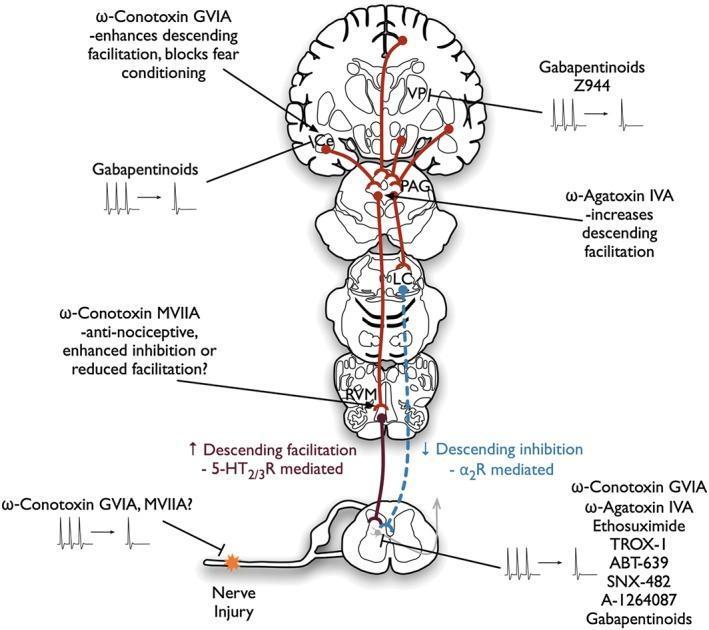
This medical schematic diagram illustrates the descending pain neuraxis and the pharmacological sites of action for various calcium channel modulators. The central nervous system structures are depicted in a vertical hierarchy: cerebral cortex (VPL and Ce labels), periaqueductal gray (PAG), locus coeruleus (LC), rostral ventromedial medulla (RVM), and the spinal cord dorsal horn. Descending pathways are shown as solid red lines (facilitatory) and dashed blue lines (inhibitory). A peripheral 'Nerve Injury' site is shown entering the spinal cord. Key pharmacological interventions are annotated with their anatomical targets: Gabapentinoids and Z944 are shown acting on the VPL, amygdala (Ce), and spinal cord, with electrophysiological waveforms demonstrating reduced neuronal firing. Various peptide toxins like w-Conotoxin GVIA, w-Conotoxin MVIIA (targeting CaV2.2), and w-Agatoxin IVA (targeting CaV2.1) are mapped to specific regions like the PAG, RVM, and primary afferents to illustrate their roles in modulating descending facilitation or inhibition. The diagram serves as a map for understanding how high-frequency neuronal firing in neuropathic pain states is mitigated by state-dependent and state-independent calcium channel blockers.
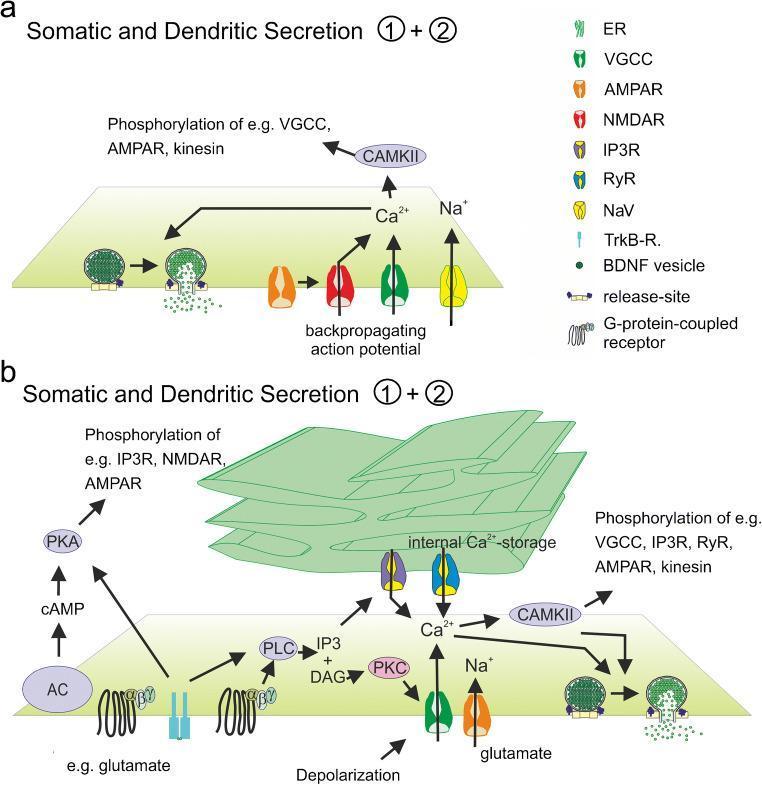
This pathophysiology diagram illustrates two cellular mechanisms (a and b) for the somatic and dendritic secretion of Brain-Derived Neurotrophic Factor (BDNF) in neurons. Mechanism (a) depicts activity-dependent release primarily triggered by extracellular calcium influx (Ca2+) through voltage-gated calcium channels (VGCC) and N-methyl-D-aspartate receptors (NMDAR) during backpropagating action potentials. In contrast, mechanism (b) highlights the role of intracellular signaling and calcium release from internal stores. This pathway involves glutamate-activated G-protein-coupled receptors (GPCR) and TrkB receptors stimulating Phospholipase C (PLC) to produce Inositol trisphosphate (IP3) and Diacylglycerol (DAG). IP3 triggers calcium release from the endoplasmic reticulum (ER) via IP3 receptors (IP3R) and Ryanodine receptors (RyR). Both mechanisms involve kinase-mediated phosphorylation (CAMKII, PKA, PKC) of components such as VGCC, NMDAR, and kinesin to facilitate the docking and exocytosis of BDNF-containing vesicles at the release sites. The diagram provides a comprehensive view of how synaptic activity and metabotropic signaling converge to regulate neurotrophin availability in the central nervous system.
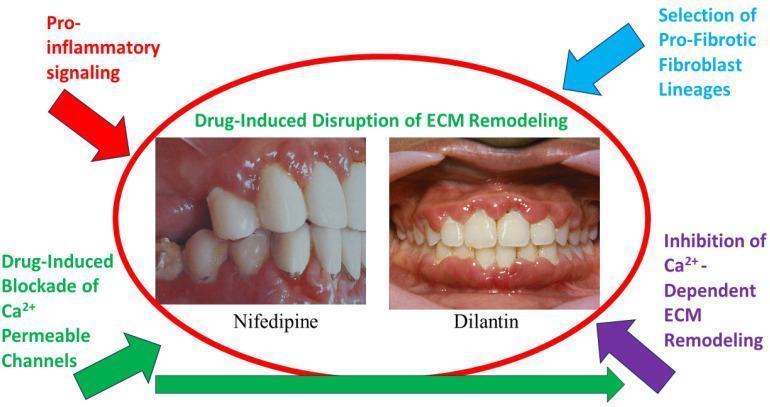
This medical visual combines clinical intraoral photographs with a conceptual diagram to illustrate drug-induced gingival overgrowth (DIGO). The central photographs compare the gingival manifestations of two specific pharmacological agents: Nifedipine (a calcium channel blocker) and Dilantin (Phenytoin, an anticonvulsant). The Nifedipine clinical image displays erythematous, swollen gingival margins with moderate hyperplasia. The Dilantin image demonstrates more severe, generalized gingival overgrowth characterized by bulbous interdental papillae and extensive coverage of the clinical crowns by thickened, lobulated gingival tissue. Surrounding these images is a pathophysiological flow diagram explaining the mechanism of extracellular matrix (ECM) disruption. Key educational concepts mapped include the drug-induced blockade of calcium-permeable channels (such as TRPV4), the inhibition of calcium-dependent ECM remodeling, and the selection of pro-fibrotic fibroblast lineages. The diagram highlights how pro-inflammatory signaling synergizes with these drug effects to disturb the homeostatic balance of collagen synthesis and degradation in periodontal tissues, leading to the observed pathological tissue enlargement.
Calcium Channel Blockers (CCBs) as Antihypertensive Drugs
Overview
Classification
1. Dihydropyridines (DHPs)
- Amlodipine, nifedipine (XL), felodipine, nicardipine, nisoldipine, isradipine, nimodipine, clevidipine
- Primarily vascular selective - potent peripheral vasodilators
- Minimal cardiac depressant effect
- Reflex sympathetic activation may cause slight tachycardia (especially short-acting agents)
2. Non-Dihydropyridines (NDHPs)
- Benzothiazepines: Diltiazem (intermediate effects)
- Diphenylalkylamines: Verapamil (greatest cardiac depression)
- Both vasodilate and exert negative chronotropic, dromotropic, and inotropic effects
- Reduce heart rate; verapamil also decreases cardiac output
- Diltiazem has intermediate cardiac and vascular effects
By Duration / Generation
| Generation | Example | Feature |
|---|---|---|
| 1st | Nifedipine IR | Short-acting; multiple daily doses; not recommended for HTN |
| 2nd | Nifedipine XL, diltiazem SR | Extended-release; once daily |
| 3rd | Amlodipine, felodipine | Intrinsically long half-life; very smooth BP control |
Mechanism of Action
-
Inhibition of L-type voltage-dependent calcium channels in vascular smooth muscle - reduces calcium entry into the cell - reduces cytosolic calcium - inhibits calmodulin activation - reduces actin-myosin interaction - decreases vascular smooth muscle contraction - peripheral vasodilation and BP reduction.
-
Reduced vascular responsiveness to angiotensin II and aldosterone - CCBs also interfere with alpha-adrenergic receptor-mediated vasoconstriction.
-
Mild natriuresis - DHPs preferentially dilate the renal afferent arteriole, increasing GFR, reducing tubular sodium reabsorption, improving renal blood flow. Sodium excretion correlates with BP reduction.
Hemodynamic Effects
| Property | DHPs (e.g., Amlodipine) | NDHPs (Verapamil/Diltiazem) |
|---|---|---|
| Peripheral vasodilation | +++ (most potent) | ++ |
| Heart rate | Slight increase (reflex) | Decrease |
| Cardiac output | Maintained or increased | Decreased |
| AV node conduction | No effect | Slowed |
| Inotropic effect | Minimal | Negative |
Clinical Efficacy
- Age (young, middle-aged, elderly)
- Sex
- Plasma renin activity
- Dietary salt intake
- Ethnicity (equally effective in African Americans, whites, and Hispanics)
Preferred Indications / Compelling Indications
- Isolated systolic hypertension (especially in elderly)
- Hypertension with angina - CCBs treat both conditions simultaneously
- Hypertension with Raynaud's phenomenon
- Hypertension in pregnancy (nifedipine SR is commonly used)
- African American patients - highly effective due to low-renin hypertension phenotype
- Hypertension with left ventricular hypertrophy (LVH)
- Hypertension with stable angina - DHPs as first-line; NDHPs for those intolerant of beta-blockers
- Hypertension with supraventricular arrhythmias - verapamil/diltiazem
- Hypertensive urgency/emergency - IV nicardipine (2-15 mg/h) or clevidipine (1-6 mg/h)
Contraindications
| Drug | Contraindications |
|---|---|
| Verapamil/Diltiazem | Heart failure with reduced ejection fraction (HFrEF) - due to negative inotropy; AV block (2nd/3rd degree); sick sinus syndrome |
| Short-acting DHPs | Avoid in chronic hypertension management (risk of sympathetic activation, MI, stroke); NOT recommended |
| All CCBs | Caution in severe hypotension |
Adverse Effects
- Peripheral edema (most common with DHPs - especially nifedipine, amlodipine) - due to capillary vasodilation; not a sign of fluid overload; responds to ACEi/ARB combination
- Reflex tachycardia - short-acting DHPs (not with long-acting)
- Flushing and headache - vasodilation-related
- Gingival hyperplasia - particularly with nifedipine (chronic use)
- Constipation - most prominent with verapamil (reduced GI smooth muscle motility)
- Bradycardia and heart block - verapamil > diltiazem
Drug Interactions
- Verapamil and diltiazem are CYP3A4 inhibitors - increase plasma levels of many drugs (e.g., statins, cyclosporine, digoxin)
- Verapamil + beta-blocker combination should be used with extreme caution - risk of severe bradycardia and heart block
- Grapefruit juice inhibits CYP3A4 and increases bioavailability of DHPs (especially nifedipine, felodipine)
Renal Considerations
- DHPs preferentially dilate the afferent arteriole - may slightly increase glomerular capillary pressure, which can increase proteinuria in some patients
- Verapamil, diltiazem, felodipine may also reduce efferent tone and can decrease proteinuria
- In CKD with proteinuria, ACEi/ARBs are preferred over amlodipine alone; however, adding a DHP-CCB to an ARB does not reduce the ARB's renoprotective effect
- In dialysis patients, long-acting DHPs (amlodipine, felodipine) are useful as combination agents
Key Drugs and Doses (Antihypertensive Use)
| Drug | Class | Route | Dose |
|---|---|---|---|
| Amlodipine | DHP (3rd gen) | Oral | 2.5-10 mg OD |
| Nifedipine XL | DHP (2nd gen) | Oral | 30-90 mg OD |
| Felodipine | DHP | Oral | 2.5-10 mg OD |
| Nicardipine | DHP | IV (HTN emergency) | 2-15 mg/h |
| Clevidipine | DHP | IV (HTN emergency) | 1-6 mg/h |
| Diltiazem SR | NDHP (benzothiazepine) | Oral | 120-480 mg OD |
| Verapamil SR | NDHP (phenylalkylamine) | Oral | 120-480 mg OD |
Summary Points
- CCBs are first-line antihypertensives effective across all patient populations
- DHPs are preferred for most patients with HTN; NDHPs preferred when rate control is also needed
- Short-acting CCBs should NOT be used for chronic hypertension management
- Amlodipine is the most widely used due to its long half-life (~35-50 hrs), once-daily dosing, and proven cardiovascular outcome data (ALLHAT trial)
- The most common side effect is peripheral edema with DHPs; constipation with verapamil
- NDHPs are contraindicated in HFrEF due to negative inotropy
- CCBs are particularly effective in elderly, African American, and low-renin hypertensive patients