
Explain 4th leopold manuever and about attitude of baby by it in details and in simple words
Reading File
Finding Sources
Finding Sources
Searching Images
Leopold maneuvers fourth maneuver palpation of fetal head engagement diagram
Reading File
Reading File
Reading File
Reading File
Searching PubMed
"Leopold maneuvers" AND "fetal position"
Leopold Maneuvers - Simple Overview
Leopold maneuvers are four systematic hand-palpation steps done on a pregnant woman's belly (usually from around 28 weeks onward) to figure out how the baby is lying inside the uterus - without needing an ultrasound. Each maneuver answers a different question.
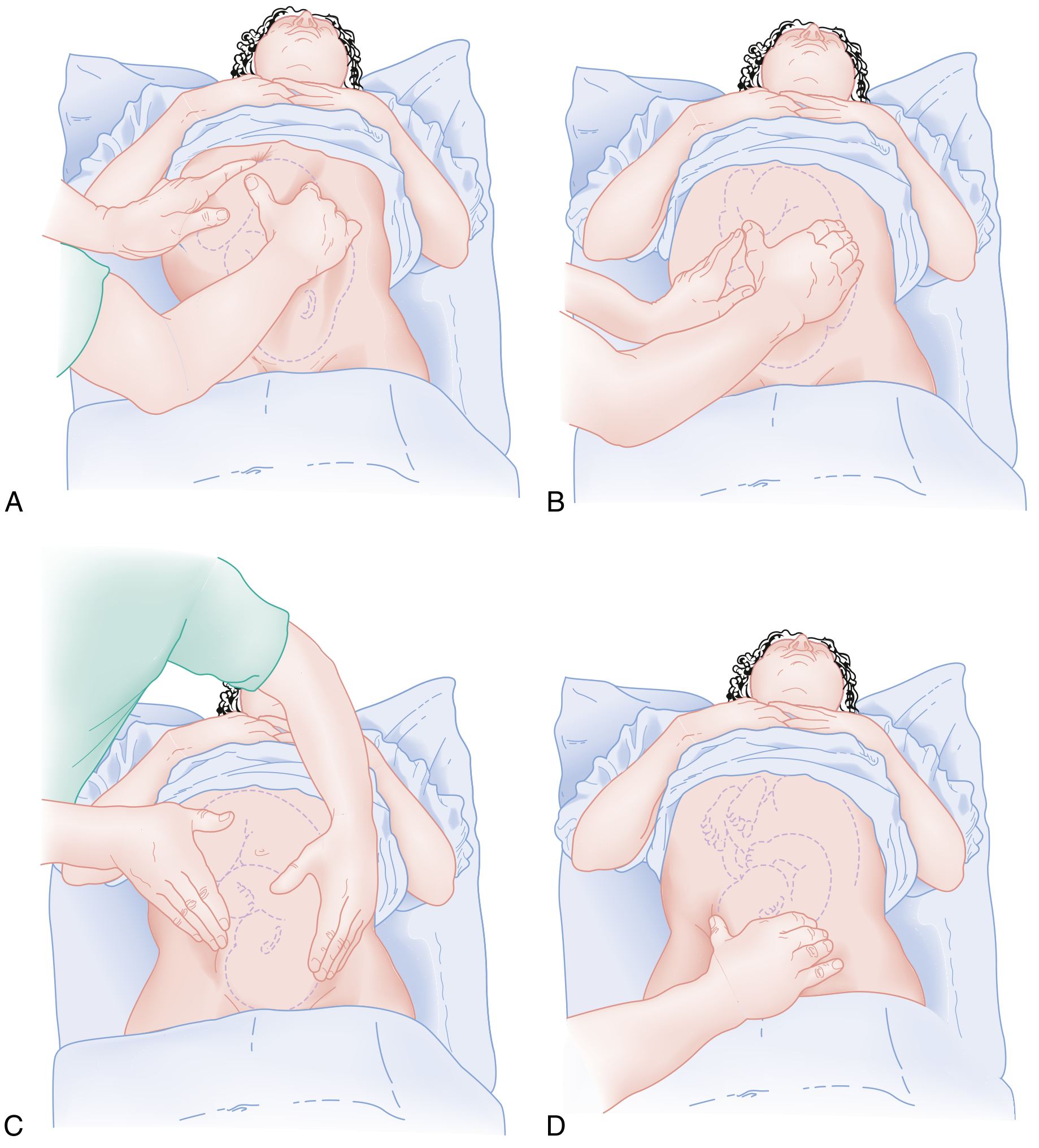
| Maneuver | What the examiner does | What it tells you |
|---|---|---|
| 1st | Feels the top of the uterus (fundus) with both hands | Which part of the baby (head or bottom) is sitting at the top |
| 2nd | Hands moved to the sides of the belly | Where the baby's back is (and where the small parts - arms/legs - are) |
| 3rd | One hand grips just above the pubic bone | Which part of the baby is sitting low, over the pelvic inlet, and whether it's still movable ("floating") or fixed |
| 4th | Examiner turns to face the mother's feet, presses fingers down deep on both sides above the pubic bone | Confirms the presenting part and, most importantly, tells you the attitude (flexion/extension) of the head and how deep it has descended into the pelvis |
- Textbook of Family Medicine 9e, p. 481-482
- ROSEN's Emergency Medicine: Concepts and Clinical Practice, p. 3409-3410
The 4th Leopold Maneuver in Detail
How it's done (step by step, in plain language):
- Unlike the first three maneuvers, the examiner now turns around to face the mother's feet (not her head).
- Using the tips of the first three fingers of each hand, the examiner presses gently but firmly downward and inward on both sides of the lower belly, just above the pubic bone, moving toward the pelvic inlet - like trying to trace the outline of the baby's head sinking into the pelvis.
- The examiner feels for a bony bump called the cephalic prominence - this is usually the baby's forehead (brow).
- The examiner also notices whether the fingers on both sides can come together easily (converge) or whether they get stopped/pushed apart because something big is in the way (diverge).
What it tells you - the baby's attitude:
"Attitude" means how the baby's head, chin, and limbs are bent or straightened relative to its own spine - basically, is the baby curled up (flexed) or stretched out (extended)?
- Normal attitude = full flexion. The chin is tucked onto the chest, arms and legs are folded in - like a curled-up ball. This is the ideal position because it makes the head present its smallest diameter to the birth canal, which is easier for delivery.
- During the 4th maneuver:
- If the fingers converge easily (meet without resistance) over the head, the head is usually still high, not yet deep in the pelvis (not "engaged"), or the head is well flexed with only a small part palpable.
- If the fingers diverge (cannot meet because a large part of the head has already dropped into the pelvis), it means the head has descended deeply and engaged.
- If the cephalic prominence (the brow) is felt on the same side as the baby's back (which was found in the 2nd maneuver), that is a sign the head is extended rather than flexed - this can suggest a face or brow presentation (poor attitude, head tipped backward instead of tucked forward).
- If the brow is felt on the same side as the baby's small parts (arms/legs, opposite the back), it confirms the head is flexed normally, as expected in a normal vertex (head-down, chin-tucked) presentation.
In short: the 4th maneuver is the only one done facing the mother's feet, and its main job is to check two things together - how deep the head has gone into the pelvis (engagement/descent) and whether the head is tucked (flexed) or tipped back (extended), which is the "attitude" of the baby.
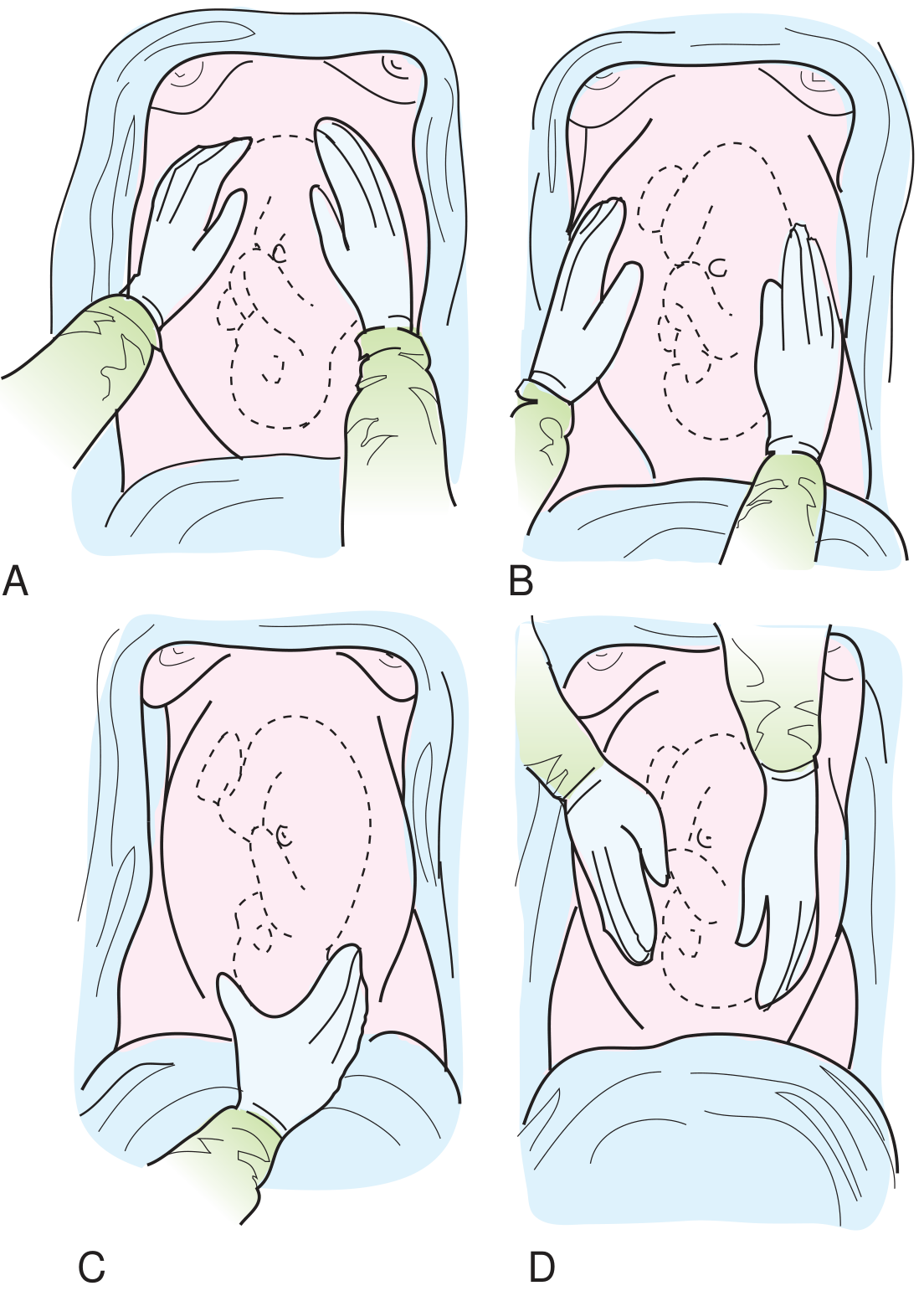
Why this matters clinically: A well-flexed, engaged head usually predicts a smoother vaginal delivery. A poorly flexed (extended) head or one that stays high and ungaged despite labor progressing can be a warning sign of a difficult delivery, malposition, or a need for closer monitoring/possible cesarean delivery.
I also checked recent PubMed systematic reviews (2024-2025) on fetal positioning topics (manual rotation, maternal posture for malposition) - none contradict this classic teaching on Leopold's maneuvers or fetal attitude; they focus on interventions for malposition rather than the examination technique itself, so no updates are needed here.
This is a shared conversation. Sign in to Orris to start your own chat.