
ECG changes
I need to clarify what aspect of ECG changes you're asking about — this is a broad topic.
Asking for Preferences
Which ECG changes are you interested in?
The user skipped, so I'll provide a comprehensive overview of ECG changes. Let me read the medical library skill first, then search in parallel.
Reading File
Now let me search the medical library and web in parallel for comprehensive ECG changes content.
Finding Sources
Finding Sources
Good results found. Let me read the most relevant sections from multiple textbooks in parallel, and also search for images and electrolyte changes.
Reading File
Reading File
Finding Sources
Finding Sources
Searching Images
ECG changes electrocardiogram ST elevation T wave inversion MI ischemia
Now let me read the remaining key sections — electrolyte changes from Harrison's, the Washington Manual ECG section, and PE/pericarditis details.
Reading File
Reading File
Reading File
Excellent — I now have rich content from multiple authoritative sources. Let me fetch the key ECG images to include in the answer.
Loading Image
Loading Image
Loading Image
I now have comprehensive content and clear images. Let me compile the full answer.
ECG Changes: A Comprehensive Overview
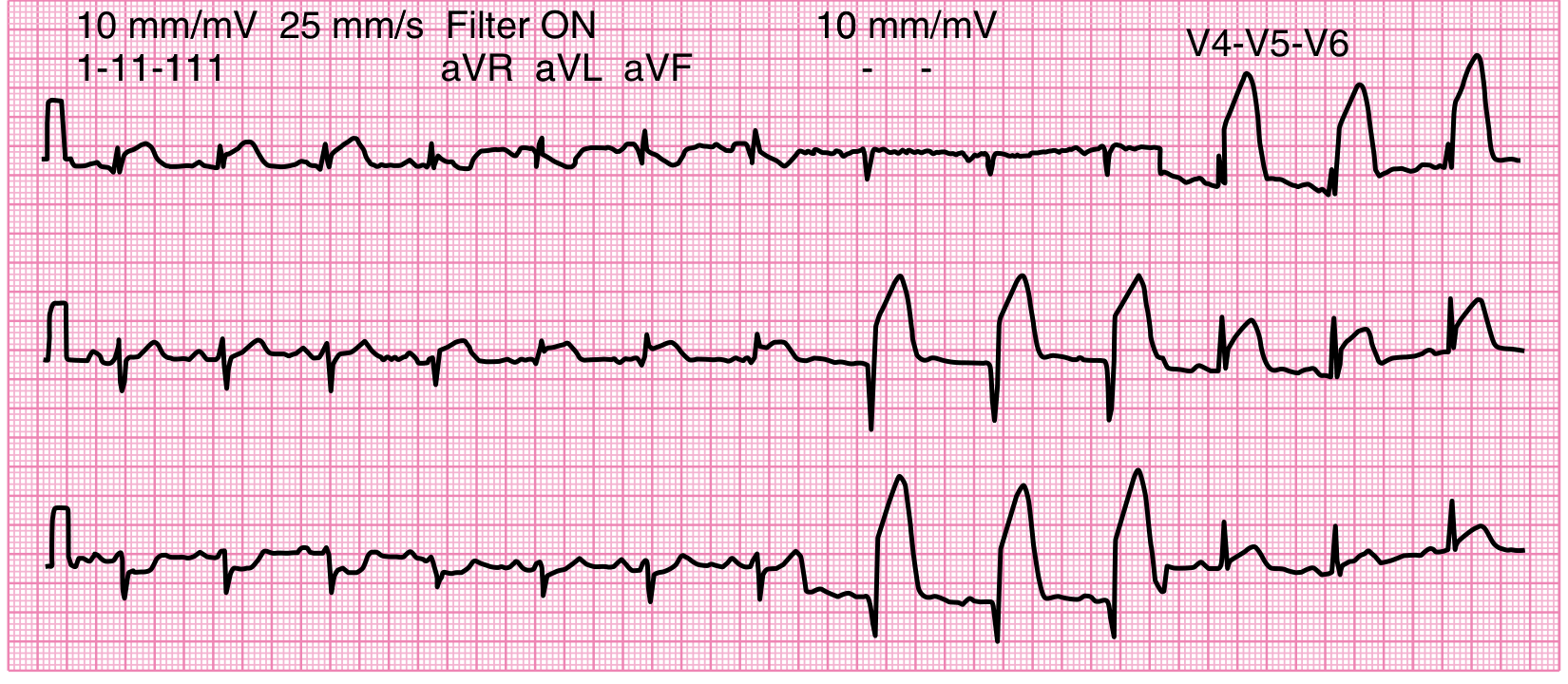
1. Acute Myocardial Infarction (STEMI)
The classic ECG evolution in acute ST-elevation MI passes through three overlapping phases:
Phase 1 — Early Acute (minutes to hours)
- Hyperacute T waves: tall, peaked, widened T waves are the earliest sign — can precede ST elevation
- ST elevation: ST segment evolves from concave → straightened → convex upward ("tombstone" appearance)
- Reciprocal ST depression in leads opposite the infarct zone; associated with larger infarcts and worse prognosis but greater benefit from reperfusion
Phase 2 — Evolved Acute (hours to days)
- ST elevation begins to regress
- T-wave inversion develops in leads with prior ST elevation
- Pathologic Q waves appear (diagnostic of transmural MI)
Phase 3 — Chronic/Stabilized
- Persistent Q waves (often permanent)
- ST segments return to baseline
- T-wave inversions may persist or resolve
"When typical ST-segment elevation persists for hours and is followed within hours to days by T-wave inversions and Q waves, the diagnosis of acute MI can be made with virtual certainty." — Goldman-Cecil Medicine
STEMI diagnostic thresholds:
| Lead | Criteria |
|---|---|
| V2–V3 (men) | ST elevation ≥2 mm at J point |
| V2–V3 (women) | ST elevation ≥1.5 mm |
| All other leads | ST elevation ≥1 mm in ≥2 contiguous leads |
Pathologic Q wave criteria:
- V2–V3: Q wave ≥0.02 s or QS complex
- Other leads: Q wave ≥0.03 s and ≥0.1 mV deep in ≥2 contiguous leads
2. Non-ST-Elevation ACS (NSTEMI / Unstable Angina)
- ST-segment depression (≥0.5 mm) — subendocardial ischemia
- T-wave inversion — may be symmetric and deep (Wellens' pattern in LAD territory = V1–V4)
- "Dynamic" ECG changes — new or worsening ST-T changes vs prior ECG strongly suggest ACS
- A normal ECG does not exclude ACS
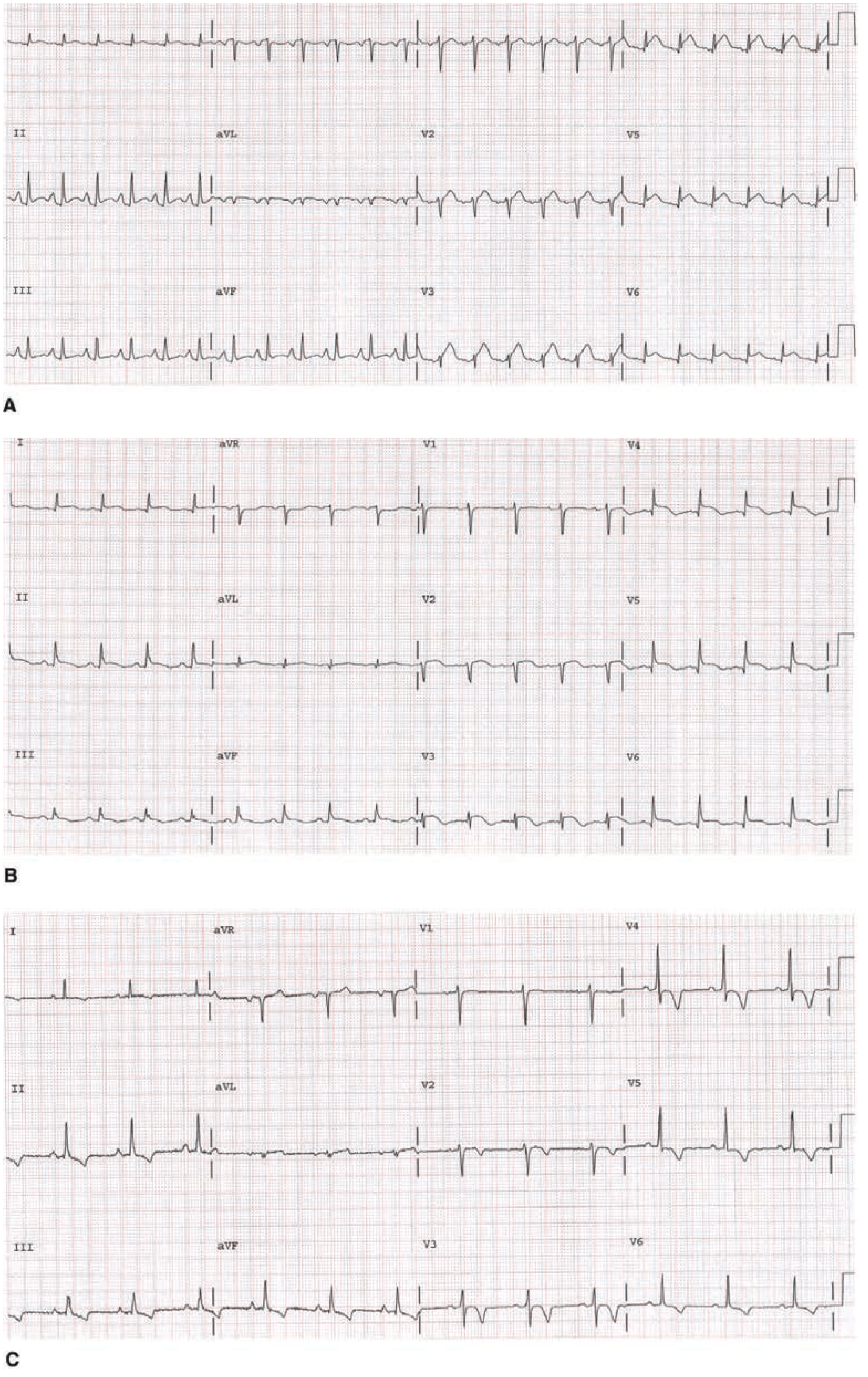
3. Pericarditis
Classic four-stage ECG evolution:
| Stage | ECG Finding |
|---|---|
| I | Diffuse ST elevation (saddle-shaped/concave) + PR depression in I, II, III, aVF; PR elevation in aVR |
| II | ST returns to baseline; T waves flatten |
| III | Diffuse T-wave inversion |
| IV | Normalization |
Distinguishing pericarditis from STEMI:
- ST elevation in pericarditis is diffuse (not territory-specific) and concave
- PR depression is characteristic of pericarditis (not STEMI)
- No reciprocal ST depression (except aVR/V1)
- ST:T-wave ratio in V6 >0.25 favors pericarditis over early repolarization
4. Electrolyte Abnormalities
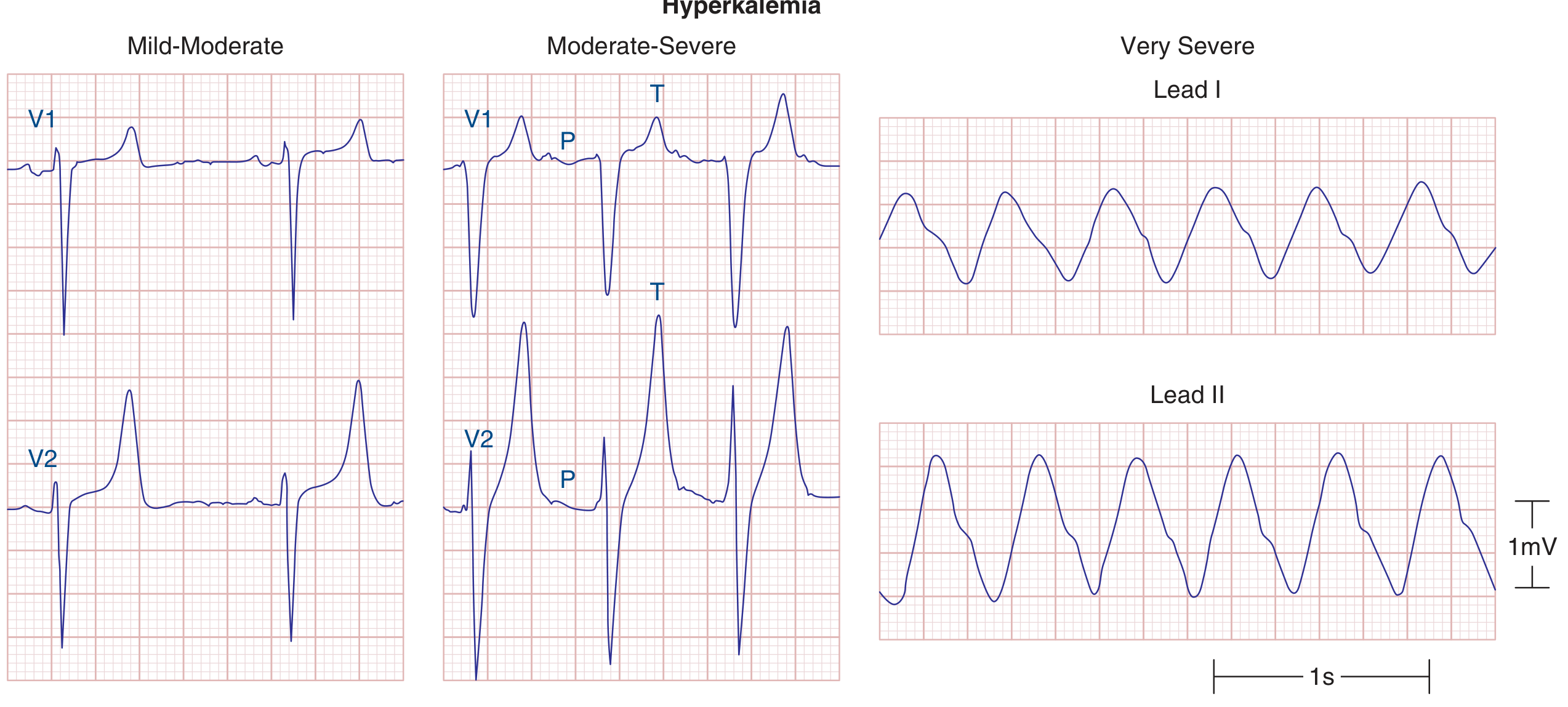
Hyperkalemia (progressive sequence):
- Peaked (tented) T waves — narrow, tall, symmetric (earliest change)
- Prolonged PR interval, diminished P-wave amplitude
- Widened QRS
- Sine-wave pattern → asystole
Hypokalemia:
- Prolonged ventricular repolarization
- Prominent U waves (most characteristic)
- Flattened or inverted T waves
- Prolonged QU interval (often mistaken for QT prolongation)
Hypocalcemia:
- Prolonged QT interval (prolonged ST segment specifically)
Hypercalcemia:
- Shortened QT interval
5. Drug-Induced ECG Changes
| Drug/Class | ECG Effect |
|---|---|
| Digoxin | "Scooping" of ST-T complex; shortened QT; PR prolongation |
| Class IA (quinidine, procainamide) | QT prolongation; wide QRS |
| Class III (amiodarone, sotalol) | QT prolongation |
| TCAs, phenothiazines | QT prolongation; wide QRS |
| Cocaine | ST elevation (vasospasm) |
6. Pulmonary Embolism
Classic (but insensitive/non-specific) pattern:
- S1Q3T3: deep S in I, Q wave + T inversion in III
- Right heart strain: sinus tachycardia, RBBB, T inversion in V1–V4
- Right axis deviation
- Most common finding is simply sinus tachycardia or a non-specific change
7. Left Ventricular Hypertrophy (LVH)
- High-voltage QRS (tall R in V5–V6, deep S in V1–V2)
- "Strain" pattern: ST depression + T inversion in lateral leads (I, aVL, V5–V6)
- Can mimic ischemia
8. Bundle Branch Blocks
| Block | QRS | Key Features |
|---|---|---|
| LBBB | ≥120 ms | Broad notched R in V5–V6, I, aVL; deep S in V1 |
| RBBB | ≥120 ms | RSR' ("rabbit ears") in V1–V2; broad S in I, V5–V6 |
New LBBB in the setting of chest pain may represent STEMI equivalent; use Sgarbossa criteria:
- ST elevation ≥1 mm concordant with QRS → 5 pts
- ST depression ≥1 mm in V1–V3 → 3 pts
- ST elevation ≥5 mm discordant with QRS → 2 pts (≥3 pts = STEMI likely)
9. Other Notable Changes
| Condition | ECG Finding |
|---|---|
| Hypothermia | Osborn (J) waves (convex hump at J point); bradycardia; prolonged intervals |
| Subarachnoid hemorrhage | Deeply inverted, wide T waves ("CVA T waves"); prolonged QT |
| Brugada syndrome | Coved ST elevation in V1–V2; RBBB morphology |
| Cardiac tamponade | Electrical alternans (P-QRS-T beat-to-beat alternation) + sinus tachycardia + low voltage |
| Pericardial/pleural effusion | Low QRS voltage |
| Posterior MI | Tall R + ST depression in V1–V2; confirmed with posterior leads V7–V9 |
Differential Diagnosis of ST Elevation (Non-STEMI Causes)
| Cardiac | Other |
|---|---|
| Prior MI with aneurysm | Pulmonary embolism |
| Pericarditis/myocarditis | Hyperkalemia |
| LVH/aortic stenosis (strain) | |
| Hypertrophic cardiomyopathy | |
| Coronary vasospasm / Prinzmetal | |
| Early repolarization (normal variant) | |
| Brugada syndrome |
(Washington Manual of Medical Therapeutics; Goldman-Cecil Medicine)
Sources: Goldman-Cecil Medicine (9780323930345) | Harrison's Principles of Internal Medicine 22E (9781265977061) | Tintinalli's Emergency Medicine (9781260019933) | Washington Manual of Medical Therapeutics (9781975190620) | Swanson's Family Medicine Review (9780323698115)
This is a shared conversation. Sign in to Orris to start your own chat.